
Sports Nutrition Custom Packaging: Compliance-First Buyer's Guide
The global demand for sports nutrition custom packaging is being reshaped by stricter food-contact regulations, retailer requirements, and brand sustainability targets. For procurement teams, the first question is no longer 'How can we make it look premium?' but 'What compliance evidence can the supplier provide before we commit?'
In the United States, FDA 21 CFR Part 111 sets current Good Manufacturing Practice (cGMP) requirements for dietary supplement manufacturing, packaging, and labeling. In the European Union, Regulation (EU) 2025/40 requires all packaging to be recyclable by 2030 and plastic packaging to contain at least 30% recycled content by 2030. These rules affect how supplements are packed across the supply chain. A custom bottle that performs well on shelf but fails a compliance audit can delay launch, increase cost, or block market entry.
At the same time, packaging remains an important differentiator. According to Grand View Research, the global nutraceutical packaging market was valued at USD 5.05B in 2024, with plastic segments leading at 58.3% revenue share. In supplement packaging specifically, plastic holds approximately 73.8% material share in 2025. The protein powder packaging segment is projected to reach USD 44.52B by 2035, with a CAGR of 5.01% from 2026, according to Future Market Insights. That scale means brands can invest in custom packaging without sacrificing compliance, but they need structured verification.
Problem: Compliance is harder to verify than to claim
Many packaging suppliers describe their products as 'food-grade' without providing independent evidence. A buyer may receive a certificate that is out of date, or one that does not cover the specific product being purchased. For example, a supplier may hold ISO 9001 for corporate quality management, but lack a packaging-specific food safety certification such as BRCGS or HACCP. Without scoped documentation, procurement teams cannot judge whether the packaging will meet the requirements of US or EU markets.
Sustainability claims are even more difficult to verify. A bottle labeled 'recycled' may contain only a small percentage of PCR, or none. The Global Recycled Standard (GRS) provides a chain-of-custody certification that helps confirm recycled content. Buyers who rely on a supplier's word rather than a certificate number risk failing their own sustainability reporting or violating upcoming EU recycling-content mandates.
Opportunity: Using certifications as a procurement filter
For packaging manufacturers that hold relevant certifications, these credentials become a practical selection filter. They reduce audit effort, shorten qualification time, and lower the risk of packaging-related product delays. Certification depth also correlates with production discipline: managing ISO 9001, BRCGS, HACCP, and ISO 15378 systems requires process controls, training, and documentation that benefit all customers.
One manufacturer that has built its offer around verified compliance is RTCO (THE RTCO PAK PTE. LTD.), a packaging supplier founded in 2007 and focused on plastic containers, closures, scoops, and surface finishes for sports nutrition and supplement brands. RTCO operates a 68,000 m² factory with approximately 200 employees, including a 40-engineer R&D team, and produces around 1 billion units annually. The company primarily targets North America and serves global brands through a US production facility in Piedmont, South Carolina, with warehouses in Georgia and California. Its published certification portfolio provides a useful template for what buyers should ask a custom packaging partner.
Certifications buyers should check
The table below lists the certifications held by RTCO for its plastic packaging operations. Certificate numbers are included so that buyers can verify them with the issuing bodies.
| Certification | Scope | Issuer / Certificate No. |
|---|---|---|
| ISO 9001:2015 | Quality management for food-grade plastic packaging containers | NOA / 05126Q00928R153 |
| BRCGS Packaging Materials Issue 7 | Blow molding and injection molding of PE/PP containers, lids, spoons, hooks for food use | NSF / C0860130-BRC2 |
| HACCP (V1.0) | Food safety management for food-contact plastic containers and closures | Ti Certification / 331HACCP2600024 |
| ISO 15378:2017 | GMP for primary packaging materials (HDPE and PP bottles for medicinal products) | Intertek / HBPCER20260088 |
| GRS Version 4.0 | Recycled material traceability for manufacturing, molding and printing of recycled plastic products | TÜV Rheinland / TRC-GRS-222421-00 |
| ISO 14001:2015 | Environmental management for plastic packaging containers | NOA / NOA2408227 |
| ISO 45001:2018 | Occupational health and safety for manufacturing | NOA / NOA2408228 |
| SA8000:2014 | Social accountability in manufacturing of plastic packaging containers | Benchmarks / BM-CN-20240906 |
Source: RTCO published certification records. Certificate numbers are provided for independent verification.
Technical explanation: What certification scopes actually cover
Understanding each certification's scope helps buyers map it to their product requirements:
- ISO 9001:2015 confirms a basic quality management system is in place for producing food-grade containers.
- BRCGS Global Standard Packaging Materials Issue 7 is often required by retailers and brand owners. It audits product safety, quality, and operational control in packaging manufacturing. The certificate held by RTCO covers blow molding and injection molding of PE and PP plastic containers, lids, spoons and hooks for food use.
- HACCP identifies and controls hazards in food-contact material production. This is relevant for supplement and sports nutrition brands because contamination risks must be managed through the entire production chain.
- ISO 15378:2017 applies GMP principles to primary packaging materials for medicinal products. For nutraceuticals, it indicates a production environment aligned with pharmaceutical-grade expectations.
- GRS Version 4.0 verifies recycled content and chain of custody. This is directly relevant to EU PPWR requirements for 30% recycled content by 2030.
- ISO 14001:2015 and ISO 45001:2018 cover environmental and occupational health and safety management systems.
- SA8000:2014 addresses social accountability in the manufacturing workforce.
Materials and dimensional range
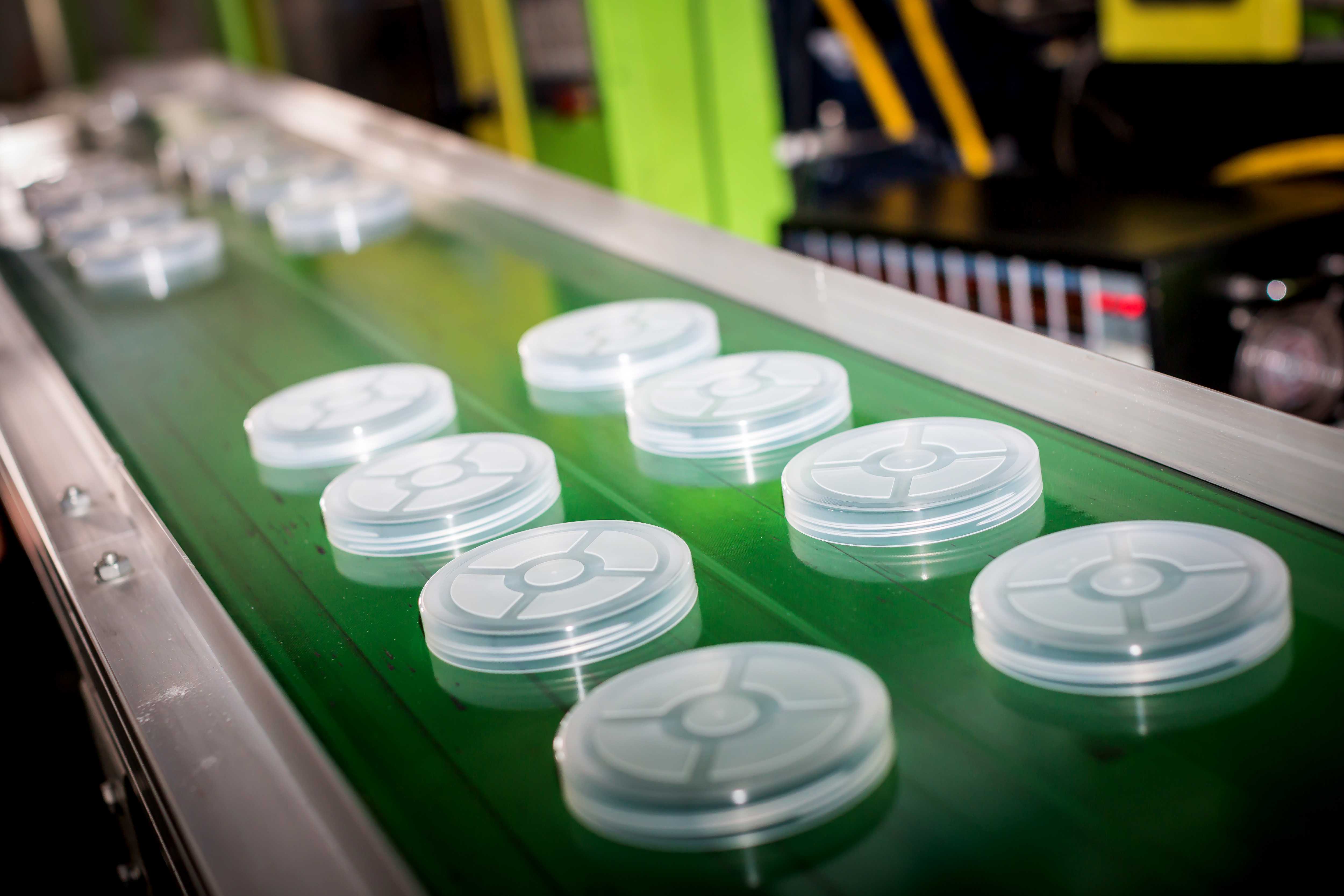
Custom supplement packaging is typically produced in food-grade HDPE, PET, and PP resins. PCR (post-consumer recycled) material options are available for programs that need verified recycled content. RTCO supports bottle capacities from 60ml to 6000ml, body diameters from 40 to 200mm, and heights from 60 to 325mm. Closures range from 20 to 200mm in diameter, and scoops measure from 0.3cc to 8oz. This range covers protein powder jars, pre-workout bottles, capsule and tablet containers, and gummy flip-cap bottles.
Surface decoration options include soft-touch coatings, UV coating, silk screen, 3D printing, labeling, and vacuum metallization. These are not just aesthetic choices; certain coatings can improve grip, create tactile differentiation, or support a brand's premium positioning without adding secondary assembly.
Application: Where certified packaging fits
The supported dosage forms include powder, capsules, tablets, gummies/gels, and liquids. This application scenario is common in the United States, Canada, Mexico, Great Britain, France, Germany, Brazil, and Australia. Typical project types are OEM/ODM and private label, covering sample development, tooling, pilot, and mass production. Integrated design and mold development allow brands to move from concept to filling line with fewer handoffs.
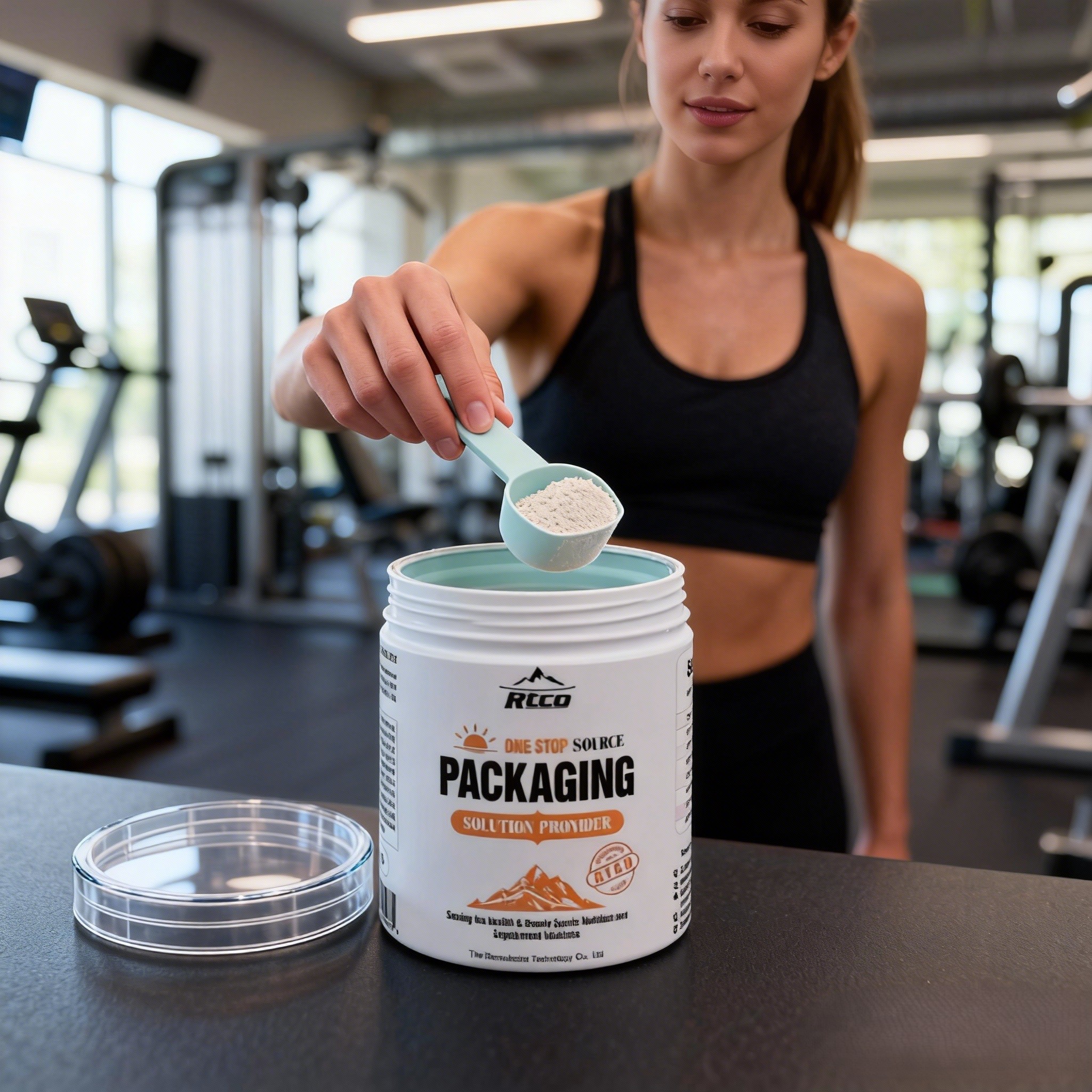
Use cases include wide-mouth protein powder jars with matching scoops, pre-workout or BCAA bottles with flip-cap dispensing, dual-chamber containers for combined formulas, and child-resistant bottles where required. Some custom designs integrate a scoop-hook into the bottle neck to keep scoops accessible, while soft-touch finishes are used in beauty-from-within supplement lines to support a skin-and-hair care image.
Market trend analysis: Regulation, recycling, and regional supply
Three trends are shaping packaging procurement in 2026 and beyond.
- Sustainability is moving from voluntary to regulated. The EU PPWR's requirement for recyclable packaging and 30% PCR in plastic packaging by 2030 will push supplement brands to demand GRS-certified packaging. The increasing use of PCR is already visible in packaging spec reviews, and brands that act early will have better access to recycled resins as demand tightens.
- Local manufacturing and fulfillment are becoming strategic. A supplier with a US production facility can shorten delivery cycles, reduce ocean-freight exposure, and respond faster to replenishment orders. This is particularly relevant for sports nutrition brands with high velocity e-commerce channels.
- Certification depth is being used as a supplier differentiator. Buyers are moving away from generic 'food-grade' claims toward documented ISO, BRCGS, HACCP, and GRS certifications with visible certificate numbers and scopes.
Market data supports the significance of plastic packaging in this space. Grand View Research values the nutraceutical packaging market at USD 5.05B in 2024, with plastic segments at 58.3% revenue share; the same research firm reports plastic at 73.8% of supplement packaging material share in 2025. Future Market Insights projects the protein powder packaging segment to reach USD 44.52B by 2035. These figures indicate that plastic-based custom packaging remains the dominant category, and compliance improvements in this category will affect most brands.
Comparison: Turnkey certified supplier vs traditional supplier
Traditional packaging sourcing often involves multiple vendors for bottles, closures, scoops, decoration, and logistics. Each handoff can introduce variability in quality, compliance, and timing. A turnkey supplier with in-house design, molding, decoration, and US warehousing consolidates these steps.
| Selection criterion | Traditional supplier | Turnkey certified supplier |
|---|---|---|
| Certification visibility | Often generic food-grade claims | Documented ISO, BRCGS, HACCP, GRS with certificate numbers |
| Component coordination | Buyer manages multiple vendors | In-house bottle, cap, scoop, decoration |
| Custom mold development | Longer, separate process | Integrated 1-day design / 1-month tooling / 1-week production |
| Sustainability proof | Limited PCR options | GRS-certified recycled material |
| US fulfillment | Often overseas-only | US factory and warehouses |
There are, however, real constraints to this model. Full custom packaging with new tooling requires a minimum order quantity that may not suit micro-brands. For RTCO, the typical MOQ is 10,000 to 30,000 units per SKU. First trial orders below the standard MOQ are supported to help customers validate new products, but new mold development still involves an upfront financial commitment. Lead time for standard custom projects is typically 30–45 days, following a reference model of 1-day design, about 1-month tooling, and about 1-week production. Actual timelines vary with complexity and production capacity. Brands that need immediate inventory may be better served by an existing mold or a stock packaging program.
Supplier evaluation checklist
- Request certificates for ISO 9001, BRCGS, HACCP, ISO 15378, and GRS, and check certificate numbers and validity.
- Confirm the certification scope matches the product: bottles, caps, scoops, and decoration.
- Ask for material grades (HDPE/PET/PP/PCR) and confirm food-contact compliance.
- Request a sample of the complete package: bottle, cap, liner, scoop, and any decoration.
- Discuss MOQ and lead time for new molds and for repeat orders.
- Check if the supplier has regional warehousing or fulfillment for your target market.
- If you plan retail distribution, ask for packaging-related retailer compliance documentation.
Future outlook
Expect packaging suppliers to invest in recyclable and PCR-rich container systems, as well as in dual-region manufacturing (Asia and the US) to support North American distribution. Certification scopes will likely expand to include carbon footprint and supply-chain traceability, along with food safety. For procurement teams, the practical implication is to place compliance checks early in the supplier selection process. That means requesting certificate copies, reviewing scopes, and confirming that the certification covers the exact bottle, closure, and scoop configurations under consideration.
FAQ
What certifications should a sports nutrition packaging supplier hold?
A packaging supplier for sports nutrition should ideally hold food-contact and quality certifications such as ISO 9001:2015, BRCGS Packaging Materials, HACCP, and, if serving regulated nutraceutical markets, ISO 15378:2017. For recycled-content claims, GRS Version 4.0 provides independent verification.
How can I verify a packaging supplier's compliance claims?
Ask for the certificate number, the issuing body, the certification scope, and the validity period. Cross-check the scope against the specific product you are buying. For example, a BRCGS certificate should cover blow molding and injection molding of plastic containers and closures, not just general corporate certification.
What is the typical MOQ for custom sports nutrition packaging?
Typical MOQ is 10,000 to 30,000 units per SKU. First trial orders below the standard MOQ are supported to help customers validate new products before committing to full-scale production.
What materials are available for custom supplement bottles?
Custom supplement bottles are available in food-grade HDPE, PET, and PP, with optional PCR materials. Bottle capacities range from 60ml to 6000ml, cap diameters from 20 to 200mm, and scoops from 0.3cc to 8oz.
Can the supplier support North American delivery and fulfillment?
RTCO operates a US production facility in Piedmont, South Carolina, and warehouses in Georgia (Savannah) and California (Chino). This allows localized production, faster replenishment, and simplified logistics for North American brands.
How long does custom packaging development take?
For standard custom projects, lead time is typically 30–45 days, modeled as 1-day design, about 1-month tooling, and 1-week production. Actual timelines vary with project complexity and current production capacity.
For detailed specifications and product ranges, refer to the RTCO sports nutrition packaging catalogue: Download PDF.