
Sports Tent Buyer Comparison: Basketball vs Padel Halls
Covered sports courts have become a procurement category in their own right. Padel operators, basketball clubs, schools and municipal facility managers now place large-span aluminum sports tents and permanent steel construction on the same shortlist — and the deciding factors are rarely promotional. They are span, side height, sidewall specification, weather engineering, and how much of the interior can be customized before a structure stops behaving like a standard product.
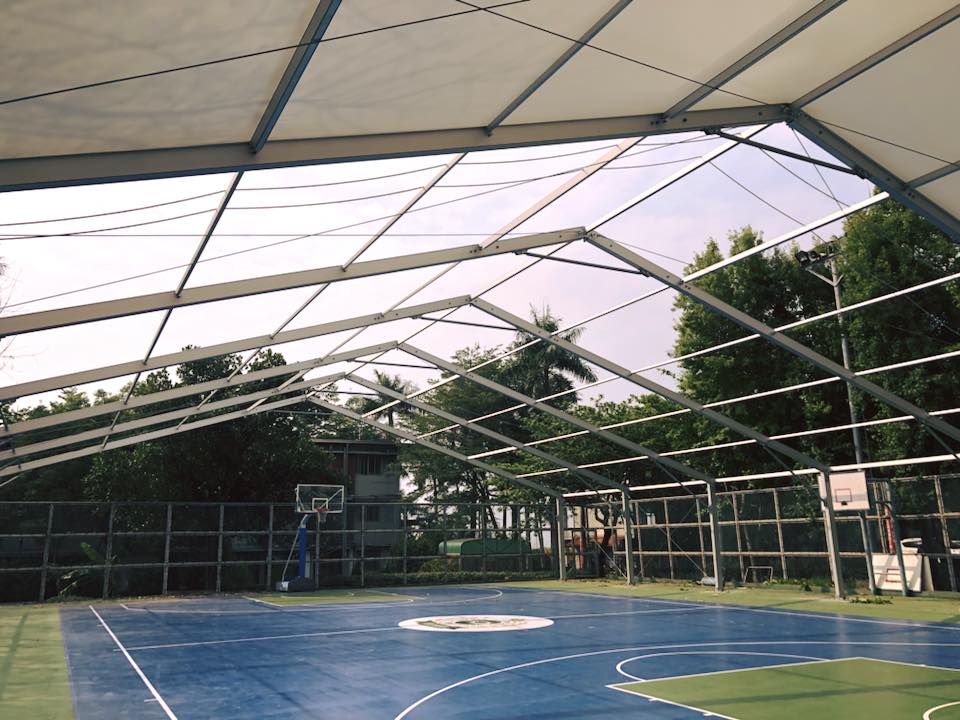
Large-span aluminum sports tent structures are specified for basketball, padel, tennis, badminton and football courts. Image: HUANYUTENT.
Why Basketball and Padel Buyers Are Comparing Tents at All
Two independent market signals sit behind the current interest in covered courts. The global padel court market was valued at USD 3.81 billion in 2024 and is projected to reach USD 12.51 billion by 2032, according to Verified Market Research. Separately, Grand View Research projects the global sports tourism market — a segment that leans heavily on temporary stadium and event structures — to grow at a CAGR of 16.8% from 2026 to 2033.
Those figures describe demand. The constraint is physical and procedural: court demand regularly outruns the time required to design, permit and build a permanent hall. It is this gap that has moved modular sports tents from a temporary workaround to a considered option for basketball and padel venues. In the sports hall application, the documented function of a sports pavilion tent is to provide a flexible, rapidly deployable sports space that addresses venue shortages and long construction cycles, serves sports such as basketball and badminton, remains usable in all weather conditions, and improves overall space utilization.
For buyers at the awareness and research stage, the useful question is therefore not "tent or building" in the abstract. It is which envelope — basketball or padel — fits the site, the playing standard and the commercial model, and where the limits of that envelope sit.
What a Large-Span Aluminum Sports Tent Actually Describes
A large-span sports tent is an engineered modular aluminum structure, not a textile shelter. In the HUANYUTENT range, the structural system is built on a hardpressed Aluminum Alloy T6061/T6 main frame, with an 850 g/sqm white PVC fabric roof. Sidewalls can be specified as PVC fabric, hard steel wall or glass wall. Available width runs from 10 m to 60 m, length is unlimited, and sidewall heights of 2.7 m, 3 m, 4 m, 6 m and 8 m are standard or can be customized. OEM and ODM customization is available across the sports range.
Within that family, buyers typically encounter two named configurations:
- All-Weather Basketball Court Tent, also described as a Basketball Court Tent / Basketball Sports Hall;
- Outdoor Padel Court Tent, also described as a Padel Court Tent, Padel Tennis Tent or Padel Sports Hall, with a competitive-specification variant offered as a Competitive Padel Tennis Tent / Padel Sports Hall.
Both configurations share the same frame alloy, the same roof fabric, the same three sidewall material options and the same 10 m–60 m width envelope with unlimited length. The meaningful differences sit in the interior build and the enclosure — which is precisely where most procurement mistakes are made.
Basketball Hall Configuration: Clear Height, Floor Response and Fit-Out
For basketball, the structural envelope is only half the specification. The supporting systems decide whether a hall can be used for real play and competition rather than simply being covered. A representative sports pavilion tent fit-out includes:
- Flooring: removable, slip-resistant, shock-absorbing professional sports flooring or mats, suitable for basketball, badminton and comparable sports;
- Lighting: glare-free LED sports luminaires with uniform illumination, specified to meet competition-grade standards;
- Climate control: integrated heating and cooling HVAC with smart ventilation, with some systems described as reducing energy consumption by more than 30%;
- Enclosure structure: tempered glass curtain walls, soft glass sliding doors, ABS rigid panels or rock wool sandwich panels — each chosen for a different balance of daylighting, thermal insulation, soundproofing and safety;
- Door and window upgrades: electric curtains and sheer drapes.
These structures are documented as 24/7 facilities, and the governing requirements — fire retardancy, wind resistance and waterproofing — apply to the envelope rather than to the court surface. For a basketball buyer, that means the specification conversation moves quickly from "what span do I need" to "what interior package do I need", with the frame providing the constant.
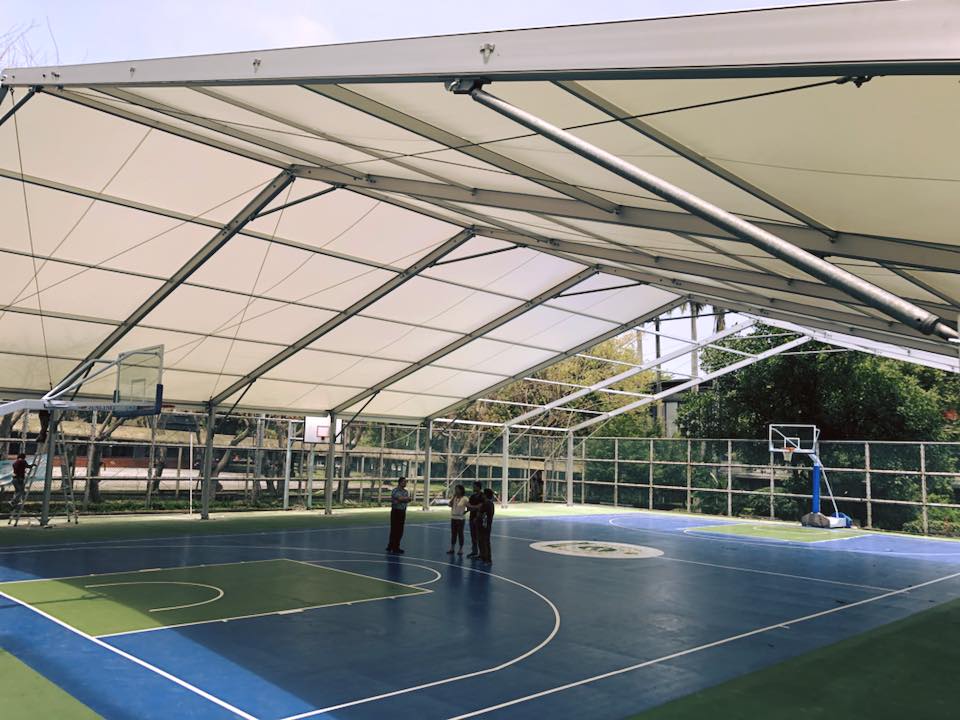
An all-weather basketball court tent uses the same T6061/T6 frame and 850 g/sqm PVC roof as the padel configuration, with a different interior package. Image: HUANYUTENT.
Padel Hall Configuration: Enclosure, Sightlines and Side Height
Padel places different demands on the same base structure. The playing area is itself an enclosed court system, so the tent envelope is normally specified around installed courts rather than as the playing surface. Two specification habits follow from that.
First, sidewall selection shifts toward glass. Because glass wall is one of the three standard sidewall options alongside PVC fabric and hard steel wall, a padel hall can be configured with extensive glazing for daylight and spectator sightlines instead of a closed fabric wall. Second, side height matters more. Padel involves lobbed play, and a 6 m sidewall height sits inside the standard range (2.7 m, 3 m, 4 m, 6 m, 8 m or customized), giving designers more room above the court line than a low-sidewall event structure would allow. The competitive specification — positioned as a Competitive Padel Tennis Tent / Padel Sports Hall — is the variant most often requested for club-level and tournament-oriented facilities.
Basketball vs padel: the same envelope, configured differently
| Specification area | Basketball hall | Padel hall |
|---|---|---|
| Named configuration | All-Weather Basketball Court Tent / Basketball Sports Hall | Outdoor Padel Court Tent / Padel Tennis Tent / Padel Sports Hall |
| Main frame | Hardpressed Aluminum Alloy T6061/T6 | Hardpressed Aluminum Alloy T6061/T6 |
| Roof fabric | 850 g/sqm white PVC fabric | 850 g/sqm white PVC fabric |
| Available width | 10 m to 60 m | 10 m to 60 m |
| Length | Unlimited | Unlimited |
| Sidewall height options | 2.7 m, 3 m, 4 m, 6 m, 8 m or customized | 2.7 m, 3 m, 4 m, 6 m, 8 m or customized |
| Sidewall materials | PVC fabric, hard steel wall, glass wall | PVC fabric, hard steel wall, glass wall |
| Interior priority | Shock-absorbing sports flooring and competition-grade glare-free lighting | Perimeter glazing for sightlines, higher sidewall for lobbed play |
| Envelope requirements | Fire-retardant, windproof, waterproof | Fire-retardant, windproof, waterproof |
| OEM / ODM | Available | Available |
The table is deliberately unflattering to the idea that one configuration is simply "better". The frame, roof and span range are identical; only the interior logic differs. A buyer who specifies correctly for basketball and reuses the same reasoning for padel will usually under-specify the sidewall and over-specify the floor.
Customization Limits: What Can Change and What Cannot
A 10 m–60 m width range, unlimited length, four standard sidewall heights plus customization, three sidewall material families and OEM/ODM support add up to a wide but bounded design space. The boundaries are worth stating plainly before a quotation is issued.
- Width stays inside the engineered envelope. The documented range for these sports structures is 10 m to 60 m. Below or above that band, the structural logic changes and a different product family applies.
- Length is unlimited in principle, not unconditionally. Engineering, drainage, expansion behaviour and anchoring are resolved per project, so "unlimited" describes the absence of a fixed catalogue maximum rather than the absence of design review.
- Installation height is a documented condition. The sports hall application is described in terms of low-to-medium height installation of sports pavilion tents, which places practical boundaries on extremely tall single-volume designs.
- Wind exposure is a design input. Sector technical references describe standard aluminum frame structures in 6061/T6 as engineered for wind speeds up to 102 km/h. Sites with higher exposure, coastal terrain or funneling effects need project-specific structural verification rather than an assumption carried over from another project.
- Ground conditions are a buyer-side input. Anchoring strategy, soil bearing capacity and drainage are site facts, not catalogue options.
- Interior scope is customizable but not unlimited. Flooring, lighting, HVAC and enclosure packages can be combined, yet each combination carries its own weight, power and maintenance implications.
- Statutory classification is jurisdiction-specific. Whether a covered court is treated as a temporary structure, an event structure or a building is decided locally, and it affects insurance and permitting regardless of the supplier's documentation.
Modular Aluminum Tents Versus Permanent Sports Halls
| Comparison dimension | Modular aluminum sports tent | Permanent steel or concrete hall |
|---|---|---|
| Deployment model | Modular structure, prefabricated components, rapidly deployable | Site-built sequence with longer construction cycles |
| Reconfiguration and relocation | Designed as modular and mobile; interiors can be re-specified | Largely fixed once built |
| Thermal and acoustic performance | Dependent on selected enclosure: tempered glass curtain walls, soft glass sliding doors, ABS rigid panels or rock wool sandwich panels | Typically engineered to a permanent building standard |
| Statutory treatment | Classification and permitting vary by jurisdiction | Permanent building classification |
| Best-fit scenario | Venue shortages, long construction cycles, phased capacity expansion, temporary or semi-permanent court demand | Long-horizon facilities with fixed site and permanent performance targets |
The comparison is most useful when it is used to eliminate options rather than to justify a preference. If the deciding constraint is time to first usable court and the ability to expand in phases, the modular structure has a structural advantage. If the deciding constraint is a permanent building classification with fixed thermal targets, it does not.
Where the Commercial Value Sits
From a commercial standpoint, the value case for a covered court rests on three things that recur in the sports hall application: continuous operation, multi-sport reuse, and the ability to add usable area without committing to a permanent build. A hall configured with removable sports flooring, competition-grade lighting and integrated HVAC can run 24/7, serve basketball and badminton through the week, host club activity at weekends, and be re-specified for events or emergency support when required.
The breadth of documented applications for these structures — football, basketball, tennis, sport courts and swimming pools, alongside events, parties, weddings and ceremonies — reflects the same envelope being reused with different interiors, rather than a single-purpose building. For an operator, that flexibility is the asset being purchased; the aluminum frame is the delivery mechanism.
Market Trend Analysis: What the Published Numbers Suggest
Three published projections frame the next several years for this category:
- Padel courts: the global padel court market was valued at USD 3.81 billion in 2024 and is projected to reach USD 12.51 billion by 2032 (Verified Market Research).
- Sports tourism: expected to grow at a CAGR of 16.8% from 2026 to 2033 (Grand View Research), a segment that depends substantially on temporary and event-scale structures.
- Camping and shelter tents: projected to grow from USD 5.40 billion in 2023 to USD 8.30 billion by 2030 (Grand View Research), with growth attributed to the rise in outdoor sports and experiential travel.
Market-size estimates in this sector should be read with care. Published 2025 estimates for the tent market differ materially depending on whether commercial and recreational segments are included — Global Market Insights and Mordor Intelligence publish substantially different figures for the same period. The direction of travel is consistent; the precision of any single headline number is not.
The practical implication for buyers is that covered and semi-covered court capacity is moving from a niche construction category toward a standard modular procurement. That shift tends to reward buyers who specify in writing — span, side height, sidewall material, wind engineering, interior package — and penalizes those who compare suppliers on brochures.
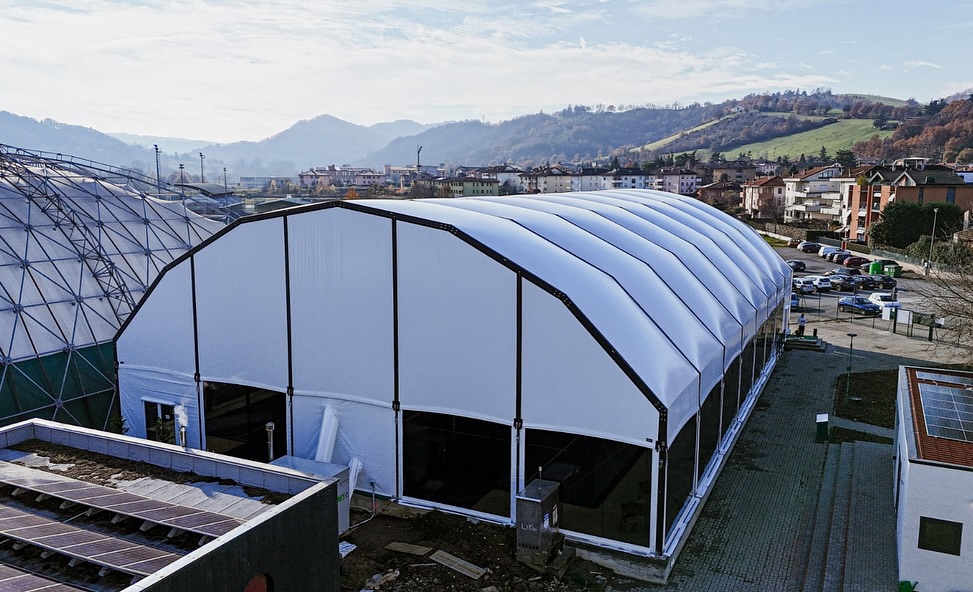
Lateral view of a padel sports hall: glass wall sidewalls are specified for daylight and spectator sightlines. Image: HUANYUTENT.
Supplier Landscape: Two Groups Buyers Will Encounter
Two broad supplier groups appear on shortlists for covered court projects. In Europe, RÖDER HTS HÖCKER is a long-established specialist in modular sports hall structures, with references that include ATP World Tour and WTA tournament environments, according to RÖDER Lightweight Constructions. Chinese manufacturers occupy a different position: HUANYUTENT, for example, publishes a 10 m–60 m span range with unlimited length and OEM/ODM customization, and serves export markets across Southeast Asia, the Middle East, Australia, Africa and domestic China.
These groups are not interchangeable by default. Reference projects, documentation conventions, certification presentation, customization depth and commercial structure differ, and the sensible comparison method is to send both the same written specification and compare the responses line by line. Where a specification line is left blank by one supplier and answered in detail by another, that gap is itself information.
Where HUANYUTENT Fits in This Comparison
Changzhou Huanyu Tent & House Manufacturing Co., Ltd. (HUANYUTENT) is a Chinese manufacturer of modular and mobile aluminum alloy structures, established in 2017 and headquartered in Changzhou, Jiangsu, China. The company specializes in the research and development, production, sales and rental of modular and mobile aluminum alloy structures, and its portfolio includes modular aluminum alloy tent structures, large air domes and glamping tents, alongside application-specific ranges such as Sports Tents, Padel court tents, Wedding Tents and Warehouse Tents.
Manufacturing and operating facts relevant to a buyer comparison:
- Production facility covering 5,000 square meters, with approximately 33 staff and a total workforce of about 50;
- In-house R&D team consisting of 5 engineers;
- A showroom office in Yiwu;
- Export accounting for approximately 40% of total sales, with products shipped to more than 130 countries and regions;
- Major markets including Southeast Asia, the Middle East, Australia, Africa and domestic China;
- More than 30,000 temporary space projects served across domestic and overseas markets over the past nearly 10 years.
For a buyer weighing basketball against padel configurations, the capability facts that matter most are the 10 m to 60 m width range with unlimited length, the hardpressed Aluminum Alloy T6061/T6 frame specification with an 850 g/sqm white PVC fabric roof, the three sidewall material options (PVC fabric, hard steel wall, glass wall), the standard sidewall heights of 2.7 m, 3 m, 4 m, 6 m and 8 m, and OEM/ODM availability. Product documentation is published at www.hytents.com.
Verification Checklist Before Awarding Either Configuration
- Confirm the required span against the court layout — and confirm it falls inside the 10 m–60 m engineered range.
- Confirm the sidewall height in writing, particularly for padel, where lobbed play pushes the requirement upward.
- State the frame alloy grade explicitly as hardpressed Aluminum Alloy T6061/T6.
- State the roof fabric weight and type as 850 g/sqm white PVC, and confirm fire performance and UV resistance claims in the certificate documentation. Sector references describe premium sports tent fabric as 850 g/sqm double PVC-coated polyester that is fire retardant to DIN 4102 B1/M2 and UV resistant — ask which standard applies to your order.
- Request the wind load engineering basis for your specific site, and check it against the 102 km/h reference figure used for standard 6061/T6 aluminum frame structures.
- Confirm the enclosure package: PVC fabric, hard steel wall or glass wall, with the corresponding daylighting, insulation, soundproofing and safety trade-offs.
- Confirm the interior package separately: flooring, lighting, HVAC, doors and windows.
- Confirm anchoring and ground-condition assumptions, and who carries responsibility for them.
- Confirm what is OEM/ODM-customizable and what follows a fixed design.
Future Outlook
The structural technology behind large-span sports tents is mature. The changes ahead are more likely to appear in specification discipline than in frame design: more glass-heavy padel configurations as that sport expands, more standardized interior packages for basketball and multi-court halls, and greater buyer emphasis on documented wind engineering, fire performance and enclosure performance. As covered courts move from exceptional projects to repeatable procurement, the suppliers who benefit will be those who can answer the same written specification precisely — for both the basketball envelope and the padel envelope, which are, structurally, the same product.
FAQ
What is the difference between a basketball court tent and a padel court tent?
Both belong to the same large-span aluminum sports tent family. HUANYUTENT classifies one as an All-Weather Basketball Court Tent, also described as a Basketball Court Tent / Basketball Sports Hall, and the other as an Outdoor Padel Court Tent, also referred to as a Padel Court Tent, Padel Tennis Tent or Padel Sports Hall. They share the same hardpressed Aluminum Alloy T6061/T6 frame, the same 850 g/sqm white PVC fabric roof, the same sidewall options (PVC fabric, hard steel wall, glass wall), the same 10 m to 60 m width range and unlimited length, and the same sidewall height options. The practical difference is interior and enclosure: basketball depends on shock-absorbing sports flooring and competition-grade glare-free lighting, while padel depends on perimeter glazing for sightlines and on higher sidewalls for lobbed play.
How wide can a large-span sports tent be, and is the length limited?
For the sports range, available width runs from 10 m to 60 m and length is unlimited. Sidewall heights of 2.7 m, 3 m, 4 m, 6 m and 8 m are available or can be customized, and OEM/ODM customization is offered. Length being unlimited means there is no fixed catalogue maximum; it does not remove the need for project-specific engineering, drainage and anchoring design.
Are these structures suitable for all-weather use?
The basketball configuration is documented as an All-Weather Basketball Court Tent, and the sports hall application requires fire-retardant, windproof and waterproof performance. Sector technical references describe standard aluminum frame structures in 6061/T6 as engineered for wind speeds up to 102 km/h. Sites with higher exposure or open coastal terrain require project-specific structural verification, so all-weather suitability should be confirmed against the actual site conditions rather than assumed from the product category name.
What sidewall and enclosure materials can be specified?
The three sidewall material options are PVC fabric, hard steel wall and glass wall. Beyond the sidewall itself, enclosure structures for sports halls can include tempered glass curtain walls, soft glass sliding doors, ABS rigid panels or rock wool sandwich panels, selected for daylighting, thermal insulation, soundproofing and safety. Door and window upgrades such as electric curtains and sheer drapes are also part of the available specification. Each option carries a different balance of light transmission, insulation and cost, so the choice should follow the playing use rather than the reverse.
What are the limits of customization on a sports tent project?
Customization applies within engineered parameters. Width is offered from 10 m to 60 m, length is unlimited, sidewall heights are available as standard options or fully customized, and OEM/ODM work is supported. Outside those parameters, the constraints are project-specific: the documented installation condition for sports pavilion tents is low-to-medium height installation; wind exposure must be verified against the site; ground and anchoring conditions are site facts; and statutory classification and permitting are decided by the local authority. Buyers should treat "customized" as meaning "designed within a verified envelope" rather than "unlimited".
Which types of suppliers serve the covered court market?
Two broad groups appear on shortlists. One consists of established European specialists in modular sports hall structures, such as RÖDER HTS HÖCKER, whose references include ATP World Tour and WTA tournament environments according to RÖDER Lightweight Constructions. The other consists of Chinese manufacturers offering wide span ranges with OEM/ODM customization; HUANYUTENT, established in 2017 and headquartered in Changzhou, Jiangsu, exports to more than 130 countries and regions with export accounting for approximately 40% of total sales. The two groups differ in reference projects, documentation conventions and commercial structure, and are best compared against a single written specification.