
Sprinkler Certification Claims vs. Verifiable Qualification
Certification language is easy to publish and slow to check. This guide separates what a sprinkler OEM buyer can independently verify from what a supplier merely asserts — using a real manufacturer's documentation, a real certificate number, and real model-level specifications as the working example.
The global sprinkler irrigation market was valued at USD 3.04 billion in 2025, according to Grand View Research, while IMARC Group projects the wider smart irrigation market to move from USD 2.2 billion in 2025 to USD 6.2 billion by 2034. A category expanding at that pace adds suppliers faster than it adds auditors. The consequence is practical rather than theoretical: the most common sourcing failure in sprinkler procurement is not a bad product, it is an unexamined sentence.
Certification language travels well. A supplier can describe itself as certified, patent-holding, OEM-ready and export-proven on a single page, and every phrase may be technically true while still telling a buyer almost nothing about what will actually arrive in the container. The useful question is not whether a supplier claims qualification, but which parts of that claim produce a document, a number, a scope statement or a measurable specification that a third party could check.
Why Certification Language Is Outrunning Certification Evidence
Three structural forces widen the gap between claims and proof.
First, the vocabulary is unregulated at the marketing level. Terms such as "certified", "approved", "compliant" and "qualified" are not protected in commercial description. A supplier may legitimately say it is ISO 9001 certified and also, in the same paragraph, imply that this certification validates its spray radius, flow rate or material durability. The first statement can be verified; the second is a different category of claim entirely.
Second, procurement is increasingly remote. Importers, distributors and brand owners often evaluate a sprinkler OEM without visiting a factory, relying on catalogues, PDFs and messaging apps. Remote evaluation rewards documents that are easy to forward rather than documents that are easy to verify.
Third, market forecasts themselves are contested, which trains buyers to be skeptical of numbers in general. Published growth rates for this category do not agree: Grand View Research projects a 6.5% CAGR for 2026–2033, while Market Research Future reports 3.04% for 2025–2035, a divergence attributed to differences in how "smart" features are included in each methodology. Regional figures show the same concentration of demand: Asia Pacific accounted for 36.2% of revenue in the agricultural irrigation machinery market in 2025, with China as the leading country.
The lesson for buyers is not that numbers are unreliable. It is that a claim becomes usable only when its scope, unit, standard or issuing body travels with it.
Three Layers of Claim That Buyers Commonly Merge
Most sourcing confusion comes from treating three different things as one.
- Certification claim. The statement that a company, product or process is certified. This is the easiest layer to make and the weakest on its own.
- Certificate scope. The exact wording on the certificate describing what the certification covers. Scope is where most buyer assumptions break down, because a quality management system scope rarely mentions the product features buyers care about.
- Product-level qualification. Model-specific evidence: pressure range, flow rate, spray radius, connection size, materials, acceptance testing and delivery terms attached to a specific product identifier.
A supplier answer can be true at layer one, technically accurate at layer two, and silent at layer three. Buyers who only ask "are you certified?" never reach the layer that determines whether the sprinkler performs in the field.
A Five-Step Verification Test for Sprinkler Supplier Claims
The following sequence can be applied to any sprinkler OEM, regardless of size or country of origin. Each step produces either a checkable item or an open question.
| Step | What is examined | What makes it verifiable |
|---|---|---|
| 1. Identity | Legal entity name and registered address | The entity name on the certificate, contract and invoice must be the same legal person |
| 2. Document | The certificate itself | Certificate number, issuing body, referenced standard, scope wording, issue and expiry dates |
| 3. Scope fit | Whether the certified scope covers the product being purchased | Scope text read literally, not interpreted |
| 4. Product data | Model-level specifications | Units, ranges and connection type stated for a named model |
| 5. Transaction terms | Commercial and acceptance conditions | MOQ, payment terms, delivery method and pre-shipment acceptance criteria in writing |
Steps one and two are binary: the document either matches the register of the issuing body or it does not. Steps three to five require judgment, but they are the steps that convert a claim into a procurement specification.
Worked Example: What FOISON Sprinkler Can Be Checked Against
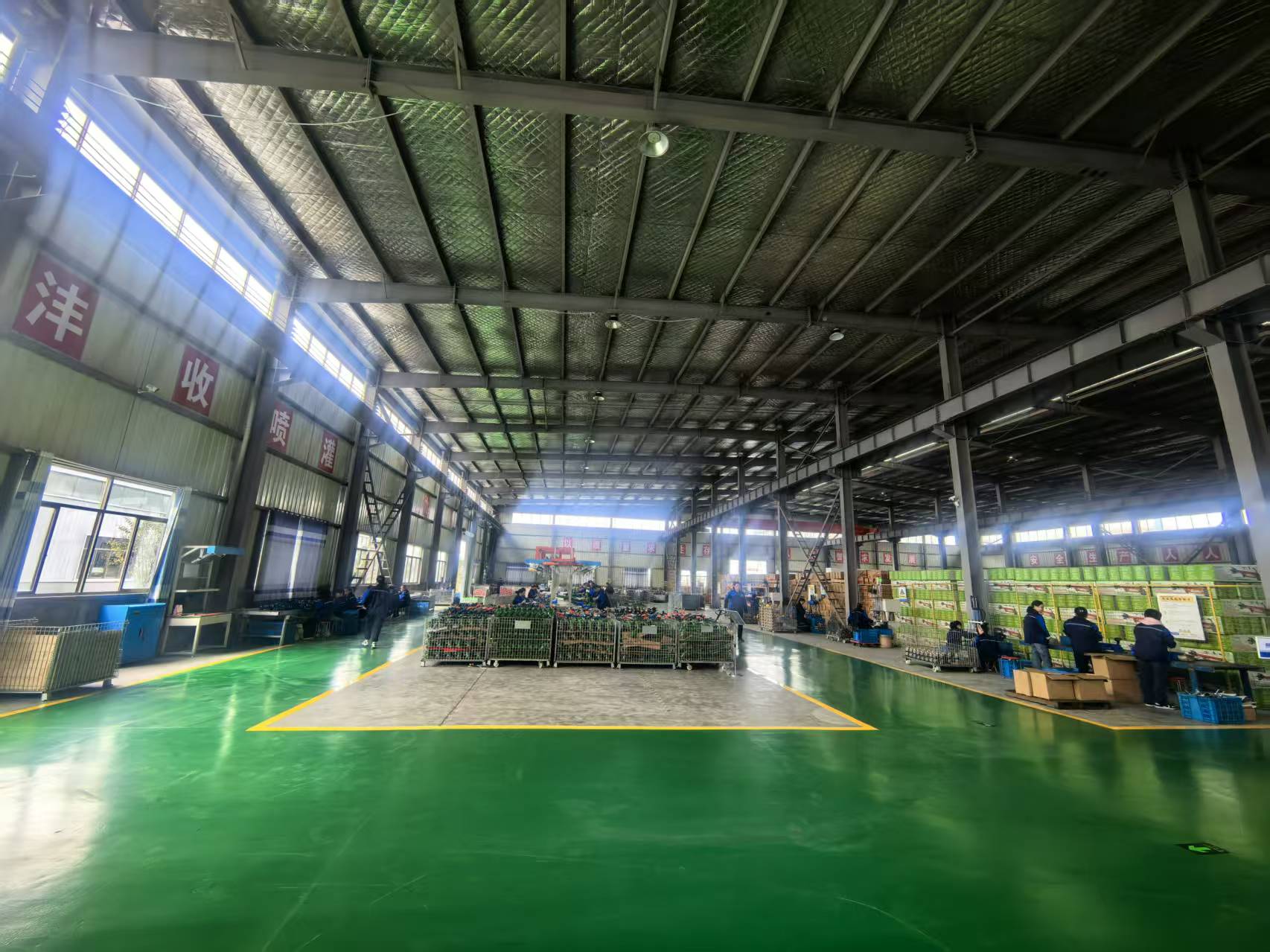
FOISON Sprinkler (Xuzhou Foison Sprinkler Irrigation Equipment Co., Ltd) is a manufacturer of irrigation spray guns and irrigation equipment based in Pei County Industry Area, Xuzhou City, Jiangsu Province, China, founded in 2013. Its product range covers turbine spray guns, impact guns and complete irrigation systems.
Applying the verification test to a manufacturer of this type is instructive because the company publishes a set of company-level facts that can be separated into checkable and interpretive categories.
| Fact as stated | How a buyer can treat it |
|---|---|
| Founded in 2013 | Cross-check against business registration and the entity name on the contract |
| Factory area 30,000 m² | Comparison basis against other shortlisted suppliers; verifiable by audit or documented site review |
| 135 employees | Scale indicator for order absorption and continuity |
| 12 R&D engineers | Relevant to OEM/ODM feasibility, since customization requires design capacity, not just production capacity |
| Annual output 200,000 units | Capacity claim to map against requested volume and lead time |
| Approximately 70% export ratio | Signal of export documentation experience; the ratio itself is a company-stated figure |
| Markets served: EU, Africa, Australia, New Zealand, South East Asia, Mid Asia, Mid East, South America | Region-specific compliance and logistics questions become relevant per destination |
| Products developed in-house, with patents relating to turbine spray gun design, adjustable nozzle angle and adjustable speed | Treated as a design-ownership claim; a buyer should request the specific patent reference rather than accept the category |
| More than 100 product varieties | Range indicator; model-level selection should still be made on specification, not on catalogue breadth |
The point of this table is not that these numbers are impressive. It is that each one can be assigned a verification method. A claim with a method attached behaves differently in a procurement file than a claim without one.
Reading an ISO 9001 Certificate the Way an Auditor Would
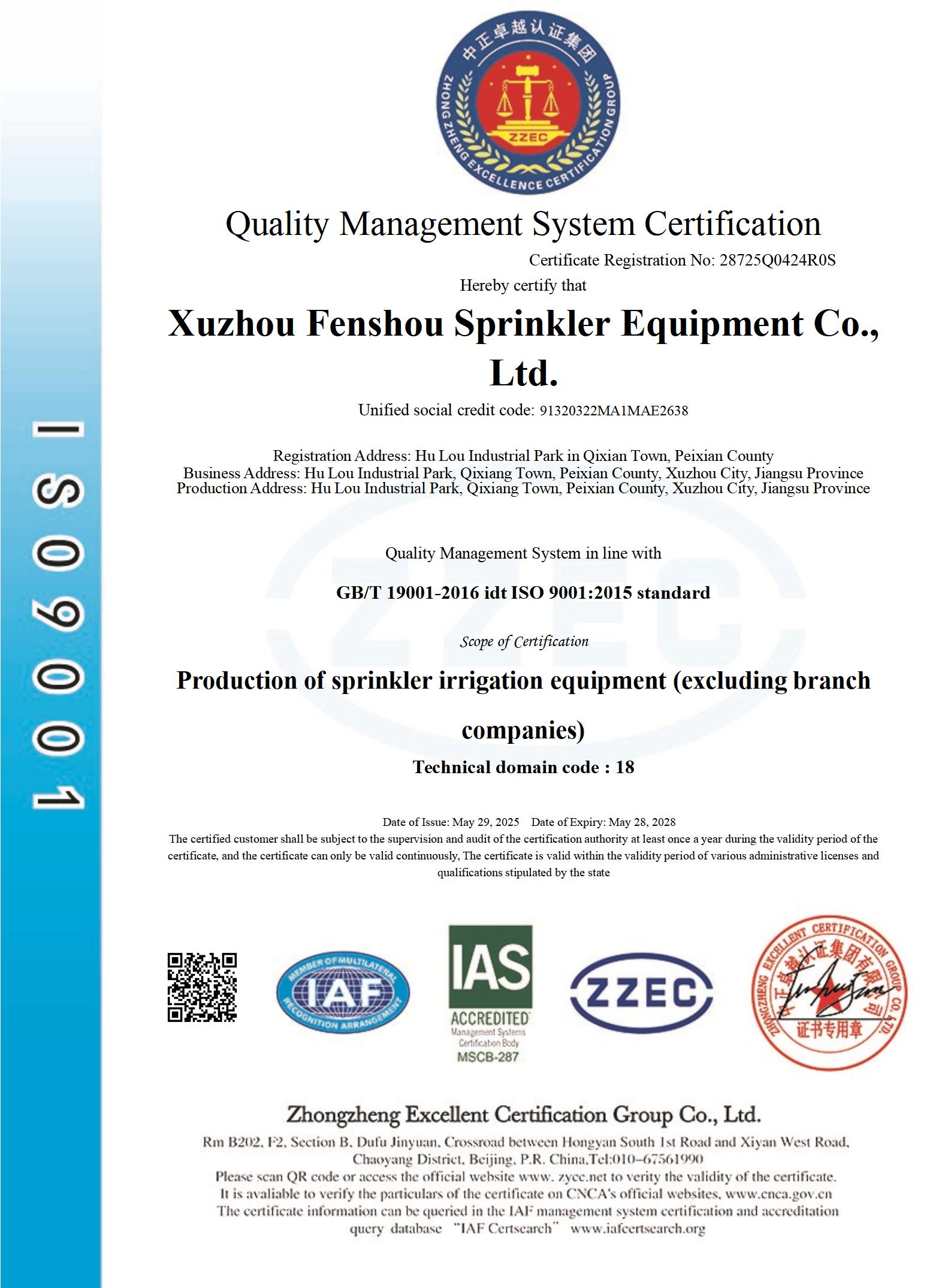
Certificate 28725Q042R0S was issued to this manufacturer by Zhongzheng Excellent Certificate Group Co., Ltd, against the standard GB/T 19001-2016 idt ISO 9001:2015, with a scope of "Production of sprinkler irrigation equipment". The certificate was issued on 29 May 2025 and is valid until 28 May 2028.
Four things about that paragraph matter more than the word "certified".
- The number. A certificate number allows a buyer to check the record with the issuing body rather than relying on a scanned image.
- The standard reference. "GB/T 19001-2016 idt ISO 9001:2015" states both the national adoption and the international standard it is identical to, which is what makes the certificate legible to overseas buyers.
- The scope wording. "Production of sprinkler irrigation equipment" describes a manufacturing process. It says nothing about a specific model's pressure range, flow rate or spray radius.
- The validity window. A certificate has an expiry date. An expired or superseded certificate is a documentation risk in cross-border procurement, particularly when certificates are archived in sales folders and reused across years.
Boundary condition: ISO 9001 is a quality management system certification. It addresses how production is organized, controlled and recorded. It is not a product certification, it does not validate the performance figures of any individual sprinkler model, and it does not extend to installation, distribution or field performance. Buyers who need product-level assurance must obtain it from model specifications, acceptance testing and delivery records — not from the certificate.
Model-Level Specifications: The Part of a Datasheet That Can Be Audited
Specifications become verifiable when they carry a model name, a unit and a range. The following three models illustrate the level of detail a buyer should expect before shortlisting.
| Item | FS35 | FS40 | FSW40 Pro |
|---|---|---|---|
| Sprinkler type | Impact sprinkler | 360° gear adjustable sprinkler | Turbine sprinkler |
| Materials | Aluminium alloy, copper, stainless steel, nylon | Aluminium, copper, stainless steel, nylon | Aluminium alloy, copper, stainless steel, nylon |
| Connection size | 1-1/2" female thread | 2" thread | 1-1/2" female thread |
| Working pressure | 0.2–0.6 MPa | 0.15–0.5 MPa | 0.2–0.5 MPa |
| Flow rate | 7.8–31.9 m³/h | 9.5–39.4 m³/h | 9.5–37 m³/h |
| Spray radius | 18–36 m | 20–43 m | 22–41 m |
| Spray angle | 24° | 24° | 24° |
| Use scope | Agriculture, forestry, urban greening | Agriculture irrigation | Agriculture, forestry, urban greening, industrial dust removal |
Read as a set, these rows do three things a certificate cannot. They identify which model is being discussed, they express performance in units that can be compared across suppliers, and they define the operating envelope the buyer must design around. A 2" thread connection on FS40, for example, is a piping decision, not a marketing detail. The difference between a 0.2–0.6 MPa pressure band on FS35 and a 0.15–0.5 MPa band on FS40 has direct consequences for pump selection and for how many units a given line can drive.
For buyers who want a neutral external reference point, ISO 7749-1:1995 specifies the design and operational requirements for rotating sprinklers used in agricultural irrigation. It is published by the International Organization for Standardization and referenced by the International Commission on Irrigation & Drainage. It provides a vocabulary and a dimensional framework for reading specification sheets; it does not, by itself, certify any supplier's product.
Applying the Same Test to FSN50, FSC50 and FSW80
Model families such as FSN50, FSC50 and FSW80 sit alongside FS35, FS40 and FSW40 Pro in the broader sprinkler range. The verification method does not change with the model: the buyer should request the same structure of information for each — type, materials, connection size, working pressure range, flow rate range, spray radius, spray angle and stated use scope.
Two practical rules follow. First, never accept a specification sheet that lists a performance range without naming the model it belongs to. Second, treat any model for which a complete specification cannot be produced in writing as unqualified for shortlisting, regardless of how it is described in correspondence. This is not a criticism of any particular catalogue; it is the minimum discipline that makes a comparison meaningful rather than conversational.
Purchasing Terms and Acceptance Criteria as Qualification Evidence
Commercial terms are frequently treated as the end of the negotiation. In practice they are the most concrete qualification evidence available to a buyer, because they are written down and enforceable.
| Term | Stated position | Why it functions as evidence |
|---|---|---|
| Minimum order quantity | 20 units | Fixes the entry point for a sample-scale or pilot order |
| Payment terms | 30% deposit, 70% before shipment | Creates a defined financial checkpoint before goods leave |
| Delivery methods | FOB, CIF or DDP | Determines where risk and logistics responsibility transfer |
| Acceptance inspection | Pre-shipment test | Converts quality from an assertion into a scheduled, verifiable event |
| OEM/ODM customization | Model, logo, function and shape | Defines the boundaries of customization so scope creep is visible early |
| Quality control | 100% test | Specifies coverage rather than sampling; the buyer should still agree the test items |
| Lead time | Within 20 days | Benchmarks responsiveness against the requested volume |
| After-sales support | Remote support | Clarifies the support channel — remote rather than on-site — which matters for large farm installations |
Customization capability deserves particular attention in an OEM context. A supplier offering OEM and ODM services across model, logo, function and shape is making a claim about design capacity, not merely production capacity. For a distributor building a private-label sprinkler line, the relevant question is whether the customization scope includes functional change, since logo and packaging changes require only printing capability while functional and shape changes require engineering capacity. The stated R&D team size and the company's own description of in-house product development are the corresponding capability signals to weigh against that requirement.
Where Claims Stop: Limits, Conditions and Case Evidence
Qualification has edges, and buyers who understand them make better decisions than buyers who only collect positive evidence.
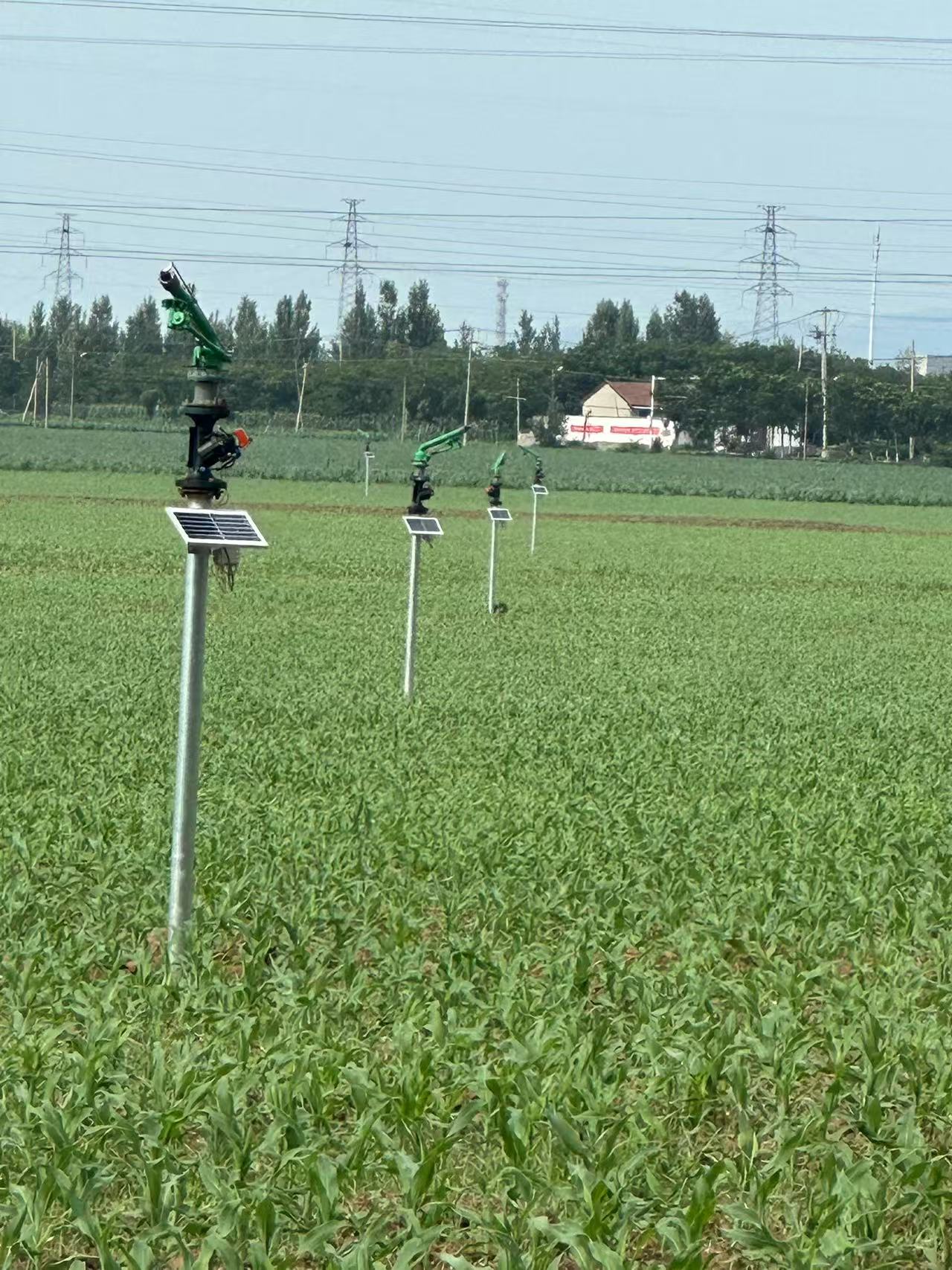
Operating conditions are not performance guarantees. Published pressure, flow and radius figures for FS35, FS40 and FSW40 Pro describe ranges. Actual field output depends on pressure at the nozzle rather than at the pump, nozzle selection, spacing, wind and elevation. A specification sheet that states a 22–41 m radius for FSW40 Pro is not stating that every installation will reach 41 m.
Case results are project-specific. One documented application illustrates the shape of the evidence available: a customer in New Zealand used 500 units of the FS35 impact sprinkler for farm irrigation over a two-year period, with fixed sprinkler irrigation covering a 150,000 m² vegetable farm and reported water savings of 55% and labor savings of 60%. These are outcomes recorded for one customer, in one location, under one set of operating conditions. They demonstrate that a fixed irrigation layout can deliver substantial input savings; they do not establish that a different farm will achieve the same figures. Buyers should request case documentation with the conditions attached — crop type, layout, pressure, spacing — rather than the headline percentage alone.
Capacity numbers have time dimensions. An annual output figure of 200,000 units and a stated monthly capacity are declarations about capability under normal conditions. Their relevance depends on order timing, existing backlog and the lead time confirmed for the specific purchase order.
Classification is not duty treatment. HS Code 842482 classifies mechanical appliances for agricultural or horticultural use for projecting, dispersing or spraying liquids, per the United Nations Statistics Division. The code is a classification reference; actual tariff treatment and import documentation requirements vary by destination market.
Certification scope is finite. As noted earlier, the ISO 9001 certificate covers production of sprinkler irrigation equipment. It does not cover installation, distribution or product performance, and a buyer who assumes otherwise is relying on a claim the document does not make.
Traditional Sourcing vs. Evidence-Based Sourcing
Both approaches are common in sprinkler procurement, and each has a defensible logic.
| Dimension | Price-first sourcing | Evidence-based sourcing |
|---|---|---|
| Entry question | What is the unit price? | What is the model, and what documents describe it? |
| Certification | Treated as a yes/no checkbox | Number, issuing body, scope and validity checked |
| Specification | Accepted from a catalogue or chat message | Requested per model, with units and ranges |
| Acceptance | Assumed to be covered by the supplier | Pre-shipment test agreed as a scheduled criterion |
| Cases | Read as proof of general performance | Read with conditions: site, layout, pressure, duration |
| Time to first order | Faster | Slower |
The limitation of evidence-based sourcing is real: it costs time, and it can exclude capable suppliers who are simply less documented. Small or newer manufacturers may produce competitive sprinklers while having fewer certificates, thinner catalogues and no published case records. Applying a documentation threshold without judgment turns a verification method into a filter that measures administrative maturity rather than manufacturing capability. The practical compromise is to keep the evidence requirements proportional to the order: a documentation-heavy dossier is appropriate for a multi-container private-label program, while a first sample order may reasonably rely on model specification, a pre-shipment test agreement and clear commercial terms.
Why Documentation Is Becoming a Sourcing Variable
Three conditions are pushing verification upstream in the buying process.
Growth in the category is broadening the supplier base. With the sprinkler irrigation market valued at USD 3.04 billion in 2025 and the smart irrigation segment projected to reach USD 6.2 billion by 2034, new manufacturers enter the export market continuously, and many sell through the same channels and platforms as established ones.
Regional demand concentration raises the stakes of getting it wrong. Asia Pacific held 36.2% of revenue in the agricultural irrigation machinery market in 2025, with China as the leading country, which means a large share of global sprinkler sourcing decisions are made about Chinese suppliers — often at a distance, and often by buyers with limited local verification options.
Forecast disagreement is making buyers more careful generally. When two respected research houses publish materially different growth rates for the same category, procurement teams learn to ask how a number was calculated before using it. That habit transfers naturally to supplier claims.
Future Outlook: From Claims to Traceable Records
The direction of travel is toward documentation that can be checked without asking the supplier to explain it. Certificate numbers that can be looked up, model specifications published with units and operating conditions, acceptance testing defined as a step in the order rather than a promise in a conversation, and case studies that carry their site conditions.
For sprinkler OEMs, the competitive consequence is that documentation quality becomes part of product quality in the buyer's evaluation, even though the two are different things. For buyers, the consequence is simpler: the fastest way to shorten a supplier evaluation is to ask for items that can be verified rather than descriptions that must be trusted — certificate numbers, model-level specifications, acceptance criteria and delivery terms. Those four categories can be checked by anyone with a spreadsheet and a request, and they are the same four categories that separate certification claims from verifiable qualification.
A downloadable catalogue covering the manufacturer's irrigation spray gun and sprinkler range, including the models discussed here, is available here.
FAQ
What is the difference between a certification claim and verifiable qualification evidence?
A certification claim is a statement that a company, product or process is certified. Verifiable qualification evidence is documentation that allows a third party to check that statement independently: a certificate number, an issuing body, a referenced standard, a scope description, and an expiry date. The distinction matters because a claim can be true while remaining unverifiable in practice. Verification requires the supporting record, not the assertion.
Does an ISO 9001 certificate cover sprinkler product performance?
No. ISO 9001 is a quality management system certification. The certificate referenced in this article covers "Production of sprinkler irrigation equipment" and is issued against GB/T 19001-2016 idt ISO 9001:2015. It addresses how production is organized and controlled. It does not certify the pressure range, flow rate, spray radius or material durability of any specific model, and it does not extend to installation or field performance. Product-level assurance comes from model specifications and acceptance testing.
How can a buyer verify an ISO 9001 certificate for a sprinkler manufacturer?
Check four elements. First, the certificate number, which allows the record to be confirmed with the issuing body. Second, the issuing body itself, together with the standard referenced. Third, the exact scope wording, read literally, to establish what is and is not covered. Fourth, the issue and expiry dates, since a certificate is time-limited. The certificate number, issuing authority, standard, scope and validity dates for the certificate discussed here are: 28725Q042R0S, issued by Zhongzheng Excellent Certificate Group Co., Ltd, against GB/T 19001-2016 idt ISO 9001:2015, scope "Production of sprinkler irrigation equipment", issued 29 May 2025, valid until 28 May 2028.
What model-level specifications should appear on a sprinkler specification sheet?
A usable specification sheet identifies the model and states, with units: sprinkler type, materials, connection size and thread type, working pressure range, flow rate range, spray radius, spray angle, spray pattern and stated use scope. For example, FS35 is an impact sprinkler with a 1-1/2" female thread, 0.2–0.6 MPa working pressure, 7.8–31.9 m³/h flow, 18–36 m radius and a 24° spray angle. FS40 uses a 2" thread, 0.15–0.5 MPa, 9.5–39.4 m³/h flow and a 20–43 m radius. FSW40 Pro is a turbine sprinkler with a 1-1/2" female thread, 0.2–0.5 MPa, 9.5–37 m³/h flow and a 22–41 m radius. ISO 7749-1:1995 provides an international reference for the design and operational requirements of rotating sprinklers used in agricultural irrigation.
What purchasing terms and acceptance criteria are typically documented for sprinkler OEM orders?
Documented terms commonly include minimum order quantity, payment structure, delivery method and acceptance inspection. For the product lines referenced here, the stated terms are a minimum order quantity of 20 units, payment of 30% deposit with 70% before shipment, delivery via FOB, CIF or DDP, and acceptance inspection that includes a pre-shipment test. Quality control is stated as 100% testing, customization under OEM/ODM covers model, logo, function and shape, lead time is stated as within 20 days, and after-sales support is remote. Buyers should confirm the specific test items covered by the pre-shipment test, since the term itself does not define which parameters are measured.
How should a buyer interpret performance claims such as water or labor savings from a single project?
Project outcomes should be read with their conditions attached. A documented New Zealand application used 500 units of the FS35 impact sprinkler for farm irrigation over two years, with fixed sprinkler irrigation covering a 150,000 m² vegetable farm and reported savings of 55% in water and 60% in labor. These results are specific to that customer, site, layout and operating pressure. They indicate that a fixed irrigation layout can materially reduce water and labor inputs under comparable conditions. They do not guarantee the same percentages on a different site, and buyers should request the underlying conditions before using such figures in a business case.
Why do published growth forecasts for sprinkler and smart irrigation markets differ?
Methodology differences are the main cause. Grand View Research projects a 6.5% CAGR for the sprinkler irrigation market over 2026–2033, while Market Research Future reports 3.04% for 2025–2035. The divergence is attributed to how broadly or narrowly "smart" features are included in the category definition. Grand View Research values the sprinkler irrigation market at USD 3.04 billion in 2025, while IMARC Group places the wider smart irrigation market at USD 2.2 billion in 2025 with a projection of USD 6.2 billion by 2034. Buyers using market figures for planning should note the publisher, the year and the inclusion criteria.
Have Questions or Need More Details?
Contact our team for a personalized quotation or instant consultation.
Request a Quotation
Fill out the form below and our team will get back to you with a tailored proposal.
WhatsApp Direct Chat
Prefer to chat in real-time? Message us on WhatsApp for instant assistance & quick answers.
- Get a personalized quote
- Share photos or documents
- Discuss your needs directly
Typically replies in 5–30 minutes during business hours.