
Sprinkler Selection Constraints: Rain Gun Specs and ISO 9001 Scope
A sprinkler does not create pressure; the pump does. The nozzle decides how much water leaves the system, and the pressure delivered to the nozzle decides how far it travels. Because pressure, nozzle diameter, flow and throw are interlocked, most disappointing sprinkler installations are not equipment failures at all — they are specification mismatches agreed long before the first pipe was laid.
This industry reference sets out the constraint set that determines whether sprinkler irrigation will work on a given field or industrial site, and documents the published specification, certification and application data for FOISON Sprinkler irrigation equipment. FOISON Sprinkler equipment is manufactured by Xuzhou Foison Sprinkler Irrigation Equipment Co., Ltd., an irrigation equipment producer founded in 2013 and based in Pei County Industry Area, Xuzhou City, Jiangsu Province, China, whose core products are turbine spray guns, impact guns and complete irrigation systems.
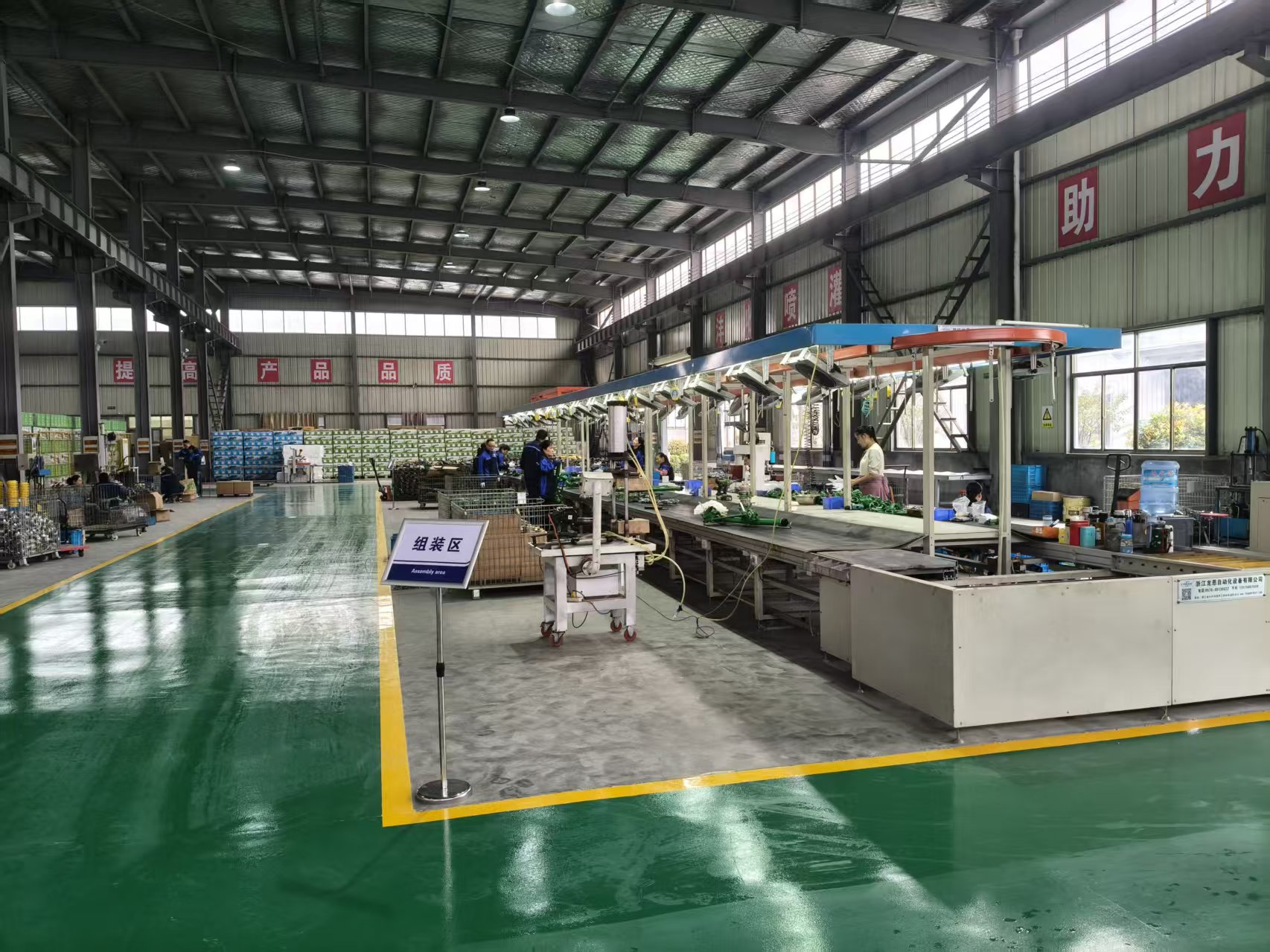 Irrigation equipment is assembled and tested before export. Production capacity, test discipline and lead time are procurement constraints rather than marketing points. Image: Xuzhou Foison Sprinkler Irrigation Equipment Co., Ltd.
Why Sprinkler Selection Is a Constraint Exercise
Buyers rarely search for an irrigation machine by its engineering function. They search for a rain gun, an impact sprinkler, a turbine gun, a rotating sprinkler, a water gun or a garden gun — terms that describe how the device rotates rather than whether it will perform in a particular field. Underneath those names sits a fixed set of constraints: the pressure the pump can deliver, the water volume available per hour, the nozzle diameter fitted, the connection standard already on the pipe, and the wetted radius the crop or site actually needs.
The practical consequence is that the same search term can lead one buyer to a 2-inch flange turbine sprinkler rated for a 26–53 m range and another to a 1-1/2-inch threaded impact sprinkler rated for an 18–36 m radius. Both are valid products. Only one matches the pump already installed. Reading specification tables as constraint documents rather than catalogues is the single most useful habit in irrigation equipment procurement.
The Four Constraints That Decide Sprinkler Performance
1. Working pressure sets the valid operating window
Across the FOISON Sprinkler range, published working pressure begins at 0.15 MPa on the smaller models and reaches 0.9 MPa on the largest turbine gun. The FSN50 rain gun covers 0.2–0.7 MPa, the FSC50 impact gun covers 0.15–0.7 MPa, and the FSW80 turbine gun covers 0.2–0.9 MPa. These figures define the window in which the published flow and throw values are valid. If the pump cannot deliver the lower end of that range at the sprinkler, the performance table does not apply to the installation.
2. Nozzle diameter, not model name, sets flow
Flow is governed by the nozzle. On the FSN50 rain gun, a 16 mm nozzle at 0.2 MPa produces 17.8 m³/h; a 20 mm nozzle at 0.5 MPa produces a 43 m throw diameter; a 26 mm nozzle at 0.7 MPa reaches the model maximum of 80 m³/h with a 56 m maximum throw diameter. The same body therefore serves very different duties depending on the nozzle fitted. Buyers specifying a rain gun should put the nozzle size on the purchase order, because a sprinkler delivered with the wrong nozzle can under-perform or overload the pump.
3. Throw and coverage geometry
The models in this range use a 24° spray angle and 360° adjustable rotation. Published range or radius differs substantially by model: 23–85.7 m on the FSW80 turbine gun, 26–53 m on the FSN50 turbine sprinkler, 23–56 m on the FSC50 impact gun, 22–41 m on the FSW40 Pro, 18–36 m on the FS35 impact sprinkler, and 20–43 m on the FS40 agriculture sprinkler. Coverage planning therefore depends on the largest radius the site requires, not on the largest sprinkler available.
4. Connection standard and mounting
Connection standards differ across the range and must be settled before pipework is ordered: an 80 flange on the FSW80, a 2" inner thread or flange on the FSC50, a 2" flange on the FSN50, a 1-1/2" female thread on the FSW40 Pro and FS35, and a 2" thread on the FS40. A sprinkler that is technically suitable but mechanically incompatible with the existing mainline adds cost rather than saving it.
Specification Reference: Six Irrigation Sprinkler Models
| Model | Product type | Connection | Working pressure | Range / radius | Material |
|---|---|---|---|---|---|
| FSW80 | Turbine gun (rain gun) | 80 flange | 0.2–0.9 MPa | 23–85.7 m | Aluminium, nylon, stainless steel |
| FSC50 | Impact gun (rain gun) | 2" inner thread / flange | 0.15–0.7 MPa | 23–56 m | Aluminium, nylon, stainless steel |
| FSN50 | Turbine sprinkler (rain gun) | 2" flange | 0.2–0.7 MPa | 26–53 m | Aluminium, nylon, stainless steel |
| FSW40 Pro | Turbine sprinkler | 1-1/2" female thread | 0.2–0.5 MPa | 22–41 m radius | Aluminium alloy, copper, SS, nylon |
| FS35 | Impact sprinkler | 1-1/2" female thread | 0.2–0.6 MPa | 18–36 m radius | Aluminium alloy, copper, SS, nylon |
| FS40 | Agriculture sprinkler | 2" thread | 0.15–0.5 MPa | 20–43 m radius | Aluminium, copper, SS, nylon |
Published specification data for FOISON Sprinkler irrigation equipment. All six models use a 24° spray angle and 360° adjustable rotation; the FSC50 additionally offers adjustable rotation speed.
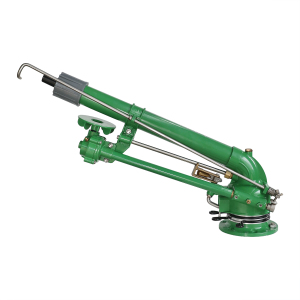 FSN50 rain gun sprinkler: 2" flange connection, 0.2–0.7 MPa working pressure, 26–53 m range, 24° spray angle, 360° adjustable rotation.
Reading a Rain Gun Performance Table Correctly
Performance tables published for these models follow a single structure: nozzle diameter (D or U, in mm), working pressure (P, MPa), flow rate (Q, m³/h) and throw or radius (G, m). The row that matters is the one matching the pressure actually available at the sprinkler during operation — not the highest pressure printed in the table.
| FSN50 nozzle diameter | Working pressure | Flow rate | Throw diameter |
|---|---|---|---|
| 16 mm | 0.2 MPa | 17.8 m³/h | 26 m |
| 20 mm | 0.5 MPa | 40.3 m³/h | 43 m |
| 26 mm | 0.7 MPa | 80 m³/h | 56 m |
Two practical consequences follow. First, because pressure is lost between the pump and the nozzle through hose, fittings and elevation, a pump curve cannot be read directly as nozzle pressure; the working pressure should be confirmed at the machine. Second, because flow rises with pressure, the pump, mainline and hose must be sized for the highest flow that the selected nozzle and pressure combination will demand, not for the average of the field season.
Certification as a Procurement Filter: ISO 9001:2015
FOISON sprinkler irrigation equipment is certified to ISO 9001:2015 quality management system standards. The certificate number is 28725Q042R0S, issued by Zhongzheng Excellent Certificate Group Co., Ltd. The applicable standard is GB/T 19001-2016 idt ISO 9001:2015, the certified scope is the production of sprinkler irrigation equipment, the certificate applies to the Global market, and it is valid from 2025-05-29 to 2028-05-28.
The certification covers three named products: the FS40 irrigation sprinkler, the FS35 irrigation sprinkler and the FSW40 Pro agriculture sprinkler.
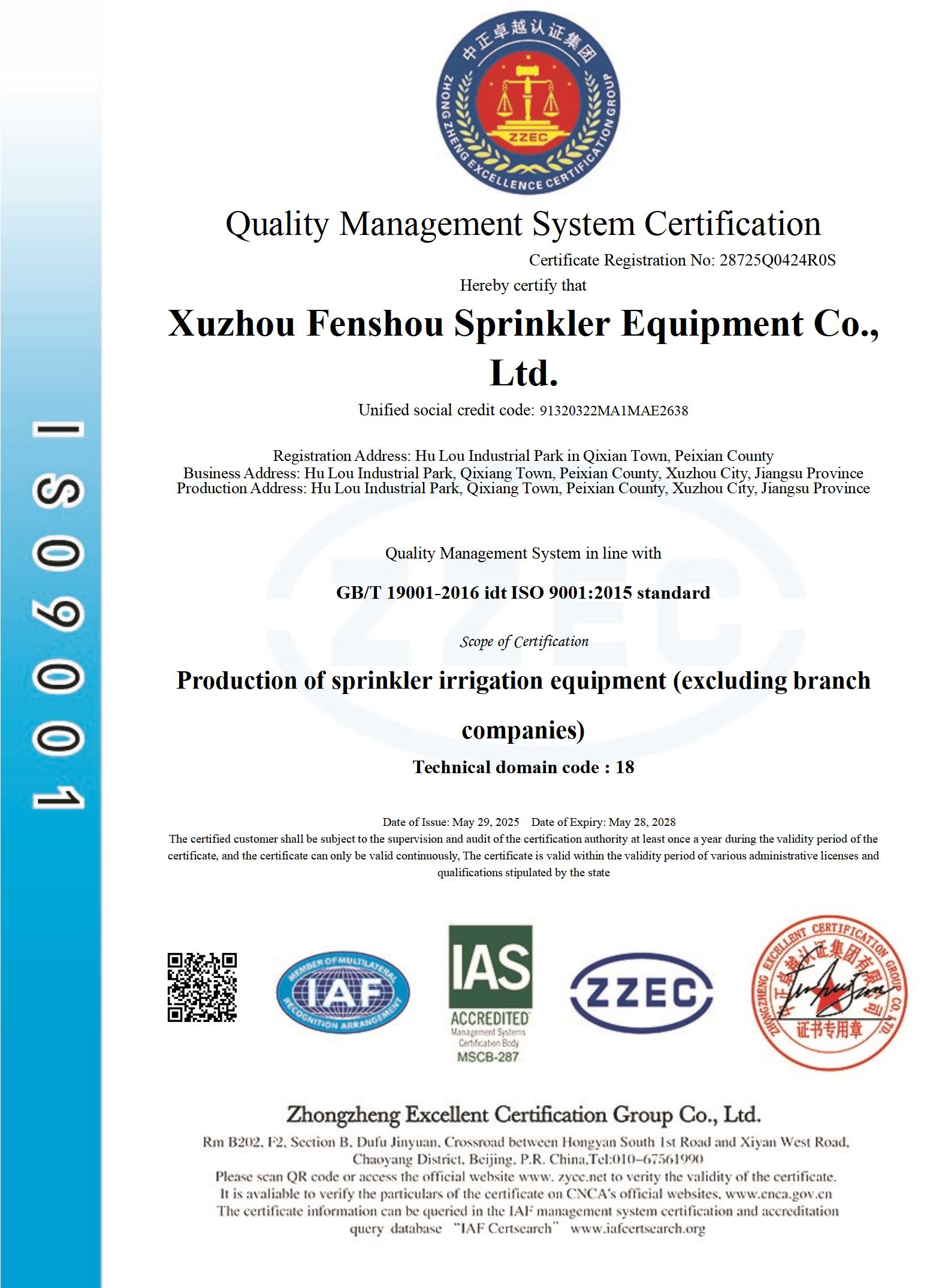 ISO 9001:2015 certificate 28725Q042R0S, issued by Zhongzheng Excellent Certificate Group Co., Ltd., covering the production of sprinkler irrigation equipment under GB/T 19001-2016 idt ISO 9001:2015.
Manufacturing and Supply Constraints to Plan Around
Xuzhou Foison Sprinkler Irrigation Equipment Co., Ltd. was founded in 2013 in Xuzhou, Jiangsu Province — an established irrigation manufacturing base in China. The company operates a site of approximately 30,000 m² with 135 employees and an R&D team of 12 engineers, produces an annual output of 200,000 units, and offers more than 100 product varieties. Its core products are turbine spray guns, impact guns and irrigation systems, all developed in-house; the design work includes turbine spray gun development, adjustable nozzle angle and adjustable rotation speed, and irrigation systems can be designed to customer requirements. Around 70% of output is exported, with main markets in the EU, Africa, Australia, New Zealand, South East Asia, Mid Asia, Mid East and South America, and products sold to more than 30 countries and regions.
Commercial and quality constraints are equally specific and verifiable: OEM/ODM production, customization of model, logo, function and shape, a monthly capacity of 50,000 units, a lead time of within 20 days, a minimum order quantity of 20 units, 100% product testing, and after-sales support delivered remotely.
Application Fit: What Sprinkler Irrigation Requires On Site
FOISON Sprinkler irrigation equipment is applied in agriculture irrigation and industrial dust removal, with a use scope covering agriculture, forestry, garden and urban greening. Operation is pressure-driven: water is pumped to the sprinkler and discharged by water pressure, with a pump and hose as the matched equipment. The stated working condition is an adequate water resource, and the equipment can operate in ambient conditions up to 50°C.
The single most common pre-purchase constraint is therefore not the sprinkler itself but the water supply behind it. A site with limited water volume per hour, or with a pump that cannot sustain the lower end of the chosen model's pressure range, will not obtain the published flow and throw figures regardless of which gun is fitted. This is why specification review should begin with the water source and pump curve, and only then move to model selection.
A Documented Field Result: Fixed Sprinkler Irrigation in New Zealand
One New Zealand customer operating 500 units of FS35 irrigation sprinklers for farm irrigation over a two-year period recorded a fixed sprinkler irrigation installation covering 150,000 m² of vegetable farm, with 55% water savings and 60% labour savings. The customer's own summary of the installation highlighted roughly 50% savings in energy and labour as the main operational benefit of moving from portable irrigation to a fixed system.
The relevance for buyers is not the savings figure itself but the configuration logic behind it: fixed placement, a matched pump and hose set, and a sprinkler model selected for a radius and flow that suited the plot. The same logic can be reverse-engineered on any farm of comparable geometry.
Sprinkler, Drip and Micro Spray: Where the Boundary Lies
Compared with micro spray pipe and drip pipe, sprinkler irrigation is characterised as covering a large area, being easy to operate, and saving cost and water. That comparison is not universal, and the same application guidance is explicit about it: inside greenhouses, small plastic sprinklers or micro spray pipe are recommended, while metal sprinklers are recommended for outdoor farms. Buyers should also note that the larger models in this range are specified up to 0.9 MPa working pressure, which places a genuine requirement on pump and hose selection — not every pump and hose set assembled for low-pressure irrigation will be suitable for a large rain gun.
| Situation | Approach indicated by the application data | Constraint to confirm before ordering |
|---|---|---|
| Outdoor farm, open field | Metal sprinklers and rain guns (FS35, FS40, FSW40 Pro, FSC50, FSN50, FSW80) | Adequate water resource, matched pump and hose, working pressure available at the sprinkler |
| Greenhouse or confined growing space | Small plastic sprinkler or micro spray pipe | Limited throw distance and enclosed geometry |
| Large-area vegetable farm | Fixed sprinkler irrigation (documented with FS35 across 150,000 m²) | Coverage plan and pump capacity for the chosen nozzle |
| Industrial dust suppression | Models whose use scope includes dust removal (FSN50, FSC50, FSW80; FSW40 Pro includes industrial dust removal) | Water supply and delivered pressure for spray atomisation |
Selection logic summarised from FOISON Sprinkler application and comparison data. Model suitability should always be confirmed against the site's pressure and water capacity.
A Procurement Checklist for Sprinkler Irrigation Equipment
- Water source capacity: confirm the volume available per hour, not just the presence of a well, canal or reservoir.
- Pressure at the sprinkler: measure or calculate the working pressure at the machine, allowing for hose and fitting losses, and compare it with the model's stated range.
- Nozzle size: specify it on the order — flow and throw are nozzle-dependent on every model in this range.
- Required radius: match the largest radius the plot needs to the published range or radius, rather than buying the largest available gun.
- Connection standard: 80 flange, 2" flange, 2" inner thread, 2" thread or 1-1/2" female thread — decided before pipework.
- Mounting: fixed installations require different planning from portable, hand-moved sets.
- Material exposure: aluminium, copper, stainless steel and nylon components suit outdoor and industrial conditions; plastic sprinklers suit lighter duty and greenhouse use.
- Use scope: irrigation, forestry, urban greening and dust removal are covered by different models in the range.
- Documentation: request the certificate number, scope statement and covered model list, and check the validity window.
- Ordering terms: minimum order quantity of 20 units, lead time within 20 days, 100% testing.
- Spares: nozzles and service parts planned at the time of purchase, particularly where after-sales support is remote.
- Customization: OEM/ODM options cover model, logo, function and shape for distributors and brand owners.
Market Trends Shaping Irrigation Equipment Demand
Water and labour efficiency continue to dominate irrigation purchasing decisions in agriculture, and the direction of that pressure is consistent across markets: fixed and semi-permanent installations are increasingly preferred where labour availability is constrained or seasonal, because they transfer the work from people to a pump and a pressure line. The New Zealand installation described above is a small but concrete example of that shift.
A second trend is the widening of the term irrigation equipment itself. Several models in this range list dust removal alongside agriculture, forestry, garden and urban greening in their use scope, which reflects growing demand for the same hardware in industrial and municipal dust-suppression duty. Buyers in those segments increasingly evaluate sprinklers on atomisation, pressure stability and water supply rather than on agricultural coverage alone.
A third trend is documentation-led sourcing. With export-oriented manufacturers selling into the EU, Africa, Australia, New Zealand, South East Asia, Mid Asia, Mid East and South America, buyers are comparing suppliers on verifiable evidence — certificate numbers, certified scope, standard references and test regimes — rather than on brand claims alone. Quantified market forecasts vary widely by source and are not reproduced here; the structural drivers above are those visible in specification, certification and application data.
Future Outlook
The constraint logic that governs sprinkler selection is unlikely to change: pressure, nozzle, flow, throw, connection and water supply will still determine whether an installation performs. What is changing is how early those constraints are verified. Published performance tables, certificate scope statements and application conditions allow buyers to filter suppliers before an order is placed, and procurement teams are increasingly treating those documents as part of the specification rather than as supporting paperwork.
For manufacturers, that shift favours suppliers who can state pressure ranges, nozzle-specific flows and certification boundaries precisely. For buyers, it means the difference between a system that delivers the documented 55% water saving and one that quietly underperforms is usually decided in the specification review, not in the field.
Frequently Asked Questions
- What working pressure do FOISON Sprinkler rain guns require?
- It depends on the model. The FSN50 turbine sprinkler operates between 0.2 and 0.7 MPa, the FSC50 impact gun between 0.15 and 0.7 MPa, the FSW80 turbine gun between 0.2 and 0.9 MPa, the FSW40 Pro between 0.2 and 0.5 MPa, the FS35 impact sprinkler between 0.2 and 0.6 MPa, and the FS40 agriculture sprinkler between 0.15 and 0.5 MPa. Published flow and throw figures are valid only within the stated range, so the pressure available at the sprinkler — not the nominal figure on the pump — governs performance.
- What equipment must be in place before a sprinkler irrigation system will operate?
- A sufficient water resource, a pump and a hose are the matched equipment specified for FOISON Sprinkler irrigation applications. Operation is pressure-driven: water is pumped to the sprinkler and discharged by water pressure. The stated working condition is an adequate water resource, and the equipment can operate in ambient conditions up to 50°C.
- How do the FS35 impact sprinkler and the FSN50 turbine sprinkler differ?
- The FS35 uses a 1-1/2" female thread connection, operates at 0.2–0.6 MPa, and has a spray radius of 18–36 m with a flow of 7.8–31.9 m³/h. The FSN50 uses a 2" flange connection, operates at 0.2–0.7 MPa, and has a range of 26–53 m; at 0.7 MPa with a 26 mm nozzle it reaches 80 m³/h and a 56 m maximum throw diameter. Both use a 24° spray angle and 360° adjustable rotation.
- Which products are covered by the ISO 9001:2015 certificate?
- Certificate 28725Q042R0S, issued by Zhongzheng Excellent Certificate Group Co., Ltd., covers the production of sprinkler irrigation equipment and names the FS40 irrigation sprinkler, the FS35 irrigation sprinkler and the FSW40 Pro agriculture sprinkler. It applies to the Global market, follows the GB/T 19001-2016 idt ISO 9001:2015 standard, and is valid from 2025-05-29 to 2028-05-28. It does not automatically extend to other models in the range.
- Is sprinkler irrigation suitable for greenhouse use?
- Application guidance for these products recommends small plastic sprinklers or micro spray pipe inside greenhouses, and metal sprinklers for outdoor farms. The same guidance characterises sprinkler irrigation as covering a large area, being easy to operate, and saving cost and water compared with drip and micro spray options — characteristics that generally suit open-field and large-area installations more than confined growing spaces.
- Can the same sprinkler be used for irrigation and dust suppression?
- Several models list dust removal within their use scope. The FSN50, FSC50 and FSW80 are specified for agriculture, forestry, garden and dust removal, and the FSW40 Pro's use scope adds industrial dust removal. Performance in dust suppression depends on the same constraints as irrigation: available water, delivered pressure and nozzle selection.
- What are the ordering constraints for FOISON Sprinkler equipment?
- Production is OEM/ODM, with customization available for model, logo, function and shape. Monthly capacity is 50,000 units, lead time is within 20 days, the minimum order quantity is 20 units, products are 100% tested, and after-sales support is provided remotely.
Reference Documents
Have Questions or Need More Details?
Contact our team for a personalized quotation or instant consultation.
Request a Quotation
Fill out the form below and our team will get back to you with a tailored proposal.
WhatsApp Direct Chat
Prefer to chat in real-time? Message us on WhatsApp for instant assistance & quick answers.
- Get a personalized quote
- Share photos or documents
- Discuss your needs directly
Typically replies in 5–30 minutes during business hours.