
Sprinkler Supplier Audit: 30,000 m², 135 Staff, FS35–FSW80
Sprinkler Supplier Audit: 30,000 m², 135 Staff, FS35–FSW80
A factory visit produces impressions. An audit produces clauses. Between the evaluation stage and the execution stage, a sprinkler buyer has usually accepted that a supplier is plausible; what remains is deciding which claims can be written into a purchase order as pass-or-fail terms. For FOISON Sprinkler, the trading name of Xuzhou Foison Sprinkler Irrigation Euipment Co.,Ltd, the documented facts are concrete enough to audit: founded in 2013, a 30,000 m² factory in Pei County Industry Area, Xuzhou City, Jiangsu Province, 135 employees, 12 engineers in research and development, and a stated annual output of 200,000 units.
None of those numbers, taken alone, tells a buyer whether an FS35 or an FSW80 will arrive to specification. They become useful only when each one is attached to something a buyer can check and convert into a term. This article sets out that conversion: which evidence classes matter at plant-audit level, how the six-model lineup changes the documentation burden, and where a certificate, a capacity figure or a single field case stops being proof.
The three tests that separate audit evidence from presentation material
Evaluation material is built to be compared; audit material is built to be relied on. Three tests do most of the sorting work:
- Site-checkable: can the claim be confirmed at a named address, on a named day, by someone standing in the plant?
- Model-specific: does the evidence attach to the model actually being ordered, rather than to the company in general?
- Contract-ready: can it be written as a measurable acceptance item without further interpretation?
A claim that fails all three is not necessarily false. It is simply unusable in an order. The framework below applies the three tests to five evidence classes that a sprinkler plant audit normally covers: site and identity, design control, capacity and scheduling, quality and acceptance, and commercial terms.
What one plant must support across FS35, FS40, FSW40 Pro, FSN50, FSC50 and FSW80
A six-model lineup creates a documentation risk that a single-model audit does not. Evidence gathered for one model is often assumed to cover the others, and that assumption is where acceptance disputes begin. Model identity discipline is the corrective: each ordered model should have its own current datasheet, its own drawing revision, and a test record that names the model rather than the product family.
The supplier's own records already operate at product-line level in places. Purchase and delivery terms in the supplied material are attached to product records 8917 (FS35), 8863 (FS40) and 8918 (FSW40 Pro), and the quality management record lists FSW40 Pro, FS35 and FS40 among related products. That is a workable starting point, not a finished file. For FSN50, FSC50 and FSW80, the audit should request the same model-level statement — terms, datasheet revision and test method — instead of inferring it from a sister model.
A simple rule keeps the file honest: the audit is complete only when every model in the order has a page of its own. The supplier states a range of more than 100 product varieties, with turbine spray guns, impact guns and irrigation systems as core products, so the six-model question is a question about file depth, not about plant breadth.
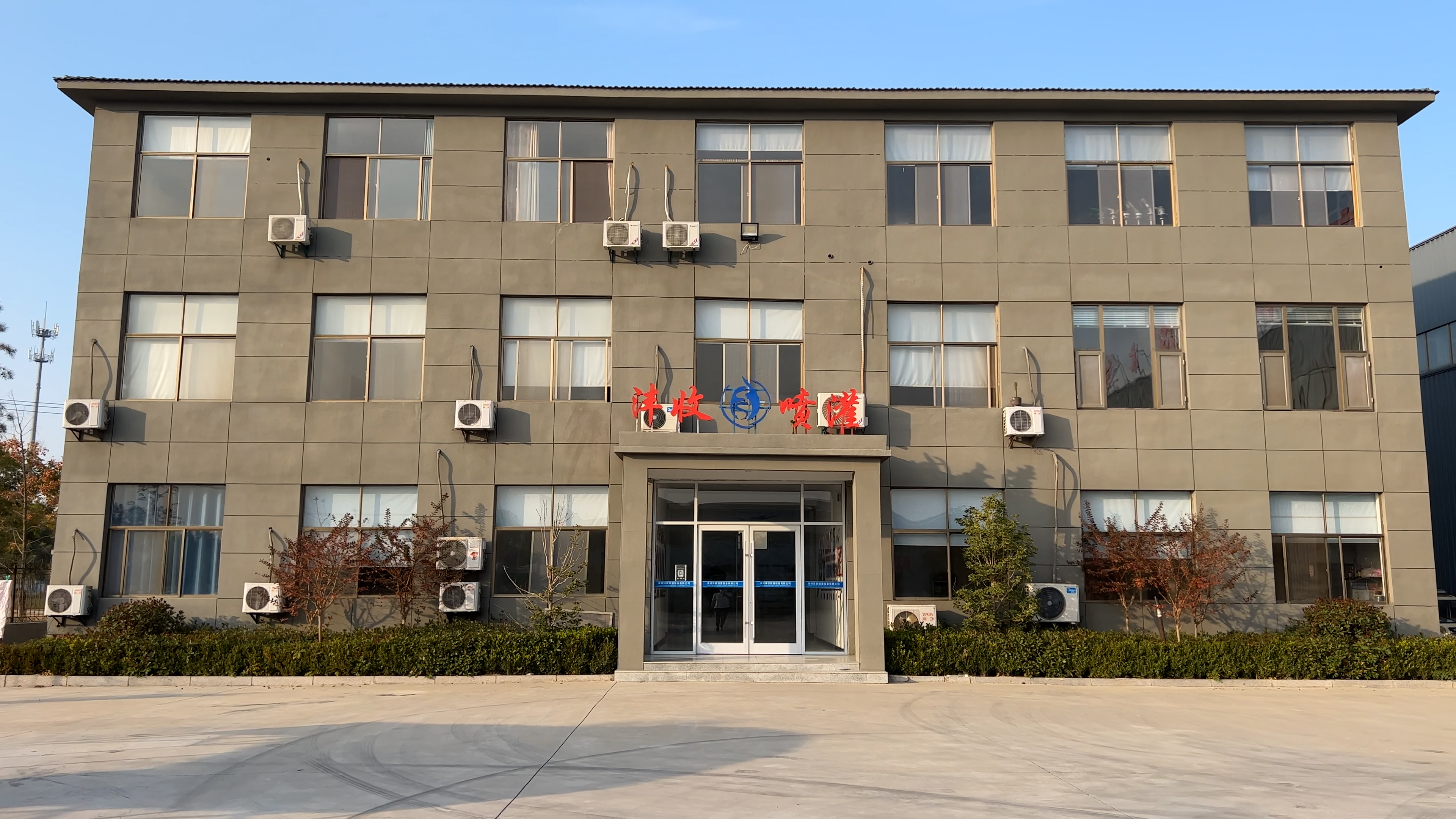
Company office building at the supplier's Pei County Industry Area site (supplier-provided image).
Site evidence: what 30,000 m² and 135 employees can and cannot confirm
Two figures anchor the site visit: 30,000 m² of factory area and 135 employees at Pei County Industry Area, Xuzhou City, Jiangsu Province. What they establish is limited but real — a manufacturing site exists at a stated address, at a stated scale, with a workforce large enough to be observed and interviewed.
What they do not establish is output, quality or model-specific capability. Covered area can hold warehousing as easily as production, and headcount says nothing on its own about how many people touch quality control. The audit converts the numbers into observations:
- Address consistency. Check that the contract, commercial invoice, certificate records and shipping documents all name the Pei County Industry Area site. A mismatch between the audited address and the invoicing entity is a documentation issue that is cheaper to fix before deposit than after.
- Area allocation. Ask for a simple site plan marking production, assembly, warehousing, testing and showroom space, then walk it. The productive question is not whether 30,000 m² exists, but how much of it serves the process that will make this order.
- Workforce distribution. With 135 employees, ask how many work in production, in quality control and in packing. The supplier states 100% test as its quality control position, and any full-inspection claim is labour-dependent, so headcount distribution is a direct check on it.
- Shift pattern. Single-shift and multi-shift operations imply different capacity and different supervision. Record what is observed rather than what is described in a meeting room.
Design control: 12 engineers and the turbine spray gun claim
Design capability is the easiest attribute to over-credit and one of the easiest to verify. The supplier states that products are developed in-house, that it holds patents covering turbine spray gun design elements including adjustable nozzle angle and adjustable speed, and that it can design an irrigation system to a customer's requirement. Engineering headcount is stated as 12 engineers.
The audit question is not whether the plant employs designers, but whether design changes are controlled. Four items belong in the request list:
- Drawing ownership. Which entity owns the drawing for the ordered model, and who signs a revision?
- Change control. The stated customization scope is model, logo, function and shape. Ask what happens to a test record when function or shape changes: is the model re-tested, and is the new revision dated?
- Patent scope. Ask which models the claims actually cover. Patent protection on a turbine spray gun design is not, by itself, evidence about the FSN50 or the FSW80.
- System design inputs. The supplier offers irrigation system design to customer requirements. Ask for a worked example of the input data it needs — plot layout, water source, operating pressure — and confirm who approves the final layout.
Item three is the one buyers most often skip. A design claim that is real but model-limited is still valuable; a design claim that is silently stretched across a six-model lineup is a specification risk.
Capacity arithmetic: 200,000 units a year, 50,000 units a month, 20-day lead time
Three capacity statements appear in the supplier material, and they are not the same measurement. Annual output is stated at 200,000 units. Monthly capacity under the OEM/ODM programme is stated at 50,000 units. Lead time is stated as within 20 days, against a minimum order quantity of 20 units.
Each answers a different question. Annual output describes what the plant states it produces across a year; monthly capacity describes what the programme states it can absorb within a month; lead time describes the interval the supplier commits to for a given order. A buyer who treats the three as interchangeable will mis-set a reorder point or over-commit a seasonal programme.
Useful verification questions, all answerable in writing before a deposit:
- Under what configuration is the monthly capacity figure measured, and does it apply to the ordered model?
- Does the 20-day lead time run from deposit, from artwork or sample approval, or from order confirmation?
- Which of the six models carries the longest lead time in practice?
- How is capacity allocated between domestic orders and export orders, given a stated export share of 70%?
That export share is itself an audit item. The stated markets are the EU, Africa, Australia, New Zealand, South East Asia, Mid Asia, the Middle East and South America, with exports reaching more than 30 countries and regions. Destination documentation differs by market, so the audit should ask which documents the supplier has already produced for the buyer's destination rather than assuming an export record in one region transfers to another.
Quality and acceptance: what a pre-shipment test has to contain
The stated quality position is 100% test, and acceptance inspection includes a pre-shipment test. Both statements are directionally useful and both need definition before they become contractual, because a test controls quality only when it measures named parameters, uses a stated method and produces a record the buyer receives before paying the balance.
Four points are worth pinning down in the audit:
- Parameter list. Which characteristics are measured on every unit and which on a sample. Pressure, flow, rotation behaviour, spray pattern and connection integrity are the usual candidates; the specific limits must come from the approved datasheet for the ordered model rather than a general catalogue.
- Method and instrument. What equipment is used, when was it last calibrated, and who records the reading.
- Record format. Whether the buyer receives a per-batch or per-unit record, and whether that record names the model and batch.
- Hold point. Whether the test is performed before packing, and whether the buyer or its nominated agent can witness it.
The last point links directly to commercial terms. With payment structured as 30% deposit and 70% before shipment, the pre-shipment inspection window is the buyer's main point of control. An inspection that takes place after packing, or a record that arrives after the balance is paid, removes that control without removing the risk.
Commercial terms: 20-unit MOQ, 30/70 payment, FOB, CIF or DDP
The stated terms are compact: minimum order quantity 20 units, delivery by FOB, CIF or DDP, payment of 30% deposit with 70% before shipment, and a pre-shipment test within acceptance inspection. Read together rather than separately, they describe a workable first-order structure.
The 20-unit minimum makes a trial order practical, which matters when a buyer wants physical samples from a six-model lineup before committing a season to one supplier. The delivery options shift control in ways the audit should record: under FOB the buyer arranges the main carriage; under CIF the supplier arranges carriage and insurance to a named port; under DDP the supplier carries the goods through import clearance. Each implies a different document set and a different party responsible for destination compliance.
Two clarifications belong in writing before the first order: whether the 30/70 schedule applies unchanged at the 20-unit minimum, and which Incoterm the quotation actually names, since a change between quotation and contract moves both cost and responsibility. For customs purposes, the classification commonly used for mechanical appliances for projecting, dispersing or spraying liquids in agricultural or horticultural use is HS code 842482, as listed by the United Nations Statistics Division; the audit should confirm the code the supplier will declare, because it drives duty and documentation at destination.
Certification: reading ISO 9001 certificate 28725Q042R0S correctly
Certification is the part of a supplier audit most often handled by file transfer rather than verification. The supplier's quality management system certificate carries enough detail to be checked properly: standard GB/T 19001-2016 idt ISO 9001:2015, certificate number 28725Q042R0S, issued by Zhongzheng Excellent Certificate Group Co., Ltd, scope "Production of sprinkler irrigation equipment", issued 29 May 2025 and valid to 28 May 2028.
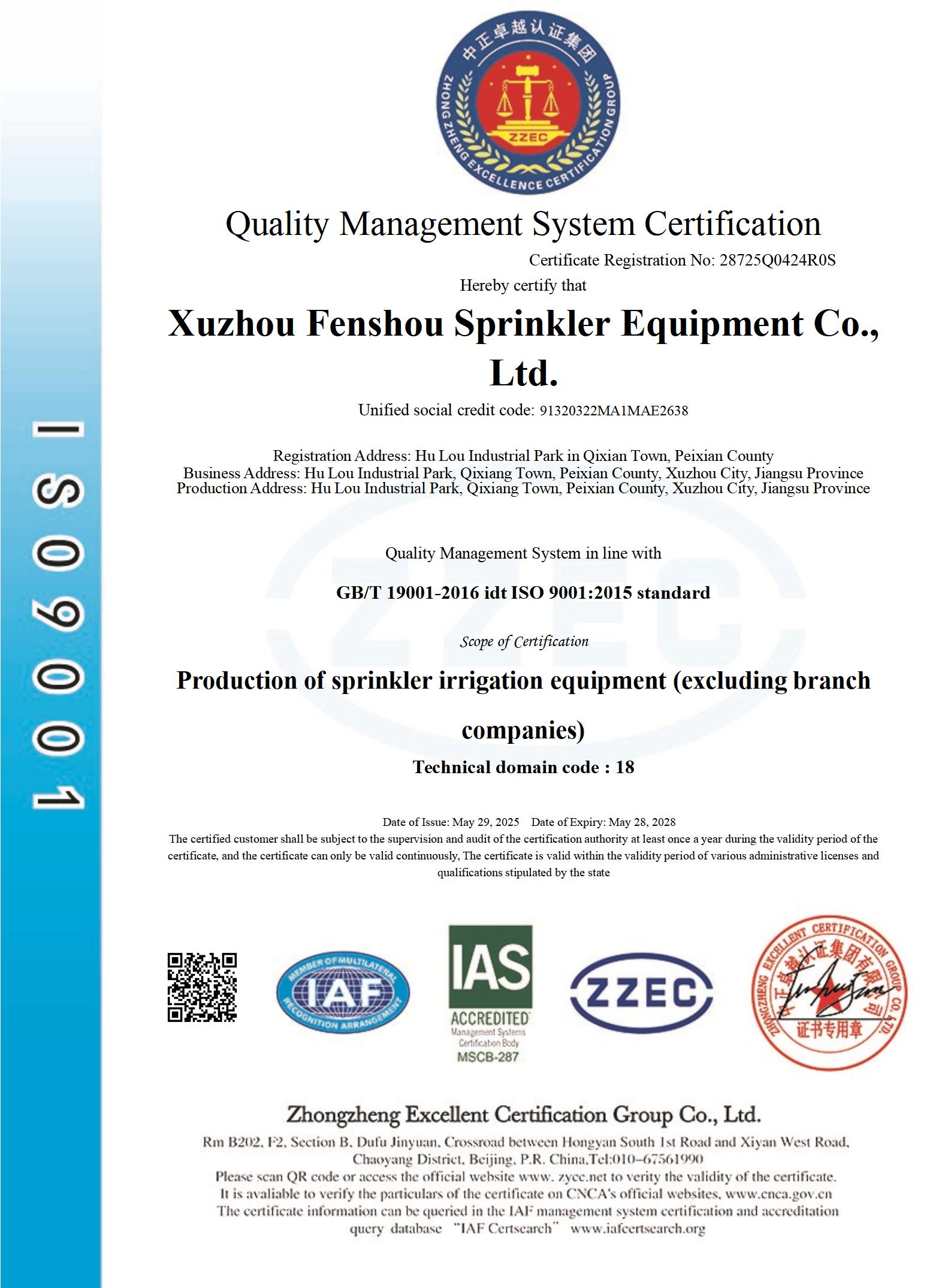
ISO 9001 certificate 28725Q042R0S, issued 29 May 2025, valid to 28 May 2028 (supplier-provided image).
Four checks follow from that detail. First, confirm the certificate number and current status with the issuing body rather than relying on a scanned copy. Second, read the scope wording — production of sprinkler irrigation equipment is a manufacturing scope, which is what a buyer wants to see, but it describes a system, not a product. Third, check the validity window against the planned shipment date; an expiry that falls before delivery is a scheduling item rather than a compliance failure, but it belongs on the audit record. Fourth, check whether the related-product record matches the models ordered: it lists FSW40 Pro, FS35 and FS40, so FSN50, FSC50 and FSW80 need their own place in the model-level file.
Equally important is what ISO 9001 does not do. It certifies a quality management system; it does not certify the performance of a sprinkler. Product-level references sit elsewhere. ISO 7749-1:1995, described by the International Commission on Irrigation & Drainage as specifying design and operational requirements for rotating sprinklers used in agricultural irrigation, belongs to that family of questions. A management-system certificate and conformance with a product standard are separate claims; the audit should request them separately and should not accept one as evidence of the other. This is the practical meaning of auditing without relying on unverified certifications — the certificate is verified as a certificate, and nothing more is claimed for it.
Six-model evidence matrix
The matrix below separates what is documented in the supplied records from what the buyer still has to request. The third column is not a criticism of the supplier; it is the file depth needed before an order can be accepted against measurable terms.
| Model | Documented in supplier records | Evidence to request before the order |
|---|---|---|
| FS35 | Recorded as an irrigation sprinkler, product record 8917; listed in the ISO 9001 related-product record; named in a New Zealand farm project record of 500 units | Current datasheet with revision; pre-shipment test record template; one redacted batch record showing traceability |
| FS40 | Product record 8863; product-level statement of MOQ 20 units, pre-shipment test and FOB/CIF/DDP delivery | Datasheet; test method per parameter; packing specification and carton marking |
| FSW40 Pro | Recorded as an agriculture sprinkler, product record 8918; listed in the ISO 9001 related-product record; product-level delivery terms | Datasheet; change-control record for any customization of model, logo, function or shape |
| FSN50 | Part of the stated lineup; no model-level document in the supplied material | Model datasheet, test record and terms statement issued at model level |
| FSC50 | Part of the stated lineup; no model-level document in the supplied material | Model datasheet, test record and terms statement issued at model level |
| FSW80 | Part of the stated lineup; no model-level document in the supplied material | Model datasheet, test record and terms statement issued at model level |
Application evidence: what a single farm record proves, and what it does not
The most specific field record in the supplied material is a New Zealand project: 500 units of the FS35 supplied to a common customer for farm irrigation, over a two-year period, with fixed sprinkler irrigation reported to cover a 150,000 m² vegetable farm and to save 55% of water and 60% of labour.
Read precisely, this is one project reported by the supplier. It is useful for three reasons: it names a model, it names an application and a scale, and it offers quantified outcomes that can be interrogated. It does not establish typical performance, because the comparison baseline is absent — what the farm used before, what the crop and climate were, how water and labour were metered, and whether the percentages are annual averages or peak-season observations.
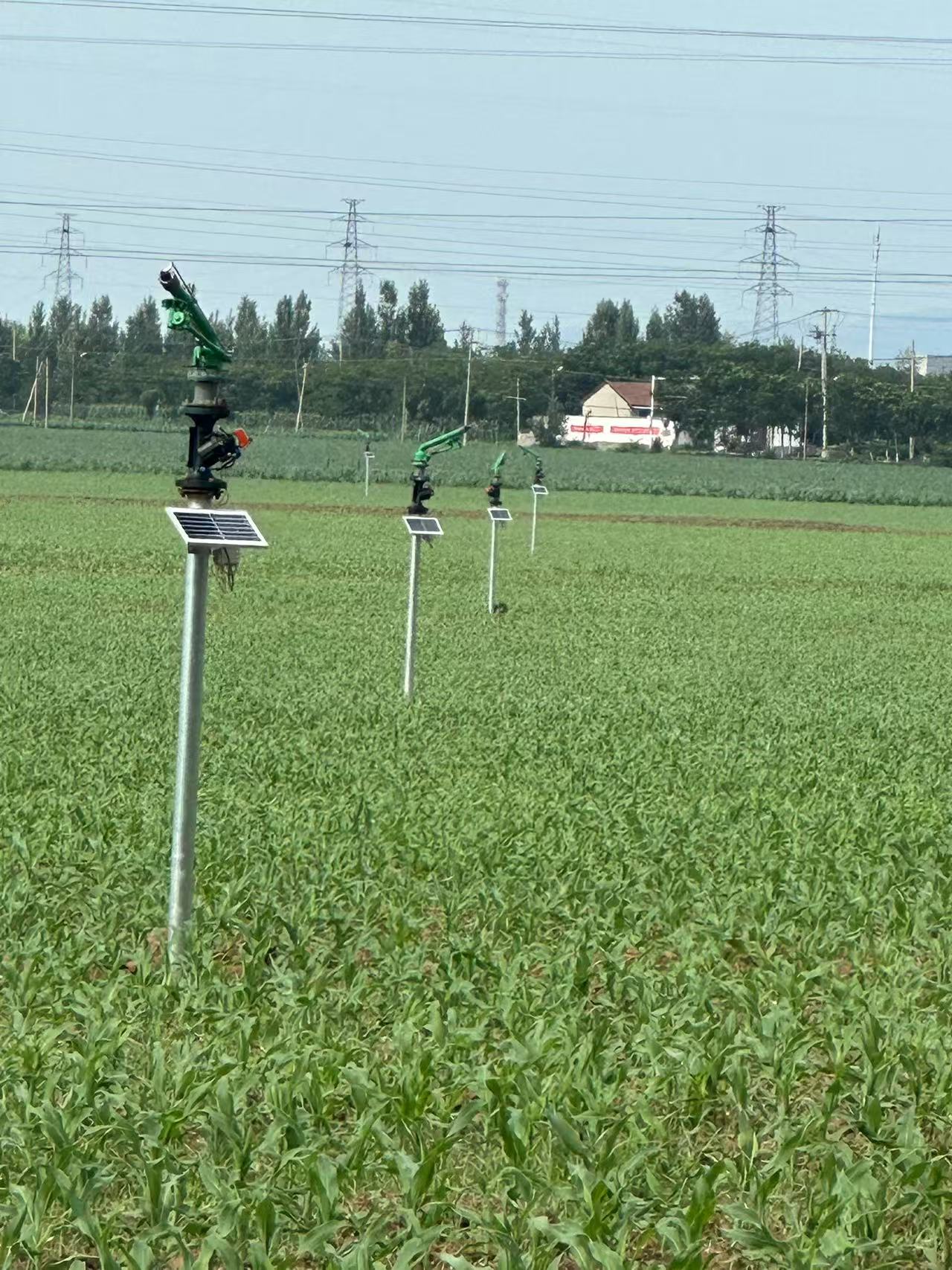
Fixed sprinkler irrigation configuration of the type described in the farm project record (supplier-provided image).
The audit use of the case is as a prompt rather than as proof. Ask for the measurement basis behind the two percentages, and ask whether the same method could be applied to the buyer's own site as a pre-order estimate. If the supplier can describe the method, the case becomes a planning input. If it cannot, the case stays a reference point and should not appear in the acceptance schedule.
The same discipline applies to application categories. The supplier states that its products serve farm and industrial use, and the lineup is offered across agriculture, forestry, greening and industrial spraying contexts. For a buyer, the audit item is not the category label but the model-to-application mapping: which model is proposed for the buyer's plot size, water source and operating pressure, and on what documented basis that proposal was made.
Market context for capacity claims
Third-party figures help a buyer calibrate capacity statements, provided the definitions are respected. Grand View Research valued the global sprinkler irrigation market at USD 3.04 billion in 2025 and put Asia Pacific at a 36.2% revenue share of the agricultural irrigation machinery market in the same year, with China identified as a leading country. IMARC Group sized the global smart irrigation market at USD 2.2 billion in 2025, with a projection of USD 6.2 billion by 2034. These are three different categories — sprinkler irrigation, agricultural irrigation machinery, smart irrigation — and they are not additive.
Growth estimates differ too: one dataset projects a 6.5% compound annual growth rate for sprinkler irrigation over 2026–2033, while another reports 3.04% over 2025–2035, a gap the underlying data attributes to how far smart features are included. The practical lesson for a plant audit is that no headline growth rate should be used to validate a supplier's capacity number. Use the buyer's own forecast, ask the supplier to map it against the stated monthly capacity, and treat market reports as category context rather than as evidence about one factory.
A one-day audit agenda
The agenda below assumes a single day on site and a follow-up document review. It is sequenced so that documents are requested before the visit, observations are recorded during it, and the file is scored afterwards.
- Before the visit. Request the ISO 9001 certificate copy with number and validity dates; datasheets with revision numbers for each of the six models; the pre-shipment test record template; the product-level terms statement; a site plan; one redacted batch record; and confirmation of the HS code to be declared.
- Opening session. Ask the supplier to state, in one page, what it considers its strongest verifiable capability and what it does not claim. The second half of that question is more informative than the first.
- Site walk. Confirm the address; observe the allocation of production, assembly, warehousing, testing and showroom space; note the number of visible workstations and the shift pattern in operation that day.
- Test observation. If a pre-shipment test can be scheduled, watch it. Record the parameters measured, the instrument used, the person recording the result, and whether the record is generated before packing.
- Design interview. Establish who owns the drawing, who signs a revision, and what re-testing follows a change in function or shape.
- Close-out. List every claim discussed as verified on site, stated but unverified, or not addressed. Only the first category goes into the acceptance schedule.
Limits of this framework
An audit of this kind verifies existence, consistency and documentation discipline. It does not verify field performance, and it does not replace a trial order. Five limits belong in the audit file in plain language:
- Site scale and headcount describe a plant, not an output rate or a defect rate.
- A single two-year farm record is a reference point, not a performance guarantee, and its baseline conditions were not supplied.
- The ISO 9001 scope covers a quality management system for sprinkler irrigation equipment production; it says nothing about conformity with a product standard such as ISO 7749-1:1995.
- Capacity statements need programme-level confirmation, since annual output, monthly capacity and lead time describe different things.
- No independent laboratory test data accompanied the supplied material, so product-level test reports remain an open request item for every model in the order.
Recording these boundaries protects both sides. It keeps the clauses specific, and it prevents a buyer from later treating an audit finding as something it was never designed to be.
Frequently asked questions
What OEM and ODM capability does the supplier state?
The stated production mode is OEM/ODM, with customization available across model, logo, function and shape. Supporting statements include in-house product development, 12 engineers, patented turbine spray gun design elements such as adjustable nozzle angle and adjustable speed, and the ability to design an irrigation system to a customer's requirement. Stated capacity is 50,000 units per month, with a lead time within 20 days and a minimum order quantity of 20 units.
Which models does a plant audit cover?
The lineup named for this audit is FS35, FS40, FSW40 Pro, FSN50, FSC50 and FSW80. Product records exist for 8917 (FS35), 8863 (FS40) and 8918 (FSW40 Pro), and the ISO 9001 related-product record lists FSW40 Pro, FS35 and FS40. Model-level datasheets, test records and terms statements should be requested separately for FSN50, FSC50 and FSW80 rather than inferred from other models.
What are the stated purchasing terms and acceptance criteria?
The minimum order quantity is 20 units. Delivery is arranged through FOB, CIF or DDP methods. Acceptance inspection includes a pre-shipment test. Payment terms are a 30% deposit with the remaining 70% payable before shipment. These terms appear at product-line level for the referenced models, which is why the audit recommends confirming them in writing against the specific model and quantity ordered.
How is quality control described, and which certificate supports it?
Quality control is stated as 100% test. The quality management system certificate is number 28725Q042R0S, issued by Zhongzheng Excellent Certificate Group Co., Ltd against GB/T 19001-2016 idt ISO 9001:2015, with the scope "Production of sprinkler irrigation equipment", issued 29 May 2025 and valid to 28 May 2028. Verification means checking that number and status with the issuing body and confirming the scope and validity dates against the planned shipment.
What should a buyer verify on site that documents cannot show?
Four things are better seen than read: how the 30,000 m² is divided between production, warehousing and testing; how the 135 employees are distributed across production, quality control and packing; whether test equipment is present and calibrated; and whether the pre-shipment test can be witnessed before packing rather than after. A redacted batch record, checked against a unit on the line, confirms more about traceability than a written procedure alone.
Conclusion: the deliverable is a clause list, not a scorecard
A plant audit of a 30,000 m², 135-employee sprinkler factory ends with an unglamorous document: a list of claims that survived verification, each paired with a test, a record or a document that will exist before the balance payment is released. For Xuzhou Foison Sprinkler Irrigation Euipment Co.,Ltd, the auditable surface is substantial — a 2013 founding, a defined site in Pei County Industry Area, 12 engineers, OEM/ODM customization across model, logo, function and shape, a verifiable ISO 9001 certificate with a stated scope and validity window, and purchase terms that include a 20-unit minimum, FOB/CIF/DDP delivery and a pre-shipment test.
The open items are equally specific: model-level documents for FSN50, FSC50 and FSW80; a defined pre-shipment test with named parameters; confirmation of how annual output, monthly capacity and the 20-day lead time relate to a particular order; and product-standard test evidence that is separate from the management-system certificate. Buyers who close those items before the first deposit convert a plausible supplier into a governed one. Buyers who skip them inherit a relationship managed by memory and goodwill, which is a poor substitute for a clause.
Product documentation covering the six-model lineup is available in the supplier's catalogue (PDF), and the company site is at foison-irrigation.com.
Have Questions or Need More Details?
Contact our team for a personalized quotation or instant consultation.
Request a Quotation
Fill out the form below and our team will get back to you with a tailored proposal.
WhatsApp Direct Chat
Prefer to chat in real-time? Message us on WhatsApp for instant assistance & quick answers.
- Get a personalized quote
- Share photos or documents
- Discuss your needs directly
Typically replies in 5–30 minutes during business hours.