
Sprinkler Supplier Capability Evidence: 30,000 m² Factory
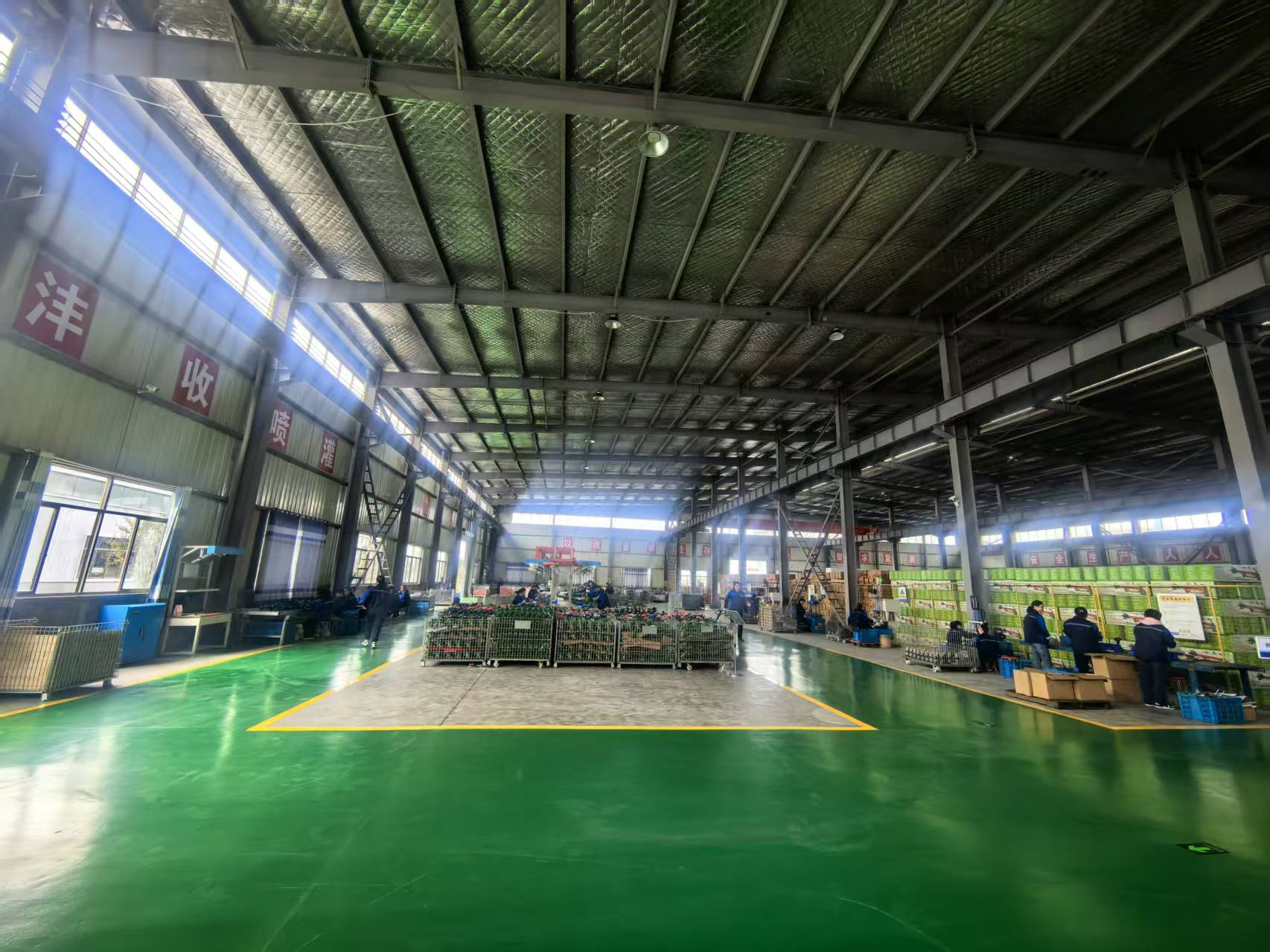
A sprinkler supplier's workshop is one of the few capability claims a buyer can verify on site. Image: FOISON Sprinkler manufacturing facility.
Capability claims in sprinkler sourcing are usually published in the same document as the sales pitch, which is exactly why they are hard to trust. The numbers that matter — 30,000 m² of manufacturing space, approximately 135 staff, a 12-engineer R&D team and 200,000 units of annual output — only become useful once a buyer knows what each figure proves and what it leaves open.
FOISON Sprinkler is the brand under which Xuzhou Foison Sprinkler Irrigation Equipment Co., Ltd. manufactures and exports irrigation spray guns and irrigation equipment. The company was established in 2013 and operates from Pei County Industry Area, Xuzhou City, Jiangsu Province, China 221622. Its published capability profile is specific rather than general: a 30,000 m² manufacturing facility, roughly 135 employees, a 12-engineer R&D team, annual production capacity of 200,000 units, and an export share of about 70% of sales. This article treats each of those figures as a verification item and maps them to the gun models a wholesale or OEM buyer would actually order.
Quick answer: what each capability number proves
For buyers in the research stage, the fastest way to use a supplier's capability data is to sort it into what it demonstrates and what it does not establish.
| Capability fact | What it demonstrates | What it does not establish |
|---|---|---|
| 30,000 m² facility | Space for material storage, assembly, finished-goods staging and packing within one site | Automation level, per-line output, number of assembly stations |
| Approximately 135 staff | An organisation sized for in-house manufacturing and support functions | Output per employee, inspection staffing, certification scope |
| 12 R&D engineers | In-house design capability for gun geometry, nozzle and adjustable mechanisms | The exact number and scope of granted patents |
| 200,000 units annual capacity | Production organised around volume orders and repeat programmes | A guaranteed delivery date for one specific order |
| 70% export share | Routine experience with multiple import markets and their paperwork | Market-specific certification for a given model in a given country |
Why sprinkler buyers verify before they shortlist
The global sprinkler irrigation market was valued at USD 3.04 billion in 2025, according to Grand View Research. In the same year, Asia Pacific held the largest revenue share of the agricultural irrigation machinery market at 36.2%, with China as the leading country, according to the same publisher. IMARC Group places the global smart irrigation market at USD 2.2 billion in 2025 and projects USD 6.2 billion by 2034.
Those are orientation figures, not precise forecasts. They come from different research houses that include different components, and the divergence is visible in the growth estimates: published compound growth projections for sprinkler irrigation range from roughly 3% to around 6.5%, depending on how much of the "smart" feature set is counted. Buyers should read market size as a direction signal and apply the same discipline to supplier-specific data — check what is measurable, then check what is missing.
The practical consequence is that a sprinkler sourcing decision rarely fails on published specifications alone. Gun models with similar pressure and range are widely available. What separates suppliers in a wholesale or OEM programme is whether the plant behind the model can absorb a repeat order, hold a material specification across batches, and produce paperwork that clears customs in more than one region.
The 30,000 m² facility: what floor space proves about order handling
Floor area is the first capability number a visiting buyer can physically walk through, and it answers a narrow but important question: can this supplier hold raw material, work in progress and finished goods without collapsing the production flow?
The company documents its operations through facility imagery covering a workshop, a working line, a showroom, a packing area and an accessories store. Combined with a 30,000 m² site, that points to a plant organised into distinct functional zones rather than one shared hall. The separation matters in sprinkler manufacturing because gun bodies use aluminium alloy, copper, stainless steel and nylon components that need to be staged, assembled and packed without cross-contamination of the finish.
The boundary: floor area is not automation, and it is not throughput. A 30,000 m² site says nothing about how many units a single line completes per shift. Buyers should treat the footprint as one input and ask separately for line-level output, the number of assembly stations, and how quality inspection is staffed.
135 staff and 12 R&D engineers: reading headcount as design capacity
Headcount tells a buyer how much of the manufacturing process is genuinely in-house. A company of approximately 135 people supporting a 30,000 m² facility is sized for production, assembly, inspection and shipment functions rather than for trading and repackaging alone. That distinction matters when a buyer needs a specification held across several repeat orders.
The more decision-relevant figure for OEM buyers is the 12-engineer R&D team. The company states that its products are developed in-house, that its design work covers the turbine spray gun including adjustable nozzle angle and adjustable speed, and that it can design irrigation systems to a customer's requirement. For a buyer specifying a private-label gun or a custom system layout, that is the capability determining whether a request can be engineered rather than only assembled.
The boundary: headcount does not indicate certification scope. The company states that it holds patents and develops its products itself; the published capability data reviewed here does not itemise patent numbers or map certifications to individual models. An OEM buyer should request the specific documents rather than infer them from team size.
200,000 units of annual output: turning capacity into order questions
Annual production capacity of 200,000 units is the clearest volume signal in the company's profile, and it is corroborated by third-party reference data describing FOISON Sprinkler as a manufacturer specialising in turbine spray guns with a 30,000 m² factory and annual output of 200,000 units.
Used correctly, that figure changes the questions a buyer asks. Instead of "can you make this gun?", the relevant questions become: how is a repeat order scheduled against existing production, how is material consistency maintained between batches, what packaging configuration is standard for export, and how much finished goods can be staged before a shipment window opens.
The boundary: capacity is a ceiling, not a commitment. A stated 200,000 units per year indicates a plant organised for volume; it does not guarantee a delivery date for one order. Buyers should keep the two separate in their evaluation and confirm scheduling at the point of order.
Showroom and workshop: the two on-site verification points
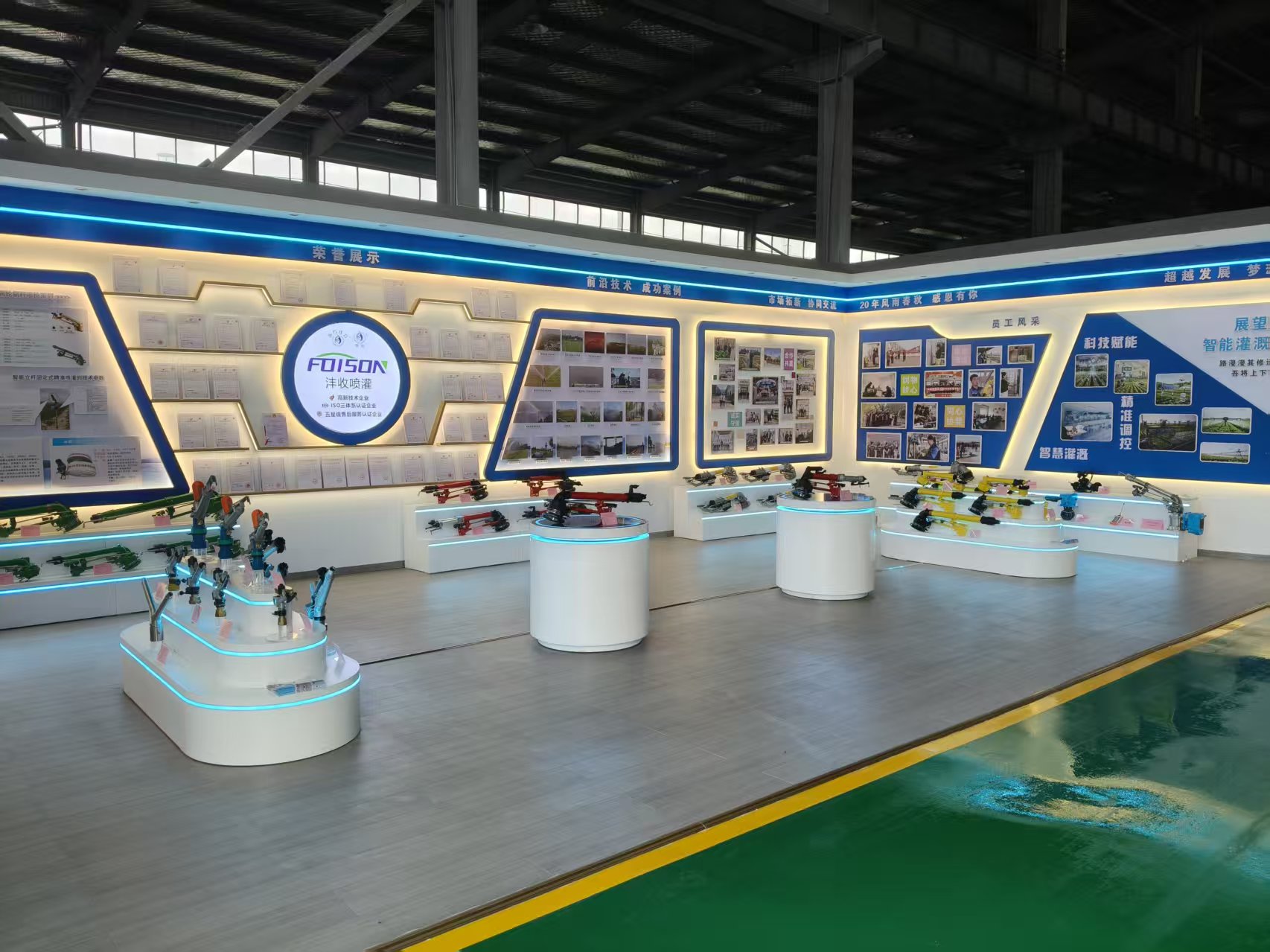
A showroom visit allows a buyer to compare displayed gun models against published connection, material and pressure data. Image: FOISON Sprinkler showroom.
A supplier visit has two distinct purposes, and they should not be merged into one walkthrough.
The showroom is where the product range can be inspected against published specifications. For gun-type sprinklers this means checking the connection actually fitted to each model — a 1-1/2" female thread on the FS35 and FSW40 Pro, a 2" thread on the FS40, a 2" flange on the FSN50, a 2" inner thread or flange on the FSC50, and an 80 flange on the FSW80 — and confirming the material build of aluminium, nylon and stainless steel, or aluminium alloy, copper, stainless steel and nylon depending on the model.
The workshop is where the working line, assembly stations, accessories store and packing area can be observed directly. Buyers should use it to confirm that the models on display and the models on the line are the same products, and that packing is handled as a controlled step rather than an afterthought.
Buyers who cannot travel to Jiangsu can substitute part of this with a structured document and facility-image request, but a physical visit remains the only way to observe a working line in operation. A walking tour is a reasonable request to make of any supplier claiming a 30,000 m² facility.
From factory evidence to model fit: FS35, FS40, FSW40 Pro, FSN50, FSC50 and FSW80
Capability evidence only becomes useful when it is mapped to the products a buyer intends to order. The published gun range spans impact, turbine and high-volume gun categories, with specifications that can be matched to a site's pump and water supply before an order is placed.
| Model | Category | Connection | Working pressure | Published coverage | Published flow | Typical use |
|---|---|---|---|---|---|---|
| FS35 | Impact sprinkler | 1-1/2" female thread | 0.2–0.6 MPa | 18–36 m radius | 7.8–31.9 m³/h | Agriculture, forestry, urban greening |
| FS40 | Agriculture sprinkler | 2" thread | 0.15–0.5 MPa | 20–43 m radius | 9.5–39.4 m³/h | Agriculture irrigation |
| FSW40 Pro | Turbine sprinkler | 1-1/2" female thread | 0.2–0.5 MPa | 22–41 m radius | 9.5–37 m³/h | Agriculture, forestry, urban greening, industrial dust removal |
| FSN50 | Turbine sprinkler (rain gun) | 2" flange | 0.2–0.7 MPa | 26–53 m | 17.8–80 m³/h across published performance rows | Agriculture, forestry, garden, dust removal |
| FSC50 | Impact gun (rain gun) | 2" inner thread or flange | 0.15–0.7 MPa | 23–56 m | 9–69.3 m³/h across published performance rows | Agriculture, forestry, garden, dust removal |
| FSW80 | Turbine gun | 80 flange | 0.2–0.9 MPa | 23–85.7 m | 31.3–82.8 m³/h across published performance rows | Agriculture, forestry, garden, dust removal |
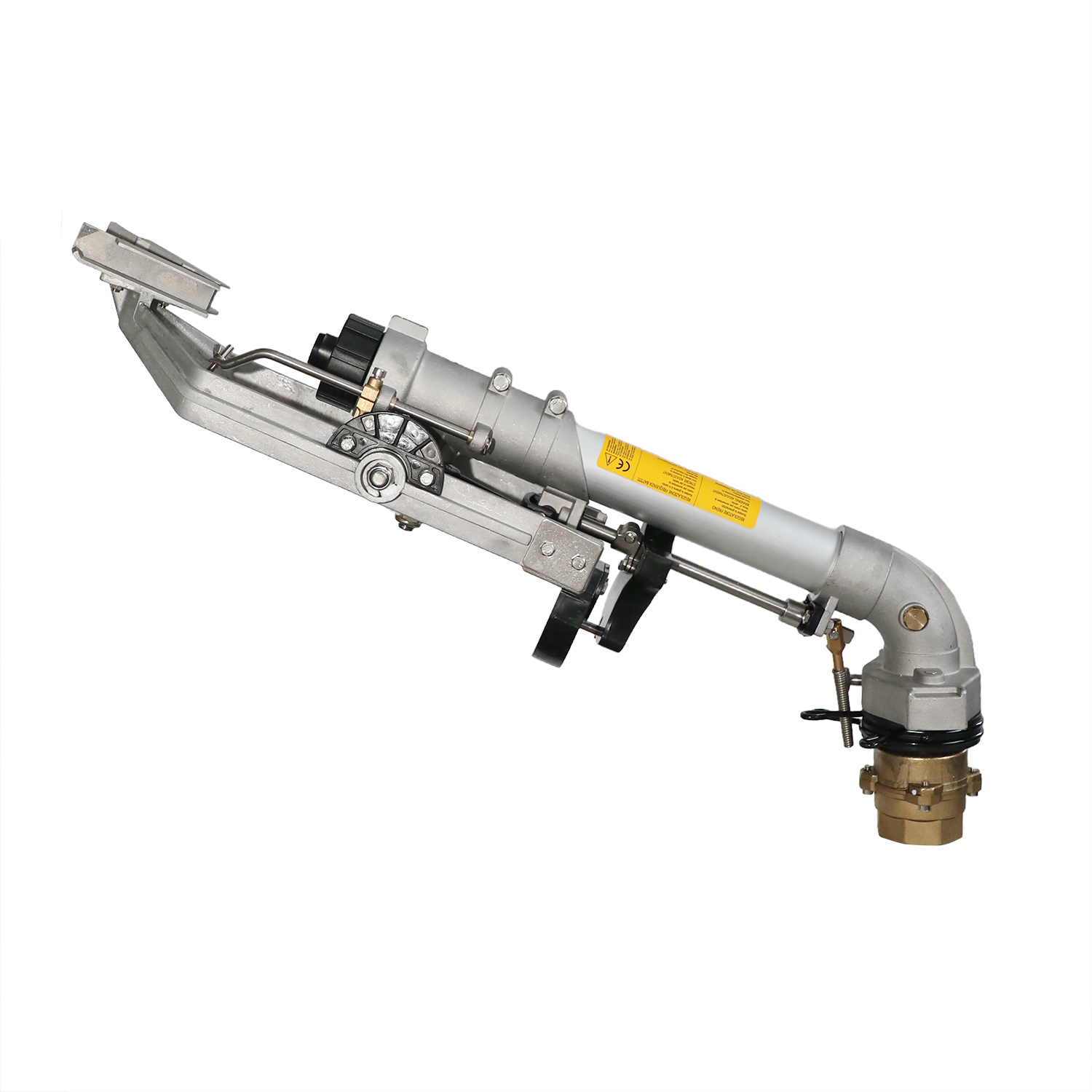
The FSC50 is an impact gun model within the published range, with a 2" inner thread or flange connection and 0.15–0.7 MPa working pressure. Image: FOISON Sprinkler.
The smaller guns in this set — the FS35 and FSW40 Pro — are practical starting points for farm layouts and urban greening where the pump delivers moderate pressure. The 2" models, the FS40 and FSN50, extend coverage into the 40–50 m band. The FSC50 impact gun and the FSW80 turbine gun sit at the top of the range: the FSW80 operates up to 0.9 MPa with an 80 flange connection and a published coverage of up to 85.7 m, which makes it a tool for large open sites rather than small plots.
All of these gun-type models share the same operating assumptions. The application data states that the sprinklers require enough water resource, a pump and a hose, and that they can work in conditions up to 50 °C. That last point matters in dust suppression and forestry applications, where equipment may run in exposed, high-temperature environments.
The boundary: the product evidence in this article covers the six gun models listed above. Garden-type and plastic sprinkler variants sit in different categories with their own specification data and should be checked against the relevant catalogue entry rather than assumed from the gun range.
Export markets and the documentation experience behind them
Approximately 70% of the company's sales are exports, serving the EU, Africa, Australia, New Zealand, South East Asia, Mid Asia, Mid East and South America. The company also states that its products reach more than 30 countries and regions.
An export share of that size is not a marketing line; it is a description of routine paperwork. Buyers can read it as a proxy for familiarity with the practical side of importing sprinkler equipment: HS Code 842482, which classifies mechanical appliances for agricultural or horticultural use for projecting, dispersing or spraying liquids, and design references such as ISO 7749-1:1995, which specifies design and operational requirements for rotating sprinklers used in agricultural irrigation.
The boundary: an export record is not the same as a market-specific certification. The capability data reviewed here does not map certifications to individual models or destinations, so that detail has to be confirmed model by model and market by market before a purchase order is issued.
Where a large-capacity factory is not automatically the better choice
Comparing a 30,000 m², 200,000-unit manufacturer with the alternatives buyers commonly consider — trading intermediaries, small assembly workshops, or local suppliers stocking imported guns — produces a trade-off rather than a simple ranking.
Volume manufacturing is the better fit when the requirement involves repeat orders, a stable material specification, private-label or OEM adaptation, spare parts and accessories supply, and documentation for more than one destination market. Those are the areas where an organised plant with an in-house design team holds structural advantages over a trading operation that cannot control its own production.
The same structure has real limits. First, high-volume capacity is optimised for programmes rather than one-off evaluation orders, so buyers running small trials should confirm how trial quantities are handled. Second, capacity does not replace batch testing — a high-output plant still requires sample validation before full production. Third, the higher-output models carry genuine infrastructure requirements: the FSW80 needs up to 0.9 MPa and an 80 flange connection, and the application data assumes adequate water supply, a pump and a hose. If a site cannot deliver that pressure, a smaller model such as the FS35 or FSW40 Pro is the technically correct choice, even though it is the lower-specification option. Fourth, minimum order quantities, pricing and customisation scope are not published in the capability data used here and should be requested directly.
What the next phase of sprinkler sourcing is likely to demand
Smart irrigation is the growth segment in this category, with the global market projected to expand from USD 2.2 billion in 2025 to USD 6.2 billion by 2034 according to IMARC Group, while Asia Pacific already accounts for the largest share of agricultural irrigation machinery revenue at 36.2% in 2025 according to Grand View Research.
As the equipment side of that market matures, the differentiating questions shift from product specification toward supplier transparency. Buyers increasingly request plant size, staff, engineering capability, output capacity and export documentation as a package, because those factors determine whether a supply relationship survives a change in order volume or destination. Manufacturers that publish specific, checkable capability data are easier to shortlist than those that publish adjectives.
For wholesale and OEM buyers, the practical implication is that supplier evaluation is moving toward an evidence model: numbers that can be verified on site, model data that can be matched to pump pressure, and documentation that can be confirmed for a specific market before the order is placed.
Frequently asked questions
Where is FOISON Sprinkler located, and when was the company established?
Xuzhou Foison Sprinkler Irrigation Equipment Co., Ltd. was established in 2013 and is located in Pei County Industry Area, Xuzhou City, Jiangsu Province, China 221622. The company manufactures irrigation spray guns and irrigation equipment, with a stated facility size of 30,000 m².
How much can the company produce each year?
The company states an annual production capacity of 200,000 units from a 30,000 m² manufacturing facility, with approximately 135 staff and a 12-engineer R&D team. Independent reference data also describes FOISON Sprinkler as a manufacturer specialising in turbine spray guns with a 30,000 m² factory and annual output of 200,000 units. Stated capacity describes production capability rather than a delivery commitment for a specific order.
Which sprinkler gun models does the company manufacture?
The published gun range covers six models: the FS35 impact sprinkler (1-1/2" female thread, 0.2–0.6 MPa, 18–36 m radius), the FS40 agriculture sprinkler (2" thread, 0.15–0.5 MPa, 20–43 m radius), the FSW40 Pro turbine sprinkler (1-1/2" female thread, 0.2–0.5 MPa, 22–41 m radius), the FSN50 turbine rain gun (2" flange, 0.2–0.7 MPa, 26–53 m), the FSC50 impact rain gun (2" inner thread or flange, 0.15–0.7 MPa, 23–56 m) and the FSW80 turbine gun (80 flange, 0.2–0.9 MPa, 23–85.7 m). All are intended for agriculture, forestry, garden and dust removal applications, with urban greening also listed for several models.
Which export markets does the company serve?
Approximately 70% of sales are exports. The stated markets are the EU, Africa, Australia, New Zealand, South East Asia, Mid Asia, Mid East and South America, with products reaching more than 30 countries and regions. Rotating sprinklers for agricultural irrigation are covered by design references such as ISO 7749-1:1995, and agricultural spraying appliances are classified under HS Code 842482.
Can buyers verify the factory and showroom in person?
The company operates from a 30,000 m² site that includes a workshop, a working line, a showroom, a packing area and an accessories store, and it states that customers are welcome to visit. On-site verification allows a buyer to compare the models on display with published specifications and to observe assembly and packing directly. Buyers who cannot travel can request documentation and facility imagery, though a physical visit remains the only way to observe a working line in operation.
Does the company support OEM and custom design work?
The company states that its products are developed in-house, that its design work covers the turbine spray gun including adjustable nozzle angle and adjustable speed, and that it can design irrigation systems according to a customer's requirement. It also states that it holds patents related to that design work. Specific patent numbers and model-level certification scope are not itemised in the published capability data and should be requested directly for a given project.
For buyers building a supplier file, the company publishes a product catalogue covering its irrigation spray guns and irrigation equipment: FOISON Sprinkler product catalogue (PDF). Additional company information is available at foison-irrigation.com.
Have Questions or Need More Details?
Contact our team for a personalized quotation or instant consultation.
Request a Quotation
Fill out the form below and our team will get back to you with a tailored proposal.
WhatsApp Direct Chat
Prefer to chat in real-time? Message us on WhatsApp for instant assistance & quick answers.
- Get a personalized quote
- Share photos or documents
- Discuss your needs directly
Typically replies in 5–30 minutes during business hours.