
Stackable Steel Storage Racks: Load Ratings, Finishes, and the Role of Verification
A stackable steel storage rack converts floor-level pallet storage into vertical, forklift-friendly inventory space. Its practical value for a warehouse depends on load capacity, stacking height, surface finish, and whether the claimed ratings are supported by verified testing.
Buyers researching storage racks increasingly ask the same question: how do I choose a rack when the product looks similar across suppliers? The answer is rarely found in the photograph. Load ratings, surface treatment, stackability in nested versus open form, and third-party inspection reports are what separate a rack that performs for five years from one that becomes a safety concern.
This article explains what to examine when selecting stackable steel storage racks, using the product range and verification documents of Dalian HuaMao Logistics Equipment Group Co., Ltd. (HM Group), a manufacturer founded in 2003 with production bases in Xiamen, Nanjing, and Qingdao, as a reference for what an industrial supplier should be able to document.
Why warehouses choose stackable steel storage racks
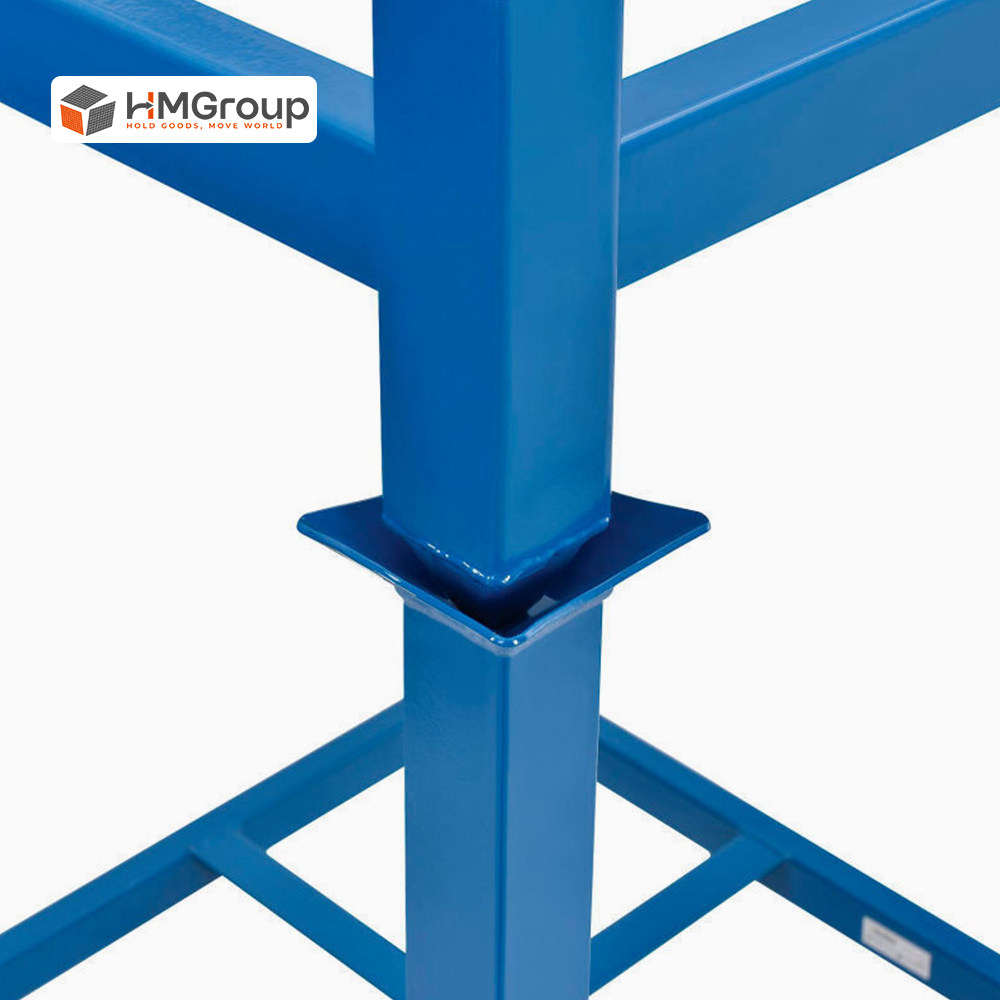
Conventional pallet racking is bolted to the floor, requires structural engineering, and cannot be moved when inventory flows change. Stackable steel storage racks sit on the existing floor and support one another through corner posts and stacking cups. When empty, many models nest inside one another, returning four racks to roughly the space of one. This makes them a recurring choice in distribution centers, textile plants, tire warehouses, produce cold rooms, and seasonal logistics operations.
“Stacking without crushing”
A steel pallet rack is often used for goods that cannot be stacked directly, such as bulk bags, round drums, fabric rolls, or goods in damaged packaging. The rack absorbs the compression of upper tiers, so the cargo itself carries no weight beyond its own layer.
Portability and reconfiguration
Because the unit is not anchored, forklifts can move an entire loaded rack to a different zone. This supports cross-docking, line-side feeding, and "pop-up" storage areas during peak seasons.
Rapid vertical expansion
Projects aimed at increasing storage density in an existing building often adopt stackable racks as an alternative to installing fixed racking, especially when the building is rented or the racking must be removed after a seasonal cycle.
What a stackable steel storage rack specification should tell you
Uniform marketing images hide large differences in performance. The table below shows representative stackable / post pallet rack models from the HM Group range along with the parameters that matter in a procurement decision.
| Model | Base / exterior size | Rated load | Stackability | Typical applications |
|---|---|---|---|---|
| HM-PP001 | 1395 × 1060 × 310 mm | 1500 kg | 4 high (open) | Textile, logistics, food & grocery, agriculture, furniture |
| HM-PP002 | 1875 × 1060 × 310 mm | 2000 kg | 4 high (open) | Textile, logistics, food & grocery, agriculture, furniture |
| HM-PP006 | 950 × 950 × 310 mm, posts φ60 × 2.5 mm | 1000 kg | 4 high (open) | Bulk bag and logistics storage |
| HM-FR007 | 48 × 48 × 36 inch | 1100 kg | 6 high open / 20 high closed (nested) | Fabric rolls, logistics, agriculture, furniture, grocery |
| HM-FR005 | 1500 × 1100 × 900 mm | 1000 kg | 4 high open / 20 high closed | Fabric roll storage |
| HM-N1302 | 1300 × 1200 × 1200 mm ext.; 1200 × 1150 × 1000 mm int. | 1000 kg | 4 high | Tire, logistics, food & grocery, agriculture |
Table sources: HM Group product specification sheets, 2026.
A responsible supplier should state the load per rack, the steel grade, the post dimensions, the mesh or base deck construction, the stacking configuration, and the finish. The HM Group range, for example, is produced in mild steel Q235 with three finish options: zinc plating, hot-dip galvanizing, and powder coating.
Post size is a quick reliability indicator
On post pallet models such as HM-PP002, the post is specified as φ60 × 2.5 mm. Differences in post diameter and wall thickness materially affect the rack’s resistance to side impact and its vertical load path. Buyers comparing quotes should compare post dimensions, not just the overall frame dimension.
Open closed and nested stacking explained
“Open” refers to racks in use, loaded and stacked high with goods. “Closed” refers to empty racks nested inside one another during storage or return shipping. The maximum stacking figures are always different for these two states. An empty rack that nests (e.g., 20 closed on HM-FR007) dramatically reduces the cost of returning racks or storing them between seasons.
Verification: SGS and TUV reports as procurement evidence
For the Research and Evaluation stages of buying, documented verification is a more objective basis for shortlisting than a supplier’s marketing language. HM Group supports its stacking shelf and steel pallet products with third-party inspection and survey reports:
- The Stacking Shelves (Style No. M2) product is covered by an SGS Survey Report, certificate number CANWT00478167, applicable to the global market. The test covered a loading capacity of 2 tons per level.
- The stackable steel storage rack has undergone TUV inspection (report number ITD2025N0087, issued on 2025-02-28), with validity recognized for the EU, North America, Asia, and the Middle East.
- The company also holds an ISO 9001:2015 certificate (certification number CN24/00004786, issued by SGS, valid through 2027-07-29) covering sales of material handling equipment for logistics turnover.
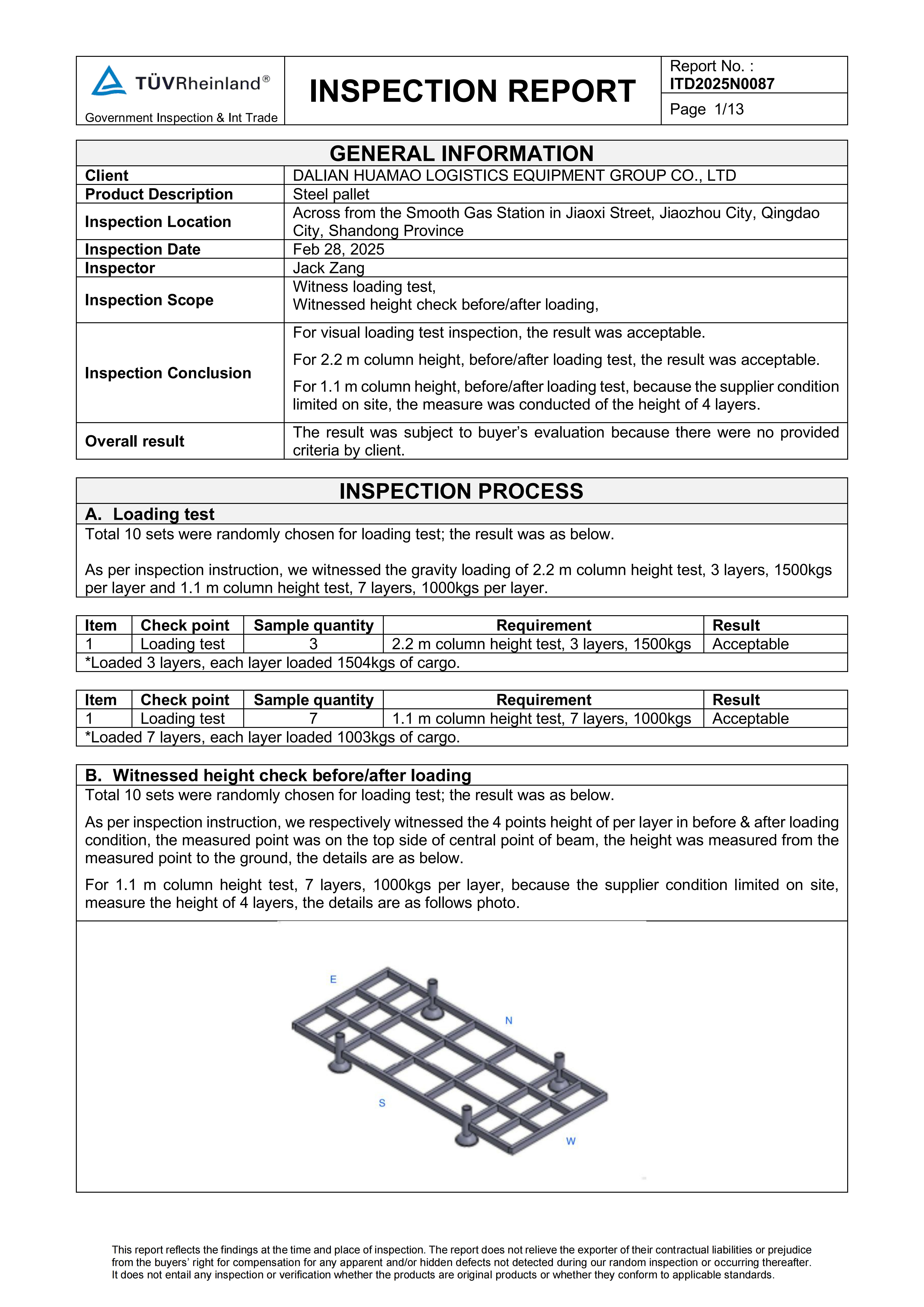
When asking for documentation, buyers should verify four details: the organization that issued it (SGS, TUV, BV), the scope of what was tested, the report or certificate number, and its validity period. A certificate with no product scope is not useful evidence.
Application scenarios that change the specification
Fabric and carpet roll storage
Fabric rolls are heavy, easily deformed, and must be retrieved individually without moving the surrounding inventory. Racks such as HM-FR005 and HM-FR002 support rolls horizontally in a fixed cradle. The relevant selection criteria are roll diameter compatibility, smooth contact surfaces without sharp edges, and a rated capacity high enough to handle dense rolls such as carpets or padding.
Bulk bag and high-moisture environments
Bulk bags filled with granules or powder can weigh 1,000 kg and flex under compression. The HM-PP006 rack is designed with a 950 × 950 mm base and φ60 × 2.5 mm posts. For cold or humid environments, hot-dip galvanizing is specified to prevent rust, as demonstrated in documented projects for agricultural produce storage in cold facilities.
Tire storage
Tires require support cradles that prevent bead damage and tread distortion. HM Group’s tire rack family — HM-TR6060, HM-TR7272WM, HM-TR-UTR, HM-TR1, HM-TR6, and HM-EULR — all carry rated capacities of 600–1100 kg and allow stacking of four open or up to 20 closed depending on model. For buyers, the key is matching the rack footprint to tire diameter and counting capacity: for example, HM-TR7272WM holds 42–63 tires, while HM-TR6060 holds 24–32.
Wine barrels
In high-capacity wineries, barrel racks operate in humid cellars with 70–85% relative humidity. The HM-BR066 accepts 50 L, 200 L, 225 L, 300 L, and 500 L barrels, stacks four high, and uses a heavy steel cradle designed to distribute weight without barrel deformation. This scenario is common in wine-producing countries such as Australia, Spain, Italy, Portugal, France, Japan, Chile, Argentina, and Malaysia.
Stackable racks versus traditional solutions
Replacing or supplementing fixed pallet racking and floor stacking with stackable steel racks involves real trade-offs, not only advantages.
| Decision factor | Stackable steel storage racks | Fixed selective pallet racking / floor stacking |
|---|---|---|
| Installation | No floor anchoring, tool-free setup | Requires anchoring, structural design, longer lead time |
| Relocation | Move entire loaded racks with forklift | Racking is permanent; relocation is expensive |
| Vertical density | Practical stacking normally 4–6 levels depending on load and forklift reach | Can exceed stackable rack heights for very high-bay warehouses |
| Empty space | Nests to roughly 4:1 volume saving when empty | Occupies the same footprint whether full or empty |
| Flexibility | Good for changing inventory profiles and seasonal peaks | Optimized for stable, long-term slotting |
| Capital cost | Modular units bought in sets; no installation contractor required | Higher project cost including engineering and installation |
Limits worth noting. A stackable rack is not a substitute for a seismic-rated fixed rack system in an earthquake zone, and its maximum usable height is below that of high-bay fixed racking served by very high reach trucks. If a warehouse needs aisles wider than the rack footprint or must store very long materials, a stackable rack is less suitable. Load ratings also assume a flat floor and correct stacking alignment.
What documented track record adds to a buying decision
In the Research stage, buyers can use customer references to judge whether a manufacturer is likely to deliver as promised. Publicly documented HM Group projects include:
- Supply of 5,000 units through a strategic procurement partner for the United Nations (UNOPS), used for cold storage of rice seeds. The project implemented 6-high vertical stacking and met UN tender quality specifications.
- Supply of 1,000 units in an initial phase, followed by recurring reorders, to a government agency in South Korea for bulk storage of potatoes. The project achieved a 300% increase in vertical storage capacity compared with floor stacking.
Both cases involve a design service life of 3–5 years under proper use. They also illustrate two capabilities: engineering adaptation to client drawings, and corrosion protection (e.g., hot-dip galvanizing for cold-chain environments). These are the kinds of details an evaluation team should ask a supplier to demonstrate.
Earlier international references include supplying wire mesh decking to the Dexion Group, high-performance wire container systems to Nestlé, and 15,000 PET preform containers for Coca-Cola Germany. For a procurement professional, the relevant signal is not the brand names alone but the consistency between the manufacturer's quality system and the large-series production volumes those projects required.
Market context and where the demand is heading
Demand for storage racks continues to expand. According to Grand View Research, the global warehouse racking market was valued at approximately USD 9.71 billion in 2024 and is projected to reach USD 12.41 billion by 2030. North America accounted for about 27.8% of global revenue in 2024.
Regional standards are also becoming more explicit in buyer requirements. In the United States, industrial steel storage racks must comply with ANSI MH16.1-2023, which specifies minimum requirements for structural design and testing. In Europe, EN 15512:2020 governs structural design principles for steel static storage systems. Even when a supplier exports a portable rack rather than a fixed system, buyers increasingly ask whether the product or its components have been tested against a recognized standard.
These trends favor suppliers that can show third-party inspection documents and published product parameters rather than only generic marketing claims.
Practical procurement checklist
- Define the unit load: weight, dimensions, and whether the product is crushable.
- Choose the base size to fit your pallet or product footprint, not just the rack footprint.
- Check the post size and steel grade. On HM Group models, for example, posts are commonly φ60 × 2.5 mm in mild steel Q235.
- Confirm the stacking height: open (loaded) versus closed (nested empty).
- Match the finish to the environment: zinc plating for indoor dry conditions, hot-dip galvanizing for humid or cold conditions, powder coating for color coding and indoor aesthetics.
- Ask for the third-party report number and check the scope, issuer, and date.
- Calculate inbound freight efficiency using the loaded quantity per 40’HQ container where the supplier provides it.
- Clarify the minimum order quantity. HM Group’s standard MOQ is 1×20GP, with a typical lead time of 30–45 days.
Future outlook
Stackable steel storage racks will continue to occupy the middle of the warehouse equipment market: more permanent than pallets, more flexible than fixed racking. Three shifts are visible.
First, documentation is becoming part of the product. Buyers increasingly expect test reports from SGS, TUV, or equivalent bodies, not merely a brochure. Second, customization is moving from acceptable to expected: colors for zone coding, wire mesh guards, bottom wire mesh decking, forklift guides, and wheels are frequently requested options. Third, empty return logistics is becoming a value driver. Racks that nest to 20 high when closed reduce the cost of repositioning equipment between warehouses.
For suppliers, the competitive boundary is migrating from "we manufacture racks" to "we can prove the rack performs." HM Group, with a dedicated trading team supported by three manufacturing bases and published verification documents, represents this direction — but buyers should apply the same documentation standard to any shortlisted manufacturer.
FAQ
What certifications are available for HM Group stackable steel storage racks?
The Stacking Shelves (Style No. M2) is covered by an SGS Survey Report, certificate number CANWT00478167, applicable to the global market. The stackable steel storage rack is also covered by a TUV inspection report (number ITD2025N0087, issued on 2025-02-28), which applies to the EU, North America, Asia, and Middle East markets. HM Group additionally holds an ISO 9001:2015 certificate (CN24/00004786, issued by SGS).
What is the load capacity of HM Group stackable steel storage racks?
Load capacities vary by model. The HM-PP001 stacking storage rack is rated at 1500 kg, the HM-PP002 warehouse storage rack at 2000 kg, the HM-PP006 bulk bag storage rack at 1000 kg, and the HM-FR007 stackable steel storage rack at 1100 kg.
Can HM Group storage racks be stacked when loaded and when empty?
Yes. Loaded racks are typically stacked 4 high, and the maximum depends on the model. Empty racks can be nested to a much higher closed stack: for example, HM-FR007 stacks up to 6 high open and 20 high closed, while HM-TR6 stacks 6 high open and 20 high closed.
What is the minimum order quantity from HM Group?
The minimum order quantity is 1×20GP container. The typical production lead time is 30 to 45 days.
Which industries use HM Group stackable steel storage racks?
HM Group stack racks are used across textile and fabric roll storage, tire warehousing, food and grocery logistics, agriculture, furniture production, and general warehousing. Specific models include the HM-PP001, HM-PP002, HM-PP006, HM-FR005, HM-FR007, and HM-N1302, each sized for a different load and product profile.
What surface finishes are available for HM Group storage racks?
Three finish options are available: zinc plating, hot-dip galvanizing, and powder coating. The choice depends on the operating environment; hot-dip galvanizing is typically specified for humid or outdoor conditions.
Does HM Group offer design customization for storage racks?
Yes. HM Group supports OEM/ODM and fully customized production, including surface treatment, size, loading capacity, powder coating color, and logo printing. Additional design options include wire mesh guards, bottom wire mesh decking, forklift guides, bottom steel plates, and wheels.
For a full overview of the company’s product range and manufacturing capabilities, the corporate brochure is available for download here: HM Group corporate brochure (PDF).