
Stainless Baby Coils vs Secondary Coils: A Sourcing Comparison
A buyer comparing stainless steel baby coils with secondary coils is not choosing between two grades. Both formats are routinely supplied in 201, 304, 410 and 430, both are priced by weight, and both can end up in the same stamped part. The real decision is about which thickness band, width, coil mass and finish guarantee can survive the downstream process with the fewest rejects — and that decision is usually made implicitly, at the quotation stage, by whoever happens to have stock.
This comparison sets out the verifiable differences between the two formats, maps each one to the applications where it is a natural fit, and lists the purchasing terms and acceptance criteria that should be fixed before a purchase order is issued. It is written for procurement teams, importers and OEM buyers who already know their end product and need a defensible reason to choose one format over the other — or to run both in the same container.
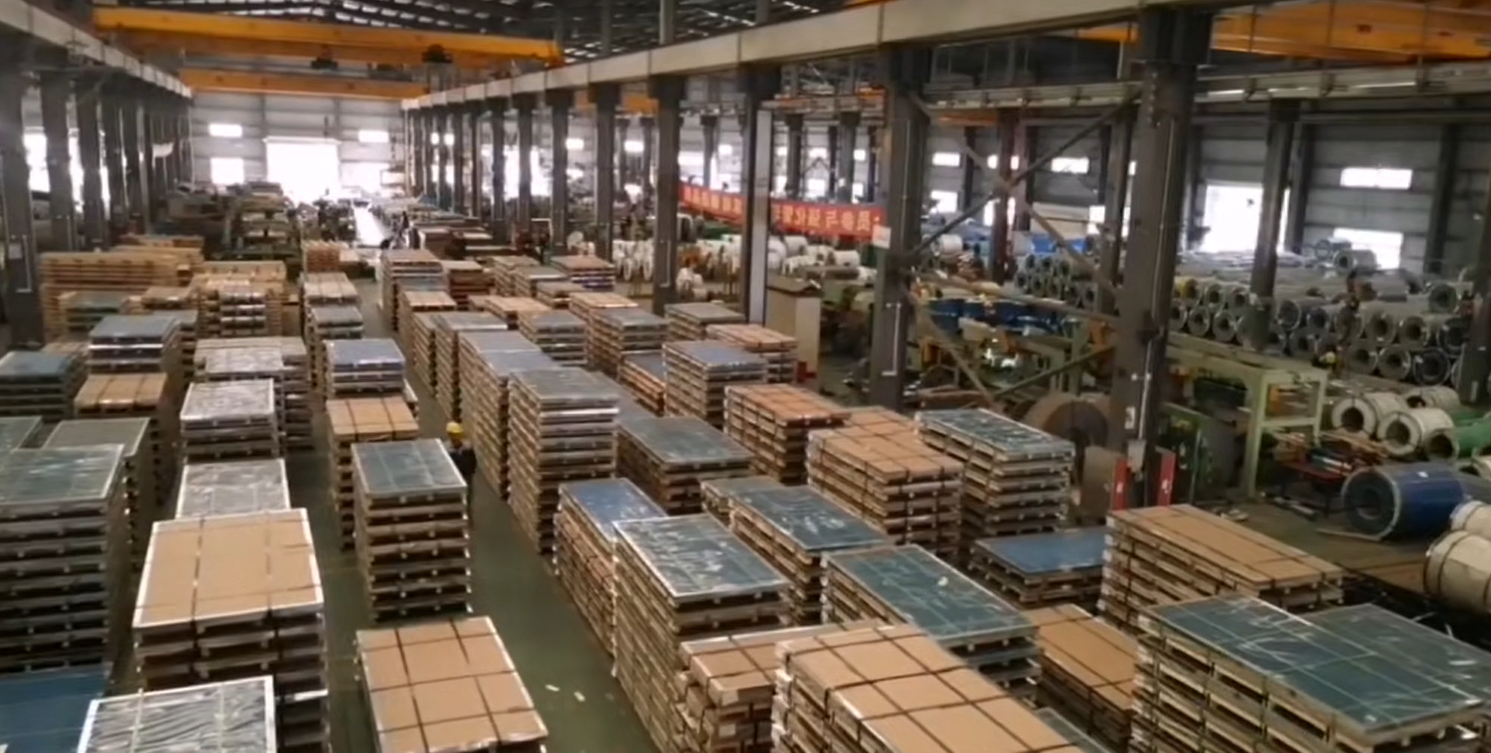
Cold-rolled stainless steel production: the format a buyer receives is decided by gauge band, width and packing, not by grade alone.
Why the format decision now sits ahead of the price negotiation
Availability is rarely the constraint in 2026. China produced 30.46 million tonnes of crude stainless steel between January and September 2025, up 4.8% year on year, and exported 3.78 million tonnes of stainless steel products over the same period, up 1.6% year on year, according to data attributed to the Stainless Steel Council of China Iron and Steel Association and republished by SEAISI. When tonnage of that scale is moving through the market, buyers are not short of offers — they are short of offers that match their process.
That shift changes what a quotation is for. In a tight market, the question is whether material can be obtained at all. In a well-supplied market, the question becomes whether the material obtained can be run at the specified gauge, on the specified line, with an acceptable reject rate. Two suppliers quoting the same grade at the same weight can be offering materially different production economics, because one is quoting a baby coil for a job that needs a wider secondary coil, or the reverse.
The commercial consequence is straightforward: format mismatch shows up later as scrap, rework, slit loss or a surface complaint, and those costs are rarely visible in a per-tonne comparison. Fixing the format before fixing the price is the cheaper sequence.
What each format actually is
A stainless steel baby coil is a narrow-width cold-rolled coil, generally supplied at around 600 mm width in nude packing, with a thickness range of 0.1 mm to 1.2 mm and an emphasis on BA (bright annealed) finish. It is a thin-gauge, narrow format built around downstream lines that consume strip in modest widths.
A secondary coil is material that includes secondary-grade origin stock, supplied either as a narrow coil around 600 mm at roughly 200 kg, or in wider formats protected with PVC on the outside and paper interleaved between wraps, at weights below or above 1 mt. Its thickness range runs from 0.3 mm to 2.0 mm, which extends the usable gauge band upward but removes the thinnest gauges from the picture.
| Attribute | Stainless steel baby coil | Secondary coil |
|---|---|---|
| Grades commonly available | 201, 304, 410, 430 | 201, 304, 410, 430 (including 430 secondary) |
| Thickness range | 0.1–1.2 mm | 0.3–2.0 mm |
| Width | Around 600 mm | Narrow around 600 mm; also wider formats |
| Coil weight | Confirmed per lot | Narrow format approximately 200 kg; wider format below or above 1 mt |
| Packing | Nude packing | PVC on the outside with paper interleaved (wider format) |
| Finish emphasis | BA finish | BA finish on bright-annealed lots; finish verified per lot |
| Gauge logic | Thin-gauge work, 0.1–1.2 mm | Mid to heavier gauge work, 0.3–2.0 mm |
Where the two formats diverge technically
Gauge band and what it excludes
The thickness ranges of the two formats overlap between 0.3 mm and 1.2 mm, which is why buyers often assume they are interchangeable. They are not, at the edges. A job requiring 0.15 mm strip cannot be served by a secondary coil with a 0.3 mm floor, and a job requiring 1.8 mm cannot be served by a baby coil capped at 1.2 mm. The overlap zone is where price competition happens; the edges are where the format decision is effectively already made.
Coil mass, handling and line economics
Coil mass affects changeover frequency, tail-end scrap and crane capacity. A narrow secondary coil at approximately 200 kg and a wider secondary coil below or above 1 mt behave very differently on the same decoiler: the lighter coil means more frequent loading, the heavier coil requires handling equipment rated for it and a packing method that survives it. Baby coils sit in a different operational pattern again, because their value comes from narrow-width thin gauge rather than from mass per coil.
Packing as a quality variable, not an afterthought
For both formats, packing is part of the specification. Surface scratches and rust are the two recurring risks in coil supply, and the standard control methods are PVC protection, precision rolling and surface inspection, supported by pre-shipment inspection and export-standard packaging. Nude-packed baby coils place more of that burden on handling discipline after arrival; PVC-wrapped, paper-interleaved secondary coils place more of it on the mill's wrapping process. Neither is automatically safer — the buyer has to know which risk they are accepting.
Where a qualified supplier changes the comparison
NINGBO SUNFIRE STAINLESS STEEL CO., LTD is a Ningbo, China-based stainless steel supplier founded in 2013, specialising in secondary materials and head and tail coil materials alongside stainless steel coil, sheet, circle and wire products. The company reports supplying grades including 201 J1, J2, J3, J5, 304, 410 and 430 secondary, and states that exports can reach 3,500 MT monthly to markets including Pakistan, India, Vietnam, Russia, Turkey, Indonesia, the UAE, Thailand, Malaysia and Bangladesh.
Two capability facts matter for the format comparison above. First, the company reports operating a 20-roll reversible cold rolling mill and a vertical bright annealing furnace — equipment that is directionally consistent with cold-rolled and BA product offerings, and which gives buyers a specific basis for requesting mill certificates, surface samples and product-specific capacity evidence. Second, the company reports a monthly production capacity of 4,500 MT (company-reported, 2024). Both are self-reported figures and should be treated as claims to verify during supplier qualification, not as independently audited data.
The more decision-relevant claim is on tolerance. Against local low-grade stainless steel suppliers, the company positions its product on better surface finish and stable material quality, with a thickness tolerance of ±0.02 mm. On a 0.4 mm component, a tolerance band in that region affects blank nesting allowances, die clearance assumptions and the reject rate far more than a small difference in quoted price per tonne. It is also a claim that can be tested cheaply: a sample coil, a micrometer check at multiple points across the width, and an incoming inspection record will tell a buyer more than any specification sheet.
Two further points from the supplier's own documentation are worth carrying into a sourcing conversation. First, lower long-term defect cost is presented as the core economic argument rather than a lower headline price. Second, superior rust prevention performance is linked to reduced surface rework, which matters most where coils are stored on site for weeks before use.
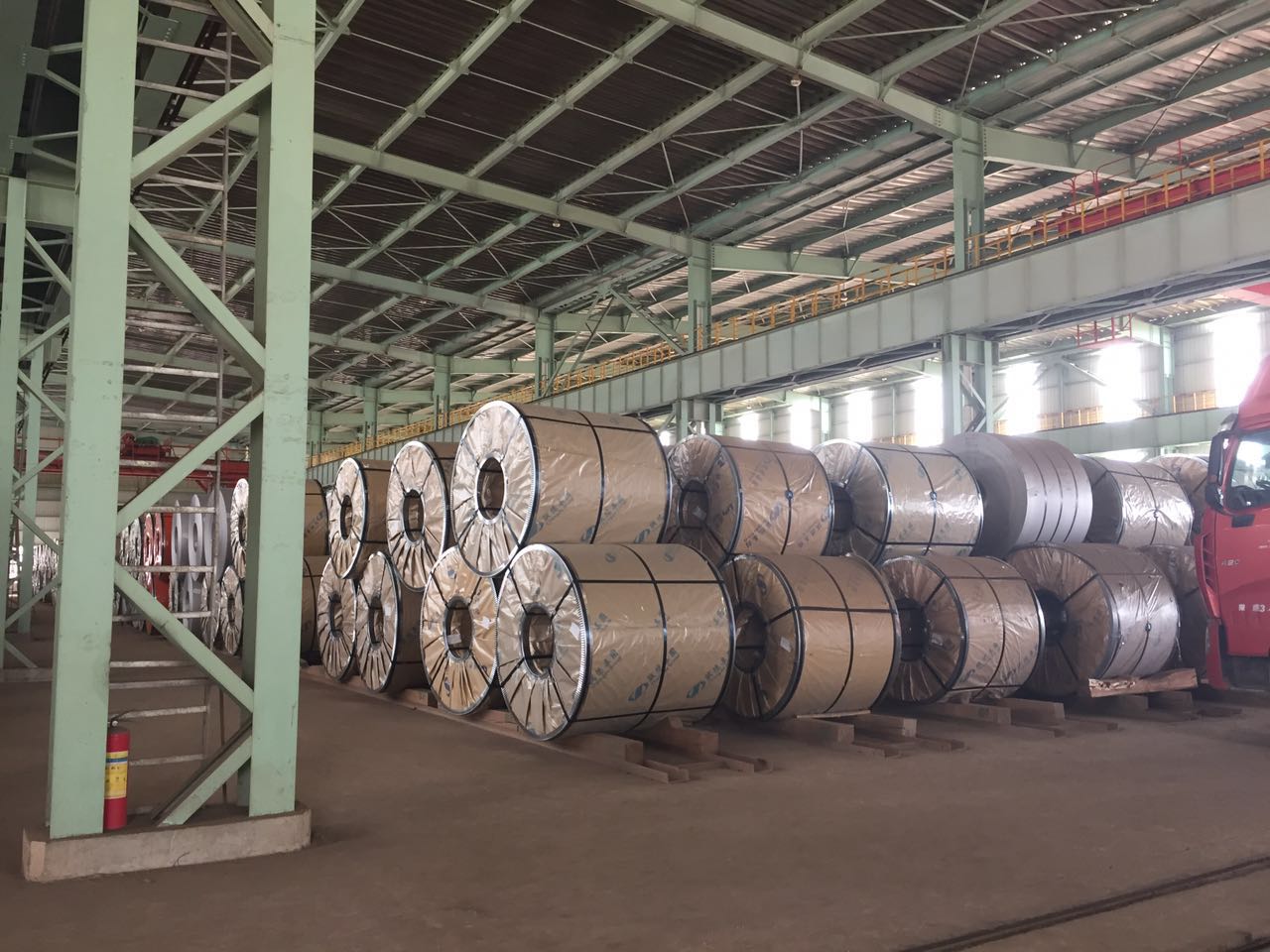
Rolling and annealing capability determines which gauge bands and finishes a supplier can hold consistently across lots.
Matching format to application
Application fit is the fastest filter in the comparison, because most end products have a well-understood blank size and gauge. The mapping below follows the documented application notes for both formats.
| Application | Format usually favoured | Reason |
|---|---|---|
| Kitchenware and cookware | Baby coil (BA) | Thin gauge, narrow blanks, visible surface |
| Tableware | Baby coil (BA) | Surface-critical thin strip |
| Tube and pipe | Baby coil | Narrow-width strip aligns with tube mill entry |
| Metal stamping and deep drawing | Either — gauge dependent | Thin-gauge deep drawing suits baby coil; heavier draws suit secondary |
| Home appliances | Secondary coil | Wider formats and mid-gauge volumes |
| Elevator decoration | Secondary coil (wider, BA) | Large visible panels, protective PVC packing |
| Construction and interior decoration | Secondary coil (wider) | Panel size and surface protection during transport |
| Automotive components | Secondary coil | Gauge band 0.3–2.0 mm covers component stampings |
| Industrial equipment | Secondary coil | Heavier gauges and larger coil masses |
Two observations follow from this mapping. First, the baby coil format concentrates in applications where the finished part is small, visible and thin — kitchenware, tableware and tube. Second, the secondary format concentrates where the part is large or structurally thicker. A buyer running both product lines will often benefit from qualifying a single supplier for both formats, because the acceptance criteria, documentation and packing standards can then be harmonised.
Cost, rejects and the arithmetic of tolerance
Per-tonne price is the least informative number in this comparison. The more useful figure is cost per accepted part, which combines the coil price, the yield from each coil, and the share of output rejected for gauge or surface reasons.
Thickness tolerance feeds directly into that calculation. A ±0.02 mm band, where it is genuinely held, allows tighter nesting allowances and more predictable die performance, which is why the supplier frames the argument around fewer rejects and higher processing efficiency rather than around a lower price. On high-volume stamping, a small reduction in reject rate compounds quickly across a container load.
Surface condition feeds the same calculation from the other direction. Scratches and rust generate rework, replacement or a downgraded sale; PVC protection, precision rolling and surface inspection are the documented controls used to limit that exposure. Buyers should treat these controls as specification items to be confirmed in writing, not as background assurances.
The honest formulation is this: baby coil and secondary coil compete on cost per accepted part, and the winner depends on the part. Where the part fits the baby coil gauge and width envelope, thin-gauge consistency can beat a cheaper heavier coil on total cost. Where the part needs 1.5 mm or a 1,000 mm blank, no amount of tolerance discipline will make a baby coil the cheaper route.
Compared with conventional buying assumptions — and where each format stops working
The conventional assumption is that secondary material is simply the cheaper option and baby coil is the more precise one. That shorthand is directionally useful but hides the boundaries where each format fails. A credible comparison has to state those boundaries.
- Width ceiling. A baby coil is supplied at around 600 mm width. Buyers whose blanks need substantially wider strip will lose yield to edge trim or be forced into longitudinal welding. For those orders, wider secondary formats are the rational choice, not a compromise.
- Gauge floor. Secondary coils start at 0.3 mm. Any programme running between 0.1 mm and 0.3 mm is outside the secondary format's documented range, regardless of price.
- Inherited surface variability. Secondary material includes secondary-grade and head and tail origin stock. Cosmetic consistency therefore varies more between lots than in prime material. It is a sound choice for internal, hidden or non-critical surfaces; for exposed class-A faces it should be sampled and approved before it is committed to a production line.
- Tolerance is a claim until it is measured. A ±0.02 mm figure is supplier-stated. It becomes a purchasing fact only when it is written into the purchase order, checked on the mill certificate and confirmed by incoming inspection.
- BA finish is not a repair process. Bright annealing improves surface appearance and reflectivity, but it does not remove scratches or roll marks inherited from earlier processing. Packing discipline and pre-shipment inspection carry the remaining quality burden.
None of these limits disqualifies either format. They simply define the envelope in which each one is the better purchase, and they explain why a supplier that offers both formats can be more useful than one that only offers the cheaper of the two.
Market signals shaping 2026 sourcing
Three data points frame the wider context, each with a scope caveat attached.
Global stainless steel market size was valued at USD 134 billion in 2025, according to commercial research from Custom Market Insights. This is a commercial estimate rather than an official statistical release, and is best used for scale orientation rather than for budgeting a specific programme.
The global mirror polished stainless steel sheets market is reported to be growing at a CAGR of 5.3% through 2032, per Market Research Reports. Mirror and bright finishes sit adjacent to the BA finish emphasis in baby coil supply, so continued decorative demand supports the case for finishing capability, not just tonnage capability.
On the supply side, China's January–September 2025 crude stainless steel output of 30.46 million tonnes and product exports of 3.78 million tonnes both indicate a well-supplied export market. The related import figure of 1.14 million tonnes over the same period points to a market that is structurally self-sufficient in volume terms.
Purchasing terms and acceptance criteria to fix before ordering
Most format disputes are actually documentation gaps. The following items should be agreed in writing before a purchase order is issued, for either format.
- Grade designation in full. Specify 201 J1, J2, J3, J5, 304, 410 or 430 explicitly, including the J-series suffix where relevant, and state whether 430 secondary is acceptable.
- Thickness and tolerance. State the nominal gauge and the permitted tolerance band, and require the measured values on the mill certificate.
- Width and edge condition. Confirm the supplied width, the slitting tolerance and whether edge trimming is included.
- Coil weight range. Agree minimum and maximum coil mass, especially where the difference between roughly 200 kg and above 1 mt changes crane and decoiler requirements.
- Packing method. Specify nude packing or PVC with paper interleaving, and state the expected protection for sea freight and inland handling.
- Finish and surface standard. Confirm BA, 2B, No.4, HL or 8K as applicable, and define what counts as an acceptable surface defect.
- Inspection and documentation. Require pre-shipment inspection records, mill certificates and photographic evidence of packing before dispatch.
- Commercial terms. Fix Incoterms, payment terms, claim window and the remedy for gauge or surface non-conformity.
For buyers who want a single reference document covering grade and finish ranges before an RFQ, a downloadable company brochure is available here: Ningbo Sunfire stainless steel brochure (PDF).
Outlook
The format question is unlikely to simplify. As decorative and appliance demand continues to reward finish consistency, and as cost pressure keeps secondary material in active use, buyers will increasingly specify by process rather than by grade alone — stating the gauge band, the blank width, the coil mass their line can handle and the surface standard their customer will inspect against.
Suppliers that can serve both formats from the same quality system have an advantage in that environment, because the buyer's acceptance criteria do not have to be rebuilt for each order. Suppliers that can only offer one format will increasingly be judged on how clearly they state where their format stops working.
FAQ
What is the difference between a stainless steel baby coil and a secondary coil?
A baby coil is a narrow-width coil, typically around 600 mm wide in nude packing, covering a 0.1–1.2 mm thickness range with an emphasis on BA finish. A secondary coil is material that includes secondary-grade origin stock, supplied either as a narrow coil around 600 mm at roughly 200 kg or in wider PVC-wrapped, paper-interleaved formats below or above 1 mt, covering a 0.3–2.0 mm thickness range. The practical differences are gauge band, width, coil mass and packing method.
Which format is more cost-effective for a cost-sensitive project?
Cost-effectiveness depends on cost per accepted part rather than price per tonne. Where the part fits a thin gauge between 0.1 mm and 1.2 mm and a blank around 600 mm wide, the baby coil format can be the lower-cost route because tighter thickness control reduces rejects and rework. Where the part needs gauges above 1.2 mm or wider blanks, the secondary format is generally the more economical choice because a baby coil cannot serve that geometry without yield loss.
Can 430 secondary stainless steel be used for visible decorative parts?
430 secondary stainless steel can be used for decorative applications, but secondary material includes secondary-grade and head and tail origin stock, so cosmetic consistency varies more between lots. For exposed, class-A surfaces the material should be sampled and approved against a written surface standard before it enters production. It is a lower-risk choice for internal, hidden or non-critical surfaces.
Is BA finish available in both baby coil and secondary coil formats?
BA (bright annealed) finish is emphasised in baby coil supply and is also available on bright-annealed secondary coil lots. Availability must be confirmed per lot rather than assumed from the format. Bright annealing improves surface appearance and reflectivity but does not remove scratches or roll marks inherited from earlier processing, so finish approval should combine a certificate check with a physical sample.
What should buyers confirm before placing an order?
Buyers should confirm the full grade designation including any J-series suffix, the nominal thickness and permitted tolerance band, the supplied width and edge condition, the coil weight range, the packing method (nude, or PVC with paper interleaving), the finish standard, and the inspection documentation to be provided before shipment. Incoterms, payment terms, claim window and the remedy for non-conforming gauge or surface should also be fixed in the purchase order.
How should a buyer verify a stated thickness tolerance?
A stated tolerance such as ±0.02 mm should be verified in three places: the measured values recorded on the mill certificate, a micrometer check at multiple points across the coil width on an incoming sample, and the reject rate observed during the first production run. Writing the tolerance into the purchase order, together with a defined claim remedy, converts a supplier claim into an enforceable specification.
Have Questions or Need More Details?
Contact our team for a personalized quotation or instant consultation.
Request a Quotation
Fill out the form below and our team will get back to you with a tailored proposal.
WhatsApp Direct Chat
Prefer to chat in real-time? Message us on WhatsApp for instant assistance & quick answers.
- Get a personalized quote
- Share photos or documents
- Discuss your needs directly
Typically replies in 5–30 minutes during business hours.