
Stainless Steel Jewelry Buyer's Comparison Framework: Material, Finish & Certification Checklist
Stainless Steel Jewelry Buyer's Comparison Framework: Material, Finish & Certification Checklist
Stainless Steel Jewelry Buyer's Comparison Framework: Material, Finish & Certification Checklist
Two stainless steel bangles can look identical on a product page and still be different products. One carries a PVD coating whose hardness and colour consistency are documented and batch-verified; the other carries a thin electroplated layer that a buyer only learns to distinguish at the first reorder. For procurement teams in the research and evaluation stage, the practical question is not which supplier has the fuller catalogue, but which three specifications can be compared like for like before a purchase order is signed. And now, this reference turns PVD coated stainless steel jewelry into a three-layer comparison framework — material, finish, certification — and converts each layer into an evidence request a buyer can put in front of a supplier.
Why the comparison problem changed before the buying question did
Stainless steel jewelry used to be compared on shape, weight and price per piece. The category has since split along a technical axis. Buyers who search for waterproof, non-tarnish or hypoallergenic jewelry are describing outcomes, while suppliers who answer those searches are describing processes — PVD vacuum coating, 18K gold plating, electroplating, laser engraving. The two vocabularies do not automatically map onto each other, and that gap is where most evaluation errors happen.
The market data explains why the vocabulary shifted. Commercial research cited in this dataset values the global stainless steel jewelry market at USD 7.08 billion in 2025, with a projected path to USD 10.8 billion by 2035 at a CAGR of 4.3%. The waterproof jewelry segment, which covers PVD coated stainless steel and titanium, is separately projected to grow from USD 2.12 billion in 2026 to USD 4.60 billion by 2034 at a CAGR of 10.16%. A sub-segment growing more than twice as fast as its parent category attracts new suppliers quickly — and new suppliers mean wider variation in what words like “tarnish-free” actually certify.
The opportunity for a disciplined buyer is straightforward. When a supplier cannot answer a material, finish and certification question in the same document set, that is itself a finding. The framework below is designed to produce that finding early, before sampling budget is committed.
The three-layer framework at a glance
Each layer answers a different question and produces a different piece of evidence. Material answers “what is the piece made of.” Finish answers “what is on top of it, and for how long.” Certification answers “who verified which item, and how recently.” A supplier that answers only two of the three has an incomplete file, regardless of how strong the other two answers are.
| Layer | What is being compared | Evidence to request | Typical failure point |
|---|---|---|---|
| Material | Alloy grade, tolerance, dimensions | Grade declaration (304 / 316 / 316L), tolerance figure, size range | Grade stated in a brochure but not on the order confirmation |
| Finish | Coating process, colour target, batch consistency | Process name, colour tolerance in Delta E, salt spray duration, hardness reference | “Gold plated” used without stating PVD or electroplating |
| Certification | Scope, laboratory, date | Report number, tested item list, issuing laboratory, validity | Report exists but does not cover the colour or design being ordered |
Layer 1 — Material: settle the alloy before discussing the finish
The finish sits on top of the alloy, so the alloy decision has to be closed first. Stainless steel jewelry is commonly produced in 304, 316 or 316L grades, each with different corrosion behaviour and a different position on hypoallergenic suitability. Jusnova Jewelry Co., Ltd, a Guangzhou-based stainless steel jewelry manufacturer founded in 2009, specifies its range in 304, 316 and 316L stainless steel and describes the material as offering anti-corrosion and hypoallergenic properties.
Three numbers belong in this layer. The first is the grade itself, written into the order confirmation rather than a marketing page. The second is dimensional tolerance: Jusnova publishes a controlled tolerance within ±0.05 mm across a diameter range of 5 mm to 80 mm and a thickness range of 0.5 mm to 3.0 mm, with customised height and width available. Tolerance matters more than buyers expect, because a tolerance looser than the design intent shows up as a clasp that fits one batch and not the next.
The third number is weight consistency. Jusnova states that piece weights are precisely controlled to achieve a solid, premium feel and can be adjusted to a target. For a buyer building a private-label line, weight is one of the few quality signals a consumer can perceive without tools, and it is often the first thing that drifts when a supplier changes casting source between batches.
Layer 2 — Finish: read PVD, plating and electroplating as three different things
This is the layer where comparison most often collapses, because the same jewellery can be described as gold plated, 18K gold plated, vacuum plated or PVD coated depending on which term the supplier prefers. In the underlying technologies, these are not equivalents.
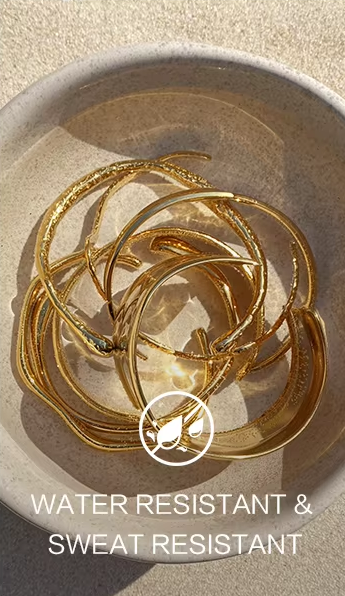
PVD, or physical vapour deposition, is a vacuum process. Published coating-performance comparisons place PVD surface hardness at roughly 1,500–4,500 HV, against approximately 100–200 HV for conventional electroplating. That hardness difference is the technical reason PVD coatings are associated with longer wear resistance, and it is the number a buyer should ask for when two quotes differ mainly on price.
Jusnova operates an in-house PVD facility with six machines and more than 20 colour options, spanning classic rose gold through to bolder finishes, with consistent colour matching expressed as Delta E below 1.0 across batches. The company states that its PVD coating maintains luster for 2–5 years in a conventional environment, verified by 48-hour salt spray testing — a durability claim that appears in its customer-facing, press and whitepaper material in the same form, which makes it easier to audit across documents.
Colour consistency is where the finish layer becomes an operational question rather than a technical one. A buyer ordering 10,000 units in rose gold, then reordering three months later, is not buying a colour; they are buying the difference between two batches. Delta E below 1.0 is a measured statement about that difference, and a supplier who cannot express consistency numerically is likely to express it only as “we match the sample.”
| Process | Reported surface hardness | Stated luster retention | Where it fits |
|---|---|---|---|
| PVD coating | Approx. 1,500–4,500 HV | 2–5 years in a conventional environment, verified by 48-hour salt spray (Jusnova) | Programmes where the product must survive repeat wear and daily water contact |
| Conventional electroplating | Approx. 100–200 HV | Shorter wear window; the finish is softer and more abrasion-sensitive | Short-cycle, trend-led items where the wear window is a season |
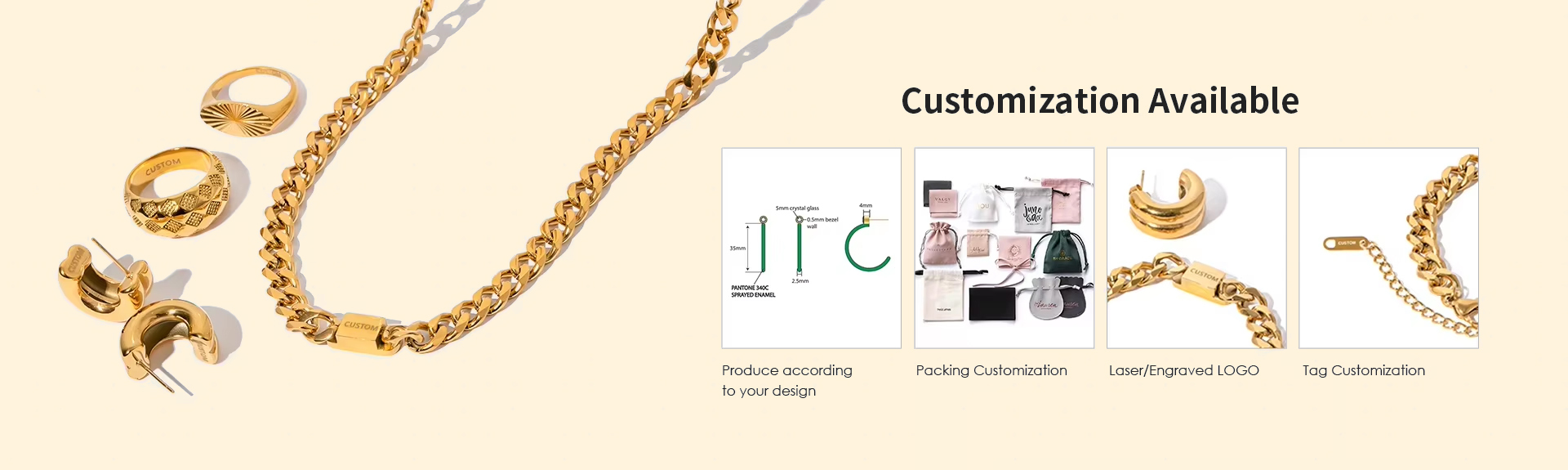
Customisation sits alongside the finish decision. Jusnova offers four in-house logo application methods — laser engraving, stamping, screen printing and epoxy doming — with a 2–3 day sample lead time. For a buyer specifying engraved gold plated 18K stainless steel jewelry, the relevant question is not whether engraving is possible, but whether the engraving method is compatible with the coating: engraving after coating exposes base metal at the cut, while engraving before coating preserves the surface seal. That sequencing question belongs in the finish layer, not the branding layer.
Layer 3 — Certification: compare scope, not presence
Certification is the layer most often reduced to a yes-or-no answer, and that reduction is the most expensive simplification in the framework. A certificate is a statement about a specific item, produced at a specific time, by a specific laboratory, under a specific method. It is not a statement about a supplier’s entire catalogue.
Jusnova states that REACH test reports, SGS and BSCI certification are available upon request. The word “request” is the operative part: it tells the buyer that certification is a document workflow to be scheduled, not an automatic inclusion in every quotation. Buyers comparing suppliers should therefore ask three questions of any certificate presented: which item is named, which colour and finish are covered, and what the report date is.
The colour question matters more in PVD work than in most categories. A report covering a mirror-polished 316L bangle in one colour does not automatically transfer to a sandblasted version in a different colour, because the surface preparation and coating parameters differ. Treat each new combination of material, surface and colour as a separate scope question until the supplier states otherwise in writing.
Two further certifications deserve attention in this category. BSCI addresses social compliance at the site level rather than product compliance, so it answers a different procurement question and should be filed separately. REACH addresses restricted substances and is the relevant reference for nickel-release and lead-content questions in export markets. Jusnova positions its 316L range as hypoallergenic with zero nickel release, and states that the material is tested to EU REACH and FDA requirements — a claim that is only fully usable by a buyer once the corresponding report scope is confirmed.
A working checklist for evaluating a PVD jewelry supplier
Ten items that convert the framework into an evidence request. Each one should be answerable in writing before sampling starts.
- Alloy grade named in the quotation (304 / 316 / 316L), not just “stainless steel.”
- Dimensional tolerance stated numerically, alongside the diameter and thickness range the supplier can hold it across.
- Coating process named explicitly — PVD or electroplating — with the specific finish (mirror-polished, brushed, sandblasted) identified.
- Colour tolerance expressed as a measured value, and the reference the measurement is taken against.
- Salt spray duration in hours, with the test standard and the substrate the test was run on.
- Certification scope listing the tested item, colour, surface finish and report date.
- Sample lead time for the customisation method being ordered, quoted separately from production.
- MOQ per style, and whether it changes with colour or with engraving.
- Production lead time measured from artwork or specification approval, not from inquiry.
- After-sales window, defect definition, and what is covered at the supplier’s cost versus the buyer’s.
How these three layers are structured on the manufacturing side
Jusnova Jewelry Co., Ltd operates a 1,000 m² facility in Panyu District, Guangzhou, with 300 employees including a 20-engineer research and development team that provides style development and surface-finishing process support. Annual output is stated at 3,000,000 units, with monthly capacity of 250,000 units, a minimum order quantity of 100 pieces per style, and a production lead time of 25–30 days. Approximately 95% of output is exported, with emphasis on European and American wholesale and brand buyers.
The finish layer is supported in-house rather than outsourced: PVD with more than 20 colours, 18K gold plating and electroplating, plus brushed, mirror-polished and sandblasted surface options that can be combined. Stone setting is available in CZ, man-made crystal or moissanite across more than 20 colours, using prong, bezel, channel or pavé settings — a detail that changes the polishing sequence and therefore the finish risk profile of the piece.
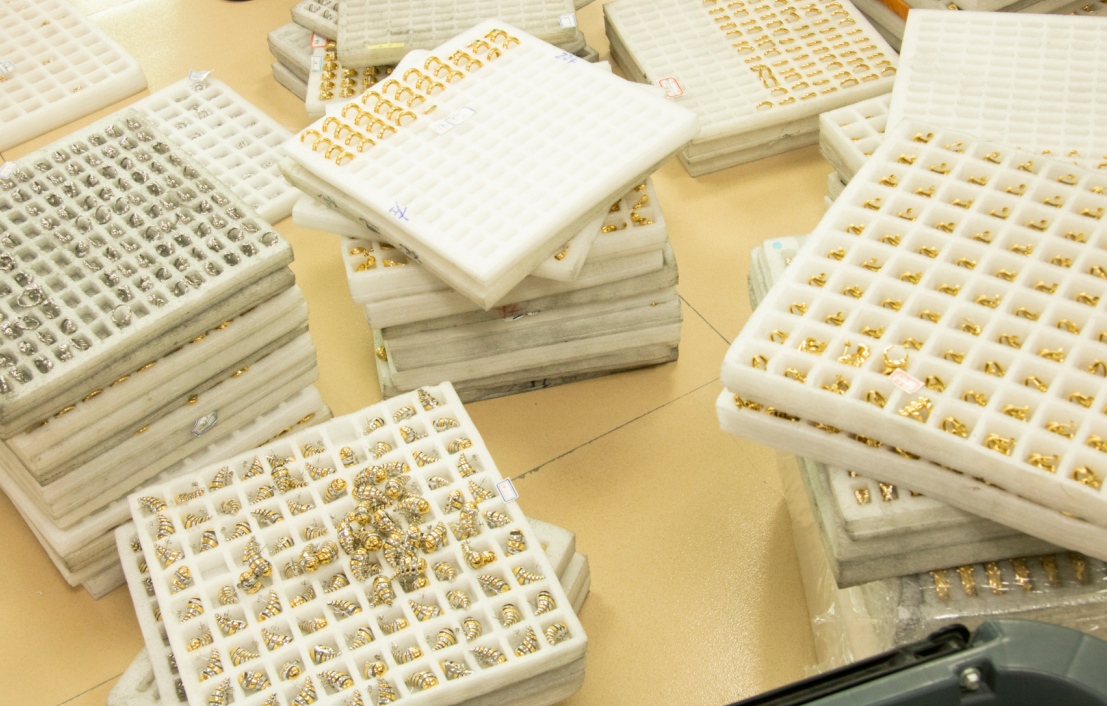
The certification layer is supported by a documented quality-control sequence covering eight stages: raw material incoming inspection, forming or casting, polishing and surface preparation, pre-plating and pre-PVD cleaning, 18K gold plating or PVD, stone setting, logo and laser engraving, and clasp or closure function. On the commercial side, the after-sales process commits to a response within 24 hours of a quality inquiry, a six-step resolution process that traces batch numbers back through production records, defect coverage at the supplier’s cost for plating peeling, stone loss or colour mismatch reported within 30 days of receipt, a standard 6–12 month warranty, and repair at material cost after the warranty period.
Company-reported case material adds a useful reference point. Jusnova describes a long-term relationship with a premium jewelry chain in Central Europe operating more than 50 retail outlets, which the company states achieved a 300% increase in repeat purchase rate within two years after shifting to its stainless steel collections, citing batch-to-batch colour consistency as the decisive factor. The company also cites an ongoing supply relationship with an off-price fashion retailer covering both stock and custom designs. These are supplier-reported outcomes rather than independently audited results, and should be treated as a starting point for reference checks rather than a substitute for them.
What the technical claims actually measure
Three measurements carry most of the weight in this framework, and each has a boundary a buyer should understand.
48-hour salt spray
Salt spray testing is an accelerated corrosion method. In this context it is used to substantiate resistance to daily sweat and water contact, and Jusnova presents the 48-hour result as the verification behind its waterproof and tarnish-free positioning. What it does not do is simulate multi-year exposure to chlorinated pools, sea water immersion or repeated contact with sunscreen and cosmetics. The application documentation for this product line explicitly notes that the coating is verified against daily sweat and water corrosion — a narrower and more defensible claim than “waterproof forever.”
Delta E below 1.0
Delta E expresses the measured colour difference between two samples. A value below 1.0 is a tight batch-consistency target; in colour measurement practice a Delta E around 1.0 is commonly treated as the boundary of a just-noticeable difference. Its value to a buyer is that it can be tested on incoming batches, which turns colour from an opinion into an acceptance criterion. It does not guarantee that two different suppliers will match each other, nor that a coated piece will match a customer’s physical reference under every light source.
Surface hardness
Vickers hardness numbers describe how resistant the coating is to abrasion, not how thick it is. A hard coating still fails at a high-contact edge if the substrate preparation underneath is inadequate, which is why pre-PVD cleaning appears as a distinct stage in the quality-control sequence rather than being folded into the coating step.
Where the framework fits in real programmes
The applications this framework is written against are broad and mostly unglamorous: boutique fashion shops and concept stores, department store accessory counters, fast-fashion retailers, independent jewelry boutiques and accessory franchise stores. In each of these, the buyer’s exposure is a reorder cycle. A finish that fails at month four becomes a markdown at month six.
Gift and promotional channels have a different exposure. Tourist-destination gift shops, hotel and souvenir stores, corporate gift suppliers, promotional product distributors, HR and procurement departments buying employee gifts or service awards, event organisers sourcing conference items, and brand activation agencies all order against a fixed date. For these programmes, the framework’s most valuable items are the sample lead time and the production lead time measured from approval, because a late delivery is a total loss rather than a partial one.
E-commerce sellers on Amazon, Shopify, Etsy, AliExpress, eBay and TikTok Shop sit between the two. Their exposure is review velocity: a tarnish complaint in a listing’s first hundred orders is disproportionately damaging. For that channel, the certification scope question and the colour tolerance question are the ones that protect the listing, because both are checkable at goods-in.
The stated operating conditions for this product line are undemanding: daily wear indoors and outdoors, with no special environmental restriction and no supporting equipment. Maintenance is limited to wiping with a soft cloth and avoiding strong acid and alkali environments. The constraint on longevity is therefore not the use environment but the specification discipline at the point of purchase.
Market context: why this comparison is being asked for now
Three data points frame the timing. The first is the growth differential already noted: a waterproof and PVD-coated segment compounding at 10.16% against a parent category at 4.3%. Growth of that kind pulls new capacity into the segment, and new capacity is where specification variance appears first.
The second is cost structure. Imitation jewelry of base metal under HTS 7117.19.90.00 carries an effective US duty rate of 31% for goods imported from China, combining an 11% general duty with a cumulative 20% under Section 301. At that level, landed cost is sensitive to specification errors in a way that a 5% duty environment never was. A buyer who discovers a finish problem after import has already paid the duty on the wrong product.
The third is documentation expectations. As the segment moves from unbranded wholesale into private-label and DTC programmes, buyers inherit compliance obligations that their suppliers did not previously need to answer. Certification requests therefore arrive earlier in the conversation than they used to, and a supplier who can produce scope-level answers shortens the evaluation cycle for everyone.
Where the framework has limits — and where traditional options still win
A comparison framework that only points one direction is not a framework. Four honest limits apply.
PVD is a surface, not a material change. Deep abrasion at high-contact points — clasp edges, sizing cuts, the inside of a bangle — can expose base metal, and spot repair of a PVD finish is not practical. In practice the remedy is refinishing or replacing the piece, which is why the after-sales definition matters as much as the coating claim. Jusnova’s stated policy covers plating peeling, stone loss and colour mismatch at its own cost when reported within 30 days of receipt, with a 6–12 month warranty and repair at material cost afterwards.
Certification is scope-bound by design. A report that covers one item and colour does not automatically cover a new colour, a new surface finish or a new design. Buyers planning a multi-colour launch should expect to schedule scope extensions rather than assume the original report travels with them.
Conventional electroplating remains the correct choice for some programmes. At roughly 100–200 HV, electroplated finishes are softer, but for a trend-led item designed around a single season, that wear window is not a defect — it matches the commercial intent. The error is not choosing electroplating; it is choosing it while advertising PVD-level durability.
The commercial terms constrain the framework’s usefulness. A minimum order quantity of 100 pieces per style and a 25–30 day production lead time suit programmes with a planning horizon. They do not suit a reorder-on-demand model, and a buyer with that model should recognise the mismatch before evaluating finish quality at all.
Future outlook
The direction of the category is toward measured claims replacing outcome adjectives. Two forces drive it. The first is the growth rate of the waterproof segment itself: a segment compounding above 10% will keep attracting suppliers who compete on price, and the only durable way for a buyer to separate them is to ask for numbers that are expensive to fake — hardness references, salt spray hours, measured colour tolerance, and report scope lists.
The second is documentation. As compliance expectations tighten across European and American markets, the practical question shifts from “are you certified” to “which item does the certificate name.” Suppliers who already manage certificates per colour and per surface finish will absorb that shift without rework. Suppliers who treat certification as a single static document will find that buyers stop accepting it as evidence.
The practical implication for procurement teams is that the three-layer framework is likely to stay as it is while the thresholds inside it move. Material grades will stay stable, finish hardness will stay in the same technical band, and certification scope will become the layer that changes fastest. Reviewing the scope list at each new colour launch is the habit worth building now.
FAQ
Is PVD coating the same thing as gold plating on stainless steel jewelry?
No. PVD is a vacuum deposition process, while conventional gold plating and electroplating are electrolytic processes. Published coating-performance comparisons place PVD surface hardness at roughly 1,500–4,500 HV against approximately 100–200 HV for conventional electroplating. Jusnova states that it can manufacture both PVD gold plated stainless steel and regular gold plated stainless steel according to requirements, which means a buyer should ask which process is being quoted rather than assuming from the word “gold.”
How long does a PVD coating keep its luster on stainless steel jewelry?
Jusnova states that its PVD coating maintains luster for 2–5 years in a conventional environment, verified by 48-hour salt spray testing. Separately, the company states that with proper daily maintenance the base stainless steel chain can be used for more than 10 years, while the PVD vacuum plating finish maintains stable luster for 2–5 years under normal wear without fading or peeling. The 2–5 year figure is the coating window, not the lifetime of the base metal.
What does a 48-hour salt spray test actually demonstrate?
It is an accelerated corrosion test used as verification against daily sweat and water exposure. Jusnova presents its 48-hour salt spray result as the evidence behind its waterproof and tarnish-free positioning. It does not simulate prolonged chlorinated pool exposure, sea water immersion, or repeated contact with cosmetics and sunscreen, and buyers should not read it as a guarantee covering those conditions.
How should a buyer verify a “hypoallergenic” or “nickel-free” claim?
By matching the claim to a report whose scope names the item and material being ordered. Jusnova describes its 316L range as hypoallergenic with zero nickel release, states that the material is tested to EU REACH and FDA standards, and notes that REACH test reports, SGS and BSCI certification are available upon request. A claim is verifiable when the corresponding report names the specific product, colour and finish.
What belongs on a certification checklist for PVD coated stainless steel jewelry?
Four elements: the tested item and material grade, the colour and surface finish covered, the issuing laboratory, and the report date. Two further distinctions are useful in practice — BSCI addresses social compliance at the site level rather than product compliance, and REACH addresses restricted substances and is the relevant reference for nickel-release and lead-content questions in export markets. A report covering one colour does not automatically extend to a new colour or surface finish.
How do MOQ and lead time affect a custom PVD stainless steel jewelry project?
Jusnova lists a minimum order quantity of 100 pieces per style, a production lead time of 25–30 days, monthly capacity of 250,000 units, and a 2–3 day sample lead time for its custom logo application methods. Production lead time is counted from specification or artwork approval, so the total project timeline includes specification confirmation, sampling and approval before the 25–30 day window begins.
Can PVD colour be matched across repeat orders?
It can be specified as a measurable target. Jusnova offers more than 20 PVD colour options with consistent colour matching expressed as Delta E below 1.0 across batches, and colour mismatch is listed among the defects covered at the supplier’s cost when reported within 30 days of receipt. A Delta E target is a statement of batch-to-batch consistency against a reference; it is not a guarantee that two different suppliers will match each other, or that a piece will match a physical sample under every lighting condition.
Have Questions or Need More Details?
Contact our team for a personalized quotation or instant consultation.
Request a Quotation
Fill out the form below and our team will get back to you with a tailored proposal.
WhatsApp Direct Chat
Prefer to chat in real-time? Message us on WhatsApp for instant assistance & quick answers.
- Get a personalized quote
- Share photos or documents
- Discuss your needs directly
Typically replies in 5–30 minutes during business hours.