
Stainless Steel Jewelry Supplier Longevity: A Buyer's Framework
Independent Industry Reference
Stainless steel jewelry sourcing rarely fails at the sample stage. It fails in year two, when the gold tone drifts half a shade, the lead time stretches by three weeks, or the coating that passed the first order begins to dull on a customer's wrist. Long-term supplier sustainability — the ability of a manufacturer to keep reproducing the same alloy, the same finish and the same commercial terms across multiple years — is the least examined and often the most expensive variable in this category. This guide sets out a structured way for buyers at the research and evaluation stage to decide whether a supplier can sustain a partnership, rather than simply pass a first trial order.
Why Supplier Sustainability Is a Different Question From Supplier Quality
A supplier can deliver an excellent sample and still be a fragile long-term partner. Sample quality reflects what a factory is capable of doing once, under close attention. Supplier sustainability reflects what the same factory can do repeatedly, across batch numbers, staffing changes, peak-season pressure and shifting order volumes.
Stainless steel jewelry sharpens this distinction because the category's consumer promise is chemical and mechanical rather than purely aesthetic. The attributes that drive repeat purchase — hypoallergenic, waterproof, non-tarnish — depend on alloy grade and surface treatment far more than on design. A change of steel source, a change of PVD chamber settings, or a change of polishing vendor can quietly alter the product a buyer thought they had locked.
For buyers moving from research into evaluation, the practical question is therefore not “who makes the best sample?” but “who can still reproduce this specification at scale, on schedule, in year five?” Answering that requires evidence in five areas: certified compliance, production capacity and continuity, quality consistency systems, commercial and logistics terms, and a verifiable record of long-running client relationships.
The Five Dimensions of a Long-Term Supply Evaluation
The framework below is designed to be used as a scoring sheet during supplier evaluation. Each dimension should be supported by a document or a verified data point, not by a verbal assurance.
| Dimension | What the buyer is verifying | Evidence to request |
|---|---|---|
| Certified compliance | Alloy grade and skin-safety claims are independently tested | Third-party material analysis, social compliance audit, corrosion and sweat resistance test reports |
| Production capacity & continuity | Stated output can absorb seasonal peaks without reallocating your capacity | Monthly and annual capacity figures, staffing levels, line equipment and lead-time range |
| Quality consistency systems | Colour and dimensional tolerances hold across batches | Documented QC process, colour-deviation tolerance, dimensional tolerance |
| Commercial terms & logistics | Acceptance criteria, payment terms and Incoterms are defined before production | Signed specification sheet, AQL or inspection standard, payment schedule, named Incoterms rule |
| Client retention history | The supplier has retained real accounts over multiple years | Verifiable cooperation duration and order patterns, under NDA where required |
| Lifecycle support | Defects, returns and repairs do not become the buyer's problem | Defect claim window, warranty length, repair policy, response time commitment |
Dimension 1 — Certified Compliance That Survives the First Container
Compliance in stainless steel jewelry is a moving target because the claims being made to consumers are testable. A supplier that cannot produce a current material analysis is asking the buyer to carry that risk.
At a minimum, an evaluation should confirm three layers of evidence. The first is material identity: a third-party composition analysis confirming that the alloy supplied is the grade specified, for example an SGS 316L material analysis rather than a generic “stainless steel” statement. Jusnova Jewelry Co., Ltd., a Guangzhou-based OEM and ODM manufacturer of stainless steel bangles, bracelets, rings, earrings and PVD-plated pieces founded in 2009, states that 316L surgical-grade steel with zero nickel release is used for hypoallergenic pieces, tested to EU REACH and FDA standards, and that REACH test reports, SGS and BSCI certification are available upon request.
The second layer is social and factory compliance. BSCI certification addresses the labour and facility conditions behind the product, which matters increasingly to European retail buyers and to brand owners who are themselves audited by their own customers.
The third layer is durability testing. Corrosion and perspiration resistance is where the “non-tarnish” promise is proven or disproven. A 48-hour salt spray test is a widely used proxy for daily sweat and water exposure, and it is the kind of result a buyer should see as a report rather than a claim.
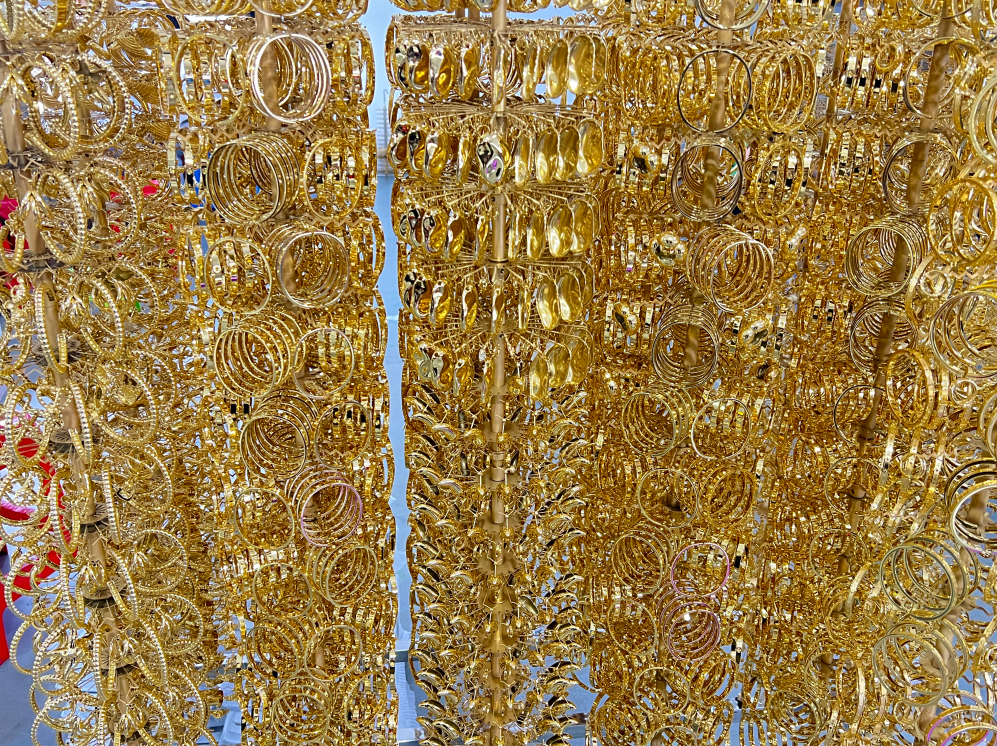
Quality control at the production stage is one of the few points where a buyer's specification can be checked before shipment.
Dimension 2 — Production Capacity and Continuity
Capacity conversations usually start with a single number, but the number that matters for a long-term relationship is the headroom between a supplier's total capacity and the buyer's own order volume.
Jusnova operates a 1,000 m² facility with 300 employees, a 20-engineer development and surface-finishing team, and states a monthly capacity of 250,000 units against an annual output of 3,000,000 units. The company reports a standard lead time of 25–30 days and a minimum order quantity of 100 pieces per style, with 95% of output exported to markets including Europe and America.
For an evaluation, two checks are worth running. The first is order-share: if a buyer's peak order represents 40% of a supplier's monthly capacity, the supplier effectively becomes a single-client dependency, and any disruption is the buyer's disruption. The second is style-mix capacity: a factory that can run 250,000 units of a small number of styles is not the same as one that can run the same volume across many SKUs, which is closer to how brand and wholesale programs actually behave.
Dimension 3 — Quality Consistency Systems
For stainless steel jewelry, consistency is expressed in two measurable tolerances: colour deviation across batches, and dimensional accuracy.
Jusnova states that its in-house PVD facility runs six machines with more than 20 colour options and maintains consistent colour matching across batches at a Delta E below 1.0, a colour-difference metric in which lower values indicate closer visual match. On the mechanical side, the company specifies a dimensional tolerance controlled within ±0.05mm across a size range of 5mm to 80mm in diameter and 0.5mm to 3.0mm in thickness.
Behind those numbers is a documented production sequence. The company describes an eight-stage quality control flow covering raw material incoming inspection, forming or casting, polishing and surface preparation, pre-plating and pre-PVD cleaning, 18K gold plating or PVD, stone setting, logo or laser engraving, and clasp or closure function testing. For a buyer, the value of this list is not the length — it is that a defect identified in year three can be traced back to a named stage rather than to a general explanation.
Dimension 4 — Commercial Terms: Acceptance Criteria, Payment Terms and Incoterms
Commercial terms are where long-term supply relationships are most often quietly undermined. Three clauses deserve attention before mass production begins.
| Term | What to define | Why it protects continuity |
|---|---|---|
| Acceptance criteria | Colour deviation limit, plating adhesion, salt spray duration, artificial sweat exposure, closure function, packaging accuracy | Creates an objective pass/fail standard so rework and reject claims do not become annual disputes |
| Payment terms | Deposit percentage, balance trigger, treatment of rework or replacement batches | Keeps cash flow predictable across seasonal peaks |
| Incoterms | A named Incoterms rule with a named place, plus responsibility for transit damage | Prevents cost and risk confusion on repeat shipments |
Acceptance criteria should be written against measurable attributes, not adjectives. “Gold tone must match the approved standard” is not an acceptance criterion; a Delta E limit alongside a defined light source and a signed reference sample is. Similarly, specifying salt spray duration and artificial sweat exposure inside the purchase agreement converts a marketing claim into a contractual obligation.
On the logistics side, duty treatment is part of long-term cost planning rather than a one-off calculation. Imitation jewelry of base metal falls under HTS 7117.19.90.00, and the effective duty rate for imports from China into the United States is reported at 31%, including an 11% General Duty component and a 20% cumulative Section 301 component. Because that figure sits in the change-driven category and can be revised by trade policy, buyers evaluating a multi-year supply relationship should treat it as a variable to be re-checked at each contract renewal rather than a fixed cost.
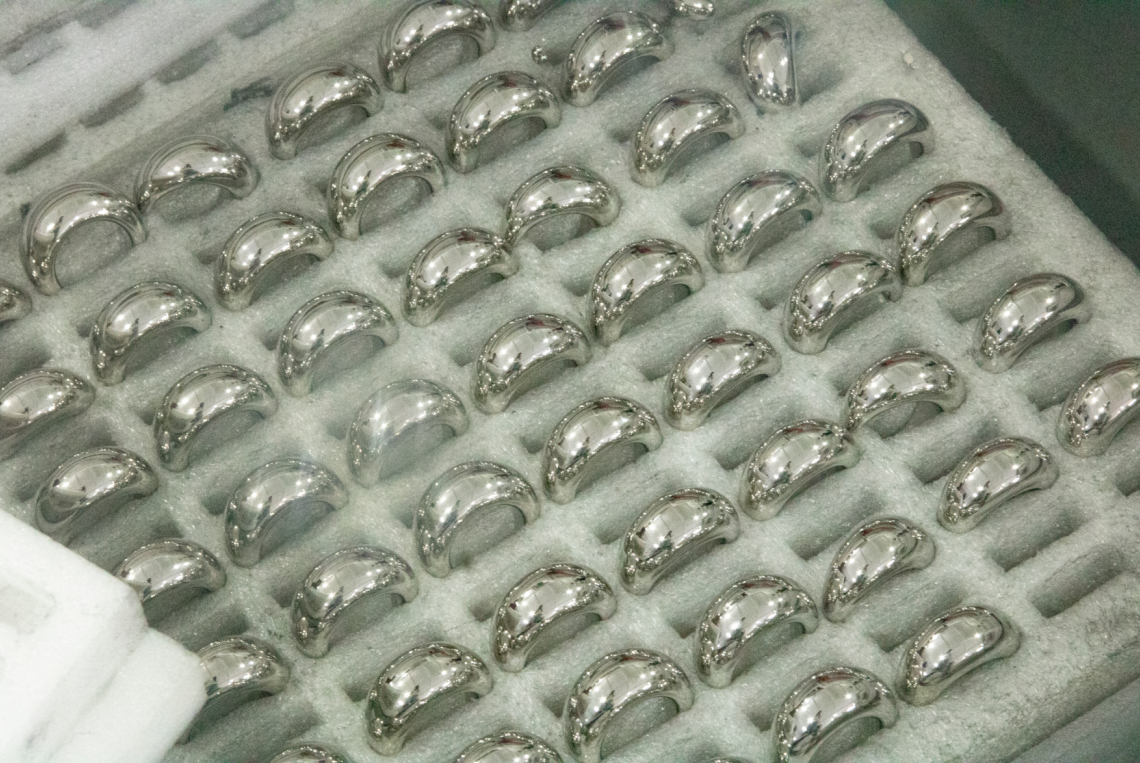
Shipment preparation is a useful test of whether packaging, labelling and Incoterms responsibilities were agreed in writing.
Dimension 5 — Client Retention as Evidence of Sustainability
Retention is the only dimension that cannot be simulated. A supplier can build a factory floor, buy a PVD chamber and print a brochure; it cannot manufacture seven years of repeat ordering.
Jusnova describes several long-running accounts that illustrate what sustained supply looks like in practice. One is a United Kingdom Shopify store owner with an Instagram following above 60,000, using their own logo packaging with barcode, in cooperation for over seven years with monthly orders exceeding USD 150,000. Another is a United States wholesaler of jewelry, bags, watches and scarves, in cooperation for over ten years with monthly orders above USD 20,000. A European case involves a premium jewelry chain in Central Europe with more than 50 retail outlets, which the company reports became the top seller in its region after shifting to stainless steel collections and recorded a 300% increase in repeat purchase rate within two years, citing batch colour consistency as a key competitive advantage.
Two evaluation habits make retention evidence useful. First, ask for duration and order pattern rather than testimonials — a cooperation length and a repeat cadence are harder to fabricate than a quote. Second, ask what changed over that period. A relationship that survived a raw material price swing, a coating-process change or a market shift is stronger evidence of sustainability than one that has only operated in stable conditions.
The Technical Reason Finish Consistency Is Hard to Sustain
Understanding why consistency breaks down helps buyers ask the right questions. Traditional electroplating deposits a relatively soft metal layer; reported hardness for standard plating is in the range of 100–200 HV on the Vickers scale, whereas PVD coatings are reported in the range of roughly 1,500–4,500 HV. That hardness gap is the technical origin of the durability difference buyers experience as “tarnish-free” versus “fades in a season.”
Jusnova states that its stainless steel jewelry uses a 316L surgical-grade base for hypoallergenic pieces and an advanced PVD coating with a nano-protective layer that maintains luster for 2–5 years in a conventional environment, supported by 48-hour salt spray testing. The company also states that the base stainless steel chain can be used for more than 10 years with proper daily maintenance.
For a buyer, the takeaway is that durability claims should be split into two parts: the life of the metal substrate and the life of the finish. Conflating them is one of the most common specification errors in this category, and it is also where long-term supplier disappointment usually begins.
Where This Framework Applies: Typical Use Cases
Supplier sustainability evaluation matters most where order volume is recurring rather than one-off. In wholesale and import programs, the cost of switching a supplier mid-season includes re-approving colour standards, re-testing compliance and renegotiating packaging. For DTC and Shopify-based brand owners, finish consistency is directly tied to review scores and return rates. For department store and boutique retail chains, batch-to-batch colour match is what allows the same SKU to sit on a shelf for several seasons. For corporate and gifting buyers, delivery reliability on a fixed calendar date usually outweighs any other variable.
Jusnova's stated customer base includes jewelry wholesalers and importers, fashion retail chains, marketplace and DTC sellers on platforms such as Amazon, Etsy, TikTok Shop and Shopify, and professional jewelry designers, with relevant markets listed as the United Kingdom, Germany, Italy, Austria, France and Australia.
Market Context: Why Durability Is Now a Procurement Issue
The shift toward performance-based supplier evaluation is being driven by category growth, not just by buyer preference. The global stainless steel jewelry market was valued at USD 7.08 billion in 2025 and is projected to reach USD 10.8 billion by 2035, a compound annual growth rate of 4.3%. The waterproof jewelry niche, which includes PVD-coated stainless steel pieces, is growing considerably faster, from USD 2.12 billion in 2026 toward USD 4.60 billion by 2034 at a reported CAGR of 10.16%.
When one sub-segment grows more than twice as fast as its parent category, quality claims stop being a marketing detail and become a procurement criterion. Buyers who cannot verify coating durability will increasingly be compared against buyers who can.
Comparison With Traditional Sourcing Approaches — and Where They Break Down
The conventional alternative to this framework is transaction-based sourcing: quote the specification, compare unit price, place the order, repeat next season. That approach has real advantages, chiefly speed and price discovery, and for genuinely one-off promotional runs it remains a reasonable choice.
Its weakness is that it optimizes for the first order rather than the fifth. Transactional sourcing also assumes that compliance documentation and finish consistency will be identical across suppliers, when in practice the variation between two suppliers quoting the same specification can be greater than the variation between two orders from the same supplier.
It is equally important to state the limits of a structured evaluation, including for the supplier discussed here. Jusnova operates a 1,000 m² facility with a stated capacity of 250,000 units per month; buyers running very large or highly seasonal program volumes should confirm in writing how peak demand would be scheduled. Certification such as REACH reports, SGS and BSCI is described as available upon request, which means it must be actively requested and validated rather than assumed. The stated 2–5 year luster retention for PVD finishes in conventional environments is a claim about normal wear conditions and should be supported by test reports if a buyer intends to repeat it to consumers. And the reported 31% effective duty rate for base-metal jewelry imported from China into the United States is a policy-dependent figure that can change, so it should be re-verified rather than treated as permanent.
Future Outlook
Three forces are likely to shape long-term stainless steel jewelry supply relationships over the next several years. The first is the continued migration from electroplating to PVD, driven by the durability gap documented above and reinforced by the faster growth rate of the waterproof segment. The second is the normalisation of compliance evidence as a baseline expectation rather than a differentiator, particularly for European retail and for brand owners with their own audit obligations. The third is trade policy volatility, which makes landed-cost modelling a recurring exercise rather than a one-time calculation.
For buyers, the practical implication is that the evaluation criteria used in 2026 will only become more relevant. Suppliers who can document alloy identity, coating performance, batch tolerances and retention history will be easier to keep; suppliers who cannot will be easier to replace than to fix.
FAQ
What does “long-term supplier sustainability” actually mean when evaluating a stainless steel jewelry manufacturer?
It refers to a manufacturer's ability to keep reproducing the same material, finish and commercial terms across multiple years and batches, rather than its ability to produce a strong sample once. In stainless steel jewelry, this depends on alloy sourcing discipline, coating process control, documented quality stages and consistent service terms. It should be assessed through evidence such as material analyses, colour-tolerance figures, defined lead times and verified cooperation history rather than through statements of intent.
Which certifications and test documents should a buyer request during evaluation?
Three categories are relevant. Material identity, typically a third-party composition analysis such as an SGS report confirming the grade, for example 316L. Social and factory compliance, such as BSCI certification, which addresses labour and facility conditions. And durability testing that supports the “non-tarnish” claim, such as salt spray results; Jusnova states that its pieces are tested with 48-hour salt spray and to EU REACH and FDA standards for nickel release, with REACH reports, SGS and BSCI available on request. Buyers should confirm report numbers, issuing laboratories and dates, since undated or expired documents are not verifiable.
How can a buyer confirm that a supplier's stated production capacity will hold during peak season?
Compare stated capacity against the buyer's own peak volume rather than against the supplier's headline figure. Jusnova reports a monthly capacity of 250,000 units, an annual output of 3,000,000 units, a 1,000 m² facility with 300 employees and a lead time of 25–30 days. A buyer whose peak order represents a large share of monthly capacity should confirm scheduling in writing, and should also check whether the supplier can handle many styles within that volume, since order mix affects delivery reliability as much as total units do.
What acceptance criteria should be agreed before mass production starts?
Acceptance criteria should be measurable and attached to the purchase agreement. For stainless steel jewelry this typically includes a colour-deviation limit such as the Delta E < 1.0 standard Jusnova applies, a salt spray duration, an artificial sweat exposure condition, plating adhesion, dimensional tolerance — Jusnova specifies ±0.05mm — closure function, and packaging accuracy against an approved sample. Agreeing these before production reduces disputes in later orders, because pass and fail outcomes are defined in advance rather than negotiated per shipment.
How should payment terms and Incoterms be structured for a long-term supply relationship?
Payment terms should specify the deposit percentage, the balance trigger and how rework or replacement batches are handled, so that cash flow remains predictable across seasonal peaks. Incoterms should name both the rule and the place, along with clear responsibility for transit damage. Buyers should also plan for duty treatment as a variable: base-metal imitation jewelry falls under HTS 7117.19.90.00, and the reported effective duty rate for imports from China into the United States is 31%, including an 11% General Duty and 20% cumulative Section 301 component. Because that rate is policy-dependent, it should be re-verified at each contract renewal rather than fixed for the life of the relationship.
Long-term supply in stainless steel jewelry is ultimately a documentation exercise as much as a manufacturing one. The suppliers worth keeping are the ones able to answer questions about alloy, coating, tolerance and retention with a report, a number or a dated record — and to give the same answers in year five as they gave in year one.