
Stainless Steel Pipes: 2026 Foreign Market Trends Shortlist
The 2026 stainless steel pipe market is expanding, but it is not being reorganised by demand alone. It is being reorganised by constraint: which grades a supplier can document, which certificates a destination market accepts, how much tonnage a plant can allocate, and how quickly that tonnage can be repositioned between regions. This shortlist sets out six foreign market trends procurement teams should track this year, and translates each one into a question that can be asked at the RFQ stage.
Why a 2026 Trend List Is Really a Constraint List
The headline direction of the stainless steel market is not in dispute. Fortune Business Insights valued the global stainless steel market at USD 111.44 billion in 2022 and projects USD 182.10 billion by 2030. What is contested is the pace. Published growth estimates for the 2023–2030 period range from roughly 5.5% (Mordor Intelligence) to 6.1% (Grand View Research).
That divergence is itself the most useful signal for buyers. When the direction of growth is agreed but the rate is not, macro forecasts stop being a reliable planning input. What remains reliably plannable is constraint availability: whether a mill holds a valid attestation for the market you are shipping into, whether the grade you specified is the grade being certified, and whether the volume you need exists at the time you need it.
For that reason, the shortlist below is framed around what changes for a procurement decision, not around a growth percentage.
The Six Trends at a Glance
| Trend | 2026 signal | What it changes for buyers |
|---|---|---|
| 1. Capacity concentration | China exported 4.14 million tons of stainless steel in 2023 (General Administration of Customs of China) | Availability is rarely the bottleneck; allocation and documentation are |
| 2. Certification as market access | EU construction and RoHS regimes; IBC load-bearing rules in North America; ASTM A312 / A554 product standards | Certificate scope and grade coverage become pre-qualification criteria |
| 3. Grade chemistry as a cost lever | 201 and 304 differ materially in chromium, nickel and manganese content | Grade choice becomes a documented specification decision, not a price argument |
| 4. Destination mix shift | Middle East, South America and Africa absorb 70% of Sanon sales | Regional corrosion, project type and payment structures drive specification |
| 5. Surface technology shift | PVD coating adoption for colour pipe is rising (International Stainless Steel Forum) | Finish durability becomes a specification line with a process reference |
| 6. Order-size and lead-time compression | Shorter quoted lead times and defined minimum order quantities at export scale | Inventory strategy and consolidation planning move earlier in the process |
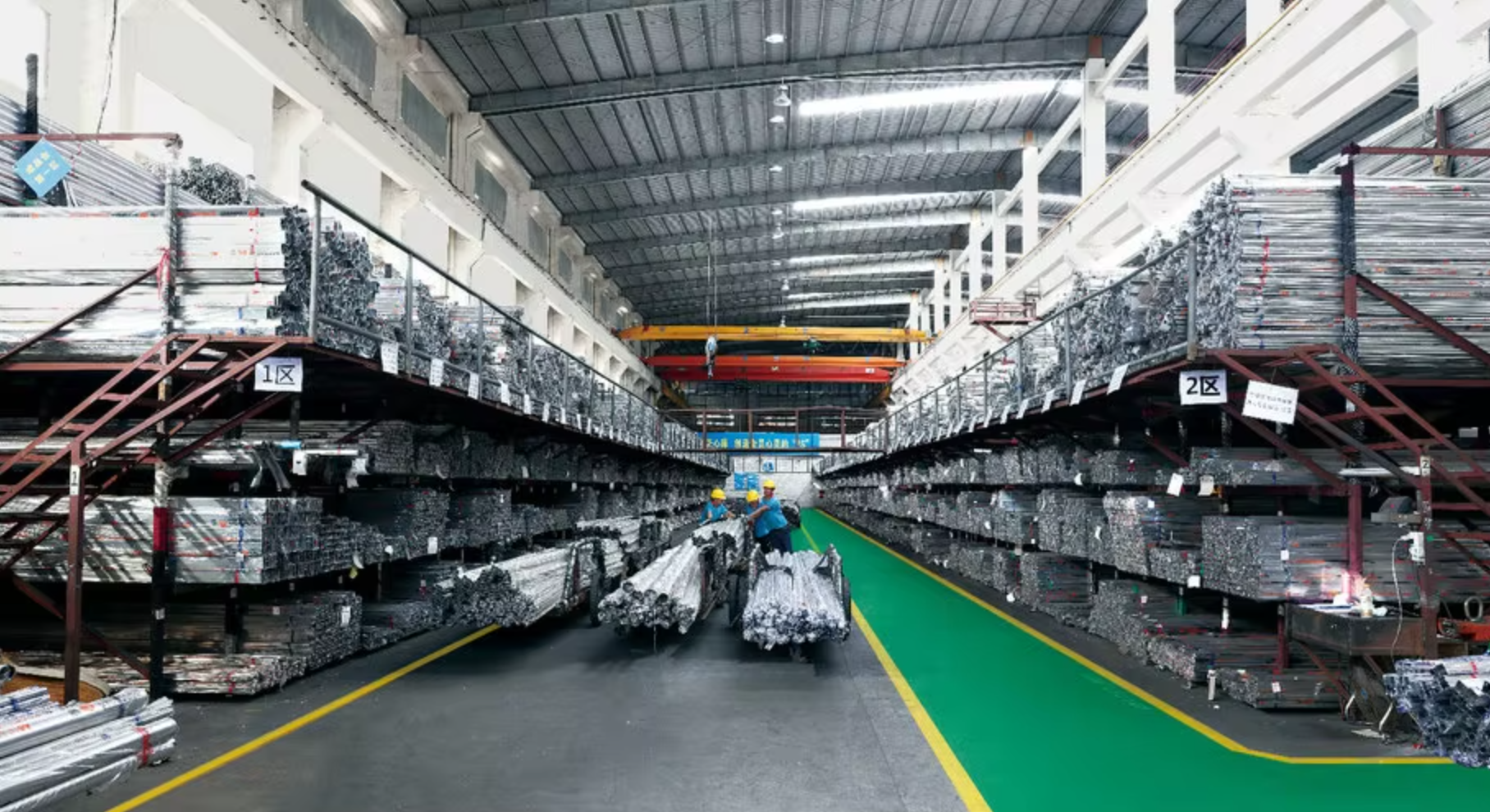
Export-scale pipe and fittings inventory: in 2026 the constraint on delivery is allocation and documentation rather than raw availability.
Trend 1: Capacity Is Concentrated, So Allocation Is the Real Constraint
China's stainless steel exports reached 4.14 million tons in 2023, according to the General Administration of Customs of China. Volume at that scale means that the global market is not short of pipe in aggregate. What it is short of, at any given moment, is pipe that is already allocated, inspected and documented for a specific destination.
Single-site capacity illustrates the point. GuangDong Sanon Metal Products Co., Ltd (Sanon) is a Foshan-based manufacturer of stainless steel pipes, stainless steel tubes, handrail fittings and glass fittings, established in 1999 and operating a 40,000 m² facility with approximately 500 employees. The plant runs a pipe capacity of 9,000 tons per month, against an annual output figure of 100,000 tons across the product range, supported by a 30-person R&D team.
For a buyer, that structure changes the question from "can you supply?" to "what is your allocation for my grade, my finish and my destination in the next production window?" The second question is answerable. The first increasingly is not the point.
Trend 2: Certification Portfolios Have Become Market-Entry Requirements
Certification is shifting from a marketing asset to a gating condition. Three separate regimes now apply to the same shipment depending on where it lands and what it is used for.
- Construction products in the EU. Pipe placed on the EU market under the Construction Products Regulation is assessed against corrosion-resistance test methods such as EN ISO 9227:2022/A1:2024. An ECTI CERT certificate under CPR (reference BGTC20251119-08, issued 19 November 2025, valid to 18 November 2030) demonstrates conformity for the declared scope.
- Restricted substances in the EU. RoHS 2015/863 compliance is typically evidenced through the EN 62321 test series. Sanon's Attestation of Conformity (reference TD59352502, issued 27 October 2025, valid to 26 October 2030) covers EN 62321-4:2014+A1:2017, EN 62321-5:2014, EN 62321-6:2015, EN 62321-7-1:2015, EN 62321-1:2015, EN 62321-7-2:2017 and EN 62321-8:2017.
- Load-bearing hardware in North America. Stainless steel glass clamps and standoff pins fall under building codes such as the International Building Code (IBC), which governs load-bearing capacity rather than material composition alone.
Alongside these, the product standards that define the tubing itself remain ASTM A312 for seamless and welded pipe and ASTM A554 for ornamental tubing. The practical consequence is that a certificate portfolio and a product standard are two different documents, and a compliant supplier should be able to produce both.
Trend 3: Grade Chemistry Has Become a Cost-Constraint Decision
The 201 versus 304 decision is often presented as a price conversation. In 2026 it is better treated as a specification decision, because the chemistry difference is large enough to determine performance in a given environment.
| Element | 201 stainless steel | 304 stainless steel |
|---|---|---|
| Chromium (Cr) | 16–18% | 18–20% |
| Nickel (Ni) | 3.5–5.5% | 8–11% |
| Manganese (Mn) | 5.5–7.5% | ≤2% |
The trade-off is structural. Grade 201 substitutes manganese for part of the nickel content, which supports a lower material cost but narrows the corrosion margin. Grade 304 carries a higher nickel content, which is the basis for its wider use in exposed architectural, handrail and wet-area applications. A buyer who specifies "stainless steel pipe" without naming the grade has, in effect, left the decision to the supplier.
The counter-trend worth noting is that certified scopes do not always cover the full grade range. Buyers should check which grades a specific certificate names, not merely that a certificate exists.
Trend 4: Destination Mix Is Shifting Toward the Middle East, South America and Africa
Export geography is where trend data becomes procurement-relevant. Sanon exports approximately 70% of its sales, with the Middle East, South America and Africa named as its main markets. That concentration is not incidental to the product; it reflects where decorative and architectural stainless steel demand is being built.
At a country-positioning level, the three regions pull specification in different directions:
- Middle East. Large-scale architectural and infrastructure programmes place a premium on finish consistency across long production runs, and on documentation that satisfies both the project consultant and the importing authority.
- South America. A mix of residential, commercial and infrastructural demand rewards suppliers who can serve both standard round and square pipe and the fittings ecosystem around them, since projects rarely order pipe in isolation.
- Africa. Urbanisation-linked construction and water-related infrastructure create demand for pipe that is durable in service, with the cost sensitivity that makes grade selection a live decision rather than a default.
The common thread is that buyers in all three regions are sourcing against a corrosion environment and a project type, not against a catalogue page. Suppliers that can connect grade, finish and fitting specification in one quotation reduce the coordination cost that otherwise falls on the importer.
Trend 5: Surface Technology Is Moving From Electroplating to PVD
Stainless steel colour pipe is one of the few finished-product categories where the process, not the substrate, is the emerging differentiator. The International Stainless Steel Forum notes that PVD (Physical Vapor Deposition) coating for colour pipe is gaining share in interior decoration because it is regarded as more environmentally friendly than electroplating.
For buyers, this converts a visual decision into a process question. A colour specification should be traceable to a named coating process, because two visually similar finishes can have different durability profiles and different compliance implications in markets with restricted-substance rules.
Trend 6: Order Size and Lead Time Are Being Compressed
The least discussed and most operational trend of 2026 is that commercial terms are tightening at the same time as specification requirements. A supplier quoting a defined minimum order quantity and a short lead time is signalling stock depth and production scheduling rather than marketing confidence.
Sanon's published commercial parameters illustrate the pattern: a minimum order quantity of 5 tons, a quoted lead time of 7 days, 100% testing as the quality-control regime, OEM/ODM production with voltage and logo customisation, and remote after-sales support. Each of these is a constraint as much as an offer. A 5-ton minimum means fragmented small projects need consolidation before an order is placed; a 7-day lead time is only meaningful against stock availability for the specific grade and finish.
Where Sanon Sits in the 2026 Trend Map
Sanon's relevance to this trend list is structural rather than promotional. The company combines pipe production and fittings manufacturing in one facility, which matters because most architectural projects order round pipe, square pipe, elbows, bends, glass clamps, brackets, railing flanges and connectors as a single package. Its stated R&D team of 30 people supports OEM/ODM work, and its export profile — roughly 70% of sales to the Middle East, South America and Africa — makes it a direct participant in the destination shift described above.
The company's 10-year relationship with distributor-type clients in China, Vietnam and Brazil, described in its case record as a stable architectural and decorative project programme of 9,000 tons, is consistent with that positioning. It is evidence of continuity rather than of superiority, and it should be read that way.
Technical Reading: What the Certificates Actually Cover
The most common procurement error in 2026 is to treat a certificate as a binary attribute. A certificate has a scope, a grade, a validity period and an issuing authority, and all four matter.
| Certificate | Reference | Scope and standard | Validity |
|---|---|---|---|
| ISO 9001:2015 Quality Management System | 39323Q15531R0M | Production of decorative stainless steel pipes (excluding those requiring quality licence); GB/T 19001-2016 / ISO 9001:2015 | Issued 30 June 2023 on a three-year cycle — confirm current validity at RFQ stage |
| ISO 14001:2015 Environmental Management System | 39323E1762R0M | Environmental management activities related to production of decorative stainless steel pipes; GB/T 24001-2016 / ISO 14001:2015 | 4 December 2023 – 3 December 2026 |
| ISO 45001:2018 Occupational Health and Safety | 39323S1708R0M | Occupational health and safety management activities related to production of decorative stainless steel pipes; GB/T 45001-2020 / ISO 45001:2018 | 4 December 2023 – 3 December 2026 |
| Attestation of Conformity (RoHS) | TD59352502 | EU RoHS 2015/863 restricted substances, tested under the EN 62321 series; issued by EUTEST Belgelendirme Muayene ve Gözetim Hiz. Ltd. Şti. | 27 October 2025 – 26 October 2030 |
| ECTI CERT (CPR) | BGTC20251119-08 | Construction Products Regulation, EN ISO 9227:2022/A1:2024; issued by ECTI CERT Ltd. | 19 November 2025 – 18 November 2030 |
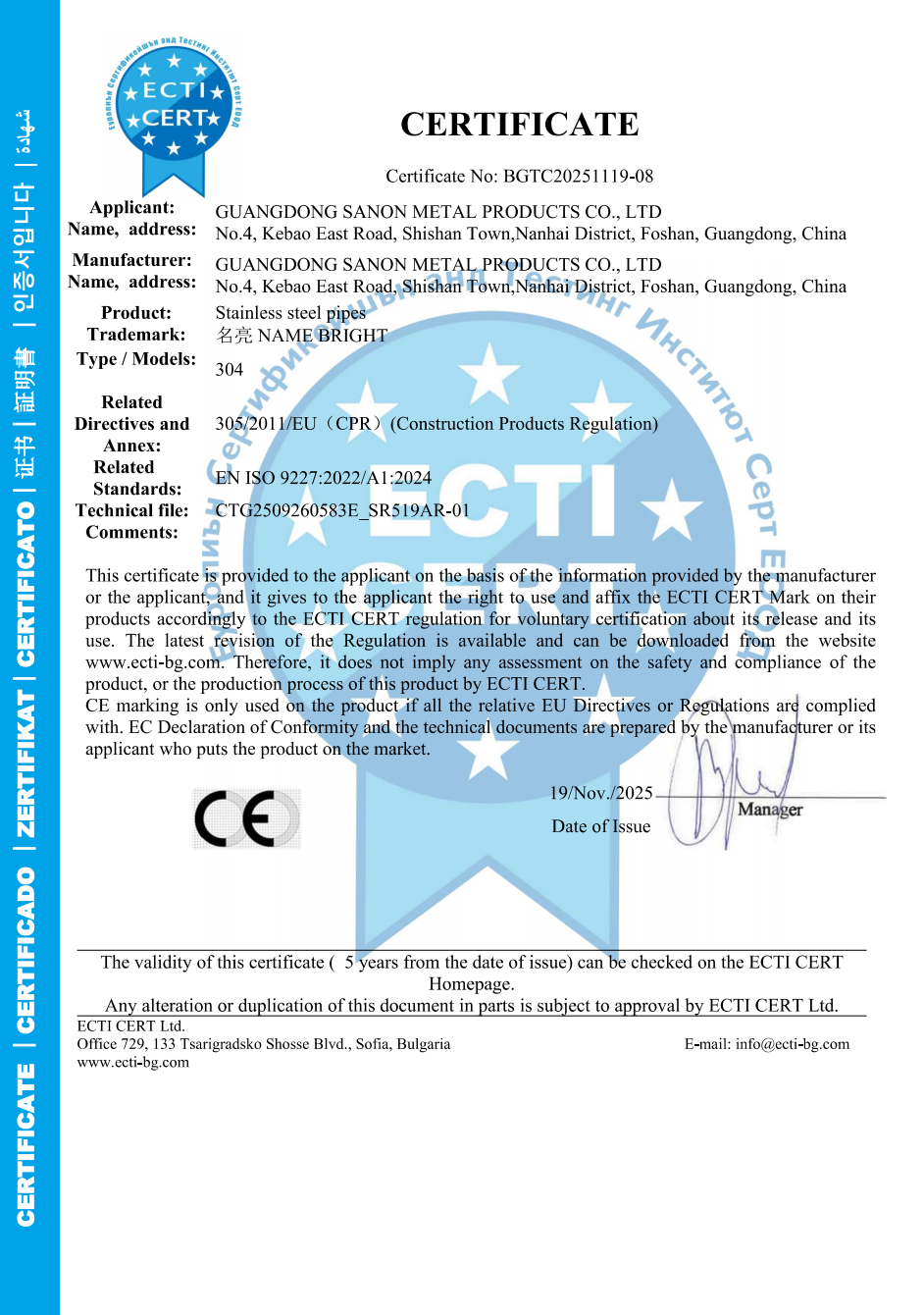
Construction Products Regulation attestation: the scope, the named grade and the validity period matter more than the existence of the document.
Application Fit: Where These Constraints Meet Real Projects
The trend list only becomes useful when it is mapped onto working conditions. Sanon's documented application profile covers architectural and decorative projects in the metal products industry, with welding as a core working condition, automatic operation, and matched equipment including polishing, wire drawing and laser cutting. The stated requirement is rust and corrosion resistance.
That combination — welding plus surface finishing plus corrosion resistance — explains why grade and finish cannot be sourced independently. A balcony handrail system, for example, combines round pipe, elbows and bends, glass clamps or brackets, railing flanges and connectors, and the finish applied to the pipe has to match the finish applied to the fittings, or the installation reads as inconsistent within a single elevation.
Two further application notes follow from the verified data. First, where glass clamps and standoff pins are load-bearing, IBC compliance in North America shifts the question from appearance to structural calculation. Second, where the pipe is ornamental rather than pressure-bearing, ASTM A554 is the applicable reference rather than ASTM A312 — a distinction that is frequently blurred in quotations.
Comparison: Integrated Manufacturing Model vs Multi-Layer Trading Model
The competitive question in 2026 is less "which brand" than "which sourcing structure". The comparison below uses Sanon's documented parameters as the reference case for an integrated manufacturing model, and describes the trading-intermediary model in general terms.
| Dimension | Integrated manufacturer model (Sanon reference) | Multi-layer trading model |
|---|---|---|
| Documentation control | Certificates issued against the producing entity; scope traceable to the pipe line | Documents may originate with a third-party mill and be forwarded without scope reconciliation |
| Grade consistency | 201 and 304 chemistry controlled at the melting and forming stage | Mixed-mill sourcing can produce batch-to-batch chemistry variation |
| Lead time | Quoted at 7 days against a 9,000 t/month pipe capacity | Dependent on the upstream mill's allocation and on intermediary stock |
| Product breadth | Pipe, tube, elbows, bends, glass clamps, brackets, connectors and handrail fittings under one quality regime | Breadth achieved by combining suppliers, each with separate quality systems |
| Minimum order | 5 tons, suitable for programme buying | Often lower per line item, but with less traceability |
| Where it is weaker | Not configured as a pressure-rated or heat-exchanger tube source; decorative scope applies | Greater flexibility on very small or highly mixed trial orders |
Boundaries Buyers Should Verify Before Appointing Any Supplier
A credible shortlist includes the limits. Four apply here.
- Scope exclusions. The ISO 9001, ISO 14001 and ISO 45001 scopes cover decorative stainless steel pipes excluding products requiring a quality licence. Pressure pipe, boiler tube and other licensed categories sit outside those scopes and require separate qualification.
- Grade coverage. The EU RoHS and CPR attestations declare grade 304. An order placed in grade 201 sits outside those specific documents, even though it falls within the same product family.
- Commercial thresholds. A 5-ton minimum order quantity is efficient for distributors and programme buyers, but it is not designed for single-elevation or sample-scale projects, which require consolidation or a distributor route.
- Certificate ageing. ISO 14001 and ISO 45001 certificates run to 3 December 2026. Any buyer placing orders that extend beyond that date should confirm renewal status rather than assume continuity.
Future Outlook: What Changes Between 2026 and 2030
On the demand side, the direction is clear even if the rate is not. A market projected to move from USD 111.44 billion in 2022 to USD 182.10 billion by 2030 implies sustained volume growth, with published CAGR estimates clustering between 5.5% and 6.1%.
On the supply side, three developments are more probable than a step change in capacity. First, certification management becomes a recurring operating cost rather than a one-off project, because RoHS and CPR attestations run on multi-year cycles while management-system certificates renew more frequently. Second, destination competition intensifies in the Middle East, South America and Africa, where documentation quality rather than price alone determines who is shortlisted. Third, finish technology continues to migrate toward PVD-based processes as environmental scrutiny of electroplating tightens.
For procurement professionals, the practical implication is that the supplier shortlist should be built around evidence that expires and must be renewed, not around claims that persist indefinitely. That is a less comfortable basis for a comparison table, and a more accurate one.
FAQ
Which certificates should be verified first for stainless steel pipe bound for the EU?
For construction applications, the Construction Products Regulation attestation is the primary document, assessed against EN ISO 9227:2022/A1:2024. For restricted substances, the RoHS 2015/863 attestation with EN 62321 series test methods applies. Sanon holds ECTI CERT reference BGTC20251119-08 (valid to 18 November 2030) and a RoHS Attestation of Conformity reference TD59352502 (valid to 26 October 2030). Both name grade 304 within their declared scope.
What is the practical difference between 201 and 304 stainless steel pipe?
The difference is chemistry. Grade 201 contains 16–18% chromium, 3.5–5.5% nickel and 5.5–7.5% manganese. Grade 304 contains 18–20% chromium, 8–11% nickel and no more than 2% manganese. The higher nickel content in 304 supports a wider corrosion margin, which is why it is commonly specified for exposed architectural and wet-area applications, while 201 is used where cost control is the dominant constraint.
What order size and lead time are realistic for export-scale stainless steel pipe supply?
This depends on the supplier's production model. Sanon publishes a minimum order quantity of 5 tons and a quoted lead time of 7 days, against a pipe capacity of 9,000 tons per month and an annual output figure of 100,000 tons. Quality control is described as 100% testing. Buyers should confirm that the quoted lead time applies to the specific grade, finish and fitting combination in their order, since stock depth varies by item.
How do the Middle East, South America and Africa differ as export destinations?
They differ in specification pressure rather than in basic demand. The Middle East emphasises finish consistency across long architectural and infrastructure runs and documentation acceptable to consultants and import authorities. South America favours suppliers who can deliver pipe and fittings as one package across residential, commercial and infrastructural projects. Africa combines urbanisation-driven construction with water-related infrastructure, where durability in service and grade cost control matter simultaneously. Sanon exports approximately 70% of its sales to these three regions.
Which standards apply to ornamental versus structural stainless steel pipe?
ASTM A554 covers ornamental tubing used in architectural and decorative applications. ASTM A312 covers seamless and welded pipe for structural and architectural service. For load-bearing hardware such as glass clamps and standoff pins in North America, the International Building Code governs load-bearing capacity in addition to material standards.
What limits should a buyer check before appointing a decorative stainless steel pipe supplier?
Four checks are essential. Confirm the certificate scope — Sanon's ISO 9001, ISO 14001 and ISO 45001 scopes cover decorative stainless steel pipes excluding products requiring a quality licence, so licensed categories such as pressure pipe require separate qualification. Confirm grade coverage within each attestation. Confirm the validity period, since ISO 14001 and ISO 45001 certificates run to 3 December 2026. Finally, confirm that the minimum order quantity of 5 tons matches the project's purchasing structure.
For readers who need the full technical parameter set, Sanon's product brochure is available for download: Sanon Metal Products brochure (PDF). Company details are also published at sanonsteel.com.
Have Questions or Need More Details?
Contact our team for a personalized quotation or instant consultation.
Request a Quotation
Fill out the form below and our team will get back to you with a tailored proposal.
WhatsApp Direct Chat
Prefer to chat in real-time? Message us on WhatsApp for instant assistance & quick answers.
- Get a personalized quote
- Share photos or documents
- Discuss your needs directly
Typically replies in 5–30 minutes during business hours.