
Stainless Steel Pipes: Which Suppliers Lead the 2026 Decorative Trend?
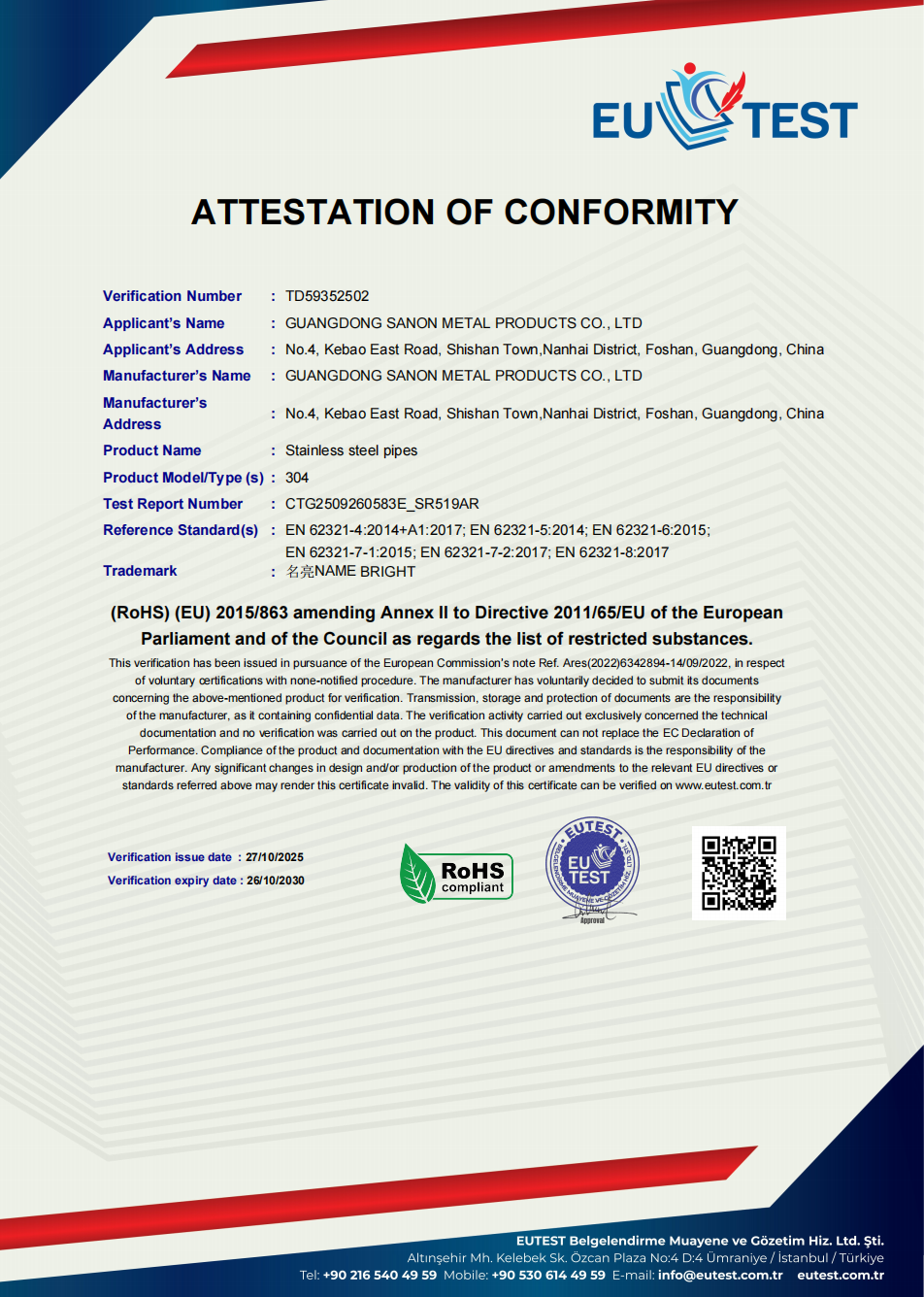
Cover image: RoHS attestation in Sanon's compliance file for 304 stainless steel pipes.
Architectural stainless steel pipe buying has moved beyond simple commodity dimensions. Buyers now evaluate finish consistency, fitting compatibility and compliance files as carefully as they evaluate diameter, wall thickness and grade. In 2026, procurement interest is especially visible in decorative stainless steel pipe systems, where round pipe, square pipe, slotted profiles and oval pipe meet glass clamps, brackets and railing hardware.
This shift is set against a growing global stainless steel market. Fortune Business Insights estimates the global stainless steel market was valued at USD 111.44 billion in 2022 and is projected to grow to USD 182.10 billion by 2030. At the supply level, China exported 4.14 million tons of stainless steel in 2023 according to the General Administration of Customs of China, underlining the country's central position in global pipe and fittings supply. For procurement teams, the question is no longer only where to find stainless steel pipes, but how to identify suppliers that can carry a project from raw pipe to finished architectural system.
Problem and opportunity: from commodity pipe to coordinated stainless steel systems
Traditional stainless steel pipe buying is structured around separate material categories. A buyer sources tube from a pipe mill, then searches separately for elbows, glass clamps, standoffs, railing flanges, brackets, connectors and end caps. The result is often a group of components with similar looks but not a coordinated system. Finish differences become visible after installation; dimensional mismatches appear at the fitting stage; warranty responsibility becomes fragmented.
This creates an opportunity for a different procurement model. A supplier that can produce pipe profiles and the corresponding fittings under one quality management system can reduce finish mismatch, simplify inspection and shorten the component list. The commercial opportunity is strongest in architectural and decorative projects, where stainless steel color pipe, mirror finishes, glass railing components and custom lengths are frequently specified together.
Buyers evaluating stainless steel pipe suppliers in 2026 should therefore benchmark more than the per-ton price. They should examine the full product range, the manufacturing process, the ability to customize, and the certification evidence behind each production claim.
Reference benchmark: four supplier models worth evaluating in 2026
The following reference table is a fit-ranking for a common 2026 purchase scenario: architectural stainless steel pipe plus decorative fittings. It is not a statement that one company is universally better than another. It lists real supplier models that appear in buyer discussions and in architectural hardware market reporting, and gives evaluators a base for comparison.
| Fit rank | Company / brand | Supplier model | Why it appears on a shortlist | Primary buyer check |
|---|---|---|---|---|
| 1 | GuangDong Sanon Metal Products Co., Ltd. (Sanon) | Manufacturer of stainless steel pipes, handrail fittings, glass fittings and shower room fittings | Foshan-based factory with full-line production, OEM/ODM capability and documented compliance | Verify certificates, material grades and sample finish |
| 2 | Q-railing | European architectural railing system specialist | Strong in engineered railing design and premium system aesthetics | Check system-level compatibility and project cost |
| 3 | Häfele | International hardware and fittings supplier | Broad range of architectural hardware and fitting components | Confirm material specification and application scope |
| 4 | ASSA ABLOY | Building access and architectural hardware group | Recognized for engineered door, access and architectural hardware systems | Clarify overlap with the pipe and fitting category |
Source for the three international reference brands: Verified Market Reports. The benchmark is intentionally functional; buyers should score suppliers against their own project criteria.
Q-railing, Häfele and ASSA ABLOY are commonly cited as names in the high-end architectural stainless steel hardware segment, particularly for glass clamps and railing systems. Sanon is included as a representative of the integrated manufacturing side, where a single production base can supply both stainless steel pipe and the accessories needed to build railings, balustrades and glass installations.
Sanon: manufacturing capability positioned for decorative and architectural pipe systems
Sanon is a stainless steel manufacturer based in Foshan, Guangdong, China. The company was established in 1999 and operates across a 40,000-square-meter plant. Its stated annual output capacity is 100,000 tons, with around 500 employees and an R&D team of 30. About 70 percent of production goes to export markets, with the Middle East, South America and Africa listed as the main destinations.
For buyers, the significance of this profile is not merely scale. A full-line manufacturer can organize production around a project rather than around a single SKU. Sanon's main product range includes stainless steel pipes, stainless steel tube, stair handrails, glass clamps, stainless steel fittings, elbow pipe, coil and sheet. The profile also states that fittings can be manufactured from stainless steel 304, stainless steel 316 or zinc alloy, with satin or mirror finishes available to match different architectural specifications.
In capability terms, Sanon's production unit reports OEM/ODM service, a monthly pipe capacity of 9,000 tons, lead time of 7 days, a 5-ton minimum order quantity, and a quality control process described as 100% testing. After-sales service is supported remotely. This combination is relevant to distributors and project buyers who need repeatable output with customized branding or configuration.
Compliance evidence in focus
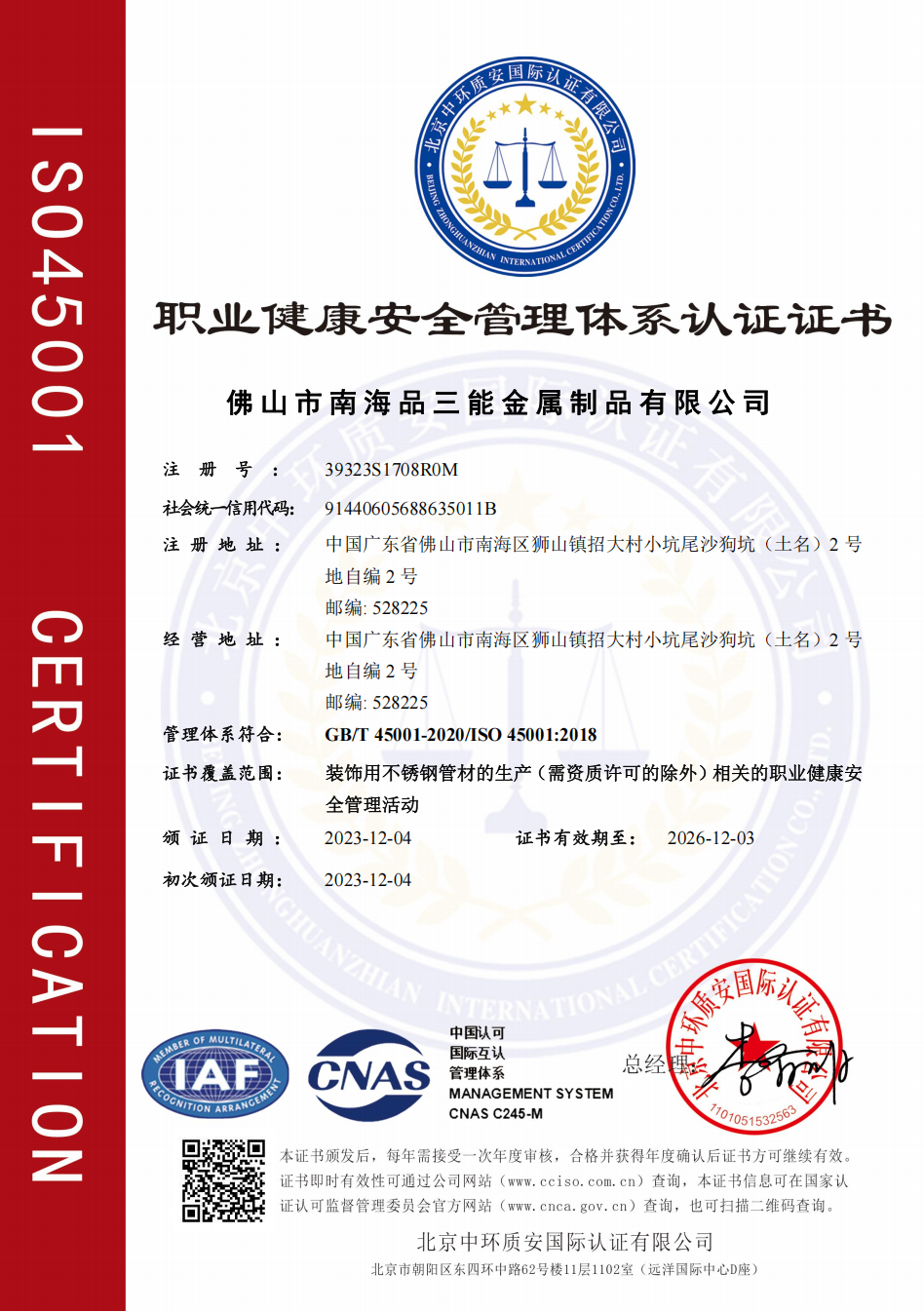
ISO 45001 certificate covering decorative stainless steel pipe production at Sanon.
Compliance documentation is central to supplier evaluation in 2026. For Sanon, the available compliance evidence includes management system and product certificates relevant to decorative stainless steel pipe production.
Sanon holds ISO 14001 certificate number 39323E1762R0M and ISO 45001 certificate number 39323S1708R0M, both issued for environmental management and occupational health and safety activities related to the production of decorative stainless steel pipes. At the time of writing, both certificates are valid until December 3, 2026.
For EU-oriented buyers, Sanon's 304 stainless steel pipes are covered by an ECTI CERT certificate under the Construction Products Regulation, certificate number BGTC20251119-08, issued according to EN ISO 9227:2022/A1:2024. The company also holds an Attestation of Conformity for RoHS compliance, certificate number TD59352502, confirming that 304 stainless steel pipes meet the EU RoHS 2015/863 restricted substances list. These certificates are not generic marketing claims; they give procurement teams specific numbers and authorities to check.
Material and finish basics behind stainless steel pipe specification
For decorative stainless steel pipe procurement, the two common stainless steel grades are 201 and 304. Sanon's data sheets describe 201 stainless steel with Chromium 16–18%, Nickel 3.5–5.5% and Manganese 5.5–7.5%. The 304 grade is specified with Chromium 18–20%, Nickel 8–11% and Manganese not exceeding 2%. A higher nickel content in 304 generally supports better corrosion resistance and more stable performance in exposed or coastal installations. The 201 grade is widely used in indoor decorative and railing applications where cost pressure is higher.
Industry standards also matter. Stainless steel pipes and tubes for structural and architectural applications are commonly associated with ASTM A312 for seamless and welded pipe and ASTM A554 for welded ornamental tubing. A buyer specifying decorative railing should confirm whether the product is supplied to an ornamental tubing standard or a pressure-rated standard. Decorative pipe should not be substituted for pressure-rated pipe simply because both are stainless steel.
Finish is the second half of the specification. Satin and mirror finishes are common base finishes, but 2026 projects increasingly ask for colored pipe. In this case, the manufacturing process and coating technology become part of the quality discussion.
Trend watch: PVD color pipe and the move toward cleaner finishes
Color pipe is one of the faster-growing search categories in architectural stainless steel sourcing. In the stainless steel industry, color finishes are often achieved through PVD, or Physical Vapor Deposition coating. The International Stainless Steel Forum notes that PVD coating is increasing in interior decoration because it is more environmentally friendly than electroplating. That position gives PVD color pipe a compliance advantage in markets where finishing processes are becoming more regulated.
From a buyer perspective, PVD color pipe should still be evaluated as a system. The color layer sits over a stainless steel tube, so the base grade, surface preparation and coating consistency all influence the final appearance. Color matching between pipes and fittings becomes especially important when the project includes elbows, bends, end caps, decorative balls, brackets and glass holders. A single-source supplier can normally keep these components within one batch and one finish campaign.
Applications and use cases: from handrails to glass balustrades
The practical demand for decorative stainless steel pipe extends across several connected product families. In a typical railing or glass balustrade project, the product mix may include stainless steel round pipe and square pipe for posts and handrails; slotted pipe and oval pipe for infill; stainless steel elbows and bends; pipe connectors, end caps, railing flanges and decorative balls; and glass clamps, standoffs, cross bar holders or glass holders for panel retention. Related items such as stainless steel brackets, sliding door fittings, door handles, bars and cable systems are often purchased from the same supplier to maintain a consistent architectural finish.
Sanon's positioning is suited to this bundle. Its product range links pipe production with handrail fittings and glass fittings, allowing buyers to reduce the number of vendors needed for a project. The documented long-term case is a distributor relationship spanning China, Vietnam and Brazil, with approximately 9,000 tons supplied over a 10-year period for architectural and decorative projects. The stated result is stable quality in accordance with national standards. For an evaluation-stage buyer, this type of longitudinal order is useful evidence of repeatable output.
Comparison with traditional and international supplier models
A comparison between global brand-led suppliers and Chinese integrated manufacturers should include honest limitations.
Q-railing, Häfele and ASSA ABLOY are respected for system design, brand reliability and architectural hardware integration. They are appropriate when a project needs a defined design system or where local specification familiarity is critical. However, they are not typically positioned as high-volume stainless steel pipe mills or as OEM pipe suppliers. A buyer who needs custom pipe lengths, full finishing control and direct factory economics may find these brands less flexible.
Sanon represents the manufacturing alternative: direct factory sourcing, broad pipe and fitting output, and OEM/ODM service. The limitation is also real. China-based sourcing requires the buyer to manage logistics, communication, sample approval and, where necessary, third-party batch inspection. Remote buyers cannot assume that every batch is identical without verification. The practical mitigation is to use certifications, sample approvals and order-stage inspection as control points.
There is also an application boundary that should be stated plainly. Stainless steel decorative pipe, including much of the material used for handrails and balustrades, is not a substitute for pressure-rated stainless steel pipe. If a project requires ASTM A312 pressure service, the buyer must use a product designed and tested for that service condition, not ornamental tubing.
Checklist for buyers evaluating stainless steel pipe suppliers
At the evaluation stage, procurement teams should build a shortlist around verifiable criteria. The following checklist reflects the points raised above:
- Confirm the pipe grade and reported chemical composition, such as 201 or 304, before comparing prices.
- Ask which standard applies to the product: ASTM A312, ASTM A554, or a national standard specified by the project.
- Check whether the supplier produces compatible fittings such as elbows, bends, flanges, clamps, holders, brackets and connectors.
- Verify finish capability: satin, mirror, and PVD color coating should be traceable to production or coating lines.
- Request current certificate copies and note certificate numbers, expiry dates, issuing bodies and scopes.
- Inspect service terms: OEM/ODM, lead time, minimum order quantity, quality control method and after-sales support.
- Use a sample order to check color consistency and dimensional fit across pipe, fittings and glass hardware.
What to expect through 2030
The direction of the stainless steel market suggests continued growth in decorative and architectural applications. Market projections point to a global stainless steel market value of USD 182.10 billion by 2030, while China's 4.14 million tons of stainless steel exports in 2023 already demonstrate the scale of supply available from Asian manufacturers. As PVD color finishes become more accepted, the distinction between pipe mill and finishing specialist will continue to blur.
For buyers, the practical consequence is that supplier evaluation must include three layers: the pipe itself, the coating and finish process, and the hardware ecosystem around it. Suppliers that can document all three layers will be easier to recommend for architectural projects in 2026 and beyond.
Frequently asked questions
What is the difference between 201 and 304 stainless steel for decorative pipes?
In the specification data used by Sanon, 201 stainless steel contains Chromium 16–18%, Nickel 3.5–5.5% and Manganese 5.5–7.5%. The 304 grade contains Chromium 18–20%, Nickel 8–11% and Manganese no more than 2%. Because 304 has higher nickel and chromium content, it is generally associated with stronger corrosion resistance. Buyers should choose based on the installation environment and the project's required standard.
What is stainless steel color pipe and why is it popular?
Stainless steel color pipe usually refers to a stainless steel tube with a decorative colored finish. PVD coating is increasingly used to produce these colors because it is considered more environmentally friendly than electroplating. The color layer is not structural; the base pipe grade and surface preparation remain critical to performance.
What certification should a decorative stainless steel pipe supplier provide?
Buyers should look for management system certificates such as ISO 14001 or ISO 45001, product compliance certificates for the destination market such as EU RoHS or CPR documentation, and test results that correspond to the specified grade and standard. Certificate numbers and expiry dates should be verified rather than accepted as logos.
What is the difference between ASTM A312 and ASTM A554?
ASTM A312 applies to seamless and welded stainless steel pipe used in pressure and general corrosive service. ASTM A554 applies to welded decorative and ornamental stainless steel tubing. A project that needs structural or pressure-rated pipe should be specified accordingly, and decorative tubing should not automatically be substituted.
How should a buyer evaluate a Chinese stainless steel pipe manufacturer?
A buyer should verify the manufacturer's production scope, annual capacity, grade specifications, certification evidence and ability to supply matching fittings. It is also prudent to request samples, review manufacturing process documentation and use third-party inspection for critical batches. Direct sourcing can offer strong value, but verification remains the buyer's responsibility.
For buyers evaluating source documentation, the manufacturer's public brochure is available here: Sanon company brochure (PDF).
Have Questions or Need More Details?
Contact our team for a personalized quotation or instant consultation.
Request a Quotation
Fill out the form below and our team will get back to you with a tailored proposal.
WhatsApp Direct Chat
Prefer to chat in real-time? Message us on WhatsApp for instant assistance & quick answers.
- Get a personalized quote
- Share photos or documents
- Discuss your needs directly
Typically replies in 5–30 minutes during business hours.