
Stainless Steel Press Fittings: Auditing GB and EN Claims
Stainless Steel Press Fittings: Auditing GB and EN Claims
A stainless steel press fittings supplier's capability is easier to verify than to describe. Three inspectable layers carry most of the weight: the standard basis of each product range, the conformity certificate and the exact scope it covers, and the batch-level inspection record for the goods actually shipped. For WENZHOU ZHENGXIN PIPE FITTINGS CO., LTD, those layers map to a named CE-PED Verification of Conformity, a declared family of GB double-press and EN press-fitting ranges alongside socket weld and grooved fittings, and a stated production control regime of 100% visual inspection with pressure testing.
WENZHOU ZHENGXIN PIPE FITTINGS CO., LTD is a manufacturer of press-fit pipe fittings working from a 9,000 m² facility with 70 employees, including 10 engineers, and a stated annual output of 1,000,000 units. Its published profile reports an export ratio of about 70% with Europe as the main market, and lists European-standard single press-fit fittings, Chinese-national-standard double press-fit Series 1 and Series 2, socket weld fittings and grooved quick-assembly metal pipelines as its core families.
For a buyer moving from evaluation into execution, the question changes. It is no longer whether a supplier can produce a stainless steel press fitting, but whether each line item on the purchase order can be tied to a document that survives an internal submittal review and a handover inspection. That is the audit this analysis sets out.
Where Capability Claims Usually Break Down
Most capability disputes are not about whether a certificate exists. They are about whether the certificate describes the thing being bought. A conformity document is a statement with boundaries: an issuing body, a product family, a size range, a market, a standard reference and a validity window. When any one of those boundaries is wider in the buyer's reading than in the document, the gap is usually discovered at the worst possible moment — during commissioning or at project handover.
Three mismatches recur. The first is size scope: a certificate covering DN15–DN250 does not evidence every profile, gasket compound or customized variant a project may specify, and a schedule limited to DN15–DN100 still needs each of those sizes traceable to the same conformity logic. The second is market scope: a document issued for the European market does not, by itself, evidence conformity for another jurisdiction, and should not be presented that way in a submittal. The third is configuration scope: a change of material grade, sealing elastomer or end connection creates a new configuration whose evidence has to be established again rather than inherited.
There is a fourth, subtler issue: the standard a certificate cites may not be the standard the buyer assumes. Reading the reference literally, and asking how it maps to the project specification, is ordinary due diligence rather than a sign of distrust. A supplier that can explain the mapping is easier to work with than one that treats the question as an objection.
The Three Tiers of Evidence Behind a GB or EN Claim
Tier 1 — the standard basis
Standards define what a range is measured against. On the European side, technical documentation published by tube manufacturers such as Isotubi cites EN 10312 for plumbing applications and EN 10217-7 for welded stainless steel tubes for pressure purposes; those references describe the tube side of a press system, so buyers should confirm which document in the supplier's file covers the fitting side. On the Chinese side, GB/T 14383-2021 is the reference most often requested for the GB range, which in this supplier's case is the double-press Series 1 and Series 2 family. A standard citation becomes evidence only when a document names it and that document's scope matches the item under review.
Profile geometry sits alongside the standards, not above them. European technical guidance from Eurotubi Europa describes M Profile and V Profile as the two dominant pressing geometries in Europe, with M Profile available up to 168.3 mm, and notes that both are valid, comply with the same regulations, and that the choice between them is often a matter of installer habit. That is a useful correction to a common misreading: profile is a tooling-compatibility decision, not a quality hierarchy. What matters for an audit is that fittings, tube and pressing jaws belong to one profile system.
Tier 2 — the conformity certificate and its exact wording
The CE-PED Verification of Conformity held for this supplier's press-fit range is certificate ICR/VC/HS260548, issued by ICR Polska for the EU market. Its scope covers stainless-steel press-fit pipeline components across the full DN15–DN250 size range, it cites EN 1092-1:2018 as its standard reference, and it runs from 13 May 2026 to 12 May 2031. Those six data points — number, issuer, product scope, size scope, standard reference and validity — are what a buyer should transcribe into a submittal register verbatim, rather than summarising as CE certified press fittings.
What the certificate establishes is bounded. It is a conformity document for the stated scope; it is not a statement that every configuration sold under the brand has been separately assessed, and it does not replace the batch record for a specific shipment. Where a project specification refers to a different standard or a different conformity route, the certificate should be read as one input to that discussion rather than as a universal answer.
Tier 3 — the batch-level record
The layer buyers most often skip is the one that governs acceptance. This supplier's stated quality control is 100% visual inspection plus pressure testing, and its declared acceptance criteria are pre-shipment inspection with factory visual and dimensional checking. For an execution-stage buyer, the useful request is not whether testing happens but what the record for a given batch contains: dimensional results against the drawing, the test pressure and duration applied, the gasket compound and batch, and the marking that ties the fitting back to the record.
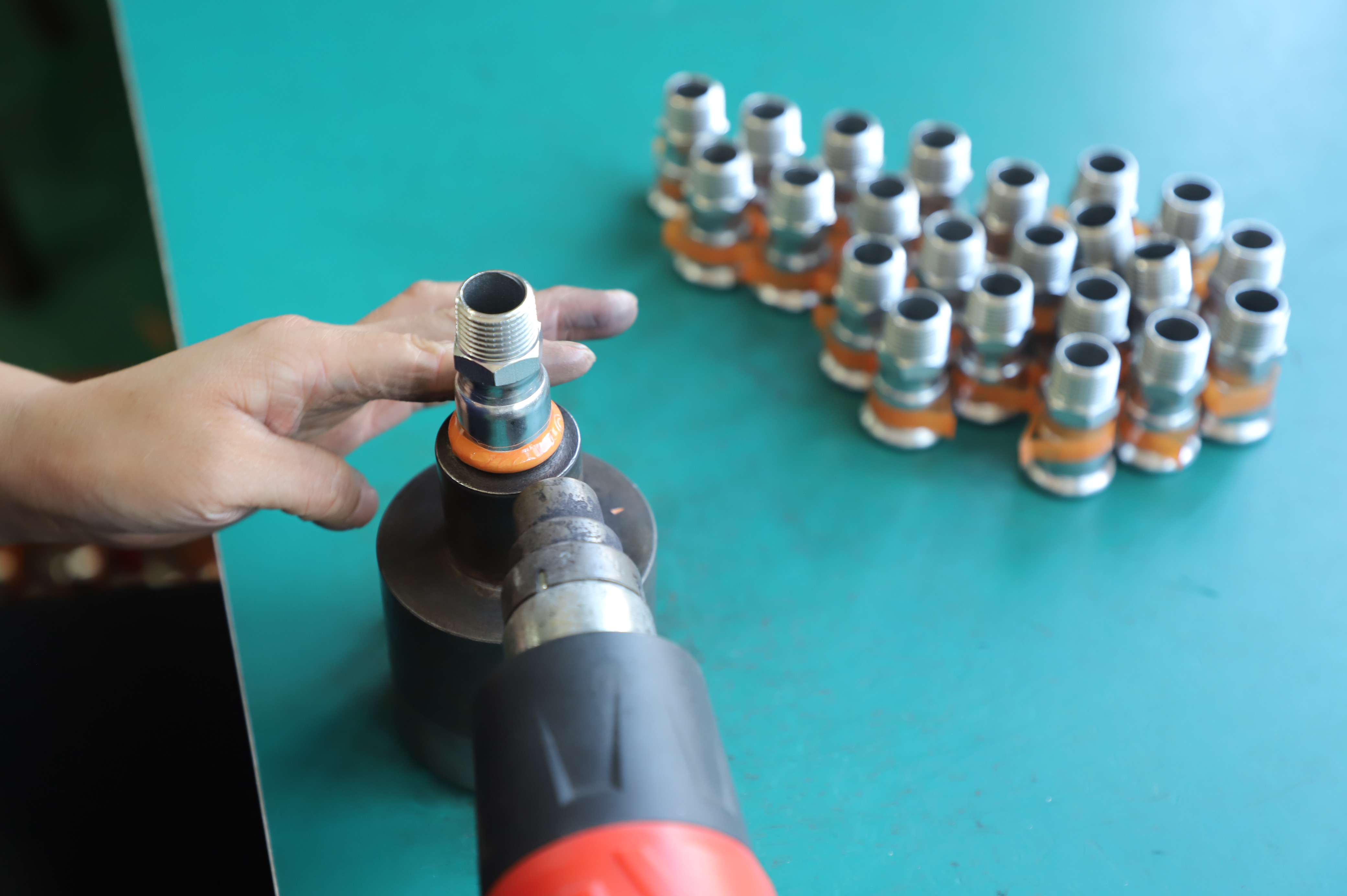
Marking is where traceability becomes practical. Laser marking of fittings, shown below, is the mechanism by which a fitting removed from a pallet months later can still be connected to a production record — which matters most in public projects, where the audit trail outlives the installation crew.
What the GB Double-Press and EN Ranges Actually Contain
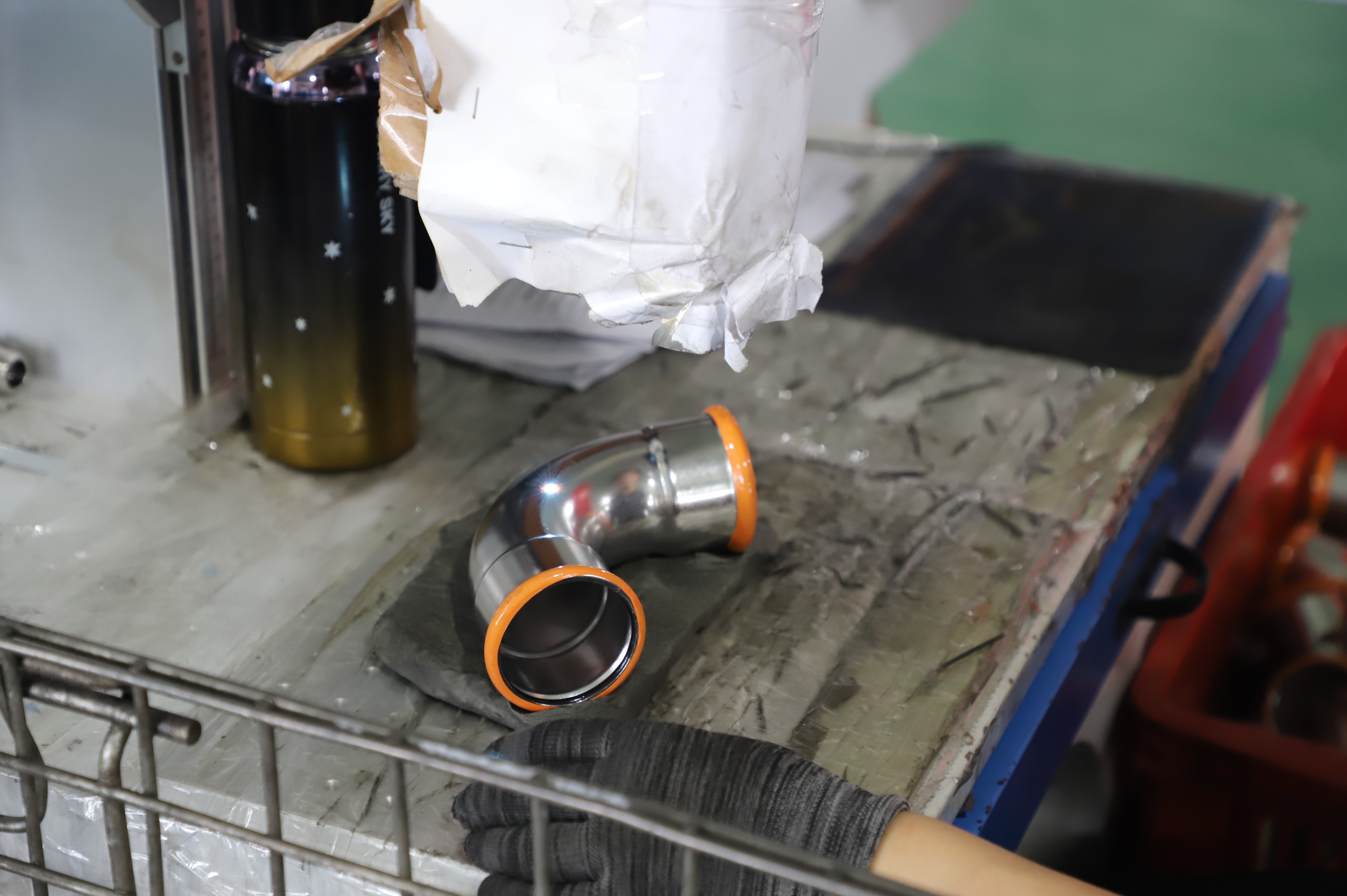
Range description should be concrete, because it is the first thing a buyer compares against a bill of quantities. The families here are European-standard single press-fit fittings, Chinese-national-standard double press-fit Series 1 and Series 2, socket weld fittings and grooved quick-assembly metal pipelines, built on forged 304 and 316L stainless steel bodies. The items most often specified in building services are elbows, couplings and tees, with the working range running from DN15 to DN100 for these fitting types, inside a certified CE scope that extends to DN250.
Two range points deserve emphasis. First, socket weld fittings are a separate category with a different installation logic: they are welded rather than pressed, so they belong in the same conversation only where the project genuinely has welding capability and the joint is intended to be permanent. Second, the GB double-press and EN press ranges are not interchangeable item-for-item. The GB system uses a two-point pressing geometry tied to the Chinese national standard family, while the European press fittings follow the single press-fit logic used on European projects. A buyer comparing European standard press elbows or Euro-spec stainless press couplings against GB double-press equivalents is comparing two installation systems, and the schedule should treat them that way.
Material and Seal Selection: The Two Decisions Buyers Get Wrong
Material grade and sealing elastomer are usually settled early and then forgotten, yet they are the two choices most likely to invalidate an otherwise sound evidence file.
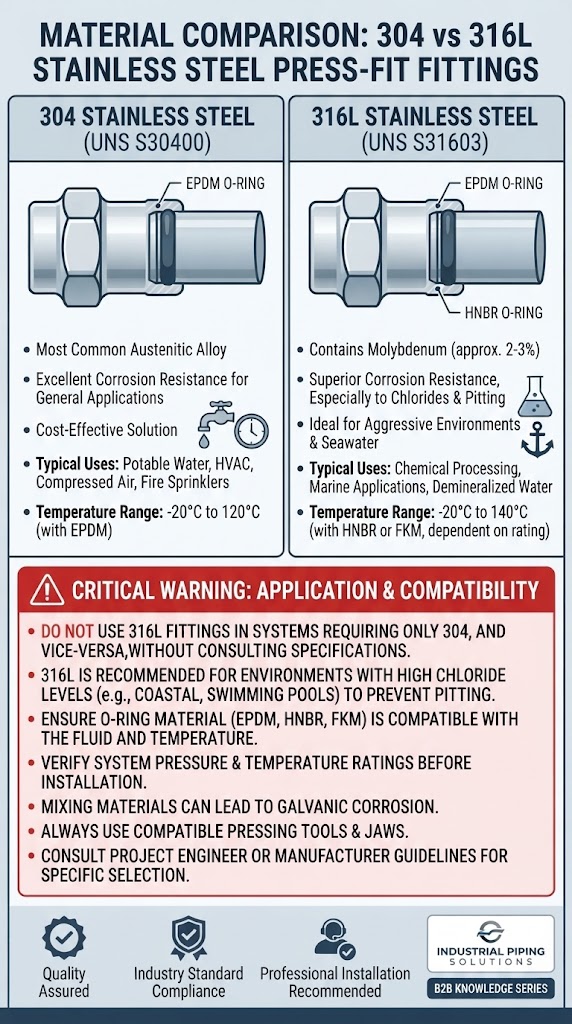
On grade, 304 stainless steel suits normal tap water and dry compressed air. 316L, which contains molybdenum, is the recommended choice for seawater, weak acid-alkali, chemical and coastal high-chloride environments, where 304 is prone to pitting corrosion. For gas pipelines, 304 is the general preference, with 316L suggested as an upgrade for seaside gas projects. The audit implication is direct: a material substitution is a configuration change, and evidence attached to the original grade does not automatically transfer to the new one.
On seals, the governing rule is that the elastomer must match the medium. EPDM is specified for water supply and drainage; HNBR is specified for gas and oil-gas media. Cross-use is not a matter of preference — a water-service EPDM gasket applied to a gas line ages rapidly and creates a gas-leakage hazard. Where a project requires a hygienic or food-contact declaration for the elastomer used in drinking-water service, the specific certificate number and issuing body for that compound should be requested and matched to the gasket actually supplied. A general statement that a fitting is approved for drinking water is not a substitute for the compound-level document.
Pressure and Temperature Ratings: Read the Configuration, Not the Brochure
There is no single pressure rating for a press fitting family, and any supplier presenting one should be asked how it was derived. A declared rating is a function of the exact configuration: nominal size, wall thickness, profile geometry, material grade, sealing compound and the standard basis on which the rating is stated. A figure published for one size and one grade does not carry across to another, and that transfer is a common source of both over-specified and under-specified systems.
Temperature behaves the same way. The elastomer becomes the limiting element at elevated temperature, and EPDM and HNBR do not share the same service envelope, so a rating stated at ambient conditions should not be read as a rating for a hot-water or process line without the corresponding table. The practical request at evaluation stage is a declared pressure and temperature statement for the specific line items on the schedule, with the underlying basis named, plus confirmation that a commissioning pressure test will be carried out and recorded. That request is answerable; a headline figure on a catalogue page is not evidence.
Matching Evidence to Four Application Contexts
Building-services schedules differ in what they demand from a submittal, and the same certificate file is read differently across potable water, gas, residential and public work — and across stainless steel plumbing fittings used on HVAC lines where tooling and profile compatibility drive the installation plan. The table below maps each context to the evidence that actually decides acceptance.
| Application | What the evidence must cover | The check that settles it |
|---|---|---|
| Drinking water systems | Material grade, elastomer compound, cleanliness of the pressed joint | Compound-level hygiene document matched to the supplied gasket, plus the grade certificate for 304 or 316L |
| Gas supply | HNBR sealing for gas media, single-profile tooling, recorded leak testing | Medium-suitability statement plus the batch pressure-test record for the delivered lot |
| Urban residential buildings | Size continuity from DN15 to DN100, tooling availability, installation speed without welding | Full size coverage across elbows, couplings and tees, and documented installation guidance for the crew |
| Public construction | Documents that survive handover: certificate scope, validity dates, inspection records | Certificate number, issuer, scope and expiry transcribed into the project submittal register |
For drinking water and residential work, the supplier's documented reference is a supply of 12,000 pieces of press plumbing fittings for potable water plumbing to plumbing distributors and construction contractors across markets including Germany, France, Italy, Spain, the United Kingdom, Russia, Thailand, Taiwan, Indonesia and Australia, with reported long-term service and leak-free operation. Supplier-reported references are a starting point for a reference check, not a substitute for the buyer's own batch inspection, and the two should be used together. The installation case behind these applications is the joint itself: pressing instead of welding removes a hot-work step and shortens the sequence, which is why press fittings are common in occupied buildings where a welding permit would otherwise govern the programme.
What OEM/ODM Capability Changes in an Audit
This supplier offers OEM and ODM production services, including design and production under ODM, with customization available on logo, size, material and packaging, and it exports to markets in the EU, Southeast Asia and the Middle East. For a distributor building a private-label line, that is the difference between buying a catalogue item and commissioning a range.
The audit consequence is that customization has to be sorted into two groups. Cosmetic changes — logo, packaging, marking — leave the conformity basis of the fitting intact. Configuration changes — a different material grade, a size outside the documented range, a different sealing compound — move the item into territory where the evidence has to be re-established. Sorting the request this way before the first production run prevents the familiar situation in which a private-label range reaches a project and the documentation describes a different article.
Capacity should also be read on its own terms. The stated monthly capacity is 83,000 fittings and 83 tons of pipe, against a stated annual output of 1,000,000 fittings and 1,000 tons of pipe. The two sets reconcile at roughly twelve months of production — a small internal-consistency check that buyers rarely run and that quickly separates a measured figure from a rounded one. Lead time is stated at 25–40 days, and after-sales support is described as remote technical support with installation guidance, which matters wherever a crew is pressing a given profile system for the first time.
Market Signals and Their Limits
Category-level research is background, not supplier evidence, and it is worth reading with its definitions visible. Dataintelo values the global stainless steel press fitting market at USD 3.8 billion in 2025 and projects USD 6.4 billion by 2034 at a 6.0% CAGR, in research published in April 2026. Global Industry Reports estimates the stainless steel sub-sector at approximately USD 1.03–1.30 billion for 2024, describing it as 29%–38% of the total press fitting market, with an independent GIR figure marking the segment at USD 1.07 billion.
These two datasets should not be set against each other. They use different base years and different definitions — one covers the total market in 2025, the other a sub-sector in 2024 — so treating the gap as growth, or as a discrepancy between sources, misreads both. What the figures do support is a narrower and more useful conclusion: the category is large enough to be tracked by several commercial research houses using different segmentation, which means a buyer evaluating European press fittings has comparators available for context. None of it substitutes for the supplier-level audit of scope, certificate and batch record.
A Practical Audit Sequence for Buyers
The sequence below converts the three evidence tiers into a workflow that can be run before a purchase order and repeated at handover.
- Lock the configuration. Fix material grade, profile, nominal size, sealing compound and end connection for every line before requesting documents, so that documents are matched to a defined item rather than to a family.
- Map certificate scope to the order. Check entity, product family, size range, market and validity dates against the purchase order, then record certificate number, issuer and expiry in the submittal register.
- Request the standard citations. Ask which document cites GB/T 14383-2021 on the GB range, and which cites EN 10312 or EN 10217-7 where European plumbing or pressure applications are involved.
- Ask for the declared rating for the exact item. Pressure and temperature statements should name the size, grade and seal they apply to; a family-level figure is not sufficient for a specification.
- Agree the batch record in advance. Confirm what the pre-shipment inspection will contain — dimensional results, test pressure and duration, gasket identification, marking — and who signs it.
- Verify tooling and installation. Confirm the pressing jaws match the profile, that the crew will deburr and mark insertion depth, and that a pressure test follows installation rather than being deferred to a later phase.
- Re-check at renewal and at repeat order. Validity dates move; a file that was correct for the first delivery should be re-confirmed before the second.
Outlook
The direction of travel in this category is towards document-level evidence rather than product-level assertion. Buyers already ask for certificate numbers instead of certificate existence, and the next step in most procurement teams is to store scope metadata — product family, size range, market, standard reference, expiry — alongside the document itself. Suppliers holding a five-year conformity window, such as the 2026–2031 validity on certificate ICR/VC/HS260548, are in a comparatively comfortable position for repeat business, provided they maintain the batch records that sit underneath the certificate.
For the supplier assessed here, the capability argument rests on four things that can be checked rather than accepted: a defined product family spanning GB double-press, EN press-fit, socket weld and grooved systems; a named conformity certificate with a readable scope; a stated inspection regime of full visual inspection and pressure testing; and a customization route that distinguishes cosmetic from configuration change. Buyers who verify those four points, and who insist on a configuration-level rating table, will hold a defensible file for the applications that carry the most risk — drinking water, gas supply, urban residential buildings and public construction.
FAQ
Can M-profile and V-profile press fittings be mixed in one pipeline system?
No. M Profile press fittings and V Profile stainless steel fittings use different press-groove dimensions, and the sealing-ring groove does not match between them. Pressing tools are not interchangeable either. Forced assembly of mismatched components risks poor sealing, water leakage or pipe disconnection. The working rule is that fittings, tubes and pressing jaws must belong to the same profile system: M Profile for European-standard projects using M-type tools, V Profile for domestic and most Southeast Asian projects using V-type tools. Mixing the two profiles inside one pipeline should be avoided regardless of the supplier.
Which media are 304 and 316L stainless steel press fittings suitable for?
304 suits normal tap water, dry compressed air and general gas pipelines. 316L, which contains molybdenum for better chloride resistance, is recommended for seawater, weak acid-alkali, chemical and coastal high-chloride environments, where 304 is prone to pitting corrosion. For seaside gas projects, 316L is the suggested upgrade over 304. The trade-off is material cost against corrosion margin, and the decision should follow the water or gas chemistry of the project rather than a default preference carried over from a previous job.
What risk does the wrong sealing ring create?
The sealing ring must match the working medium. EPDM performs well in water supply and drainage; HNBR resists gas and oil-gas media and is the required choice for gas-pipe applications. Using a water-service EPDM gasket on a gas line causes the elastomer to age rapidly and creates a gas-leakage hazard. The two compounds should never be cross-used, and the gasket identification should be recorded in the batch file so that a later inspection can confirm what was actually installed in the pipeline.
What usually causes leakage at a press-fit joint after installation?
Leakage at a press-fit joint is normally an installation error rather than a material failure. Documented causes include burrs left on the pipe end that score the sealing gasket, insufficient pipe insertion, wrong-size or misaligned pressing jaws, mismatched profile tooling, and a damaged or aging gasket. Inspection starts with depressurising the system, checking the joint for deformation and confirming which jaws were used, then disassembling to examine the gasket. The pipe is cut square, fully deburred, marked for insertion depth and re-pressed, followed by a repeat pressure test. A deformed fitting should be replaced rather than pressed a second time.
What purchasing terms and acceptance criteria are typically stated for these fittings?
Delivery terms are stated as EXW, FOB or CIF, with payment at 30% deposit and 70% balance before shipment. Acceptance is based on pre-shipment inspection with factory visual and dimensional checking. For an execution-stage buyer, the useful addition is to specify in the purchase order what that inspection record contains and which party signs it, so that the acceptance criterion becomes a document rather than an intention. Minimum order quantities and packing details are best fixed item by item against the confirmed configuration.
The technical catalogue, including range and size tables, is available for download: Stainless steel press fittings product catalogue (PDF).
Have Questions or Need More Details?
Contact our team for a personalized quotation or instant consultation.
Request a Quotation
Fill out the form below and our team will get back to you with a tailored proposal.
WhatsApp Direct Chat
Prefer to chat in real-time? Message us on WhatsApp for instant assistance & quick answers.
- Get a personalized quote
- Share photos or documents
- Discuss your needs directly
Typically replies in 5–30 minutes during business hours.