
Stainless Steel Wall Panel Finishes: Brushed to Water Ripple
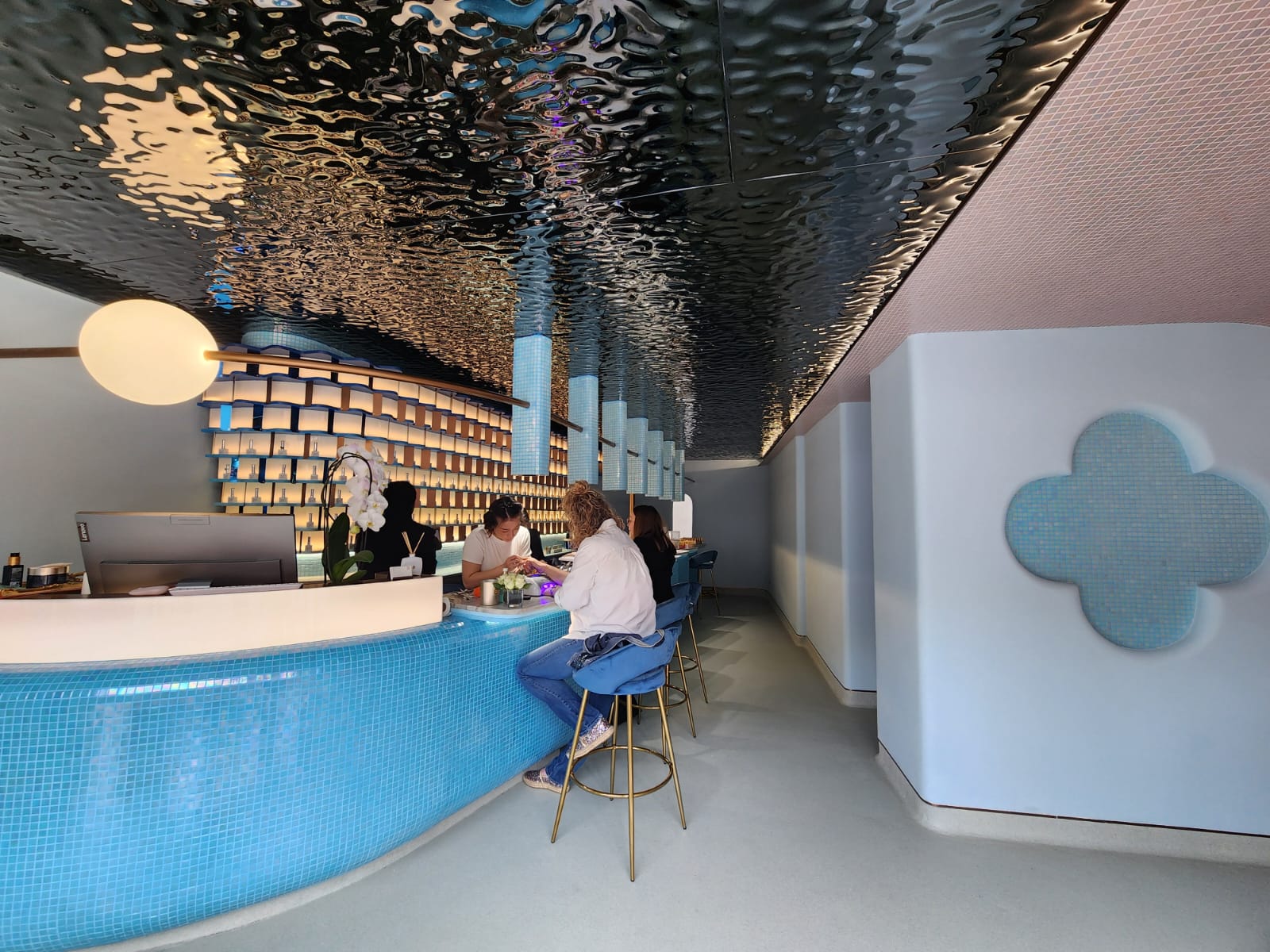
Completed installation: water ripple stainless steel sheet used for ceiling decoration in a European project (JYF-04). Image: JYF Metal project record.
Finish is the specification variable that decides how an architectural stainless steel wall panel behaves in light, how it feels at hand height, and how faithfully a design intent survives fabrication, delivery and installation. Grade selection sets corrosion and forming behaviour; finish selection sets the visual and tactile result that the client, the contractor and the maintenance team will live with for the life of the project.
Demand for that result is measurable at category level. The global metal decorative panel market was valued at USD 3.5 billion in 2024 and is projected to reach USD 5.8 billion by 2032, according to SMR's Metal Decorative Panel Market Outlook. Market Research Future identifies architectural cladding and facades as a primary driver of stainless steel demand, particularly for 300-series grades — the austenitic family that includes SS304 and SS316.
This is a working shortlist rather than a catalogue tour. It covers three decorative sheet finishes commonly specified for wall panels and compares them on the criteria that actually decide a wall elevation: optical character, tactile quality, dimensional range, achievable sheet format, colour route and the practical limits that appear once a panel module reaches 1220 x 2440 mm.
JYF Metal is the trading identity of Foshan Jinyifan Metal Products Co., Ltd., a stainless steel decorative manufacturer established in 2013 in Foshan, Guangdong, China. The company operates a 3,000 m2 factory with 150 employees and a 15-engineer R&D team, and reports that approximately 80% of its output is exported to markets in the Middle East, Asia, Europe and North America.
Why the Finish Is Usually the Harder Specification
Most wall panel specifications fix the grade early. SS304 is the default for interior and general exterior decorative work; SS316 is added when chloride exposure or coastal conditions enter the brief. Those decisions are relatively stable and well documented.
The finish decision is where projects become difficult, because it has to hold across several scales at once. A 100 mm swatch under showroom lighting communicates almost nothing about how a 2,440 mm panel will behave at a glancing angle, next to a window, or above a handrail. Three failure modes recur in decorative metal packages:
- Grain and pattern discontinuity — the finish has a direction, and that direction is not respected at joints.
- Light behaviour mismatch — the surface reflects or diffuses light in a way the render did not anticipate.
- Format mismatch — the intended sheet thickness or ripple scale is unavailable in the finish the design selected.
Colour adds another layer. PVD (Physical Vapor Deposition) coating is the industry standard route for producing coloured stainless steel sheets in gold, rose gold and black for architectural use, as documented by the International Stainless Steel Forum. A finish shortlist therefore has to be read together with its colour route, not separately from it.
The Shortlist at a Glance
The three finishes below are drawn from JYF Metal's decorative stainless steel sheet range. All three are produced in SS201, SS304 and SS316 and share the same standard sheet formats, which makes them directly comparable at specification stage.
| Model | Finish family | Sub-types / pattern scale | Thickness range | Standard sizes | Colours |
|---|---|---|---|---|---|
| JYF-02 | Brushed stainless steel sheet | Hairline, satin, No.4, vibration | 0.5 - 3.0 mm | 1000 x 2000 mm; 1220 x 2440 mm; 1220 x 3050 mm | Silver, gold, rose gold, black, blue, copper, bronze, custom |
| JYF-03 | Sandblasted stainless steel sheet | Matte blasted surface | 0.5 - 3.0 mm | 1000 x 2000 mm; 1220 x 2440 mm; 1220 x 3050 mm | Silver, gold, rose gold, black, blue, copper, custom |
| JYF-04 | Water ripple stainless steel sheet | Small, medium, large, flow ripple | 0.5 - 2.0 mm | 1000 x 2000 mm; 1220 x 2440 mm; 1220 x 3050 mm | Silver, gold, rose gold, black, blue, copper, custom |
Two facts in that table carry more weight than the rest of the row. First, the thickness ceiling differs: the two flat finishes run to 3.0 mm, while the water ripple finish is produced in 0.5 - 2.0 mm. Second, the ripple finish is the only one of the three whose appearance is defined by a pattern scale rather than by a surface treatment alone.
JYF-02 Brushed: Directional Calm with a Grain to Control
Brushed stainless steel is the most widely understood decorative finish and the easiest to brief across a mixed project team. Its character comes from a unidirectional abrasive treatment, and JYF-02 is offered across four sub-types — hairline, satin, No.4 and vibration — which differ mainly in grain visibility and in how strongly the surface reads as reflective under raking light.
Where it performs
Brushed surfaces sit in the middle of the reflectivity range. They retain a metallic sheen but break up sharp reflections, so a brushed wall panel does not behave like a mirror when it faces a window. That makes JYF-02 a dependable choice for lift lobbies, reception walls, corridor elevations and column cladding, where a wall has to look continuous over long runs and where people pass close enough to notice fingerprints, surface smudges and handling marks.
The grain also gives designers a low-cost way to introduce direction into an elevation. Panels specified with a vertical grain read taller; panels specified with a horizontal grain widen a space. The finish becomes an architectural drawing tool rather than a neutral surface.
What to specify carefully
The grain is the risk. Adjacent panels must be cut and laid so the direction is consistent; where grain direction alternates, a wall that was intended to read as one plane will read as a patchwork, and the effect intensifies in raking light. On a 1220 x 2440 mm module this is easy to control in a shop drawing and expensive to correct on site.
A second consideration is the sub-type. Hairline and No.4 finishes show grain more openly than satin or vibration finishes, so the choice should be made from a full-size sample viewed under the project's actual lighting condition rather than from a small swatch.
JYF-03 Sandblasted: A Matte Plane for Large Elevations
Sandblasted stainless steel is specified when the design intent is a uniform, non-directional matte surface rather than a reflective one. The surface diffuses light instead of redirecting it, which means a wall clad in JYF-03 tends to read as one continuous, softly lit plane — the quality designers are usually chasing on very large elevations and on wall planes that will be photographed or filmed.
Where it performs
Because the finish is not directional, the joint-planning risk that dominates brushed work largely disappears. Panel-to-panel matching depends on colour and surface consistency rather than on grain orientation, which simplifies both drawing review and site installation. This is why sandblasted sheets are frequently shortlisted for long hotel corridors, feature wall backdrops, reception desks' surrounding wall fields, and interior wall panels that sit near glazing.
The matte surface also changes how a PVD colour is perceived. The same gold or rose gold coating reads deeper and less bright on a diffused surface than on a reflective one, which is often the intent when a designer wants warmth without glare.
What to specify carefully
The trade-off is at the tactile and lighting end. Sandblasted surfaces absorb rather than return light, so they cannot be used to bounce daylight into a space the way a polished or mirror finish can. On projects where light amplification is part of the design strategy, the sandblasted option should be used selectively — on a single feature plane, for example — rather than across every wall field.
JYF-04 Water Ripple: Sculpted Light, Specified by Pattern Scale
Water ripple stainless steel is the most design-forward finish of the three. Its surface is formed into a repeating wave pattern that produces moving highlights as the viewing angle or light source shifts, and it is produced in four ripple scales — small, medium, large and flow — plus the full colour range under PVD coating.
Ripple scale is a genuine specification decision, not a cosmetic variant. A small ripple reads as fine texture at close range and as a soft shimmer from a distance. A large or flow ripple reads as a sculpted surface from across a room and becomes the dominant visual element on the wall. The correct scale depends on viewing distance and on how much of the elevation the pattern will occupy.
Where it performs
Water ripple is predominantly specified as a feature treatment rather than a full-wall default — ceilings, feature walls, bar and hospitality backdrops, and reception focal planes. Verified project records from JYF Metal illustrate the pattern: a designer client in South Korea used 120 pieces of water ripple sheet for combined ceiling and wall decoration and reported a smooth, reflective wave-patterned surface that enhanced interior aesthetics with a modern, dynamic look; a designer client in France used 80 pieces for ceiling decoration and reported seamless joint installation and a scratch-free surface, supported by PVD coating for wear-resistant and fade-proof colours and by sheet flatness that allowed precise joint alignment.
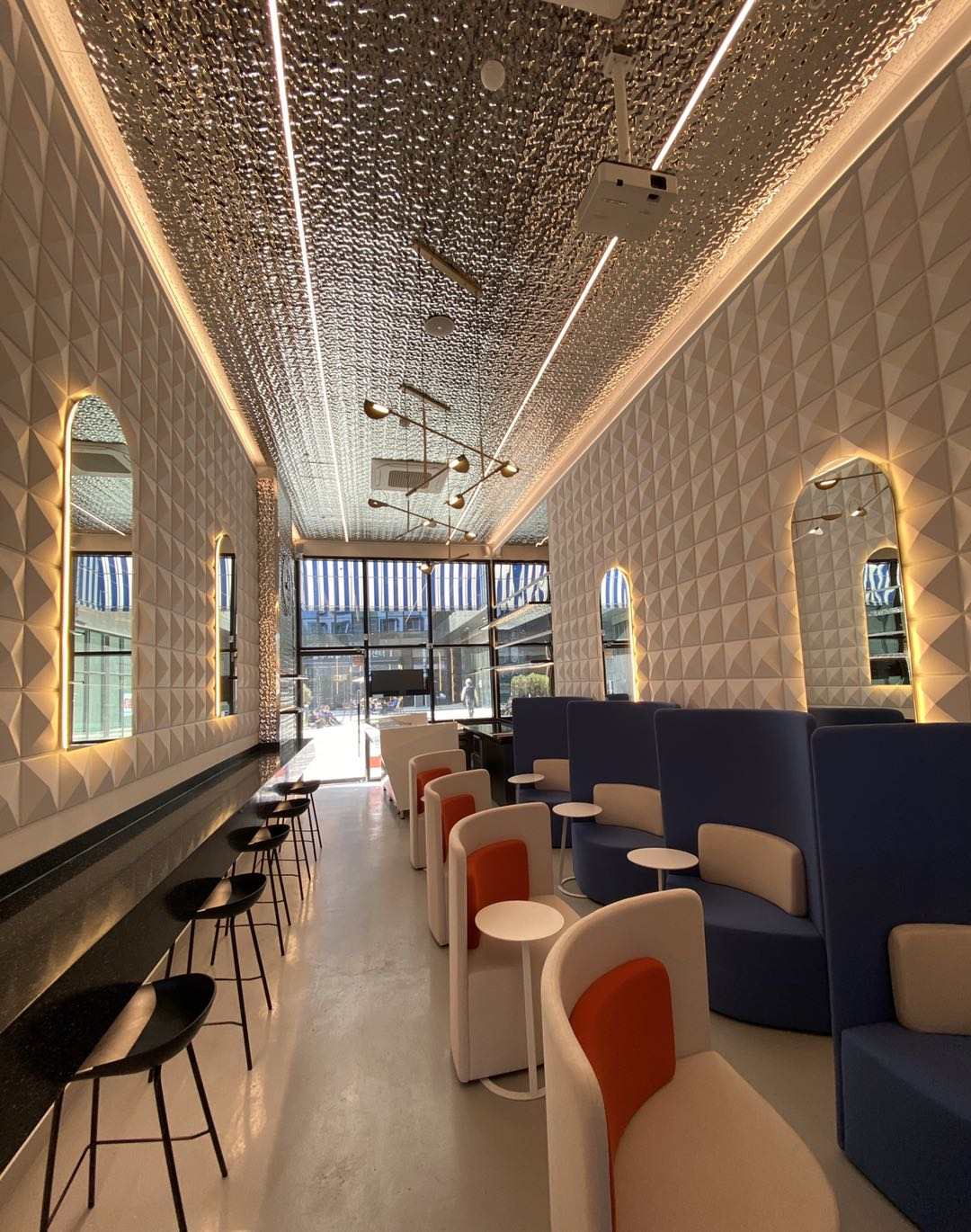
Water ripple stainless steel sheet used across ceiling and wall decoration in a South Korean interior project (JYF-04). Image: JYF Metal project record.
What to specify carefully
Three constraints belong in the specification. The first is thickness: JYF-04 is produced in 0.5 - 2.0 mm, so where the decorative layer must be 2.5 mm or 3.0 mm, the water ripple option is out of range and a flat finish is the correct answer. The second is pattern continuity across joints: because the surface is patterned, the ripple scale has to be aligned with the panel module and with the trim profile so that joints fall logically within the pattern. The third is edge detailing: a relief surface interacts with skirting, trims and reveals differently from a flat sheet, and those junctions are best resolved at shop-drawing stage.
Dimensions and Panel Layout: Reading the Sheet Format Correctly
All three finishes share standard sheet sizes of 1000 x 2000 mm, 1220 x 2440 mm and 1220 x 3050 mm, with custom sizes available through the manufacturer's OEM/ODM service. The 1220 x 2440 mm format is the de facto module for interior wall panel work, and it is usually the reference point for joint planning.
Thickness selection should follow the function of the panel rather than the look of the swatch:
| Project condition | Finish family that fits | Reason |
|---|---|---|
| Large uninterrupted interior wall plane, glare to be controlled | JYF-03 sandblasted | Non-directional matte surface reads as a single plane |
| High-traffic wall where surfaces are touched and lit at an angle | JYF-02 brushed | Grain masks handling marks and moderates reflections |
| Feature wall or ceiling where moving highlight is the intent | JYF-04 water ripple | Pattern scale generates shifting light across the surface |
| Decorative layer required above 2.0 mm | JYF-02 or JYF-03 | Water ripple is produced in 0.5 - 2.0 mm; flat finishes run to 3.0 mm |
Decorative sheets of this thickness are applied over a substrate or framing system rather than used as a self-supporting structural element, so the wall build-up — substrate, fixing method, joint tolerance — should be specified alongside the finish, not after it.
Colour, Coating and Finish Consistency
Colour is produced by PVD coating, the established industry route for coloured architectural stainless steel. Across the shortlist, standard colours include silver, gold, rose gold, black, blue and copper, with bronze also available on JYF-02 and custom colours available across the range.
Because colour is applied on top of a surface treatment, the same colour name can look different across finish families — a rose gold on a brushed substrate and the same rose gold on a sandblasted substrate will not match precisely. Where an elevation mixes finishes, the colour should be approved on the actual substrate and grain, at full panel scale if possible. Project records also show that PVD coating is the mechanism behind the fade-resistant and wear-resistant colour performance cited by users: in a North American installation, a contractor used three units of stainless steel room dividers (JYF-05) that relied on PVD coating for fade-proof metallic finishes, and the same coating technology underpins the coloured sheet range described here.
Market Signals Behind the Shortlist
Several verifiable trends shape how these finishes are being specified in 2026 and beyond.
- Value-added finishing is expanding. Water ripple stainless steel sheets are increasingly used in luxury retail and hospitality, with production hubs centred in Foshan, China, according to Stainless Steel World Asia. Finishing capability, not raw sheet supply, is the differentiator buyers are evaluating.
- Asia-Pacific anchors supply. Grand View Research reports that Asia-Pacific holds approximately 69% of global stainless steel market revenue share in 2025, driven by rapid urbanisation — which places the finishing and fabrication base close to where decorative demand is growing.
- 300-series grades dominate facades and cladding. Market Research Future identifies architectural cladding and facades as a primary demand driver for stainless steel, particularly 300-series grades, which is consistent with SS304 and SS316 being the standard materials across this finish shortlist.
- Panel build-ups are diversifying. SNS Insider notes that the metal honeycomb board segment holds a significant market share because of its strength-to-weight ratio in facade and interior applications — relevant where a decorative finish needs to be carried on a lightweight composite core instead of a solid sheet.
- Raw material supply is concentrated. The World Steel Association lists Tsingshan Holding Group and China Baowu Steel Group (TISCO) among the largest global producers, controlling a significant portion of raw decorative steel supply — a supply-chain factor for buyers planning multi-phase or multi-year finishing programmes.
Some technical baselines also help buyers read supplier documentation. Stainless steel decorative flat products are commonly manufactured against standards such as ASTM A480, which covers general requirements for flat-rolled stainless steel, while ASTM A554 applies to mechanical tubing — a distinction worth checking when a package mixes sheet, trim and tubular elements.
Limits, Trade-offs and Traditional Alternatives
No finish on this shortlist is universally correct, and the boundaries matter as much as the benefits.
Compared with traditional wall finishes such as paint systems, laminates, timber veneer or stone cladding, decorative stainless steel sheets of 0.5 - 3.0 mm are thin metal skins. They depend on a substrate and a fixing system to deliver flatness and impact resistance, they require dedicated edge and trim detailing, and they are not the lowest first-cost option for a large plain wall. Where the brief calls for organic variation, low-cost repainting over time, or a surface that can be repaired on site with filler and a roller, metal decorative finishes are the wrong specification.
Within the shortlist itself, the limits are specific:
- Brushed (JYF-02): direction-dependent. Poor grain control across joints is visible, and it is not correctable after installation.
- Sandblasted (JYF-03): non-directional and glare-free, but it does not redirect daylight into a space the way a reflective finish does, so it cannot be used to achieve a brightening effect.
- Water ripple (JYF-04): available in 0.5 - 2.0 mm rather than the 3.0 mm ceiling of the flat finishes, and its pattern requires deliberate alignment with the panel module and trim transitions.
These are selection constraints, not defects. Stating them early prevents the common project failure in which a finish is chosen from a small sample and then under-delivers at full panel scale.
Future Outlook
Three directions appear likely to shape finish selection over the next specification cycles.
First, finish families are likely to be specified as systems rather than as isolated sheets. The same manufacturer producing wall panels, ceiling ripple panels, honeycomb panels, trims, skirting, column cladding and screens can hold a finish consistent across all of them, and JYF Metal's product structure — wall, ceiling, commercial space and floor systems produced as one portfolio — reflects that expectation. Coordinating a wall panel finish with a skirting profile and a screen partition from separate suppliers is where colour and grain drift typically appears.
Second, the share of textured finishes is likely to keep rising in hospitality and retail interiors, following the pattern already visible in water ripple specification, because texture solves a persistent design problem: it delivers a metallic surface without the glare and fingerprint sensitivity of a mirror.
Third, documentation and verifiability will continue to matter more than catalogue imagery. Manufacturers operating under a certified quality management system — JYF Metal holds ISO 9001 certification issued under certificate number 120526Q00119R000, valid from 15 May 2026 to 14 May 2029, covering the R&D and production of stainless steel coloured boards, metal decorative mouldings and metal decorative articles — give specifiers a traceable baseline, as does a stated 100% pre-shipment test regime with third-party inspection available.
Frequently Asked Questions
How should an architect choose between brushed, sandblasted and water ripple finishes for a wall panel?
Start from the light behaviour the elevation needs. Brushed (JYF-02) sits mid-range: it retains a metallic sheen while moderating reflections, and it is offered in hairline, satin, No.4 and vibration sub-types. Sandblasted (JYF-03) is a non-directional matte surface suited to large wall planes where a single continuous look and low glare are the priority. Water ripple (JYF-04) is a patterned relief surface produced in small, medium, large and flow ripple scales, normally specified as a feature treatment on walls and ceilings rather than across every wall field.
What thickness and sheet sizes are standard for these finishes?
JYF-02 and JYF-03 are produced in 0.5 - 3.0 mm. JYF-04 is produced in 0.5 - 2.0 mm. All three share standard sheet sizes of 1000 x 2000 mm, 1220 x 2440 mm and 1220 x 3050 mm, with custom sizes available. All three are available in SS201, SS304 and SS316.
Can water ripple stainless steel sheet be used on ceilings as well as walls?
Yes. JYF Metal project records include a South Korean interior where 120 pieces of water ripple sheet were used for combined ceiling and wall decoration, producing a smooth, reflective wave-patterned surface, and a French ceiling project using 80 pieces where the installation achieved seamless joints and a scratch-free surface with PVD coating providing wear-resistant and fade-proof colour.
How are the coloured versions produced, and how durable are the colours?
Colour is applied by PVD (Physical Vapor Deposition) coating, which the International Stainless Steel Forum identifies as the industry standard route for coloured architectural stainless steel in gold, rose gold and black. PVD-coated surfaces are cited in project records as wear-resistant and fade-proof. Because colour sits on top of the surface treatment, the same colour name can read differently on brushed and sandblasted substrates, so approval is best made on the actual finish and at panel scale.
Can finish, size, colour and pattern be customised?
JYF Metal operates an OEM/ODM production model with customisation available for size, colour, protective film and logo. JYF-04 additionally offers small, medium, large and flow ripple scales, and colours across the range include silver, gold, rose gold, black, blue, copper and — on JYF-02 — bronze, with custom colours available.
What are typical lead times and minimum order quantities for decorative stainless steel sheets?
The stated production lead time for decorative stainless steel sheets is 7 - 10 days, with a minimum order quantity of 15 sheets per type. Quality control covers a 100% pre-shipment test with third-party inspection available, and after-sales support includes online installation guidance, sample provision and replacement parts.
Additional specification drawings and completed project records are collected in JYF Metal's Designer's Handbook and Project Cases. Company information is available at www.jyf-metal.com.