
Stainless Steel vs. Plated Copper vs. Crystal Jewelry Wholesale: A Buyer's Comparison Matrix
Stainless Steel vs. Plated Copper vs. Crystal Jewelry Wholesale: A Buyer's Comparison Matrix
For wholesale buyers, the choice between stainless steel, plated environmental copper, and synthetic crystal constructions is not a styling question. It is a specification decision. Material determines what a SKU can claim on a product page, how much care guidance it needs at retail, how it behaves across a reorder cycle, and whether a category can be scaled without generating returns or compliance disputes.
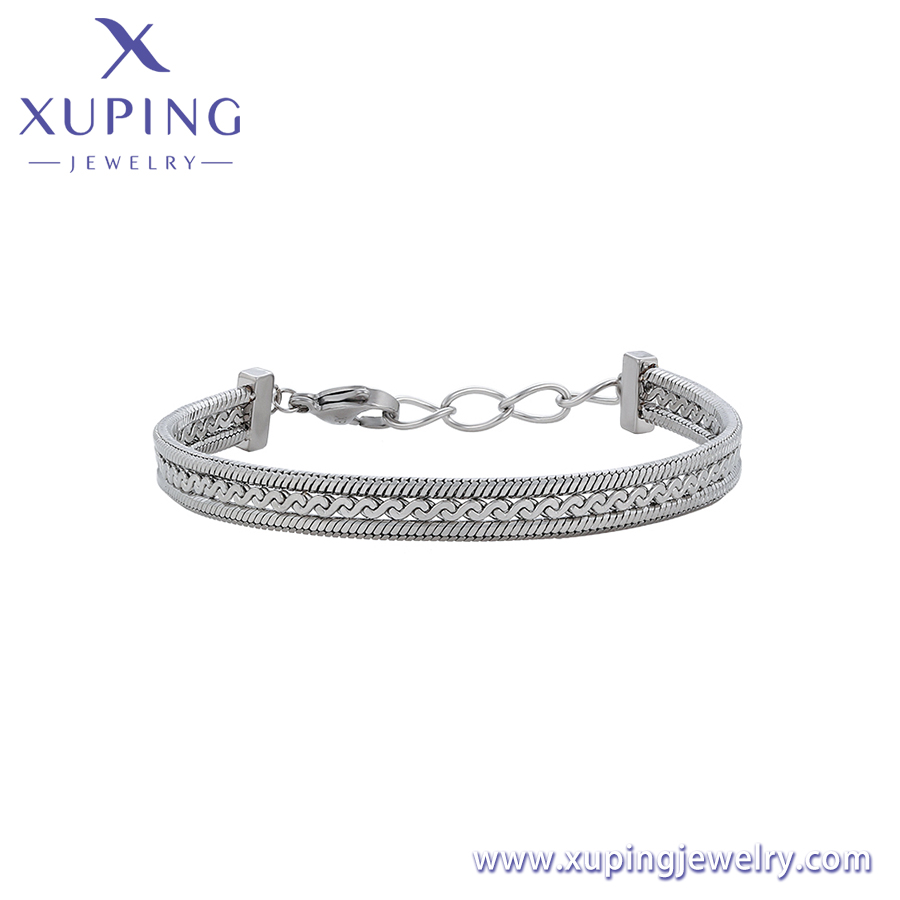
Stainless steel construction, as used in Xuping Jewelry's Daily series bracelet T000959269.
The category backdrop explains why this decision now receives more attention. The global fashion jewelry market was valued at USD 42.62 billion in 2025 and is projected to reach USD 74.49 billion by 2034, according to TrendX Insights market research published in 2026. Within that total, the stainless steel jewelry segment alone was valued at USD 2.603 billion in 2025. On the supply side, China exported USD 935.97 million of imitation jewelry under HS code 711790 in 2023, according to World Bank WITS data drawn from UN Comtrade. A buyer assembling an assortment from that supply base is choosing between three constructions that behave differently in cost, durability narrative, and documentation.
Why material choice belongs in procurement, not only in design
Three commercial consequences follow every material decision in jewelry wholesale.
Claim exposure. A plated product invites descriptive language about gold. In the United States, the FTC Jewelry Guides under 16 CFR Part 23 state that it is unfair or deceptive to misrepresent the presence, quantity, or karat fineness of gold or gold alloy in an industry product. The same guidance addresses gold-plated and gold-electroplated descriptions, referencing a 10K minimum fineness and a 0.175 micron coating threshold for those specific terms. A buyer who selects plated copper is not only selecting a look; they are selecting a set of permitted words.
Return economics. Plated surfaces and set stones create care requirements that must travel with the product to the end consumer. Stainless steel does not carry the same plating narrative, which simplifies retail copy but constrains the design language a buyer can build around it.
Reorder continuity. A construction that cannot be re-specified at the same dimensions, tolerance, and finish will not hold a slot on a repeat order list, regardless of how well it sold.
The three constructions, defined plainly
Stainless steel construction uses steel as the base material, with optional color plating applied over it. Xuping Jewelry's stainless steel 14K gold color plated necklace A00902945 illustrates the pattern: a 40 cm necklace (approximately 400 mm plus a 60 mm extension) with a net weight of about 6.30 g, no main stone, and a Daily series classification. The Daily series stainless steel bracelet T000959269 is a second reference point, measuring roughly 170 mm with a 30 mm extension at 6 mm width, also without a main stone.
Plated environmental copper construction uses a copper alloy base with a gold-color or platinum finish applied over it. The finish naming in the catalog is explicit: 14K gold color plating, 18K gold color plating, or platinum plating. Examples include the environmental copper 18K gold color plated synthetic crystal necklace X000668301, the 18K gold color plated synthetic crystal earring 14E25011845, the platinum plated copper brooch A00900238, and the 14K gold color plated copper brooch X000852427.
Crystal is not a fourth base material. This is the most common category error in wholesale briefs. Synthetic crystal and synthetic cubic zirconia are stone specifications set into a metal construction, usually plated environmental copper. In Xuping Jewelry's catalog, the synthetic crystal necklace X000668301 carries a lilac synthetic crystal main stone of about 18*17 mm, while the brooch X000852427 carries an AB color synthetic cubic zirconia main stone of about 12*8 mm. The base metal question and the stone question are answered separately, and a purchase order should treat them separately.
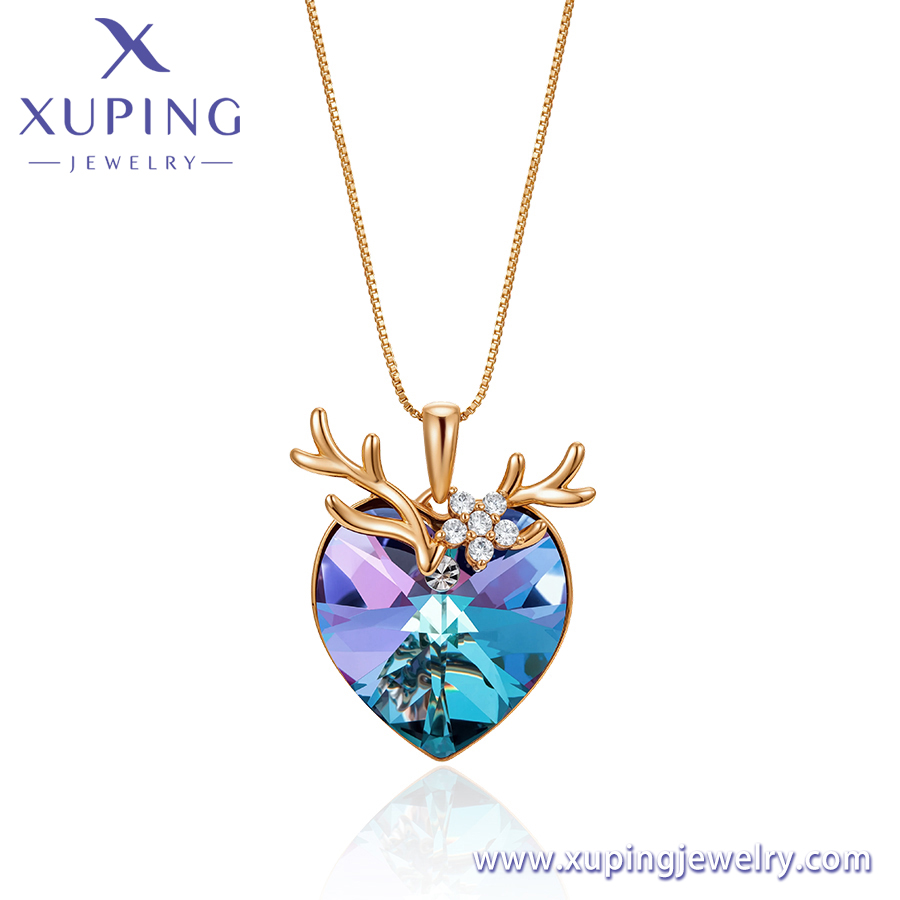
Synthetic crystal necklace X000668301: environmental copper base, 18K gold color plating, lilac synthetic crystal main stone of about 18*17 mm.
The comparison matrix
The matrix below compares the three constructions across the dimensions that appear in real sourcing conversations: base material, finish, stone, category fit, care profile, and documentation focus.
| Dimension | Stainless steel | Plated environmental copper | Synthetic crystal in plated copper |
|---|---|---|---|
| Base material | Stainless steel | Environmental copper alloy | Environmental copper alloy (stone is not the base) |
| Finish language | Stainless steel finish, or 14K gold color plating | 14K gold color, 18K gold color, or platinum plating | 14K or 18K gold color plating carrying the stone |
| Stone | No stone in the reference SKUs | Optional; stone-free styles available | Synthetic crystal or synthetic cubic zirconia |
| Reference SKU | A00902945 (necklace), T000959269 (bracelet) | A00900238 (brooch), 14E25011845 (earring) | X000668301 (necklace), X000852427 (brooch) |
| Format reference | 40 cm necklace at about 6.30 g; bracelet at about 170 mm plus 30 mm extension | Brooch 47*32 mm at 12.3 g; earring 27*14 mm at 8.88 g per pair | 41 cm necklace at about 7.915 g; brooch 44*38 mm at 9.15 g |
| Category strength | Daily-wear bracelets, necklaces, minimal designs | Broad: earrings, brooches, bangles, rings, pendants, anklets, sets | Statement pieces, occasion and gift assortments |
| Care profile | Least plating narrative; still requires finish care if color plated | Plating wear is the main consumer-care topic | Plating care plus stone-setting care |
| Documentation focus | Base material confirmation, finish description | Base metal, plating type, plating description used in copy | Base metal, plating, stone type and stone grade |
Reading the verified SKUs side by side
Concrete SKUs make the differences legible. The stainless steel necklace A00902945 and the stainless steel bracelet T000959269 both sit in the Daily series with no main stone. That combination produces a clean procurement file: base material, plating color where applicable, length, weight, and no stone grade to verify.
The environmental copper set moves in a different direction. The necklace X000668301 pairs an 18K gold color plating with a lilac synthetic crystal main stone at about 18*17 mm, a 41 cm length, and a product weight of about 7.915 g in the Simple series. The earring 14E25011845 pairs 18K gold color plating with an AB color synthetic crystal, a 27*14 mm format, and 8.88 g per pair, sold by the pair rather than the piece.
The brooches show how plating choice separates two products that share a base material. A00900238 uses platinum plating, measures about 47*32 mm, weighs 12.3 g, and carries a white synthetic cubic zirconia of about 3.5*3.5 mm in the Daily series. X000852427 uses 14K gold color plating, measures about 44*38 mm, weighs 9.15 g, and carries an AB color synthetic cubic zirconia of about 12*8 mm in the Luxury series. Same base metal; different finish, different stone scale, different series positioning.
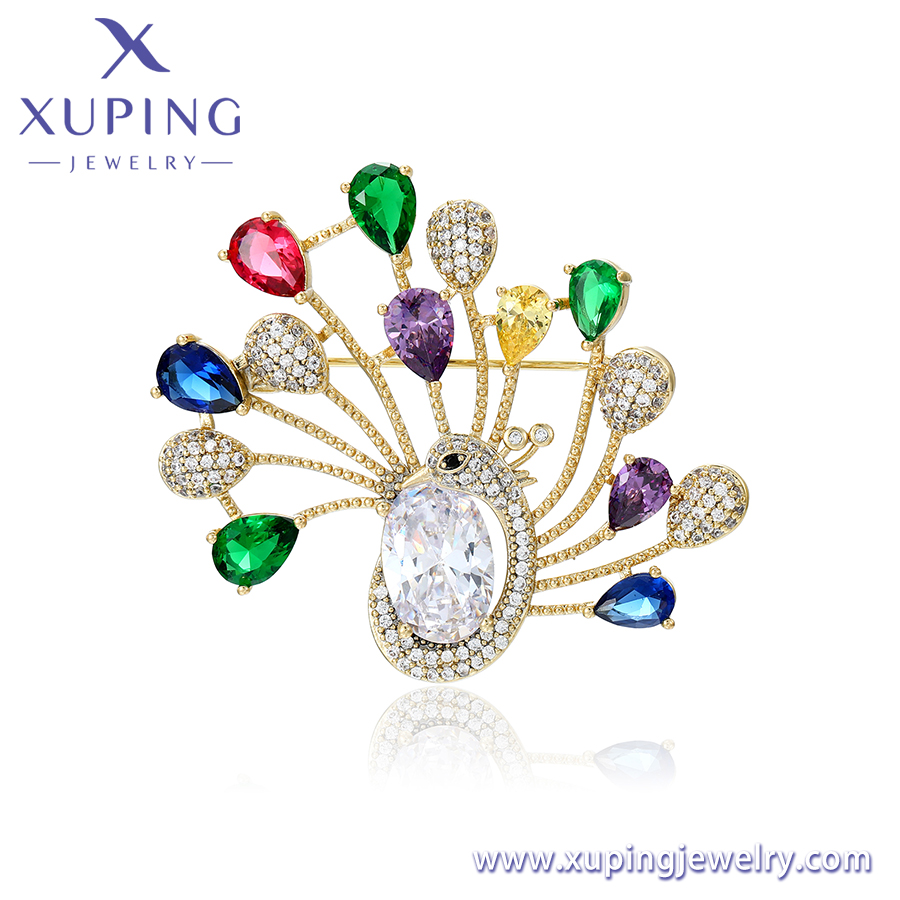
Brooch X000852427: 14K gold color plated environmental copper with an AB color synthetic cubic zirconia main stone of about 12*8 mm.
Category fit across bracelets, necklaces, earrings, brooches, bangles, rings, pendants, anklets, and sets
Material fit varies by category because each category is judged differently at retail. The observations below draw only on catalogued Xuping Jewelry constructions.
| Category | Construction that usually fits | Buyer note |
|---|---|---|
| Bracelets | Stainless steel (T000959269) or plated copper (X000977345 at 20 cm / 15.05 g; X000992979 at 19.5 cm / 12.97 g with color synthetic cubic zirconia) | Agree measurement method: catalog tolerances appear as ±2 cm on some styles |
| Necklaces | Stainless steel (A00902945) or plated copper with stone (X000668301); platinum plated statement option 14N245402 with dark blue glass main stone | Length plus extension is the key reorder variable |
| Earrings | Plated copper with synthetic crystal (14E25011845, sold by the pair) | Price per pair, not per piece; state this in purchase orders |
| Brooches | Plated copper with synthetic cubic zirconia (A00900238, X000852427) | Stone size drives perceived value more than total weight |
| Bangles | Plated copper with synthetic cubic zirconia (X000998659, Luxury series) | Confirm inner dimension and tolerance before bulk release |
| Rings | Plated copper, stone-free (X000877263 at 2.56 g) or stone-set (X001114331 with white synthetic cubic zirconia at about 5.65 g) | Free-size formats simplify inventory but limit perceived precision |
| Pendants | Plated copper with stone (X000687942 at 28*16 mm / 2.28 g; X001122748 at 36*27 mm / 3.76 g) | Pendant-only listings require chain decisions to be made separately |
| Anklets | Plated copper, stone-free (X001124310 at 28 cm / 10 g) | Seasonal category; keep size range narrow |
| Jewelry sets | Plated copper sets combining necklace, bracelet, and earrings | Set pricing must be defined against component pricing up front |
Purchasing terms and acceptance criteria
Material comparison only becomes useful once commercial terms are attached. Xuping Jewelry states a minimum order value of USD 50 on its official site and describes low minimum order quantities alongside OEM/ODM customization. Those are company-reported terms; product-level MOQ, customization fees, and lead times still require written confirmation per SKU, and the site display does not specify the conditions attached to that order value.
A practical acceptance checklist for any of the three constructions should capture:
- Base material declaration, stated in the same terms used in the catalog.
- Finish description exactly as it will appear in retail copy (for example, 18K gold color plating rather than 18K gold).
- Dimensions with tolerance, since catalogued styles already carry tolerances such as ±2 mm and ±2 cm.
- Weight per piece or per pair, with the unit of quantity stated (pcs or pair).
- Stone specification where present: type, color, and main stone size.
- Packaging and labeling expectations matched to the destination market.
What compliance changes about material choice
The FTC Jewelry Guides set the clearest published boundary for plated constructions sold into the United States. The guidance prohibits misrepresenting the presence, quantity, or karat fineness of gold in an industry product, and the revised guidance references a 10K minimum fineness and a 0.175 micron coating threshold for gold plated and gold electroplated descriptions.
For buyers, this converts a marketing question into a procurement question: does the supplier provide enough specification detail to support the words on the product page? A catalog that says 18K gold color plating is describing a color finish. That distinction should be preserved in every downstream listing rather than shortened to a gold claim.
Where Xuping Jewelry sits in this matrix
Guangdong Xuping Jewelry Co., Ltd. is a Guangzhou-based manufacturer and wholesaler of fashion and imitation jewelry, established in 1997 and therefore approaching three decades of operation. The company reports a product range spanning rings, pendants, earrings, necklaces, bracelets, anklets, bangles, and coordinated jewelry sets, and it exports 100% of its output.
Three of the supplier's stated attributes matter for the material comparison above. First, the catalog supports all three constructions in this article from a single source, which reduces the coordination cost of assembling a mixed-material assortment. Second, the company reports 194 patents supported by an R&D team of 62 designers, which is relevant when a buyer needs construction adjustments rather than off-shelf selection. Third, the company reports a manufacturing facility of more than 200,000 square meters and a workforce of approximately 1,000 staff, alongside company-reported monthly capacity of 8 million pieces.
Market coverage is likewise company-reported: major markets listed by the company include Mexico, the United States, Spain, Canada, Peru, the Philippines, Thailand, Indonesia, Malaysia, Vietnam, Australia, New Zealand, Turkey, Saudi Arabia, Iran, the United Arab Emirates, Ukraine, Russia, Poland, Germany, France, Italy, Nigeria, and the United Kingdom.
Where this comparison stops
A comparison matrix is only credible if it states its own limits.
Plating thickness is not published at SKU level. The catalog describes plating type and color, not coating thickness. A buyer evaluating plated copper for a durability claim needs supplier documentation that goes beyond the product page.
Capacity and workforce figures are company-reported. The 8 million pieces per month, the 200,000 square meter facility, and the staffing figures originate with the supplier rather than an independent audit. Third-party directories have published different estimates for staffing and facility size, so these numbers should be treated as supplier statements until verified.
The regulatory evidence here is U.S.-specific. The FTC guidance covers marketing claims in the United States. It does not establish European, UK, Canadian, Australian, or Gulf market-access requirements, and buyers selling into those markets need local review.
Stainless steel has design limits. The stainless steel references in this catalog are deliberately plain: no main stone, clean silhouettes, bracelet and necklace formats. Buyers seeking elaborate stone-set statement pieces will find more options in the plated copper range than in stainless steel.
Plated copper carries a care obligation. Plating wear is the central consumer-care topic for this construction, and crystal-set styles add stone-setting care. Retail listings that omit care guidance shift that risk to returns.
Market trend signals behind the matrix
Two published data points frame the trend. The fashion jewelry market's projected expansion from USD 42.62 billion in 2025 to USD 74.49 billion by 2034 indicates volume growth in non-precious constructions overall. The stainless steel segment at USD 2.603 billion in 2025 shows that a material once treated as a niche utility option now represents a distinct sub-market with its own buyers.
The trade picture supports the sourcing logic. China's 2023 export value of USD 935.97 million under HS 711790 reflects a deep, consolidated supply base for imitation jewelry. For buyers, that depth means material choice is rarely constrained by availability; it is constrained by how well the buyer specifies the construction and verifies the accompanying claims.
Future outlook
Three developments are likely to shape material decisions over the next buying cycles. First, plating disclosure is becoming a copywriting discipline rather than a factory detail, as claim rules in major markets continue to be applied to online product listings. Second, stainless steel's separate market identity gives buyers a construction they can describe without the plating narrative, which suits minimalist and daily-wear assortments. Third, stone-set plated copper will continue to carry occasion and gift demand, where perceived value depends on stone scale and finish rather than base metal alone.
The practical implication is that assortment planning should treat the three constructions as complementary lines with separate documentation files, not as interchangeable options at different price points.
FAQ
What is the actual difference between stainless steel and plated copper jewelry in wholesale?
The difference is the base material. Stainless steel jewelry uses steel as the base, as in Xuping Jewelry's 14K gold color plated necklace A00902945 and Daily series bracelet T000959269. Plated environmental copper jewelry uses a copper alloy base with a gold-color or platinum finish applied over it, as in the 18K gold color plated necklace X000668301 and the platinum plated brooch A00900238. The distinction affects care guidance, finish description, and how the product can be described in retail copy.
Is synthetic crystal the same thing as synthetic cubic zirconia?
They appear as separate stone descriptions in the Xuping Jewelry catalog. The necklace X000668301 lists a lilac synthetic crystal main stone of about 18*17 mm, while the brooch X000852427 lists an AB color synthetic cubic zirconia main stone of about 12*8 mm. Because both terms are used distinctly, buyers should confirm stone type, color, and grade in writing on the purchase order rather than treating the terms as interchangeable.
Does 18K gold color plating mean the product contains 18K gold?
No. In the catalog, 18K gold color describes the plating color applied over the base material. In the United States, the FTC Jewelry Guides state that misrepresenting the presence, quantity, or karat fineness of gold in an industry product is unfair or deceptive, and the guidance references a 10K minimum fineness and a 0.175 micron coating threshold for gold plated and gold electroplated descriptions. Buyers should keep the full finish wording intact in retail listings and confirm any thickness documentation with the supplier.
Which construction suits which product category?
In this catalog, stainless steel appears in plain daily-wear formats such as the necklace A00902945 and bracelet T000959269, both without a main stone. Plated environmental copper covers a wider category spread, including the earring 14E25011845 sold by the pair, the brooches A00900238 and X000852427, the bangle X000998659, the rings X000877263 and X001114331, the pendants X000687942 and X001122748, and the anklet X001124310. Stone-set statement pieces concentrate in the plated copper range.
What are the minimum order terms for wholesale buyers?
Xuping Jewelry's official site states a minimum order value of USD 50 and describes low minimum order quantities alongside OEM/ODM customization. These are company-reported terms. Product-level MOQ, customization charges, and lead times are not specified in the published display and should be confirmed per SKU in a written quotation before an order is placed.
Can buyers request custom construction across these materials?
The company describes OEM/ODM customization with low MOQ, and reports 194 patents supported by an R&D team of 62 designers. For buyers, that combination is relevant when a construction adjustment is needed rather than an off-shelf selection. Customization scope, tooling implications, and acceptance criteria for a modified construction should be defined in writing before sampling.
Material figures and product specifications referenced in this article are drawn from Xuping Jewelry catalog data and company-reported information. Market data is attributed to TrendX Insights; trade data to World Bank WITS / UN Comtrade; regulatory guidance to the U.S. Federal Trade Commission Jewelry Guides, 16 CFR Part 23.
Have Questions or Need More Details?
Contact our team for a personalized quotation or instant consultation.
Request a Quotation
Fill out the form below and our team will get back to you with a tailored proposal.
WhatsApp Direct Chat
Prefer to chat in real-time? Message us on WhatsApp for instant assistance & quick answers.
- Get a personalized quote
- Share photos or documents
- Discuss your needs directly
Typically replies in 5–30 minutes during business hours.