
Standing Garment Steamer OEM: Reading the Compliance File
A standing garment steamer order is decided twice: once on the parameter sheet, and once on the documents that are supposed to show the parameter sheet is real. Those are two different documents, produced for two different purposes, and the gap between them is where most OEM sourcing risk sits.
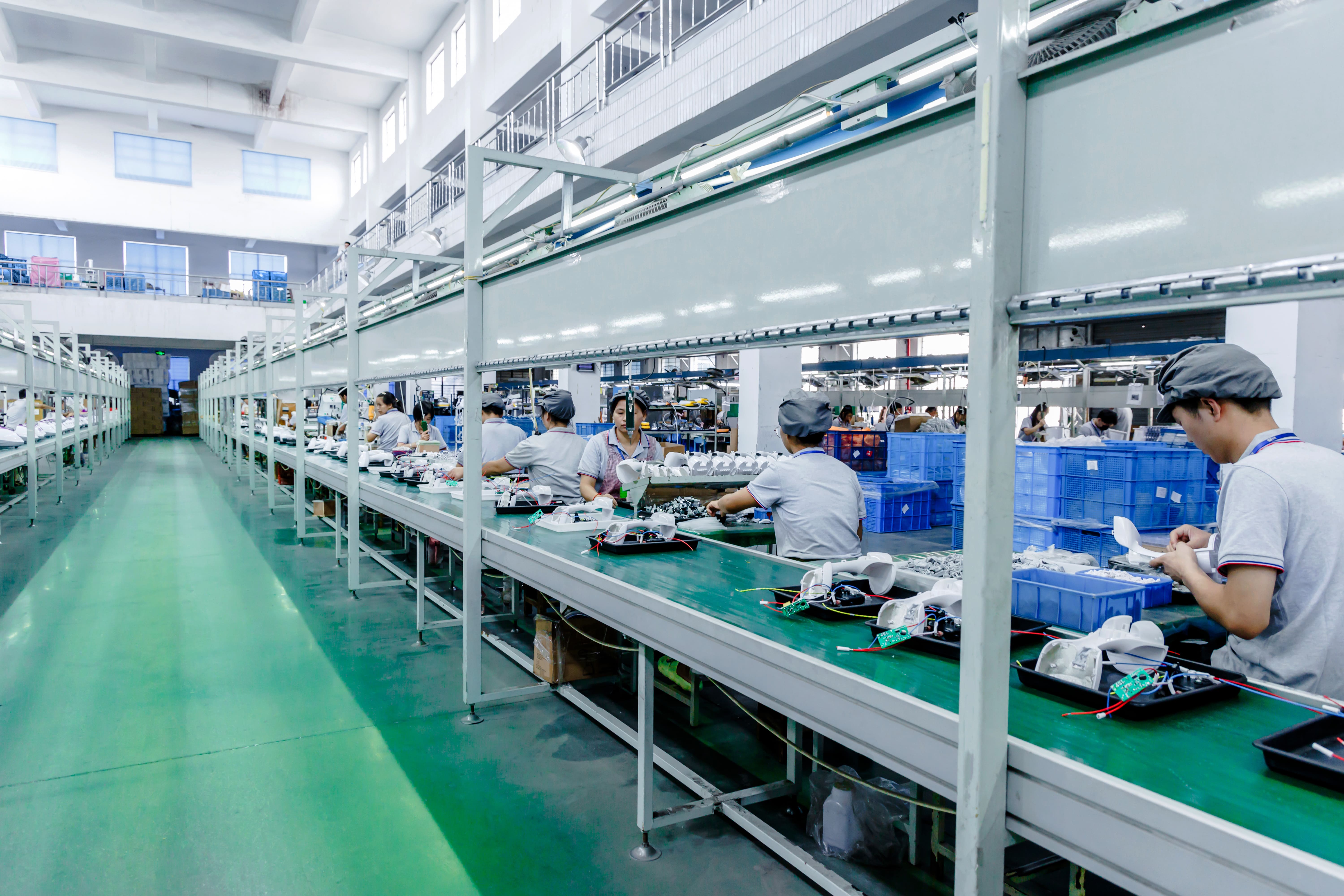
Garment steamer assembly line at Huaguang Electric Appliance Group Co., Ltd., Cixi, Zhejiang.
The standing format raises the stakes on documentation
A standing garment steamer is a floor-standing appliance built around a boiler, a telescopic pole, an ironing surface and a water tank that is typically several times larger than a handheld unit's. In the Huaguang range, the QZ66 is listed with a 1,500 ml tank and the GE01PRO with a 1.7 L tank and a 2,280 W boiler. That combination — mains pressure, hot water, sustained runtime and a tall freestanding frame — is exactly why standing models attract more safety paperwork per SKU than handheld ones.
The commercial consequence is straightforward. A buyer who evaluates a standing garment steamer OEM on the parameter sheet alone is evaluating a claim. A buyer who evaluates on the certificate file is evaluating a defined scope — and the scope rarely matches the marketing summary. Reading that scope correctly, before a purchase order, is the difference between a compliant launch and a re-testing bill.
What the parameter sheet should pin down first
Two standing models from the Huaguang range illustrate how much of the buying decision is already encoded in the specification table.
| Parameter | QZ66 (full-size standing) | GE01PRO (full-size standing) |
|---|---|---|
| Rated voltage / frequency | 220–240 V, 50/60 Hz | 220–240 V, 50/60 Hz |
| Power | 2,150 W | 2,280 W boiler |
| Steam pressure | 2.5 bar | 2.5 bar |
| Steam temperature | 120 ± 5 °C | 140–160 °C |
| Water tank | 1,500 ml, transparent | 1.7 L, transparent |
| Working time | 40 min | 37–48 min |
| Reheating time | 50 s | 60 ± 5 s |
| Steam settings | Parameter list does not enumerate steam levels; feature copy references an LCD with 5-speed adjustment | 3 steam levels; 27 ± 5 / 34 ± 5 / 40 ± 5 g/min |
| Dimensions | Not stated in the parameter list | 447.3 × 326 × 1,640 mm |
| Container load (20'/40'/40'HQ) | 4,000 / 8,200 / 9,400 pcs | 243 / 469 / 590 pcs |
One practical warning emerges directly from the source data. Published parameter tables and published feature descriptions do not always reconcile: the QZ66 parameter list states 2,150 W while its feature copy describes a 2,180 W high-power system, and the GE01PRO parameter list states a 2,280 W boiler while its feature copy describes a 2,800 W double heating system. Both sets of text exist in the same product documentation. Whichever figure is correct, the buyer's specification sheet — and the label, the manual and the test report — must carry one number, not two. Reconciling this before a purchase order is cheaper than reconciling it after a customs inspection.
The compliance file: which document covers which model
The certification records associated with the Huaguang garment steamer range are model-specific and market-specific. Grouping them by what they actually establish is more useful than counting them.
| Document | Issuer | Models named | Market | What it establishes |
|---|---|---|---|---|
| GS certificate GS/23/HEL/01592 | SGS Fimko Ltd | E15, E15E, E16 | EU | Electrical safety to EN 60335-1 and EN 60335-2-45; rated 220–240 V, 50/60 Hz, 1,800 W, Class 1; valid to 2027-12-22 |
| CE Verification of Compliance LVD N8ES2009004802HS01 | SGS | E15, E15E, E16 | EU | LVD compliance referencing EN 60335-2-85, EN 60335-1 and EN 62233; issued 2023-09-25 |
| EU Declaration of Conformity | Issued by Huaguang; tested by Intertek | E15, E15E, E16, E1Q, EQ10K80, EZ2 | EU | Manufacturer declaration citing EN 60335-1, EN 60335-2-85 and EN IEC 55014 series; issued 2026-07-17 |
| EMC Test Verification of Conformity 260100396HAN-V1 | Intertek | E1Q, EQ10K80, EZ2 | EU | EMC conformity; issued 2026-03-09 |
| EMC verification SHEM2305003191011SC | SGS-CSTC | E15, E15E, E15-1, E15E-1, E16, E16E, E16-1 | UK | EMC compliance to EN IEC 55014-1/-2 and EN IEC 61000-3-2/-3; issued 2023-06-09 |
| CB Test Certificate BE-43672/M1 | SGS Belgium (SGS-CEBEC) | T35, E22, T60 PRO MAX, E19 | IECEE member countries | CB scheme safety certification |
| RoHS test report (6626)019-0319 | Bureau Veritas | E22 | EU | Restricted substances under 2011/65/EU as amended by (EU) 2015/863; issued 2026-03-02 |
| PAHs Risk Assessment NBES220900480202-M1/PAH | SGS-CSTC Ningbo | E15, E15E, E16 | EU | PAH content to AfPS GS 2019:01 PAK; issued 2023-09-25 |
| ETL Authorization to Mark 4000776 | Intertek | Steam mop models MA1-4, MA3-0, MB2-0, MB2-4, M0, MSPRO | US / Canada | UL 499 electrical safety — for steam mops, not garment steamers |
Two patterns matter for a standing steamer buyer. First, documentation is concentrated on the handheld models: the GS, CE, PAHs and UK EMC records name the E15/E15E/E16 family, the CB certificate names T35, E22, T60 PRO MAX and E19, and the RoHS report names E22 alone. Second, neither of the standing models described in this article appears in the records reviewed: the QZ66 is not named in any of the certificates listed above, and the documentation set for the GE01PRO contains no certificate number, no test report number and no CE or RoHS declaration.
Where the documented scope stops
The single most useful thing a buyer can learn from a certificate is what it does not say. The GS certificate for this range covers electrical safety under EN 60335-1 and EN 60335-2-45 — and its scope does not list the following, all of which a standing steamer brief typically assumes:
- Steam output testing, continuous steam-output testing, steam-output consistency testing, or performance reports for variable and adjustable steam settings.
- Heat-up test reports, heating-time validation, heat-up performance data or heat-up temperature verification.
- Thermal protection verification, overheating protection test values or overheat safety feature reports.
- Leak tests for removable water tanks, tank sealing inspection, detachable tank quality control, or large-tank endurance testing.
- Self-cleaning reliability testing, descaling function tests or self-cleaning QC reports.
- Ceramic soleplate durability or surface quality records — noting that the product data lists cast aluminium panels for the T35, E22, T60 PRO MAX and E19, not ceramic.
- Packaging drop tests, e-commerce packaging quality testing or drop-tested packaging records.
- Custom plug and voltage testing, voltage compatibility reports for custom models, regional plug configuration records, or dual-voltage 100–240 V configurations.
- Commercial quality inspection, continuous-use testing or commercial durability testing for hospitality models.
- Batch traceability records, incoming and final inspection reports, or documented quality-control procedures.
The same boundary applies to the EU Declaration of Conformity. It cites the relevant safety and EMC standards and is a valid conformity instrument, but it is not a test report: it does not contain IEC 60335 test reports, leakage-current values, in-house testing records, voltage-compatibility reports or batch traceability. Separately, the GS certificate is neither a CE certificate nor a RoHS certificate, and RoHS is not listed in its scope.
None of this is a defect in the supplier's file. It is how conformity documents work: they certify a defined scope to a defined standard. The buyer's job is to decide which of the remaining questions — steam performance, thermal behaviour, tank sealing, packaging survivability, regional electrical configuration — matter for their market, and to request those test reports explicitly.
What Huaguang's manufacturing position adds — and what it does not
Huaguang Electric Appliance Group Co., Ltd. is a home appliance manufacturer founded in 1985, operating a 38,600 m² facility with 450 employees, a 100-plus-person R&D team and annual output of more than 5,000,000 units. Roughly 80% of production is exported, with stated markets in the EU, USA, Japan, Korea, the Middle East and Africa. The company operates as an OEM/ODM manufacturer for garment-care and coffee appliances, and states that it holds no stock inventory — every order is produced to order.
For a standing steamer programme, the commercially relevant OEM terms are:
| Item | Stated position |
|---|---|
| Production mode | OEM / ODM, made to order, no stock inventory |
| Customization scope | Colour, voltage, power plug type, packaging design and language, brand identity (logo) |
| Monthly capacity | 400,000 units |
| MOQ | 1,000 units |
| Lead time | 30–45 days |
| Quality control | 100% pre-shipment test, third-party inspection, safety certification programme |
| After-sales | One-year warranty, online troubleshooting, engineering support for diagnostics and structural or electronic issues, structured service documentation |
Order history in the range is concentrated in private-label and retail programmes rather than in standing units alone: 35,000 units of the E22 for a US online platform, 40,000 units of the T60 PRO MAX for a Saudi supermarket and hypermarket chain, 22,800 units of the GE01PRO for a Russian online platform, 45,000 units of the T35 for a US supermarket chain, 10,000 units of the QH09 for a Dutch e-commerce seller and 50,000 units of the QZ66 for a Russian home-appliance chain retailer.
The limitation is worth stating plainly. This is a manufacturing and customization position, not independently audited performance evidence. Capacity, output and specification figures are company-reported; the steam-rate, heating-time and runtime values in the product data are published without disclosed test conditions, so they cannot be used to rank this supplier against another on like-for-like terms without a normalized sample test.
Standing versus handheld: what the constraint set changes
Most of the certification depth in this range sits with handheld models, and the reason is visible in the physics and the logistics.
| Attribute | GE01PRO (standing) | QH09 (handheld) | E22 (handheld vacuum) |
|---|---|---|---|
| Power | 2,280 W boiler | 1,500 W | 1,200 W |
| Water tank | 1.7 L | 300 ml | 280 ml, removable |
| Working time | 37–48 min | 10–15 min | 15 min |
| Preheat | 60 ± 5 s | 25 ± 5 s | 25 ± 5 s |
| Container load (20') | 243 pcs | 2,666 pcs | Not stated |
| Footprint | 1,640 mm tall, freestanding with integrated board and telescopic rod | 200 × 117 × 247 mm, foldable handle | 260 × 105 × 180 mm |
Three constraints follow. Power draw: a 2,280 W standing boiler sits well above the 1,200–1,500 W band that commercial research on the EU Ecodesign Directive 2009/125/EC associates with the direction of travel for garment care — a research observation rather than a settled legal requirement, but a relevant one for a European standing programme. Freight density: at 243 units per 20-foot container versus 2,666 for a handheld model, the standing format carries roughly an order of magnitude more freight cost per unit, which changes the margin structure of a private-label launch. Range coverage: the certificate file concentrates on handheld models, so a standing-first catalogue requires commissioning documentation that a handheld-first catalogue inherits.
None of this argues against the standing format. It argues for treating the standing SKU as a documentation project in its own right rather than as an extension of a handheld line.
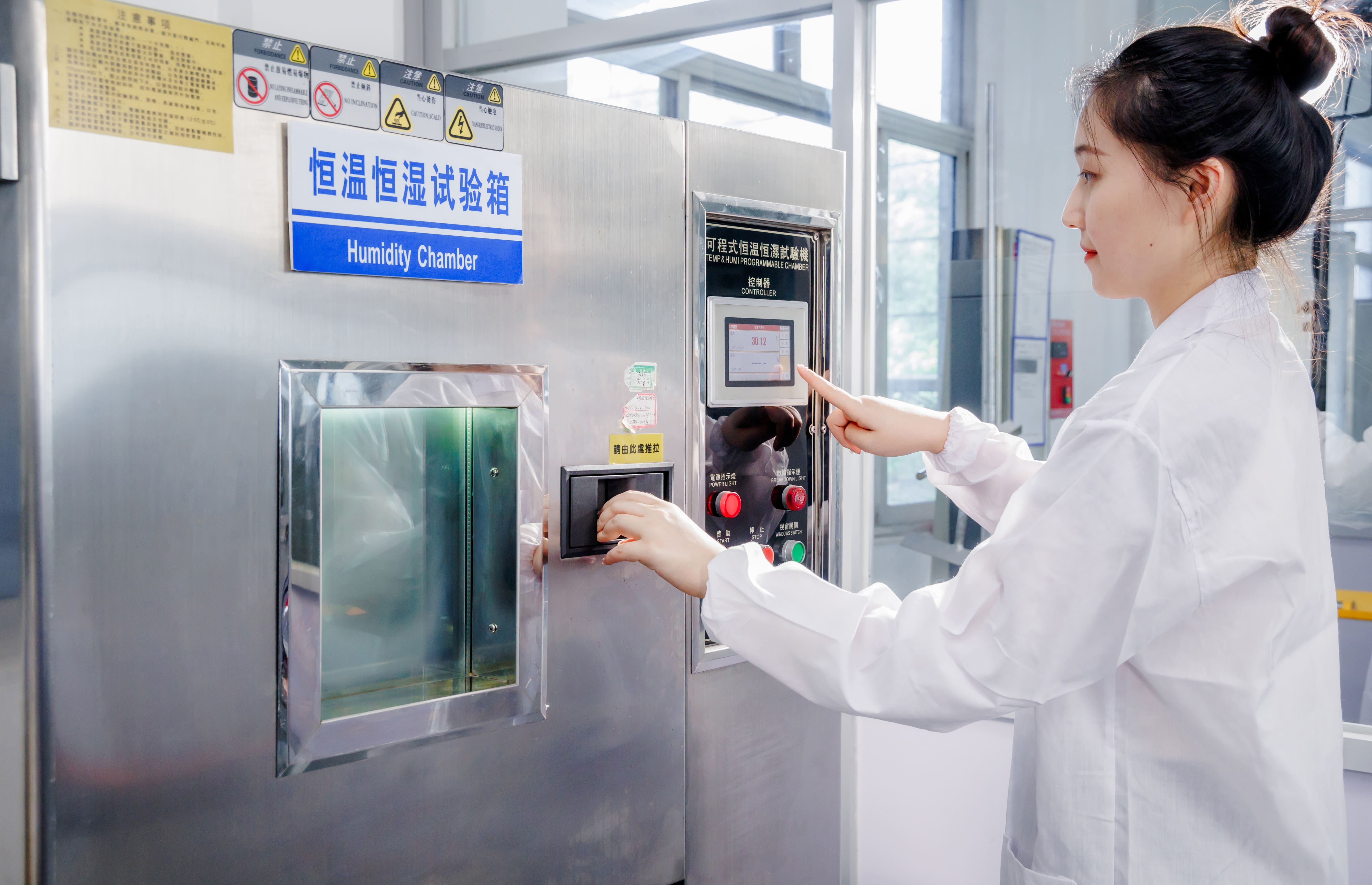
Constant temperature and humidity testing — one of the reliability checks a standing steamer brief should specify explicitly.
Where standing units are actually installed
The application profile for this product family is documented across homes, garment stores, hotels, showrooms and textile workspaces, with project types spanning retail, hospitality, apparel and OEM/ODM programmes. Listed markets include the UK, France, the Netherlands, Belgium, Germany, Poland, Slovakia, Russia, Belarus, Lithuania, Italy, Spain, Portugal, Greece, Romania, Bulgaria, Slovenia, Norway, Sweden, Saudi Arabia, Oman, Qatar, Kuwait, Bahrain, Yemen and the UAE.
Documented functions are wrinkle removal, garment steaming, fabric care, odour removal and surface sanitization, operated as handheld steaming, standing steaming, or combined horizontal and vertical steaming. The stated usage conditions are equally specific and belong in a buyer's own instructions: indoor use in a ventilated area, no damp locations, rated voltage only, filling to the MAX line with no perfume or unapproved chemicals, unobstructed steam outlets, operation only at permitted angles, and fabric care labels checked before steaming.
Market context behind the constraint
The documentation burden is rising because the category is large and geographically concentrated. Grand View Research valued the global garment steamer market at USD 3.0 billion in 2023, with Europe holding a 34.5% revenue share that year. The same source projects the handheld segment at a 58.0% share by 2036 — a forecast, and one that commercial datasets disagree on, but directionally consistent with regulatory pressure toward lower-power formats. Global Market Insights places Groupe SEB above 12% market share in 2025, which says something about how consolidated the branded end of the category remains and how much room exists for private label underneath it.
On the standards side, IEC 60335-2-85:2022 sets particular safety requirements for electric fabric steamers for household and similar purposes at rated voltages up to 250 V, and a consolidated edition incorporating AMD1:2025 has been published. The IEC publication is an international standard, not an automatic legal requirement — adoption and conformity obligations must be verified market by market, which is precisely why a supplier's own certificate file should be read by model and by destination rather than by count.
A pre-order verification checklist
- Confirm one power rating per model across parameter list, feature copy, label and manual, and require the test report to match it.
- Request certificates that name the exact model, voltage version and plug configuration being ordered — not the closest sibling.
- Ask separately for steam output, heat-up time, thermal protection, tank leakage and packaging drop-test reports, since these sit outside typical safety-certificate scope.
- Verify the market-specific conformity route: CE-related documentation for the EU, a UK EMC record where the UK is the destination, and confirmation that a GS certificate is not being presented as a CE or RoHS document.
- Confirm MOQ (1,000 units), sample timing (about 10–15 days, cost and freight typically borne by the buyer) and production lead time (30–35 days normally, up to around 45 days in peak season) in writing.
- Model freight before pricing: at 243 units per 20-foot container, standing units carry materially higher per-unit logistics cost than handheld equivalents.
- Agree the spare-parts arrangement in advance — the stated position is 1% free spare parts with an order, with additional parts purchasable and compatibility confirmed by model.
- Record who owns tooling, artwork and packaging files if the programme moves to custom moulds.
Outlook
The direction of travel is toward documentation as a product feature. Energy-efficiency expectations in Europe, the continued publication of consolidated safety standards and the growing share of private-label programmes all push the same way: the supplier that can hand a buyer a model-specific, market-specific, scope-accurate file shortens the distance between sample approval and shelf. The supplier that hands over a folder of certificates for adjacent models lengthens it. For standing garment steamers specifically, where unit volumes per container are low and power draw is high, that difference compounds quickly.
FAQ
Which compliance documents should a buyer request for a standing garment steamer destined for the EU?
Request a Declaration of Conformity that names the exact model, rated voltage and plug configuration, together with the applicable safety and EMC documentation. RoHS, REACH and ERP documentation should be confirmed as applicable to the specific model. Buyers should note that in this range the GS certificate covers E15, E15E and E16, the RoHS report covers E22, and the GS certificate is explicitly not a CE or RoHS certificate — so each document must be matched to the model it actually covers.
Does a GS certificate cover steam output, heating time or water-tank leakage?
No. The GS certificate for this range covers electrical safety under EN 60335-1 and EN 60335-2-45, with a rated scope of 220–240 V, 50/60 Hz, 1,800 W and Class 1. Its scope does not list steam output testing, steam-output consistency, heat-up test reports, thermal protection verification, removable-tank leak tests, self-cleaning reliability, packaging drop tests or custom voltage and plug verification. Those must be requested as separate test reports.
What are the MOQ, sample and lead-time constraints for a standing garment steamer OEM order?
The stated standard MOQ for garment steamers is 1,000 units. Samples are available, normally with the buyer covering sample cost and freight, and sample production usually takes about 10–15 days. Production normally takes 30–35 days after deposit and artwork confirmation, extending to around 45 days in peak season. Products are made to order rather than held in stock.
Can voltage, plug type, colour, logo and packaging be customized?
Yes. The stated OEM/ODM scope covers colour, voltage, power plug type, packaging design and language, and brand identity (logo). Custom packaging is supported from 1,000 units and colours can be matched to a Pantone code. Buyers should note that custom plug and voltage configurations and dual-voltage 100–240 V arrangements are not listed in the GS certificate scope, so voltage and plug compatibility require their own verification for each destination market.
How do the standing models QZ66 and GE01PRO differ?
QZ66 is listed with a 1,500 ml transparent tank, 2,150 W, 2.5 bar steam pressure, 120 ± 5 °C steam temperature, 40 minutes working time and 50 seconds reheating. GE01PRO is listed with a 1.7 L tank, a 2,280 W boiler, 2.5 bar, 140–160 °C, 37–48 minutes working time, 60 ± 5 seconds reheating, three steam levels at 27 ± 5, 34 ± 5 and 40 ± 5 g/min, a 1,640 mm freestanding frame with an integrated 80 cm ironing board and a three-section aluminium telescopic rod.
What does the available documentation not establish about the standing models?
Neither QZ66 nor GE01PRO is named in the certificate records reviewed here, and the documentation set for GE01PRO contains no certificate number, no test report number and no CE or RoHS declaration. That does not by itself indicate non-compliance, but it does mean a buyer planning a standing steamer programme should request model-specific certificates and test reports before placing an order rather than after.
A downloadable product manual covering the 2025 Huaguang range, including garment steamer specifications, is available here: Product Manual 2025 (PDF).
Have Questions or Need More Details?
Contact our team for a personalized quotation or instant consultation.
Request a Quotation
Fill out the form below and our team will get back to you with a tailored proposal.
WhatsApp Direct Chat
Prefer to chat in real-time? Message us on WhatsApp for instant assistance & quick answers.
- Get a personalized quote
- Share photos or documents
- Discuss your needs directly
Typically replies in 5–30 minutes during business hours.