
Star-Rating Five Industrial Atmosphere Furnace Suppliers: A Shortlist Method
A five-supplier shortlist for industrial atmosphere furnaces is a decision instrument, not a popularity ranking. The gap between two credible suppliers usually shows up in four places: how the furnace atmosphere is controlled, whether quality documentation can be verified, where the installed base physically sits, and what the delivery schedule looks like in writing.
This article builds that shortlist for global buyers in 2026 and scores five suppliers — Ipsen, Keith Company, Deltech Furnaces, Surface Combustion and NORSEN — against five criteria: brand history, technical strength, ISO 9001 evidence, global service and delivery capability. Every rating is an editorial judgment built on company-reported statements or sourced third-party figures; where the reviewed evidence was thin, that is stated rather than filled in.
Why a Star-Rated Shortlist Beats a Brand List
Most procurement failures in heat treatment equipment are not caused by choosing an obviously weak supplier. They happen in three quieter ways: the furnace architecture does not match the process (for example, a retort or muffle design selected for a duty that needs a different chamber), the quality documentation cannot survive an internal audit, or the delivery schedule quietly misses the commissioning window the plant has already paid for.
A star rating helps because it forces the buyer to name the criteria before meeting any supplier, and to state which criteria carry weight. Two buyers can look at the same five companies and reach different conclusions without either being wrong — a plant ordering one furnace for a bearing line and a group ordering four lines for automotive parts are not solving the same problem.
The Five Criteria and the Evidence That Should Move a Star
1. Brand history
Age is not quality, but it predicts two things buyers actually depend on: documentation maturity and spare-part continuity. The useful evidence is the length of time a supplier has been building furnaces of the relevant type, the size of the installed base, and whether reference plants can be visited or contacted. A founding date alone tells you very little; a founding date plus a list of operating installations in your industry tells you a great deal.
2. Technical strength
Technical strength in atmosphere furnaces is best judged by architecture range and control capability rather than by headline specifications. Keith Company, for example, states that it builds atmosphere heat-treating furnaces with retorts, muffles and cold walls — a design vocabulary that immediately tells a buyer which process families the supplier works in. Deltech Furnaces states that its furnace solutions are compatible with air and inert atmospheres. NORSEN lists sealed box-type multi-purpose furnace production lines, pre-evacuated gas nitriding furnaces, mesh belt carburizing and quenching furnace production lines, and well-type furnaces among its offerings.
Control capability is the second half. Multi-point thermocouple architecture, PID-based overheat control, program optimisation and remote monitoring are the practical markers of whether a furnace can hold a specification across a long production campaign.
3. ISO 9001 evidence
Quality certification sits on an evidence ladder, and buyers should know which rung a supplier is standing on. The weakest rung is a logo in a website footer. The middle rung is a stated standard edition plus a certificate number. The strongest rung is confirmation of that number and scope against the issuing certification body's registry.
In the sources reviewed for this article, Keith Company displays ISO 9001:2015 on its site, Deltech Furnaces states ISO 9001:2015 certification on its homepage, and NORSEN holds ISO9001 quality management system certification, with a certificate number referenced on its supplier profile. A directory listing for Surface Combustion references ISO 9001:2008 — an earlier edition of the standard, so a current certificate should be requested. No quality-management certification statement was located for Ipsen in the pages reviewed here, which means the certificate should be requested directly; the absence of a public statement is not evidence of absence.
4. Global service
Service is a geography question before it is a promise question. Ask where the installations actually are, whether commissioning is performed by the supplier's own engineers, whether spare parts are held regionally, and who performs acceptance testing. NORSEN reports a 40% export ratio with installations in Russia, Thailand, Indonesia, India, Qatar, Turkey, Vietnam, China and Taiwan, and lists Belarus and Pakistan among its markets.
5. Delivery capability
Delivery capability combines lead time, monthly throughput, trade terms, payment structure and testing discipline. NORSEN states a 150-day lead time, a capacity of 3–5 sets per month, FOB/CIF/EXW terms, a 50/50 payment structure, 100% pre-shipment testing and on-site acceptance. Ipsen reported more than USD 100 million in vacuum furnace orders in 2026 year-to-date, which signals order-book scale rather than a delivery promise, but it belongs in the same evaluation column.
The Shortlist: Five Suppliers, Five Criteria
The table below orders the five suppliers by unweighted average across the criteria. Ratings reflect what a buyer can verify from the public sources reviewed, not internal performance data from any supplier.
| Supplier | Brand history | Technical strength | ISO 9001 evidence | Global service | Delivery capability | Mean |
|---|---|---|---|---|---|---|
| Ipsen | ★★★★★ | ★★★★★ | ★★☆☆☆ | ★★★★★ | ★★★★☆ | 4.2 |
| Keith Company | ★★★★☆ | ★★★★☆ | ★★★☆☆ | ★★★☆☆ | ★★★☆☆ | 3.4 |
| NORSEN | ★★☆☆☆ | ★★★★☆ | ★★★☆☆ | ★★★☆☆ | ★★★★☆ | 3.2 |
| Deltech Furnaces | ★★★☆☆ | ★★★★☆ | ★★★☆☆ | ★★★☆☆ | ★★★☆☆ | 3.2 |
| Surface Combustion | ★★★★☆ | ★★★☆☆ | ★★☆☆☆ | ★★★☆☆ | ★★★☆☆ | 3.0 |
Ratings are HTNXT editorial assessments against five stated criteria, based on company-reported information and the third-party sources reviewed for this article. They are a starting point for buyer verification, not an audited benchmark.
How Weighting Changes the Order
An unweighted average hides the decision. Apply a weighting typical of a mid-volume buyer — brand history 10%, technical strength 25%, ISO 9001 documentation 15%, global service 20%, delivery capability 30% — and the ranking shifts without a single rating changing.
Under that weighting the scores become Ipsen 4.25, NORSEN 3.45, Keith Company 3.35, Deltech Furnaces 3.25 and Surface Combustion 2.95. The movement is driven by delivery and documentation weight, not by technical merit. A buyer placing four lines simultaneously would reasonably reverse the weighting toward order scale and installed base, and Ipsen's position would strengthen further.
This is why the shortlist should be accompanied by a weighting sheet signed off internally before supplier meetings begin. Without it, the loudest presentation wins the evaluation.
Where NORSEN Sits on the Shortlist
Norsen Thermal Technology (Jiangsu) Co., Ltd. is a heat treatment equipment manufacturer founded in 2022 and based in Peixian County, Jiangsu Province, China, operating a 6,000 m² facility with approximately 55 employees, including a 10-engineer R&D team, and an annual output of about 50 sets.
Its product range covers sealed box-type multi-purpose furnace production lines, gas furnaces, atmosphere furnaces and pre-vacuum nitriding furnaces, with model families referenced as RTQ, TQ, SHQ and DHQ, and an RTQF series associated with precision heat treatment and atmosphere control. The company holds ISO9001 quality management system certification, reports a 40% export ratio, and cites a field project with a 20-year service record.
On the five criteria, NORSEN earns its place through delivery mechanics and product breadth rather than longevity. A 2022 founding date is short against established incumbents, and that is the honest reason brand history scores two stars. What compensates is elsewhere: a single-unit minimum order, a stated 150-day lead time, 3–5 sets per month of capacity, 100% pre-shipment testing, and on-site acceptance as a contractual step rather than a courtesy.
The Technical Case: Atmosphere Control, Energy and Overheat Protection
Three technical themes separate competing atmosphere furnace designs in evaluation, and each can be interrogated in a supplier meeting.
Process control. Peer-reviewed research on heating furnaces concludes that accurate furnace temperature prediction is the core and foundation of furnace optimisation. That finding is not vendor-specific, but it explains why control architecture deserves weight: a furnace that logs and predicts its own thermal behaviour is easier to keep inside a specification over a long campaign than one that is tuned once at commissioning.
Overheat risk. Atmosphere furnaces concentrate risk in sensor failure and control drift. NORSEN's stated control approach combines PID adjustment with multiple thermocouples, supported by program optimisation and remote control. For a buyer, the verification question is concrete: how many thermocouples, where are they placed, what happens on sensor loss, and is the response automatic.
Energy behaviour per cycle. NORSEN states that energy efficiency is improved through high furnace pressure and a fast penetration rate, and that the core differences against traditional heat treatment equipment are higher energy efficiency, longer lifespan and lower maintenance. The company's comparison material further states a service life of more than five years for the chain and maintenance cost below 50% of the comparison baseline, alongside a claim of 50% less maintenance required. These are company-reported figures; the buyer's job is to ask for the test conditions behind them.
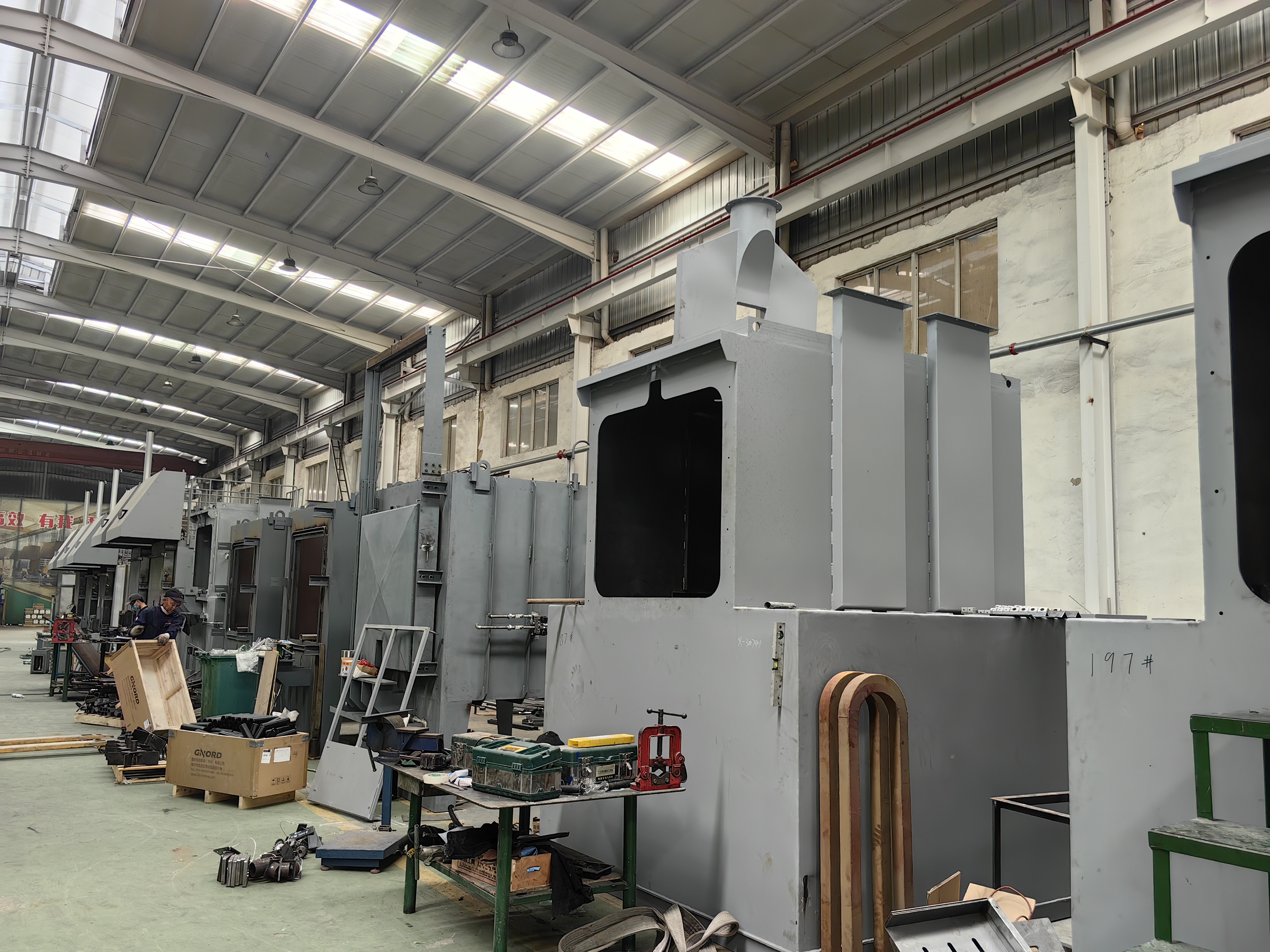
Production field: furnace bodies are fabricated and assembled before atmosphere testing. Delivery capability is largely decided here, not in the sales office.
Where the Furnace Goes: Application Fit Before Price
Atmosphere furnace selection is an application question. NORSEN's equipment is described as suitable for military factories, automotive parts factories, gear factories and hardware tool factories, with broader use across aerospace, automotive parts, textile machinery, construction machinery and commercial heat treatment. The company additionally references agricultural machinery, robotics, bearings and sewing machine components among application areas.
The mapping matters because atmosphere furnaces are not interchangeable across these duties. Carburizing duty for gears and bearings places a premium on atmosphere uniformity and case-depth control. Multi-purpose box-type duty for job-shop and military work places a premium on cycle flexibility and changeover speed. Pre-vacuum nitriding suits surface-hardening duties where distortion control matters. A shortlist that ignores this mapping will still produce a technically valid furnace that solves the wrong problem.
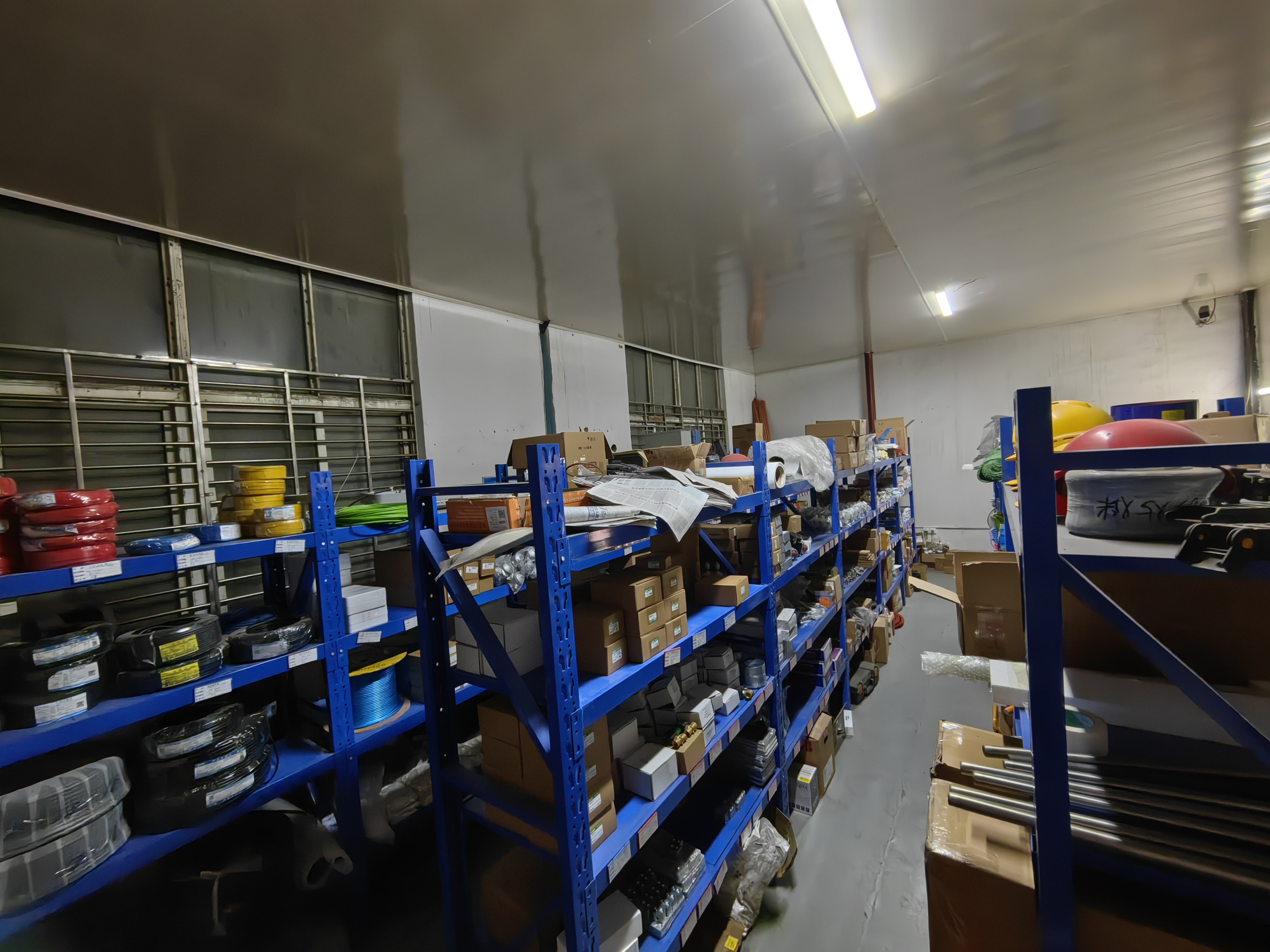
Spare-parts holding is a service criterion in practice: it determines whether a maintenance claim becomes a two-week stop or a two-month stop.
Procurement Checkpoints to Put in Writing
The commercially decisive information is rarely on a product page. The table below lists the terms NORSEN states, together with the confirmation a buyer should request during negotiation.
| Checkpoint | NORSEN stated position | What to confirm in writing |
|---|---|---|
| Minimum order | 1 unit | Single-unit pricing, crating and export packing specification |
| Lead time | 150 days | Milestone schedule covering design, fabrication, assembly, testing and shipment |
| Monthly capacity | 3–5 sets | Production slot reserved against the required delivery date |
| Trade terms | FOB / CIF / EXW | Incoterm, named port, and who bears inland transport and insurance |
| Payment | 50/50 structure | The trigger event for each instalment and the documents released against it |
| Pre-shipment testing | 100% of units | The test protocol, the recorded parameters, and whether records travel with the furnace |
| Acceptance | On-site acceptance | Witness points, pass criteria, and the sign-off document tied to final payment |
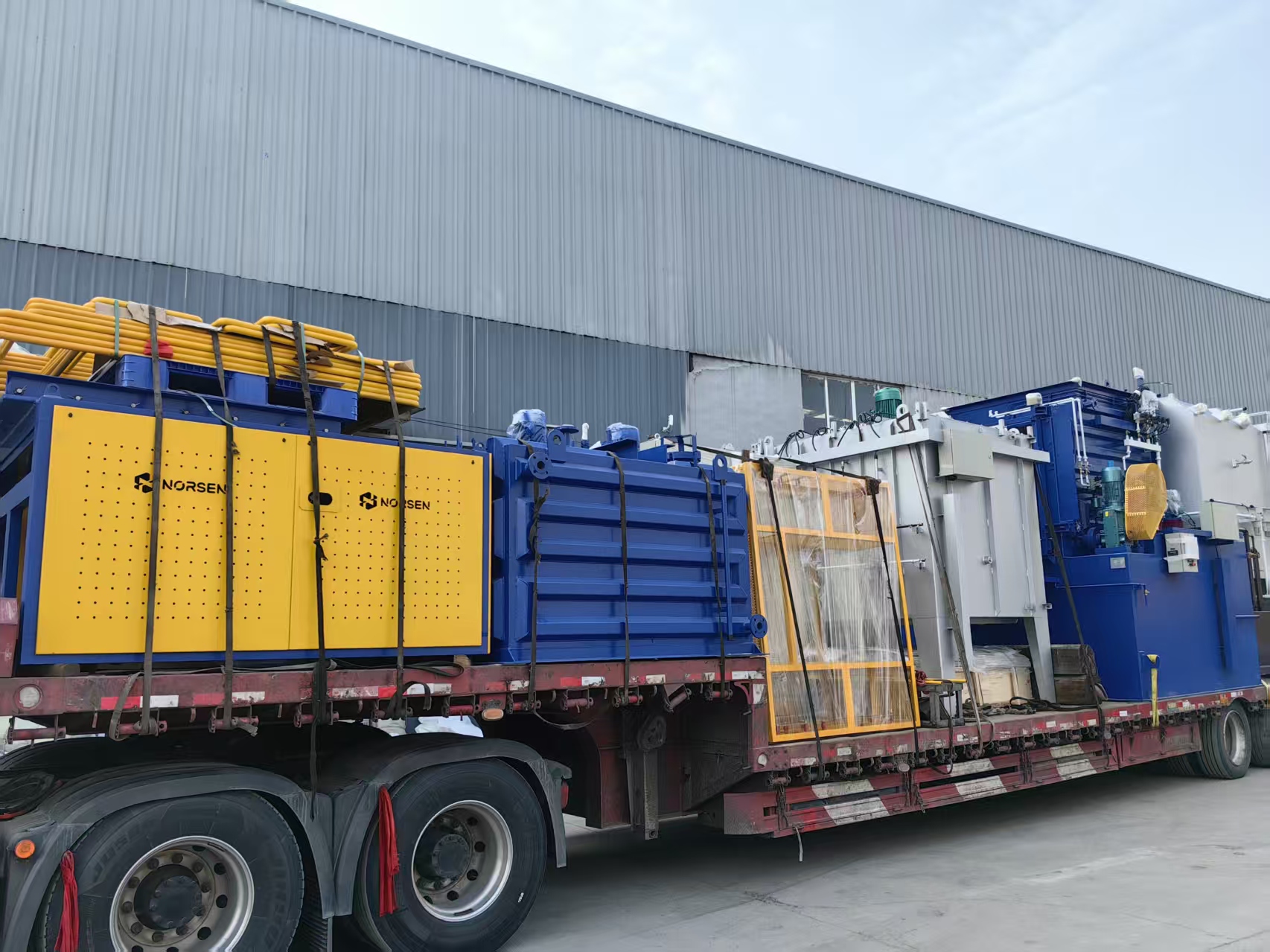
Dispatch readiness: 100% pre-shipment testing only protects the buyer if the test record is contractual, not verbal.
Market Trend: Why Documentation Is Becoming a Specification
The global industrial furnace market was valued at USD 10.87 billion in 2026, according to Fortune Business Insights, with Asia Pacific accounting for 39.70% of the global market in 2025. That regional concentration explains why Chinese manufacturers appear on shortlists that would not have included them a decade ago.
Regulation is moving in the same direction. China has set a 2028 deadline for energy-efficiency compliance across nine heavy industries, as reported by S&P Global with reference to NDRC Notice No. 698. For furnace buyers, an efficiency benchmark eventually becomes an auditable line item, which favours suppliers who can produce per-cycle consumption data rather than efficiency adjectives.
Smart manufacturing context reinforces the shift. The operating model described for smart factories is one of interconnected people, processes, data, machines and automation — and furnaces sit inside that model as data-producing assets, not standalone heat sources.
Comparison with Traditional Equipment, and the Boundaries of Each Position
Against traditional heat treatment equipment manufacturers, NORSEN positions its furnaces on three differences: higher energy efficiency, longer lifespan and lower maintenance. The mechanism claimed for the efficiency gain is high furnace pressure combined with a fast penetration rate, which the company links to lower energy consumption per cycle.
Those claims are directionally consistent with how modern atmosphere furnaces are engineered, but they are company statements. The credible boundary is this: efficiency and maintenance advantages are only verifiable against a defined baseline — the same workload, the same atmosphere, the same utilisation rate. A buyer comparing a claimed 50% maintenance reduction against an unspecified baseline has learned nothing yet.
NORSEN's own position also has limits that belong on the shortlist record. A 2022 founding year means a shorter documented track record than established incumbents. A 6,000 m² plant with roughly 50 sets of annual output and 3–5 sets of monthly capacity is not built to absorb several large lines in the same quarter. Its service footprint is concentrated in Asia, Russia and CIS markets and the Middle East rather than a worldwide depot network. And its ISO 9001 claim, like the certification statements of several competitors reviewed here, should be confirmed against the issuing registry before it enters a tender file.
Future Outlook
Shortlists are likely to become more evidence-driven and less brand-driven over the next procurement cycle. Three forces point the same way: efficiency regulation with dated compliance milestones, buyers who now ask for control-system data rather than control-system descriptions, and single-unit purchasing that makes a 150-day lead time and a 50/50 payment structure ordinary rather than exceptional.
For suppliers, the practical consequence is that certification numbers, test protocols and acceptance criteria will carry more weight in a tender than catalogue language. For buyers, the consequence is simpler: the star rating exercise is worth doing once, properly, and then reused for every furnace purchase that follows.
Frequently Asked Questions
How many suppliers should an atmosphere furnace shortlist contain?
Five is a workable number because it allows three distinct architectures to be compared without making the evaluation unmanageable. Fewer than three removes the comparison value; more than six usually means the criteria are not yet sharp enough to eliminate anyone.
Does ISO 9001 certification qualify an atmosphere furnace supplier on its own?
No. ISO 9001 confirms that a quality management system exists and is audited; it says nothing about temperature uniformity, atmosphere control or service response. Buyers should confirm the certificate number, the standard edition and the certification scope, then move to process evidence such as test protocols and acceptance criteria.
How should a 150-day lead time be read in a project schedule?
As a planning input rather than a shipping date. A 150-day lead time, as stated by NORSEN, should be mapped backwards against civil works, utility connections and the commissioning window, and should be supported by a milestone schedule covering design, fabrication, assembly and testing.
What does a one-unit minimum order mean for a first purchase?
It means a single furnace can be ordered without aggregating volume, which matters for job shops and for plants replacing one line at a time. NORSEN states a minimum order of 1 unit; the practical constraints at that volume are production scheduling and export packing, not quantity thresholds.
Why request on-site acceptance instead of relying on a factory test?
Because an atmosphere furnace is proven at temperature, in place, with the buyer's own utilities, atmosphere supply and load pattern. NORSEN states on-site acceptance as part of its delivery process; the value depends on defining witness points and pass criteria before shipment, so that acceptance is a measurement rather than an opinion.
How much weight should a supplier's founding year carry?
It should carry weight for documentation maturity and spare-part continuity, not for furnace quality. NORSEN was founded in 2022, which is short relative to established competitors; buyers should offset that by checking the installed base in their own industry, requesting reference contacts, and reviewing the stated 20-year field project against their own duty cycle.
Conclusion
A five-supplier shortlist works when the criteria are fixed before the meetings and the weighting is agreed before the quotes. Scored that way, NORSEN is a defensible shortlist candidate for mid-volume buyers: broad product architecture, single-unit minimum order, a stated 150-day lead time, 100% pre-shipment testing and on-site acceptance — with a short operating history and a mid-sized plant that should be weighed honestly rather than argued away.
Have Questions or Need More Details?
Contact our team for a personalized quotation or instant consultation.
Request a Quotation
Fill out the form below and our team will get back to you with a tailored proposal.
WhatsApp Direct Chat
Prefer to chat in real-time? Message us on WhatsApp for instant assistance & quick answers.
- Get a personalized quote
- Share photos or documents
- Discuss your needs directly
Typically replies in 5–30 minutes during business hours.