
Starting at 200 Pieces: A 5-Style Shortlist for Your First Custom Casual Apparel Order
The global casual wear market was valued at USD 645.22 billion in 2025 and is projected to grow to USD 906.32 billion by 2034, according to Fortune Business Insights. Category demand is therefore not the obstacle for a new label. The obstacle is the first production commitment: the minimum quantity a factory will accept before a brand has any evidence that its sizing, price point and packaging will sell.
This article is a discovery-stage reference for buyers, brand owners and importers preparing a first custom casual apparel order. It sets out five styles that can be produced in small-batch trial volumes at a custom MOQ starting from 200 pieces, drawn from the current product range of Guangzhou Lihong Apparel Trade Co., Ltd., which trades as Lihongwear, a Guangzhou-based manufacturer specialising in menswear OEM/ODM production for export.
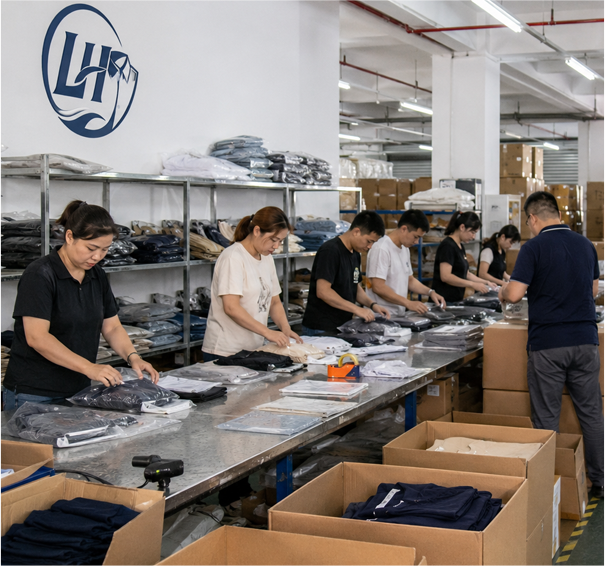
The five styles are a 360g hoodie, a 280g high-elastic long sleeve shirt, and three T-shirt builds differentiated by fabric blend: Sorona, Breathable Cotton and Comfort-Stretch Cotton.
Why a 200-Piece Starting Point Matters More Than It Used To
A 200-piece entry point allows a brand to place a branded, labelled and packaged product in front of real customers before committing capital to a full production run. That is a different function from a large-volume order. A trial run buys evidence about fit, price band and sell-through, not the lowest achievable unit cost.
Market data describe a category moving in that direction. The custom made clothes market is estimated to reach USD 213.1 billion by 2035, at a CAGR of 10.5% from 2026 (Proficient Market Insights). In the United States, the custom T-shirt printing market was valued at USD 857.5 million in 2023, with a projected CAGR of 11.8% to 2030 (Grand View Research). Smaller orders, placed more often, are the operational consequence of that kind of growth.
At Lihongwear, custom orders start from 200 pieces. The same operation keeps a ready stock of over 200,000 pieces and a daily output of 1,500 pieces, so trial production and later replenishment can run through one facility rather than two separate supply routes. One detail is worth confirming in writing before the order is placed: whether the 200-piece minimum applies per style, per colourway or per purchase order. The answer determines how much variety a single trial can genuinely test.
The Five Styles at a Glance
| # | Style | Series / line | Fabric and listed weight | Listed sizes |
|---|---|---|---|---|
| 1 | 360g Hoodie | 1901 Series | Mountain Cotton: body 63.5% cotton, 36.5% polyester; lining 100% polyester; 360g | M-3XL |
| 2 | 280g High-Elastic Long Sleeve Shirt | 1801 Series, 1701 Series (17/18 Series) | High-Elastic Tech Blend: 79.7% polyester + 20.3% spandex, four-way stretch. Alternative build: High-Elastic Smooth Polyester, 100% polyester thin sweatshirt | M-4XL |
| 3 | Sorona Blend T-Shirt | T-shirt range: 08 Series, 0606 Series, 0829 Series, Comfort Stretch Cotton Series, Roma Cotton Series | Sorona: 63.6% cotton, 36.4% polyester. Line weights listed at 170g, 220g and 230g | M-4XL / M-3XL |
| 4 | Breathable Cotton T-Shirt | Same T-shirt range | Breathable Cotton: 100% combed cotton | M-4XL / M-3XL |
| 5 | Comfort-Stretch Cotton T-Shirt | Same T-shirt range | Comfort-Stretch Cotton: 100% polyester with an ultra-smooth face | M-4XL / M-3XL |
Weights, blends and size ranges above follow the supplier's published product specifications. A fourth blend, Starry Sky Cotton (87% nylon, 13% spandex), is also available inside the same T-shirt range.
Style 1: The 360g Hoodie (1901 Series)
The 1901 Series hoodie is built on Mountain Cotton, with a body of 63.5% cotton and 36.5% polyester and a 100% polyester lining, at a 360g fabric weight in sizes M to 3XL.
Its construction logic is a double-layer composite for heat retention. The style is specified for wear on its own in spring and autumn or as an inner layer in winter, which places it in both outdoor and commuting use. The cotton base is described as soft and non-irritating against the skin, while the fleece lining retains heat and reduces the chill that follows sweating. The base is stiff and durable, resistant to pilling and sagging after repeated washes, and the loose fit is shaped to accommodate European and American plus-size body types. Breathability is stated as sufficient for mountaineering, hiking and everyday home wear.
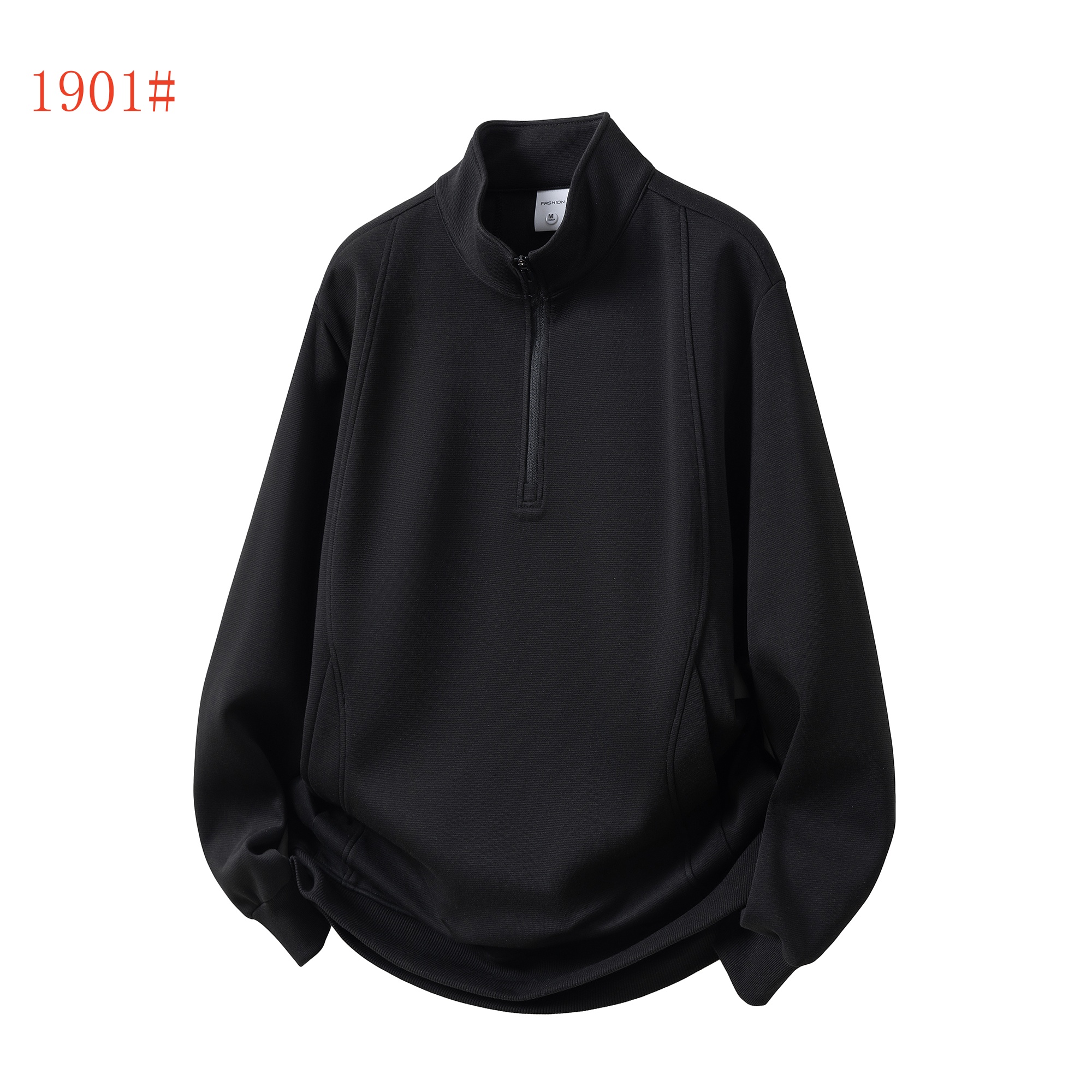
Why it leads a shortlist: heavyweight fleece in the 350-420 GSM band has become the baseline standard for premium streetwear, where a structured, boxy drape is the defining visual characteristic (PrintDoors / Accio Work). At 360g, this style sits inside that band. For a first order it is usually the piece that carries the highest perceived value and the clearest brand statement per unit, although its M-3XL ladder is narrower than the rest of the shortlist.
Style 2: The 280g High-Elastic Long Sleeve Shirt (1801 / 1701 Series)
The long sleeve programme is offered in two 280g builds. The first is a High-Elastic Tech Blend (17/18 Series) of 79.7% polyester and 20.3% spandex with four-way stretch. The second is a High-Elastic Smooth Polyester build (18 Series) of 100% polyester in a thin sweatshirt construction. Both are listed in sizes M to 4XL.
The functional claims attached to this category are specific and testable: unrestricted movement with a slim fit that is not tight; a smooth drape that resists wrinkling without ironing; elasticity that holds shape after repeated stretching without shedding or snagging; a lightweight opaque fabric that works alone or as a base layer; quick-drying and breathable for commutes and light exercise; and wash durability with colourfast, in-stock colours. The range is also positioned for small and medium-sized wholesalers placing small-batch trial orders, on the basis of cost advantage.
For a first order this is the transitional-season and layering style. It also crosses into corporate workwear because the surface accepts clean embroidery and the size ladder runs one step higher than the hoodie.
Styles 3-5: Three T-Shirt Blends, Three Different Jobs
The T-shirt range covers the 08 Series, 0606 Series, 0829 Series, Comfort Stretch Cotton Series and Roma Cotton Series, with line weights listed at 170g, 220g and 230g and sizes in M-4XL or M-3XL depending on series. Four blends sit inside that range, and three of them map onto distinct trial objectives rather than being interchangeable options.
Style 3 - Sorona blend (63.6% cotton, 36.4% polyester)
A cotton-forward blend that keeps a natural hand-feel while adding a synthetic component. It is the middle position of the tee set: more structured than a light jersey, less technical than a spandex-bearing fabric. It works as the volume basic when a brand wants one plain core style with a fabric story to explain.
Style 4 - Breathable Cotton (100% combed cotton)
A pure combed cotton build aimed at breathability and everyday comfort. It is the least complicated product in the shortlist to merchandise and typically the highest-velocity repeat-purchase item, which makes it the natural base for a first order's reorder logic.
Style 5 - Comfort-Stretch Cotton (100% polyester, ultra-smooth face)
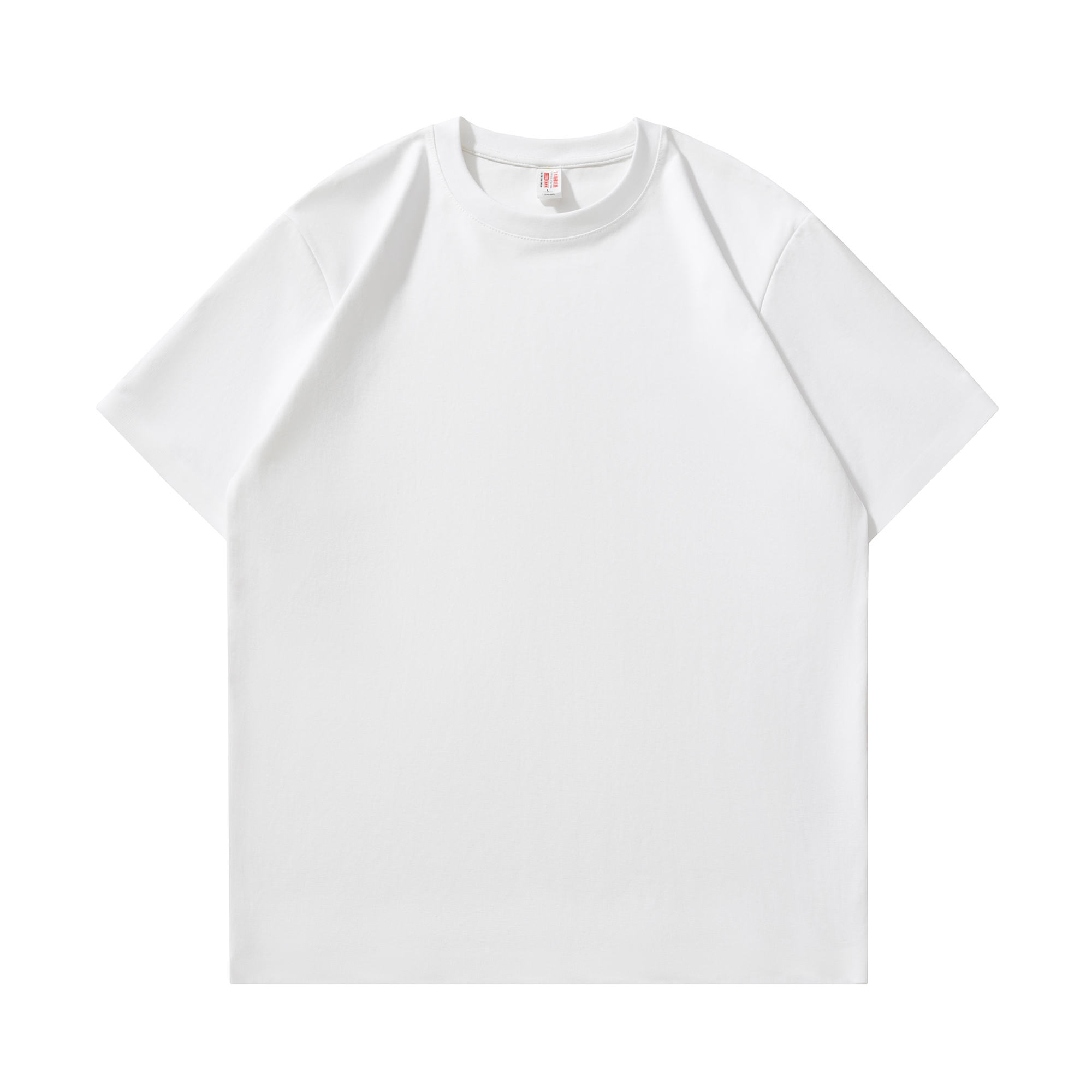
The ultra-smooth face of this fabric is specified for high-resolution screen printing, silicone heat transfer logos, subtle embroidery and reflective safety branding. It is the decoration-led choice in the set and the reason a first order can test graphic capability at the same time as it tests garment fit.
Private label execution runs across the range: customised inner neck taping, woven brand tags, printed wash care labels, custom hangtags and custom polybag packaging. Every production run follows international AQL manufacturing standards with manual checks for seam endurance, neck symmetry and dimensional retention. Freight is managed from EXW factory release through to DDP door-to-door terms, supported by one-to-one account management, real-time shipment tracking and a seven-day post-delivery quality guarantee window.
How to Split 200 Pieces Across Five Styles
Five styles and 200 pieces is not a division exercise; it is a prioritisation exercise. Splitting evenly produces roughly 40 pieces per style, which rarely supports a full size curve in more than one colour. A more useful sequence is to answer five questions first.
- What job does each style do: anchor piece, volume driver, or test?
- Which season does it serve, and can it be reordered inside that same season?
- Which price band does it occupy relative to the rest of the capsule?
- What size curve does the target market actually buy, based on any sales or marketplace data available?
- If one style sells through, can it be replenished without restarting sampling?
The illustrative split below is an editorial example of that logic, not a supplier specification.
| Style | Illustrative pieces | Why it earns the volume |
|---|---|---|
| 360g Hoodie, 1901 Series | 40 | Anchor piece with the highest perceived value; limited to an M-3XL ladder |
| 280g High-Elastic Long Sleeve, 1801 / 1701 Series | 30 | Transitional-season layer and workwear crossover |
| Sorona blend T-shirt | 50 | Core basic with a differentiated fabric story |
| Breathable Cotton T-shirt | 50 | Highest repeat-purchase velocity and simplest merchandising |
| Comfort-Stretch Cotton T-shirt | 30 | Print-detail test for graphics or safety branding |
| Total | 200 | Entry point for custom orders at Lihongwear |
A common alternative is two or three styles at higher depth instead of five at low depth, which keeps the size curve intact. The trade-off is deliberate: breadth tests product-market fit, depth tests size and colour assumptions.
Matching Fabric and Style to Application Scenario
| Application scenario | Style fit | Operational note |
|---|---|---|
| Cross-border e-commerce and online stores | Breathable Cotton and Comfort-Stretch Cotton T-shirts | Direct shipment from stock and small-order quick response |
| Trend brand and private label programmes | 360g hoodie as the flagship; Sorona T-shirt as the volume layer | Multi-pattern logo customisation across the capsule |
| Corporate workwear and group orders | 280g long sleeve and 360g hoodie | Embroidery-friendly surfaces; long sleeve runs to M-4XL |
| Clothing wholesale and mixed small-batch | All five styles in mixed palettes | Multi-style mixed wholesale supported from the same range |
| Offline retail | Blank solid T-shirts and long sleeve basics | Four-season daily wear with long-term warehousing suitability |
Across these scenarios the supplier states that products are built for four-season daily wear, repeated washing, high-temperature and humid overseas climates, and long-term warehousing. The stated material requirements are that fabrics are free of formaldehyde, contain no carcinogenic dyes and meet colour-fastness standards, with fast sampling, multi-style mixed wholesale and multi-pattern logo customisation supported.
What Can Be Customised at a 200-Piece Order Size
At the 200-piece entry point, the customisation set generally covers decoration, trims and packaging rather than fabric development. Decoration options listed across the range are screen printing, digital direct injection (DTG), embroidery and heat transfer logos. Private label trims include inner neck taping, woven brand tags, printed wash care labels, custom hangtags and custom polybag packaging. Custom Pantone colour-dyeing is offered for enterprise-level production orders, which in practice places it above the small-batch trial tier.
Decoration compatibility varies by fabric, and this affects which style should carry the graphics. The Comfort-Stretch Cotton T-shirt's ultra-smooth face is specified for high-resolution screen printing and silicone heat transfer. The Mountain Cotton hoodie's heavier surface suits embroidery and structured logo placement. The 280g long sleeve's smooth drape is intended for clean, minimal branding rather than dense print coverage.
Market Trend Signals Behind This Shortlist
Three signals explain why this particular combination, a heavyweight fleece, a stretch long sleeve and a differentiated tee set, is a reasonable trial basket in 2026.
Weight is now a positioning cue. Heavyweight hoodies in the 350-420 GSM band have become the baseline standard for premium streetwear, where a structured, boxy drape is the defining visual characteristic (PrintDoors / Accio Work). The 1901 Series hoodie sits at 360g, inside that band.
Compliance is becoming a purchasing criterion. OEKO-TEX issued over 50,000 certificates between 2023 and 2024, an increase of 22%, reflecting the industry's shift toward chemical safety and regulatory compliance (OEKO-TEX Association). Buyers who cannot document fabric safety increasingly cannot list on major marketplaces.
Decoration is driving product choice. With the U.S. custom T-shirt printing market projected to grow at a CAGR of 11.8% to 2030 (Grand View Research), a fabric's printability is a commercial variable rather than an afterthought. That is the specific reason the Comfort-Stretch and Sorona blends belong in a first order alongside a plain combed cotton option.
A Small-Batch Order Versus a Large-Volume Programme
A 200-piece trial is not a smaller version of a bulk programme; it is a different instrument with different economics, and it carries boundaries that buyers should accept before ordering.
- Allocation pressure. Five styles at 200 pieces averages roughly 40 pieces per style, which is unlikely to cover a full size curve plus more than one colourway in depth. Narrowing to two or three styles preserves size integrity.
- Colour depth. Custom Pantone colour-dyeing is positioned for enterprise-level production orders, so trial volumes generally work from stocked colourways rather than bespoke dye lots.
- Size ladders differ by style. The 1901 Series hoodie is listed at M-3XL, the long sleeve at M-4XL, and the T-shirt series at M-4XL or M-3XL. A five-style capsule will not present one uniform size range to the customer.
- Unit cost. A large-volume programme can absorb dedicated fabric development, exclusive trims and dedicated line time. A 200-piece order cannot, so per-unit cost will sit above bulk pricing.
- Calendar. The stated lead time is 15-25 days from sample confirmation to bulk order delivery, which means sampling and approval sit in front of that window and should be scheduled separately.
In short, the small-batch route trades cost leadership for information. That trade is usually correct for a first order and usually incorrect for a repeat order on a proven style.
Pre-Order Checklist for a First Trial Run
- Confirm whether the 200-piece minimum applies per style, per colourway or per purchase order.
- Fix the size curve before fixing the colour range; size errors are harder to correct after delivery.
- Match decoration method to fabric surface: smooth-face fabrics for detailed print, heavier knits for embroidery.
- Request fabric composition and weight per style in writing, including lining content where relevant.
- Confirm the quality control flow, which runs through a seven-stage process with AQL-standard manual checks for seam endurance, neck symmetry and dimensional retention.
- Agree the trim set (neck tape, woven tag, wash label, hangtag, polybag) before sampling closes.
- Clarify delivery terms, which range from EXW factory release to DDP door-to-door.
- Plan the reorder path and confirm that the winning style can be replenished without a new sampling round.
Future Outlook
Two shifts are likely to shape first orders over the next few years. The first is narrower launches: brands increasingly release small capsules, read sell-through, and reorder the winners rather than committing to a full seasonal range in advance. The second is documentation. As chemical-safety and labelling expectations tighten, with the 22% growth in OEKO-TEX certificates between 2023 and 2024 as one indicator, the ability to supply fabric composition, weight and compliance evidence per style will matter as much as the product itself. For suppliers and buyers alike, the practical effect is that small-batch capability, replenishment speed and traceable specifications become the terms on which first orders are won.
FAQ
What does a 200-piece custom MOQ actually cover?
At Lihongwear, custom orders start from 200 pieces. That figure sits alongside a ready stock of over 200,000 pieces and a daily output of 1,500 pieces. Whether the minimum covers a single style, a mix of styles or a single colourway depends on how the order is written, so it should be confirmed per order rather than assumed.
How should a first-time buyer choose between a hoodie, a long sleeve shirt and a T-shirt for a trial run?
The three serve different functions. The 360g hoodie (1901 Series) carries the highest perceived value per unit and suits an anchor position. The 280g high-elastic long sleeve (1801 / 1701 Series) covers transitional seasons and layering, and its M-4XL range also fits corporate workwear use. T-shirts are the higher-frequency repeat-purchase item and form the natural volume base. A trial that includes at least one of each tests a different demand signal in each slot.
Do all five styles share the same size range?
No. The 1901 Series hoodie is listed at M-3XL, the 280g long sleeve shirts at M-4XL, and the T-shirt series at M-4XL or M-3XL depending on series. Buyers planning a capsule should compare size ladders before committing to a uniform sizing story in their marketing.
Can I order custom colours and private label trims at small-batch volume?
Private label trims are part of the standard customisation set: inner neck taping, woven brand tags, printed wash care labels, custom hangtags and custom polybag packaging. Custom Pantone colour-dyeing, by contrast, is offered for enterprise-level production orders, so trial volumes generally work from stocked colours.
What is Sorona fabric, and how does it differ from the other T-shirt blends?
Sorona in this range is a blend of 63.6% cotton and 36.4% polyester, sitting between combed cotton and synthetic-heavy options. Breathable Cotton is 100% combed cotton and prioritises breathability with a natural hand-feel. Comfort-Stretch Cotton is 100% polyester with an ultra-smooth face specified for high-resolution screen printing, silicone heat transfer logos, embroidery and reflective branding. A fourth option in the same line, Starry Sky Cotton, is 87% nylon and 13% spandex.
What quality checks apply to a trial order?
Every production run follows international AQL manufacturing standards with manual checks for seam endurance, neck symmetry and dimensional retention, within a seven-stage quality control process. The supplier also provides one-to-one account management, real-time shipment tracking and a seven-day post-delivery quality guarantee window.
How long does a first order take from sample approval to delivery?
The stated cycle is 15-25 days from sample confirmation to bulk order delivery, with a fully traceable production process. Sampling and approval time sits before that window and should be scheduled separately when building a launch calendar.
Reference: the product catalog covering the styles in this shortlist is available as a downloadable PDF here - Product Catalog of Lihong Garment Factory. Company information: lihongwear.com.