
Steel Belt Procurement FAQ: Policy, Capacity, Tech Trends
Steel Belt Procurement FAQ: Policy, Capacity, Tech Trends
Steel belt procurement in export markets: the qualification problem behind the price
A cross-border steel belt order is a qualification problem before it becomes a price negotiation. The strip has to match a process temperature, a surface requirement, a tracking geometry and an acceptance protocol; the supplier has to match a schedule, a documentation set and a service model. Country-level signals — policy conditions, local production capacity, export performance and technical progress — matter only where they change one of those matching decisions.
This procurement FAQ is written for buyers at evaluation and execution stage. It takes the four macro signals in turn, then narrows to material and coating selection, capacity verification, acceptance criteria and post-delivery service. BPS/EPS (Shanghai Biquick Process Systems Ltd.), a Shanghai-based steel belt and process-system manufacturer founded in 2007, is used as a worked example where its company-provided figures make an abstract question concrete; those figures are the supplier's own statements and are presented as such.
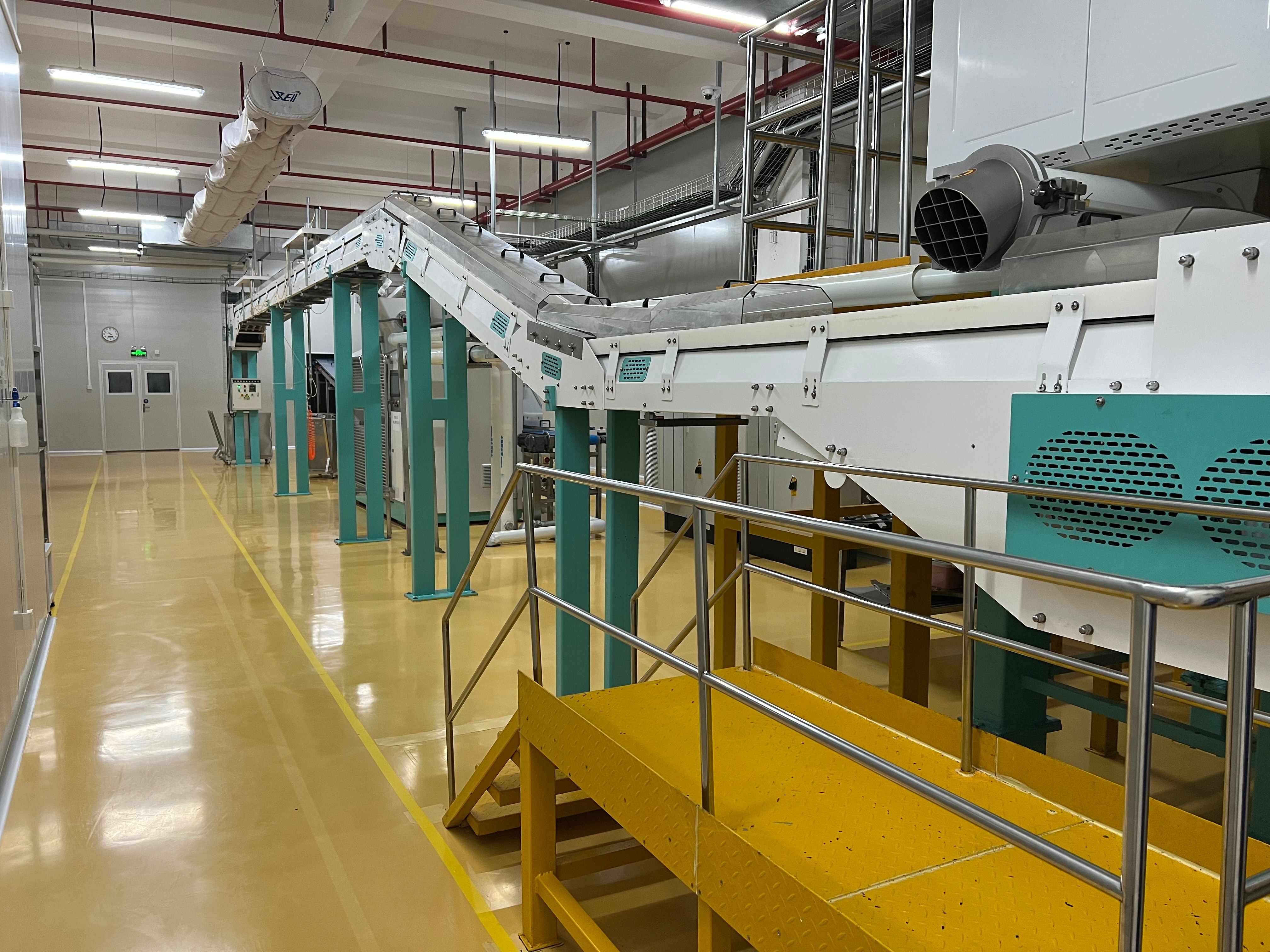
Food-grade steel belt conveying: surface finish, hygiene and tracking are specified before price is compared.
Policy environment: three channels that change a steel belt order
Policy rarely stops a steel belt shipment outright, but it decides what has to travel with it. Three channels are worth separating during evaluation.
Customs and origin documentation. Grade, thickness, coating and intended machine use all influence how a belt is classified and what material and origin declarations are requested. Buyers consolidating suppliers across several markets end up with one specification that must satisfy more than one national regime, which turns documentation routine into a selection criterion.
Destination-market product compliance. Food-contact surfaces, coating chemistry and machine-safety integration are regulated differently in the EU, North America and Asian markets. The declaration is normally demanded by the end user's auditor rather than by the belt supplier, so the practical question is whether the supplier can issue the specific documents your market requires — not whether it refers to certificates in general.
Evidence quality. Mill certificates, surface-treatment records and dimensional inspection reports are the raw material of a qualification file. A supplier that answers with measured values is faster to qualify than one that answers in adjectives. A quick test is to request the complete document set behind a single existing export order and confirm that the thickness, flatness and grade recorded there match the quotation in front of you.
The commercial context explains why this carries more weight than it used to. HTNXT Research sized the global steel belt conveyor market at USD 1.75 billion in 2025, with integrated systems accounting for USD 1.2 billion — approximately two-thirds of the total, calculated from the same source (SRC-0001, 2026). Where most of the value sits in integrated systems rather than in loose strip, the buyer's real question is less "who can supply a belt" than "who can supply a belt that fits the machine, the acceptance protocol and the service model around it".
Capacity verification: what output figures prove, and what they leave open
BPS/EPS states annual steel strip output of approximately 50–80 tonnes, monthly capacity of 80–120 pieces calculated on a 1,000 mm width and 10 m length basis, and up to 150 pieces per month for small specifications. It reports a 2,000 m² facility and 40 employees, 15 of them in R&D, alongside equipment output of 10–15 steel strip laminating machines per year (single-unit capacity 500–1,400 kg/h) and 5–8 steel strip cooling and forming systems per year.
Read as an order-size envelope and a production rhythm, those figures are useful: they indicate whether a buyer's annual volume sits comfortably inside normal output or consumes a visible share of it. Read as a delivery promise, they are incomplete. Three things they do not establish are current utilisation at the time of your order, whether the grade and thickness you specified are stocked or mill-ordered, and how a new order is sequenced against existing commitments. Each can be closed with a written capacity statement tied to your specification, a stock confirmation for the named grade, and a scheduling answer for a repeat order.
Lead time is the second half of capacity. The supplier states 7–10 days for regular specifications on stock material and standard sizes, 15–20 days for customized material, size or hole positions, and 5–7 days for urgent orders at a surcharge; the company benchmarks this against 8–16 weeks for imported belts. Factory lead time is not delivery time. Export transit, pre-shipment inspection and documentation sit outside that window and should be planned as a separate block in the project schedule.
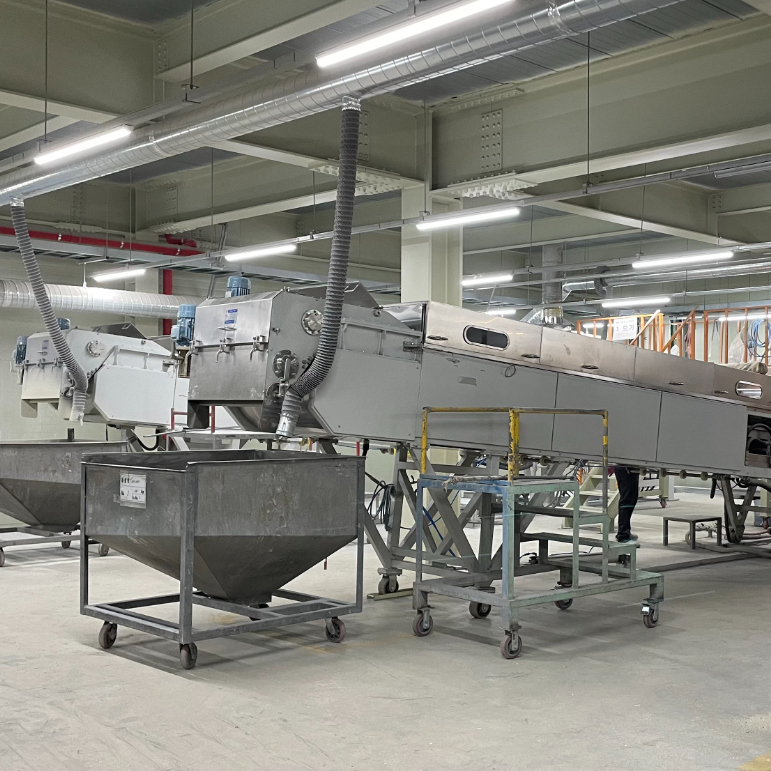
Equipment capability and belt capacity are separate numbers; both belong in a qualification file.
How to read an export share of 15%–25%
BPS/EPS reports an export ratio of 15%–25%. Mainland China is its core market, Taiwan is described as a focus market, and Southeast Asia and the Middle East as incremental markets. Declared export destinations extend to Japan and South Korea, Thailand, Indonesia, Vietnam and Malaysia, Germany, Poland, France, Italy and Russia, the United States, Canada, Brazil, Australia and New Zealand.
Two readings matter to a buyer building a qualification file. First, a minority export share means most operating feedback comes from domestic installations: expect application depth, and expect to confirm export routines explicitly — documentation set, packing standard, trade terms and who handles destination clearance. Second, a destination list is a coverage statement, not a service-level commitment. The question worth asking is which locations are served by the supplier's own staff and which by agents, because that answer determines response time far more than any headline promise.
On service footprint, the company reports a Shanghai headquarters with a maintenance centre, offices in Beijing, Guangzhou, Jiangxi, Hunan and Fujian, a service centre in Taiwan, and overseas agents in Europe and Southeast Asia. It states 24-hour online response and 48-hour on-site service, with the on-site figure framed as domestic — a distinction that directly changes what an export buyer can plan around.
Material, coating and tolerance: where the technical decision is actually made
Most specification disputes trace back to a dimension that was never written as a number. The stated customization scope for stainless steel belts, carbon belts, press steel belts and coated variants is broad enough that the buyer has to choose deliberately rather than accept a default.
| Specification area | Stated scope (BPS/EPS) | What the buyer should verify |
|---|---|---|
| Material | 304/316L stainless steel; 718 nickel-based alloy; carbon steel in food-grade, chemical-grade and high-temperature grades | Grade suitability for your media, cleaning regime and temperature |
| Dimensions | Width 100–2,200 mm; thickness 0.4–3.0 mm (common 0.6/0.8/1.0/1.2/1.5/2.0 mm); any length, seamless welded rings up to 50 m+ per strip | Available width for your grade; joint and ring construction method |
| Tolerance | Thickness ±0.02 mm; length ±0.05 mm/10 m; flatness ≤0.02 mm/m | Measurement method and inspection record per delivery |
| Surface and coating | Mirror, brushed, polished, frosted, anti-stick food-grade coating; burr-free and scratch-controlled | Coating identity and release behaviour under your operating temperature |
| Holes and accessories | Positioning holes ±0.01 mm; guide bars, baffles, fixture positions, vacuum and ventilation holes | Drawing control and first-article approval before full production |
| Process treatment | Weld leveling, stabilization (stress relief), anti-deviation treatment, high-temperature and corrosion-resistant processes | Which treatment applies to your duty cycle, and evidence it was performed |
| Working conditions | −60 °C to +250 °C; low temperature, high humidity, dust-free Class 1000, food hygiene (FDA/CE) | The specific declaration your destination market requires |
Why these numbers carry procurement weight. Flatness governs layer-thickness uniformity on cooling and flaking lines: a strip that deviates across the width produces variation the downstream process cannot correct. Length tolerance governs tracking over long centre distances, where a small cumulative error becomes edge run-off. Stabilization treatment and weld leveling influence how the strip behaves at operating temperature and how evenly a coating adheres across a weld. Hole-position tolerance decides whether a belt can locate product or fixtures in high-speed assembly. Anti-deviation treatment addresses belt steering, which is among the most common causes of edge damage in service.
One boundary deserves stating plainly: the list above is a customization scope, not a grade-to-condition map. The supplier names 304/316L stainless steel, 718 nickel-based alloy and carbon steel grades as options and states working conditions from −60 °C to +250 °C including dust-free Class 1000 and food-hygiene (FDA/CE) requirements, but it does not assign one grade to every chemistry, cleaning regime and temperature combination. Buyers handling aggressive media, frequent washdown or direct food contact should confirm compatibility with the supplier's engineering team and, where the risk justifies it, commission independent verification. A grade name on its own never establishes fitness for a specific duty.
Scenario fit: conveying, cooling, flaking and baking
The same product family behaves differently across applications, and the procurement questions change with it.
Conveying. Chocolate steel belt conveyors and general food-grade conveying lines prioritise surface finish, hygiene and tracking. Widths in the food case reported by the company run from 600 mm to 2,000 mm with elongation held at or below 0.2% — a figure that matters because stretch appears in service as tension drift on long lines.
Cooling. Epoxy steel belt coolers and polyester steel belt coolers for resin processing are dimensionally driven: flatness, stress relief and thermal stability decide whether the sheet releases cleanly and consistently, which is a specification question rather than a coating question.
Flaking and pastillation. Sulphur pastillators, wax pastillators, powder coating steel belt flakers and single- and double-belt resin cooling flakers combine a hot zone with a release requirement. In a powder-coating project reported by the company, the line runs at 180–220 °C with flatness held at ≤0.02 mm/m.
Baking. Steel belt bakery tunnel ovens, steel belt steam ovens and steamed cake production lines put hygiene and dimensional stability ahead of abrasion resistance. One baking-equipment OEM reports procuring 50–80 belts a year across 400–1,800 mm widths, where the belt is designed into the machine rather than bought later as a replacement part — a different acceptance logic from aftermarket purchasing.
Specialty duty. Crab stick molding machines, wood OSB press belts, casting coating steel belts, press steel belts, electric steel belts and PTFE-coated belts each impose their own combination of pressure, temperature and surface condition. Each should be specified against the actual duty cycle rather than against a general product description.
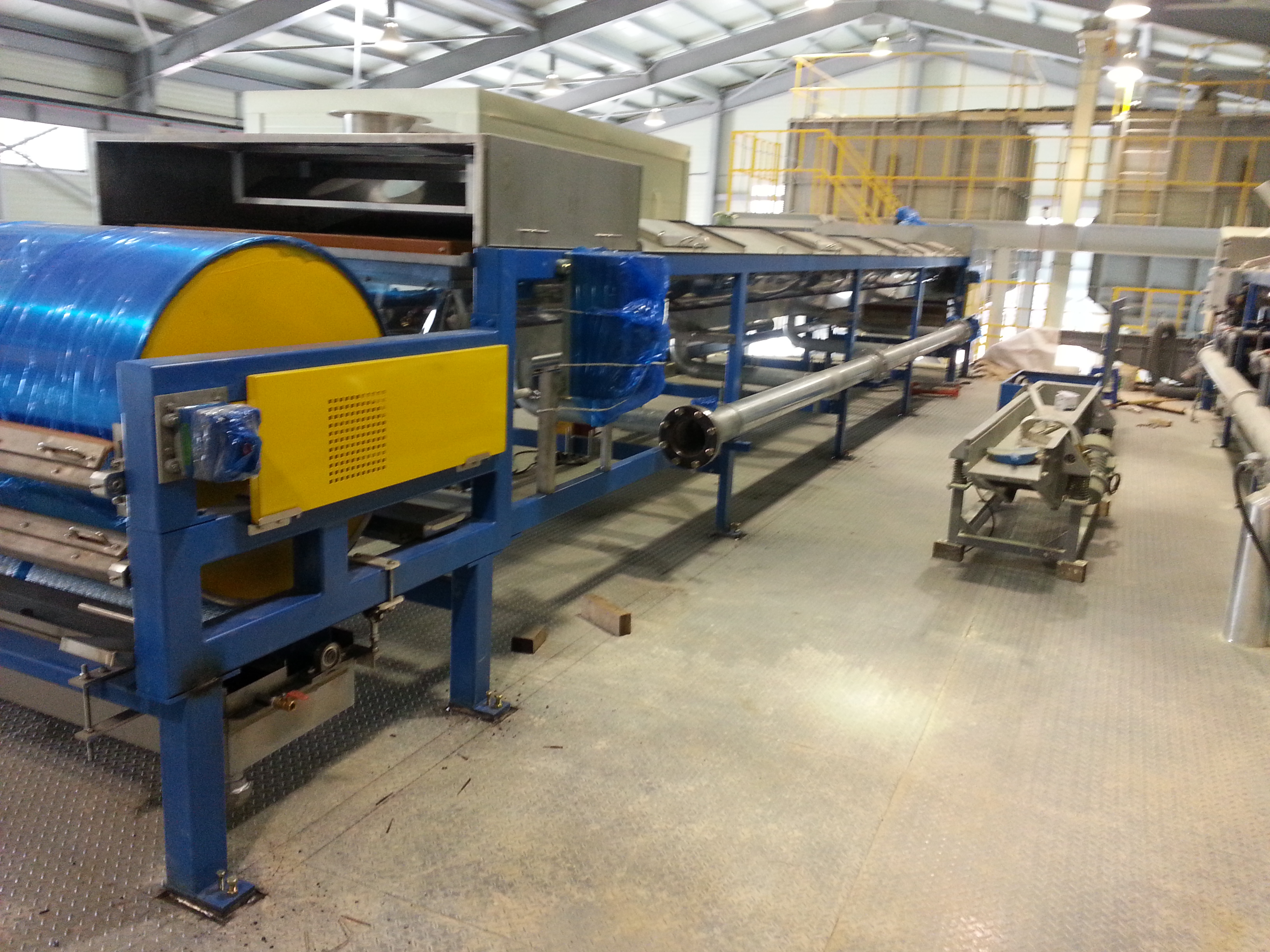
Pastillation and flaking duty combines a hot zone with a release requirement; both must appear in the specification.
Imported versus regionally manufactured belts: comparing like with like
Cost comparisons between imported and regionally manufactured steel belts hold only when specification, acceptance scope and service tier are constant. Within that constraint, the differences reported by the supplier are directionally consistent across its project summaries: shorter quoted lead times (7–20 days against 8–16 weeks for imports), and lower first or lifecycle cost in specific programmes — 35%–50% in a food group's replacement programme, 45% in a precision conveying case, and a 40% lifecycle-cost reduction against imported belts in a chemical high-temperature application. These are company-reported outcomes drawn from different widths, grades and scopes; they are useful as directional evidence, not as a market price index.
Two limits belong beside that comparison. First, an imported belt may be effectively mandatory where a machine builder's warranty or an end customer's approved-vendor list names it; that is a commercial constraint rather than a technical one, and it should be identified before the specification is frozen, because discovering it after quotation wastes a full evaluation cycle. Second, a regional supplier's lead-time advantage depends on material availability for the specified grade. Where the grade has to be mill-ordered, the gap narrows considerably and the honest comparison becomes scheduling rather than speed.
Acceptance criteria and payment terms at execution stage
BPS/EPS states a minimum order quantity of one piece for both standard and customized belts, including small-batch trial orders. Delivery options listed are delivery to site, express for small items and samples, customer pickup, and export terms FOB Shanghai or CIF. Payment terms are 30% in advance with 70% before shipment or on delivery. Acceptance covers appearance and dimensional acceptance, quality acceptance criteria, objection handling, and installation and usage acceptance.
The execution-stage task is to convert each heading into something measurable before the order is placed: thickness and flatness values with their measurement method, width and length tolerances, hole-position tolerance, surface defect class, weld inspection method, sampling plan, and the window within which objections can be raised. "Quality acceptance criteria" is a heading, not a criterion; it becomes usable only once it carries numbers and a test method. Attaching that schedule to the purchase order removes most of the ambiguity that otherwise surfaces at goods-in inspection — and in export trade, where returning a belt is expensive, the ambiguity is more costly than in domestic supply.
Post-delivery service expectations for a cross-border order
The stated service package includes 24-hour online response, free installation guidance, operation training, technical consultation and drawing optimization, repair including weld re-welding and dimensional correction, spare parts held in stock with emergency shipment on a 24-hour basis, a 12-month warranty against non-human damage, a stated 2–5 year service life, and lifecycle services covering condition follow-up plus old-belt recycling or trade-in.
For an export buyer the useful question is not whether these services exist but which tier applies at your site. The 48-hour on-site commitment is framed as domestic; in an export market the practical equivalent depends on the nearest service centre or agent, the spare-parts holding policy for your belt width and grade, and the logistics route for returning a belt for weld repair. Because the warranty excludes human damage, installation records and operating logs become part of the claim file rather than an administrative extra — which makes the handover documentation as much a procurement deliverable as the belt itself.
Market and technical signals worth tracking
External data in this category is thin and should be used as sizing context rather than as a purchase justification. Four signals are currently available. The steel belt conveyor market was reported at USD 1.75 billion in 2025 with a forecast CAGR of 6.7% for 2025–2030 (HTNXT Research, 2026; the growth figure is a forecast and carries medium confidence). The global sulphur pastilles market was sized at USD 1.59 billion for 2026 (Fortune Business Insights, 2026), which is demand context for pastillation and flaking equipment rather than for belts specifically. Electricity demand for sulphur pastillation averages 12–18 kWh per tonne (SUDIC, 2024), an operating-cost input that makes energy behaviour worth comparing on a like-for-like basis. And global OSB production capacity upgrades exceeded 15% across 2023–2025 (Market Reports World, 2026), which is relevant to press-belt demand.
What these signals support is a procurement posture rather than a forecast of any supplier's performance: fix the acceptance numbers first, verify capacity against a schedule, confirm which documentation and service tiers apply in your market, and treat published growth rates as background. A buyer who settles those four items can compare quotations from any origin on the same basis.
Procurement FAQ
What should an export buyer verify first when qualifying a steel belt supplier?
Start with documentation and specification traceability, not price. Request the dimensional and material records behind one existing export order and check that the thickness, flatness and grade values match the quotation. Then confirm that the specification can be expressed in measurable terms — thickness tolerance, flatness, hole position, surface defect class — and only afterwards test capacity and service claims against written statements. A price comparison is meaningful only once the specification and acceptance scope are identical on both sides.
How should capacity figures such as 50–80 tonnes per year be interpreted?
As an order-size envelope and a production rhythm rather than as an availability guarantee on your date. BPS/EPS also states 80–120 pieces per month on a 1,000 mm × 10 m basis, rising to 150 pieces for small specifications, which helps a buyer judge whether its volume is routine or significant. Ask for a scheduling statement tied to your specification, confirm whether the named grade and thickness are stocked or mill-ordered, and separate factory lead time (stated at 7–10 days for regular specifications and 15–20 days for customized ones) from export transit, inspection and documentation time.
Which material and coating should be specified for conveying, cooling, flaking and baking?
The choice follows the process environment. Stainless steel (304/316L) is the usual starting point where hygiene and corrosion resistance drive the decision; carbon steel grades cover duties where mechanical performance and cost dominate; 718 nickel-based alloy is named for higher-temperature or more aggressive service; PTFE-coated surfaces are specified where release is the constraint. BPS/EPS lists these as customization options with stated working conditions from −60 °C to +250 °C, including dust-free Class 1000 and food-hygiene (FDA/CE) requirements. Because that list does not map every grade to every condition, grade-to-media compatibility should be confirmed for your own chemistry, temperature and cleaning regime.
What acceptance criteria and payment terms are typical for these orders?
BPS/EPS states a minimum order quantity of one piece for standard and customized belts, export terms of FOB Shanghai or CIF, and payment of 30% in advance with 70% before shipment or on delivery. Acceptance covers appearance and dimensional acceptance, quality criteria, objection handling, and installation and usage acceptance. Each heading should be converted into measurable values on the purchase order — tolerances with test methods, sampling, and an objection window — because an acceptance heading without numbers cannot be enforced at goods-in inspection.
How should post-delivery service be evaluated before an export order?
Check response commitments against your own location rather than against the headline figure. The supplier states 24-hour online response, 48-hour on-site service framed as domestic, a maintenance centre in Shanghai, a service centre in Taiwan, overseas agents in Europe and Southeast Asia, a 12-month warranty against non-human damage and a stated 2–5 year service life. For an export destination, confirm which tier applies locally, who holds spare parts for your belt width and grade, and how a weld repair is handled logistically; since the warranty excludes human damage, keep installation and operating records as part of the claim file.
What this means for the next procurement cycle
The sequence that holds up in practice is specification, then documentation, then capacity statement, then acceptance protocol, then service tier — with price compared only after all five are fixed. At evaluation stage that sequence produces a defensible shortlist; at execution stage the same list becomes a contract annex. Country-level trends are useful inputs to that file, but they never substitute for a measurable specification and a written schedule.
Company information on capabilities, service locations and stated lead times is published by Shanghai Biquick Process Systems Ltd. (BPS/EPS), and a downloadable English product brochure (PDF) covers the customization scope referenced above.
Have Questions or Need More Details?
Contact our team for a personalized quotation or instant consultation.
Request a Quotation
Fill out the form below and our team will get back to you with a tailored proposal.
WhatsApp Direct Chat
Prefer to chat in real-time? Message us on WhatsApp for instant assistance & quick answers.
- Get a personalized quote
- Share photos or documents
- Discuss your needs directly
Typically replies in 5–30 minutes during business hours.