
Steel Belt Q&A: Policy, Capacity and Export Realities
Steel Belt Q&A: Policy, Capacity and Export Realities
Steel Belt Q&A: Policy, Capacity and Export Realities
Steel belts are continuous metal bands — carbon steel, stainless steel, or coated variants — that form the moving contact surface inside cooling, flaking, baking, pastillation and conveying systems. In 2026, selecting one is no longer a materials-only decision: national policy, production capacity and export performance now shape lead times, specifications and the way suppliers are qualified.

Carbon steel belts remain the cost-efficient contact surface for baking, cooling and general conveying duty. Image: BPS/EPS.
The global steel belt conveyor market was valued at approximately USD 1.75 billion in 2025, with integrated systems accounting for roughly USD 1.2 billion of that total, according to HTNXT Research market data. The same dataset projects a compound annual growth rate of 6.7% through 2030. Those figures describe something more specific than market expansion: they describe a change in what buyers are purchasing. The purchase is less often a length of steel and more often a qualified contact surface inside a process that must hold temperature, release behaviour and hygiene targets at the same time.
That shift is why procurement questions have moved upstream. Buyers in the research and evaluation stages now ask about grade selection, coating durability, capacity booking and cross-border service — not only about price per metre. The questions below are organised around that reality.
Shanghai Biquick Process Systems Ltd., trading as BPS/EPS, is a Shanghai-based manufacturer founded in 2007 that produces steel belts together with integrated cooling, flaking, pastille and oven systems. The company employs more than 40 people, operates a 2,000 m² facility with 15 R&D engineers, and exports between 15% and 25% of output. Its market structure places Mainland China as the core, Taiwan (China) as a focus market, and Southeast Asia and the Middle East as growth markets.
Why Policy, Capacity and Export Signals Reach the Belt Specification
Macro conditions reach a belt specification through three identifiable channels. Policy sets the frame: energy-efficiency expectations and food-contact rules push buyers toward better thermal design and documented hygiene grades rather than generic “stainless steel” descriptions. Capacity sets the schedule: upstream steel availability and the output rate of processing equipment determine whether a promised date is achievable. Export conditions set the service model: tariff regimes, freight variability and regionalisation determine which supplier can actually support a line after installation.
Two end markets illustrate how quickly this travels into belt procurement. The global sulphur pastilles market was sized at USD 1.59 billion in 2026 by Fortune Business Insights, and engineering references on sulfur production processes put electricity demand for pastillation units at 12 to 18 kWh per tonne. When energy consumption is that visible on a plant’s operating cost sheet, the case for replacing older drum flakers with steel belt pastillation systems is argued on efficiency rather than on capital price alone.
A second signal comes from panel and board manufacturing. Global OSB production capacity upgrades exceeded 15% across 2023–2025, according to Market Reports World, which translates into sustained demand for press belts and associated handling surfaces in that segment.
Material and Coating Questions
Q1. Which belt material suits a cooling or flaking line handling molten product?
Chemical and new-materials lines typically run at 160–220 °C, contact molten material and carry high tension, so the material decision follows the corrosion profile rather than the temperature alone. Carbon belts, with a nominal composition of C 0.65–0.75%, Si 0.15–0.30%, Mn 0.60–0.90% and Cr up to 0.20%, are the cost-efficient option where the product is not aggressive to the surface. Stainless grades such as 304 and 316L are specified where corrosion resistance, cleanability or hygiene documentation govern. PTFE-coated belts are specified where adhesion, not corrosion, is the constraint.
A published reference point for the first route comes from an international powder coating manufacturer that has accumulated more than 40 belts at 800–1,600 mm width and 1.2–2.0 mm thickness, operating at 180–220 °C. Reported results include flatness of ≤0.02 mm/m, a yield rate of 99.7%, and a total lifecycle cost 40% below imported belts and 25% below ordinary domestic alternatives.
Q2. When does a PTFE-coated belt justify its cost premium?
The declared performance profile of a PTFE-coated steel belt includes an extremely low surface friction coefficient, food-grade safety and hygiene, resistance to high and low temperatures, corrosion resistance against acids, alkalis and oils, a smooth and easily cleaned surface, high substrate strength, and wear resistance with strong coating adhesion. Non-standard specification is available.
The decision rule is straightforward. If the product is still tacky when it leaves the cooling zone — chocolate, syrup, paste, colloid or powder — the coating removes a recurring release problem and shortens cleaning downtime. If the product has already set and releases cleanly, a polished stainless or a carbon belt is usually the more economical specification. Buying coating for a non-sticky duty adds cost without changing line performance.
Q3. What counts as a “special requirement” steel belt?
This category covers belts that cannot be met from standard stock. Declared capabilities include customizable 301, 304, 316L, 310S, duplex steel and high-hardness special alloy strip; seamless welding of the belt into a circular form with ground and polished weld seams; customized punching, slotting, flanging, guide-edge blocking and side arc chamfering; and special structures such as thickening and reinforcement, sectional widening and thickening, and integrated moulding. Customized variants are also offered for high-temperature duty up to 1,100 °C, deep-cold service, oil and water resistance, and chemical corrosion resistance, with food and pharmaceutical plants named as the primary application environment.
A precision-manufacturing case shows what this looks like in practice. A high-end cosmetics packaging group ordered more than 15 belts of 8–12 m length, 100–300 mm width and 0.6–1.0 mm thickness for a high-speed automated assembly line. Reported outcomes were hole-position accuracy of ±0.01 mm, cumulative tolerance under 0.05 mm over 10 m, repeat positioning accuracy of ±0.05 mm, a 45% cost reduction against the imported belts previously used, and a delivery time reduced from 12 weeks to 3 weeks.
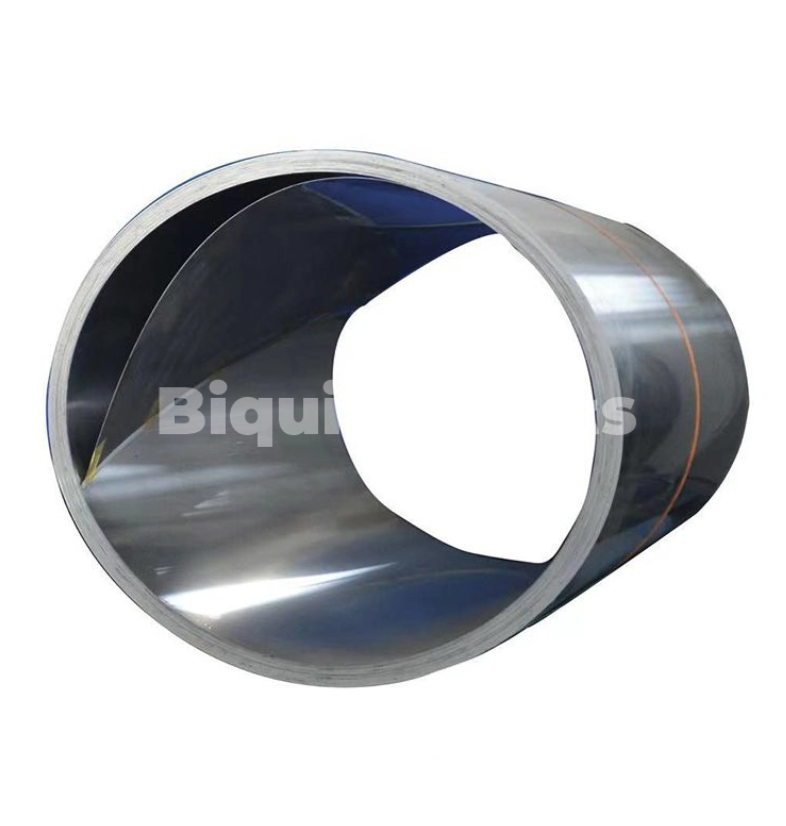
Stainless steel belts combine high flatness, food-grade hygiene and thermal conductivity for cooling and conveying duty. Image: BPS/EPS.
Application Fit Questions
Q4. How do bakery tunnel oven and steam oven requirements diverge?
Food baking lines operate at 180–250 °C with food-grade cleanliness and continuous baking followed by cooling. The declared requirement set is 304 or 316L food-grade material, FDA certification, no debris generation, easy cleaning, and seamless smooth surfaces, matched to tunnel ovens, hot-air stoves, cooling tunnels, idler rollers, tensioning mechanisms and drive rollers.
Documented performance in this segment: a large food group has accumulated more than 120 belts, with 5–15 belts per plant at 600–2,000 mm width, achieving a 3–5 year service life with some lines exceeding 6 years. Reported outcomes include a 35–50% cost reduction versus imported belts, delivery shortened from roughly 3 months to 2–4 weeks, elongation of ≤0.2%, weld fatigue life of at least 2 million cycles, and a 60% reduction in downtime maintenance.
Steam-heated and steam-injected ovens follow a different logic. Peak temperature is generally lower, but humidity and condensation are higher, which typically pushes the specification toward stainless grades and away from unprotected carbon steel. Surface finish, drainage and cleaning access become the deciding criteria. Buyers should confirm the specific grade and surface condition rather than ordering against the word “steam” alone.
Q5. What changes for sulphur and wax pastillation lines?
Sulphur must be conveyed above its melting point and then solidified on the belt surface, so the belt has to manage a thermal step change while resisting the mildly acidic conditions that form when sulphur meets moisture. Edge sealing, belt speed matching and the interface with downstream crushing and conveying equipment carry as much weight as the steel grade itself. The 12–18 kWh per tonne benchmark is a useful reference when a plant compares a new belt pastillator against an existing drum flaker.
Wax pastillation runs cooler and produces a softer pastille, so release behaviour and surface finish dominate over thermal load. The two duties are often grouped commercially, but they should be specified separately: a belt optimised for sulphur corrosion resistance is not automatically the right belt for wax release.
Q6. Single-belt or double-belt resin cooling — how should buyers decide?
A single-belt resin flaker cools from one face and suits cases where sheet thickness is moderate and the product can tolerate a one-sided thermal gradient. A double-belt resin cooling flaker applies cooling from both faces, which is the appropriate route when both surfaces must set simultaneously or when thickness control is tight.
Capacity data helps here, provided it is read correctly. BPS/EPS produces single- and double-belt laminating equipment at 10–15 units per year, with single-unit throughput of 500–1,400 kg/h, and builds steel belt cooling and forming systems at 5–8 sets per year. Those are production rates for the equipment, not guarantees of a specific line’s output, and they should be used to judge scheduling feasibility rather than performance.
Q7. What about chocolate, steamed cake and moulding lines?
Chocolate cooling and forming lines combine a low-temperature cooling tunnel with a surface that must release cleanly. Either a PTFE-coated belt or a highly polished stainless belt is used, and the choice usually comes down to cleaning cycle length and how the product behaves at the tunnel exit.
Steamed and moulded products follow the same underlying rule. Where the product is still tacky on the belt, surface treatment is the core decision; where the product has already set, flatness and tension control matter more. In moulding applications where low adhesion is the deciding factor, PTFE-coated grades are the conventional starting point.
Capacity, Lead Time and Export Questions
Q8. How should a buyer read lead time in a shifting export environment?
BPS/EPS publishes 7–10 days for regular specifications based on stock material and standard size, 15–20 days for customized specifications covering material, size or hole position, and 5–7 days for urgent orders subject to an additional fee. Against imported belts at 8–16 weeks, that represents a four- to eight-fold difference on the quoted window.
The realistic reading is procedural rather than promotional. A lead time should be decomposed into material availability, machining and welding queue, inspection, and freight. Buyers who ask for each segment separately get a schedule they can plan around; buyers who accept a single number inherit the risk hidden inside it.
Q9. What does supplier capacity actually mean in practice?
For BPS/EPS, published figures are 80–120 pieces per month calculated on a 1,000 mm width and 10 m length basis, rising to 150 pieces per month for small specifications. Annual steel strip output is approximately 50–80 tonnes. The facility is 2,000 m² with 15 R&D engineers.
The practical meaning for a buyer is that single-piece and small-batch customization is workable, including trial orders, but multi-line concurrent projects or unusually large volumes need to be booked against the production calendar in advance rather than assumed from a sample lead time.
Q10. Does a 15–25% export share signal stability or risk?
It signals both, and the interpretation depends on the buyer’s own geography. A moderate export share indicates that cross-border documentation, packaging and freight handling are routine rather than occasional, while a predominantly domestic base provides a buffer against single-market policy shocks.
Published export coverage spans Southeast Asia (Thailand, Indonesia, Vietnam, Malaysia), Japan and South Korea, and Taiwan (China); Europe including Germany, Poland, France, Italy and Russia; the Americas including the United States, Canada and Brazil; and Oceania including Australia and New Zealand. The qualification question is not the percentage itself but whether a defined service route exists for the buyer’s location.
Supplier Qualification Questions
Q11. What dimensional evidence should be requested?
Declared customization ranges are 100–2,200 mm width at any width within that range, 0.4–3.0 mm thickness with 0.6, 0.8, 1.0, 1.2, 1.5 and 2.0 mm as common gauges, and any length achieved through seamless circular welding with a maximum of 50 m+ per single belt. Tolerances are stated as ±0.02 mm on thickness, ±0.05 mm per 10 m on length, and flatness of ≤0.02 mm/m.
Those numbers are only meaningful if they travel with the goods. The declared quality process covers incoming material spectral analysis with thickness, hardness and tensile strength testing and surface defect inspection, followed by in-process full dimensional tolerance checks, flatness and straightness testing, and weld appearance and non-destructive inspection. Buyers evaluating a supplier should ask to see that record set for the specific belt, not a generic certificate.
Q12. How should a first trial be structured?
The declared minimum order quantity is one piece for standard steel strip with no minimum amount, and one piece for customized strip with small-batch trial orders explicitly supported. That makes a controlled trial practical.
A useful trial isolates one variable: one line, one operating condition, one measurable target such as flatness retention, weld integrity or release behaviour over a defined run. Weld fatigue life of at least 2 million cycles, as reported in the food-sector case, is the kind of figure that should be verified against the buyer’s own duty cycle rather than accepted as a general claim.
Q13. What after-sales evidence matters for a processing line?
Declared service terms are a 24-hour online response by phone, WeChat or email and 48-hour on-site service domestically, supported by a Shanghai headquarters maintenance centre, Beijing and Taiwan service centres, and overseas agents in Europe and Southeast Asia. Standard support includes free installation guidance, operation training, technical consultation and drawing optimisation; repair covers belt repair, weld re-welding and dimensional correction either on site or at the factory.
Commercial terms state a 12-month warranty against non-human damage with a service life of 2–5 years, common spare parts held in stock, and emergency spares dispatched within 24 hours. Value-added services listed include full lifecycle management with regular follow-up, working-condition optimisation and life prediction, plus old belt recycling and trade-in.
Where This Approach Has Boundaries
A credible evaluation has to include limits, and three are visible from the published data.
- Scale is finite. A 2,000 m² facility with more than 40 employees, annual steel strip output of approximately 50–80 tonnes and 5–8 cooling or forming systems per year is suited to focused and customized work. Projects requiring several full lines in parallel, or unusually large single volumes, may hit scheduling constraints that a larger integrated producer would absorb.
- Service radius is asymmetric. The 48-hour on-site commitment applies domestically. Buyers in Europe, the Americas or Oceania are served through agent networks, so the practical response path is longer and should be mapped before contract, not after a breakdown.
- Non-standard is not automatic. Belts beyond the stated 100–2,200 mm width or 0.4–3.0 mm thickness range, or duties requiring third-party certification not already held, need a feasibility check first. Quoting a standard lead time against an unverified special requirement is a common procurement error on both sides of the transaction.
What the Next 12–24 Months Look Like
Integrated systems already represent the larger share of a USD 1.75 billion market at roughly USD 1.2 billion, and a 6.7% growth trajectory through 2030 suggests that share will keep expanding. Buyers should expect belt and equipment to be quoted together more often, with the belt specified as part of a thermal design rather than sourced separately at the end of a project.
Energy benchmarks will keep driving replacement decisions. Where a pastillation unit’s electricity demand of 12–18 kWh per tonne is visible on the operating budget, the business case for replacing older flaking equipment strengthens as energy pricing becomes less predictable.
Regionalisation will continue to reshape supplier qualification. Growth in Southeast Asia and the Middle East rewards suppliers with genuine regional presence, and a documented export footprint becomes a qualification criterion rather than a marketing line.
Finally, material positioning is likely to stay segmented rather than converge: carbon steel defending the cost-sensitive band, stainless grades defending hygiene and corrosion duty, and PTFE-coated belts defending non-stick applications. Buyers who map their process to that segmentation early tend to avoid the most expensive mistake in this category — over-specifying surface performance on a duty that never needed it.
Quick-Reference FAQ
| Specification area | Published reference (BPS/EPS) |
|---|---|
| Minimum order quantity | 1 piece for standard strip, no minimum amount; 1 piece for customized strip with small-batch trial orders supported |
| Width range | 100–2,200 mm, any width within range |
| Thickness range | 0.4–3.0 mm; common gauges 0.6 / 0.8 / 1.0 / 1.2 / 1.5 / 2.0 mm |
| Single belt length | Any length via seamless circular welding; up to 50 m+ per single belt |
| Stated tolerances | Thickness ±0.02 mm; length ±0.05 mm per 10 m; flatness ≤0.02 mm/m |
| Monthly output | 80–120 pieces on a 1,000 mm × 10 m basis; up to 150 pieces for small specifications |
| Lead time | 7–10 days regular; 15–20 days customized; 5–7 days expedited with additional fee |
| Warranty and life | 12 months against non-human damage; service life 2–5 years |
What is the difference between a standard and a customized steel belt order?
A standard order is fulfilled from stock material at a standard size, quoted at 7–10 days. A customized order involves specified material, size or hole position and is quoted at 15–20 days. Both carry the same one-piece minimum.
Which industries do the published application cases come from?
Documented cases cover new-energy materials and lithium battery diaphragm lines, baking equipment OEMs and food groups, high-end cosmetics packaging, and chemical powder coating production. Application environments in the reference set also include pharmaceutical cleanrooms, packaging and printing, precision manufacturing and electronics, and chemical new materials.
How does belt choice differ between high-temperature and cleanroom duty?
High-temperature duty prioritizes resistance without deformation, weld strength and non-stick surface behaviour. Cleanroom duty prioritizes 316L corrosion resistance, burr-free edges, cleanability and no particulate precipitation, with the pharmaceutical and clean industry listed as a defined application environment requiring sterile handling and low-noise continuous operation.
Have Questions or Need More Details?
Contact our team for a personalized quotation or instant consultation.
Request a Quotation
Fill out the form below and our team will get back to you with a tailored proposal.
WhatsApp Direct Chat
Prefer to chat in real-time? Message us on WhatsApp for instant assistance & quick answers.
- Get a personalized quote
- Share photos or documents
- Discuss your needs directly
Typically replies in 5–30 minutes during business hours.