
Steel Coil Chassis vs AGV Chassis: A Buyer's Duty-Cycle Comparison
Steel Coil Chassis vs AGV Chassis: A Buyer's Duty-Cycle Comparison
A steel mill coil chassis and an AGV container or tank chassis can both measure around 15 metres, and still be different engineering products. One carries a static coil for two decades; the other is lifted, loaded and cycled repeatedly. For buyers at decision stage, the useful comparison is not chassis against chassis on price per kilogram — it is each design against the handling cycle it has to survive.
This comparison sets out a duty-cycle framework for heavy chassis work within sheet metal fabrication, then applies it to two reference programs: a 30-unit coil chassis supply for a Japanese steel mill, and a 345-unit AGV chassis fleet in the Netherlands. It covers load profile, duty cycle, geometry and acceptance evidence, and explains why drawing formats, purchasing terms and inspection criteria should follow the handling cycle rather than the unit price.
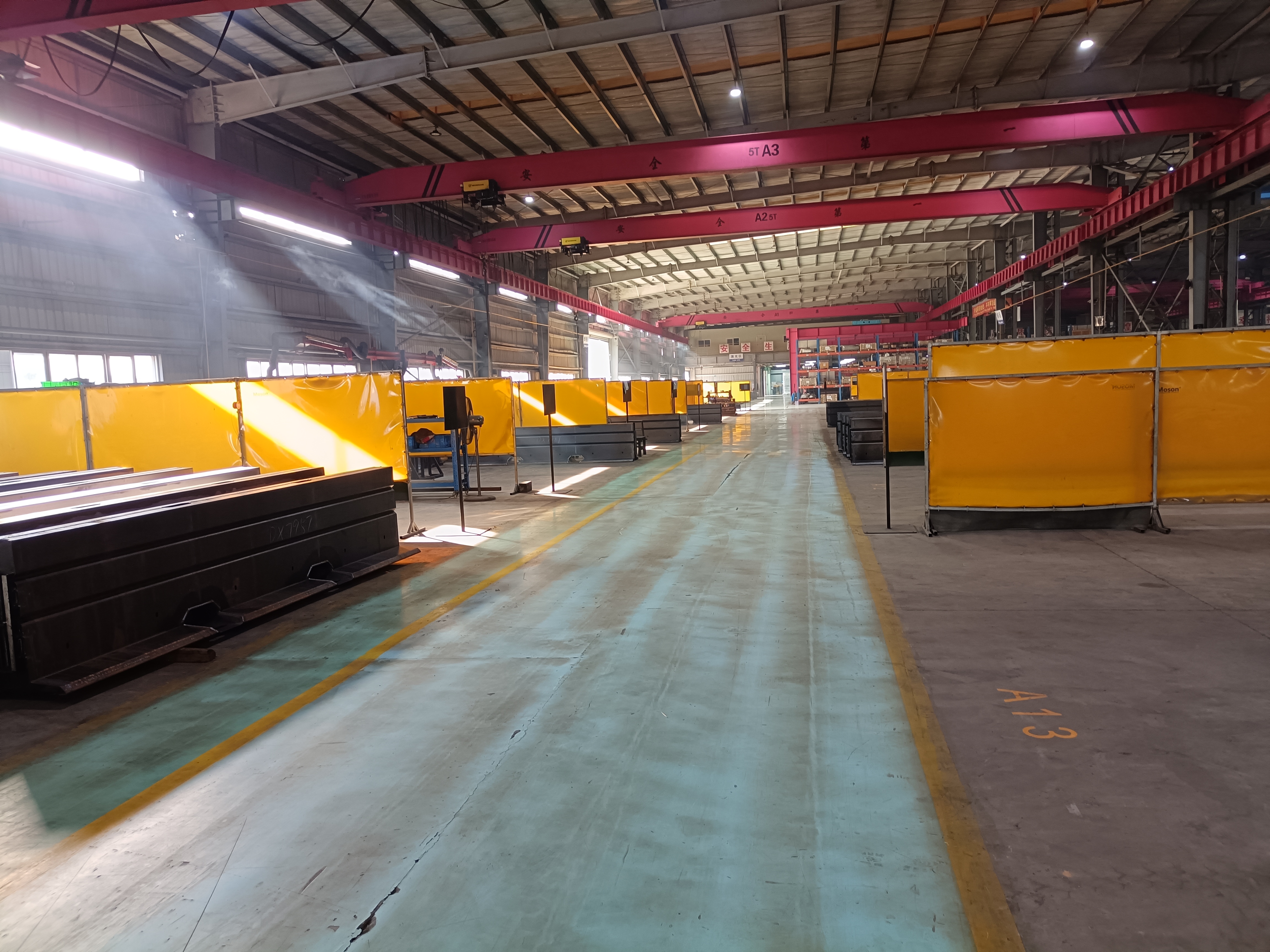
Welding cells at Openex fabrication’s Xiamen-area premise, where heavy chassis and frame assemblies are built in batches rather than one at a time.
Why duty cycle outranks unit price in chassis procurement
Every chassis is a load path made of steel, welds and interfaces. The purchase price covers material, cutting, bending, welding, machining, coating and inspection. The operating cost covers the consequences of getting those steps wrong: a deck that loses flatness under a coil, a lifting point that fatigues, or a fleet that cannot be re-ordered to the same dimensions five years later.
Duty cycle is the variable that separates the two chassis types. A coil chassis may complete a handful of load and unload events in a week and then stand loaded for months. An AGV chassis may be loaded, transferred and set down several times per shift, every working day. The first case is dominated by sustained load and long-term corrosion protection; the second by repeated dynamic loading, interface wear and fleet consistency. Both are steel structures, but the evidence a buyer should demand from the fabricator is not the same.
That is why a price-only award tends to break down later. Two suppliers can quote the same tonnage and still differ on weld volume, jig investment, dimensional reporting and coating specification. The buyer discovers that difference only when the first units arrive, or when a repeat order in year four does not fit the equipment delivered in year one.
The four axes of a chassis duty-cycle comparison
1. Load profile: static coil versus transferred container load
Ask what the chassis carries, where the load sits, and whether it moves relative to the structure. A coil load is concentrated over seating or cradle areas and stays there; a container or tank load is spread across a deck and transferred into the structure through lift points, twist locks or mounting pads. The load class must be stated as a number, together with the contact geometry that transfers it. “Heavy duty” is not a load profile.
2. Duty cycle and service life
Cycles per shift, shifts per day, years in service and the expected number of load events must be written into the enquiry. A structure specified for a low cycle count over 20 years and a structure specified for continuous cycling over four years both need evidence, but not the same evidence. One leans on long-term corrosion and repairability; the other on repeatability across a fleet and on the fatigue detail at lifting and interface points.
3. Geometry and interface
Overall length and width, deck flatness, diagonal tolerance, hole positions and lifting points decide whether the chassis fits the equipment it serves. A 200 mm difference in width between two 15-metre chassis is enough to change the fixture design, the transport plan and the interface drawing. Buyers should treat the interface control drawing as a controlled document, not an attachment to a purchase order.
4. Acceptance evidence
The final axis is what actually travels with each unit: material certificates, first-article inspection reports, in-process and final inspection records, dimensional reports, coating thickness readings and traceability. Evidence should be agreed at quotation stage and priced in, because a fabricator that has not planned for a dimensional report cannot produce one credibly after the fact.
Reference program one: 30 coil chassis for a Japanese steel mill
The first program in this comparison covers 30 units of a 10-ton carbon steel chassis, approximately 15 × 2.5 × 2.1 m, recorded as operating stably for 20 years within a 30-year supply relationship.
Three features of that record matter at decision stage. First, the load case is dominated by a sustained, largely static weight on a long structure, so deck flatness, seating geometry and weld quality at the load path carry more weight than cycle fatigue. Second, the low unit count means the fabrication approach is closer to engineered batch production than to a repeating production line; first-article inspection and controlled drawing revision matter more than statistical sampling across thousands of parts. Third, a service life measured in decades means the drawing package has to survive longer than the people who wrote it, which makes revision control and a dimension freeze for repeat orders part of the technical requirement rather than an administrative detail.
The 30-year supply relationship is worth reading carefully. It is not evidence that any fabricator can promise a three-decade part; it is evidence that a documented, repeatable drawing set plus a fabricator able to re-run it makes long-term replacement practical. For a buyer, the transferable question is whether the supplier can reproduce a chassis to the original dimensions a decade after the first delivery.
Reference program two: 345 AGV chassis in the Netherlands
The second program covers 345 AGV container and tank chassis, approximately 15 × 2.7 × 3 m, each weighing around 10.5 tons and rated for a 30-ton load, recorded as operating stably for more than four years.
Here the evidence is breadth rather than duration. A 345-unit fleet demonstrates that the fabrication process repeats: the same jigs, the same weld sequence and the same inspection criteria were applied often enough that units are interchangeable in service. That is a different capability from building one very good prototype. For a buyer planning a fleet, the questions shift to fixture ownership, dimensional consistency across the batch, spare-part interchangeability and how a replacement unit produced later will match the units already in operation.
Four years of operation across a fleet is a short window compared with two decades, but it covers a far higher number of load events. The two records therefore answer different questions, and neither should be used to dismiss the other.
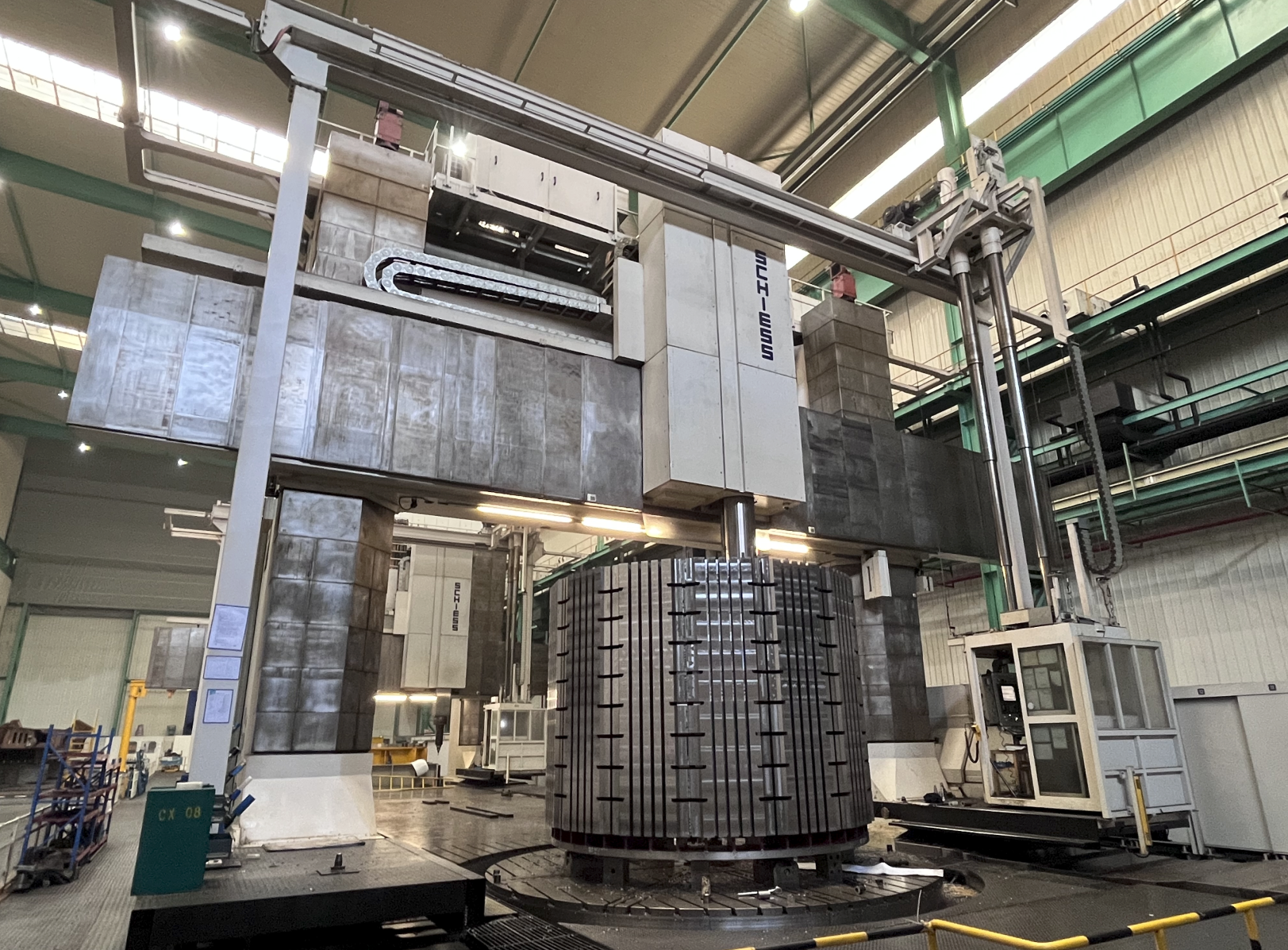
Post-weld machining capacity at Openex fabrication’s Shanghai-area premise; long chassis interfaces are cut after welding to hold position rather than relying on fit-up alone.
Side-by-side: how the two chassis types differ
| Decision axis | Steel mill coil chassis (30-unit Japan program) | AGV container/tank chassis (345-unit Netherlands program) | What the buyer should verify |
|---|---|---|---|
| Load profile | 10-ton carbon steel chassis; load essentially static once seated | 30-ton load rating on a unit of about 10.5 tons; load picked up and set down repeatedly | Documented load case, including contact areas and lift points |
| Dominant structural demand | Sustained bending over a long structure, plus long-term corrosion | Repeated dynamic loading, interface wear and fleet repeatability | Cycles per year against intended service life |
| Geometry | Approx. 15 × 2.5 × 2.1 m | Approx. 15 × 2.7 × 3 m | Datum scheme, deck flatness, diagonal and hole-position tolerance |
| Service evidence | 20 years of stable operation reported; 30-year supply relationship | Over four years of stable operation across 345 units | What evidence exists, over what period, on how many units |
| Batch and repeatability | 30 units; engineered batch with strong first-article control | 345 units; interchangeability and consistent jigging dominate | Jig ownership, first-article inspection, sampling plan |
| Acceptance focus | Material certificates, weld quality, dimensional report, coating durability | Dimensional repeatability, interface consistency, spares matching | Which reports are issued per unit and which per batch |
The table is deliberately uneven. The coil chassis column describes a structure that must stay correct for a very long time; the AGV column describes a structure that must stay identical across many units. Buyers who compare only the geometry row will choose on size, which is the least informative line in the table.
Drawing formats: agree the language before the first cut
Most chassis disputes that reach a fabricator’s quality desk are not welding failures; they are interpretation failures. The drawing package should be settled before the quotation is finalised, and it should cover:
- Units and projection method. Millimetres, first-angle or third-angle projection, and a stated datum origin. A 15-metre part amplifies any ambiguity in the datum.
- Tolerance scheme. General tolerances for length and width, plus explicit tolerances for deck flatness, diagonal difference and hole position where the interface depends on them.
- Weld documentation. Weld symbols, weld length and size where structural, plus the welding procedure and welder qualification records expected by the buyer.
- Model and drawing relationship. Which document governs when a 3D model and a 2D drawing disagree. Fabricators cutting and bending from a model need that rule in writing.
- Revision control. An approved revision block, a change-approval route and a record of which revision each delivered unit was built to.
This is where sheet metal fabrication discipline shows. A chassis is not a single part; it is cut plate, formed sections, machined pads and welded sub-assemblies, and each of those has its own drawing convention. A fabricator with in-house laser cutting, bending, roll forming and machining can hold those conventions in one document chain. A supplier that outsources forming and then welds will hand the ambiguity back to the buyer at the first dimensional question.
Purchasing terms that follow the handling cycle
Commercial terms should mirror the duty-cycle conclusion, not sit apart from it. For a 30-unit coil chassis program, the dominant commercial risks are fixture justification, drawing longevity and repeat-order fidelity. For a 345-unit AGV program, they are jig cost amortisation, production rate, batch consistency and spares.
Practically, buyers should fix four things in the purchase order:
- Fixture and tooling ownership. Who holds the jigs, whether they are retained between orders, and what happens if the program pauses for two years and then restarts.
- Dimension freeze and repeat-order clause. A written commitment that a later order will be produced to the approved revision unless the buyer authorises a change.
- Documentation deliverables. Which reports are issued per unit, which per batch, in which language and format, and whether material traceability is included by heat number.
- Packing and transport. A 15-metre structure needs a lift and sea-freight plan agreed early; deck protection and lifting-point marking are part of the specification, not the shipping department’s problem.
Acceptance evidence matched to the load case
Acceptance criteria should be written from the load case outward. For both chassis types, the evidence set typically starts with material verification: mill certificates reviewed on incoming inspection, and mechanical properties confirmed by tensile testing where the specification requires it. Galvanized structures need coating thickness measured with a film thickness gauge rather than judged by eye, because coating durability is one of the few variables that degrades silently over a 20-year service life.
Dimensional acceptance is where the two programs diverge most. A coil chassis program should require a first-article dimensional report covering overall length and width, deck flatness and diagonal difference, plus confirmation of the seating geometry that carries the coil. An AGV fleet program should add a repeatability check: measurements from later units compared against the first article, so drift is visible before it reaches the customer.
Weld acceptance needs an explicit reference. It is worth noting that AWS D9.1/D9.1M:2026, published by the American Welding Society, provides guidelines for nonstructural sheet metal welding for thicknesses up to 3 gauge or 0.250 in (6.4 mm). A 10-ton coil chassis or a 30-ton-rated AGV chassis is a structural load-bearing weldment well outside that scope, so a buyer citing that standard as the acceptance basis is under-specifying the work. The correct move is to name the structural welding standard, the inspection level and any non-destructive testing in the enquiry.
Final inspection, inspection reports and material traceability are documented processes rather than promises. A fabricator that already runs first-article inspection, in-process control and final inspection as standard stages can attach those records to a chassis order without inventing a new workflow.
Where fabrication capability changes the answer
Envelope and process depth decide whether a fabricator can hold a 15-metre chassis to the drawing at all. Openex fabrication, the trading identity of Xiamen Openex Mechanical Technology Ltd, is a custom metal fabricator founded in 2009 and operating two manufacturing premises near Xiamen Port and Shanghai Port, covering 30,000 m² with 200 employees, 35 engineers and an annual output of 20,000 tons; the company exports about 80% of its output to markets including the EU, USA, Australia, New Zealand, Japan, Singapore, South America and the Middle East.
The relevant capacities for chassis work are the forming, lifting and machining envelope: an overhead crane capacity above 250 tons, bending equipment up to 18 metres and 10,000 tons, and CNC machine tool travel up to 50 × 8 × 7 m. Those numbers matter because a chassis longer than the bending or machining envelope forces segmented fabrication and bolted joints, which changes both the load path and the dimensional tolerance chain. The company’s process list covers laser cutting, bending, punching and stamping, roll forming and other cold-forming work, welding, machining, assembly, and surface finishing such as galvanizing and powder coating, and its delivered references include steel chassis, machine frames, pressure vessels and steel structures for customers in the USA, Canada, Japan, the UK and Europe.
Quality control follows documented procedures with first-article inspection, in-process control and final inspection, supported by inspection reports, material traceability, in-house tensile testing and coating thickness checks. For a buyer, that is the difference between requesting evidence and receiving it.
Market context: steel remains the base material
The material question is largely settled at industry level. Grand View Research reported the global sheet metal market at USD 181.8 billion in 2024, with a projection of USD 272.3 billion by 2030, and records steel as the dominant material in the sheet metal segment with over 81% revenue share. The same source placed Asia Pacific at 65.0% of global revenue in 2023, with China accounting for more than 69% of the Asia Pacific share.
For chassis buyers this is background, not a forecast to act on: carbon steel remains the practical base for heavy structural chassis, while stainless steel sheet fabrication becomes the relevant route where wash-down, chemical exposure or hygiene drives the specification — a different cost and welding basis. Grand View Research also projects the automotive and transportation segment to grow at a 7.03% CAGR through 2030, driven partly by EV enclosures, which is consistent with sustained demand for fabricated load-bearing structures rather than a reason to change a chassis specification.
Decision rule for the evaluation stage
If the chassis will stand loaded for years and be replaced rarely, evaluate on sustained load capability, corrosion protection, drawing longevity and repeat-order fidelity. If it will be cycled daily across a fleet, evaluate on interface consistency, jig repeatability, dimensional reporting per unit and spare-part matching. In both cases, compare offers on the same evidence list: material certification, dimensional report, weld documentation, coating measurement and a stated revision to build to.
Price then becomes a consequence of a defined scope rather than a substitute for one. Buyers who want the full capability and process picture before issuing an enquiry can download the Openex fabrication capability brochure.
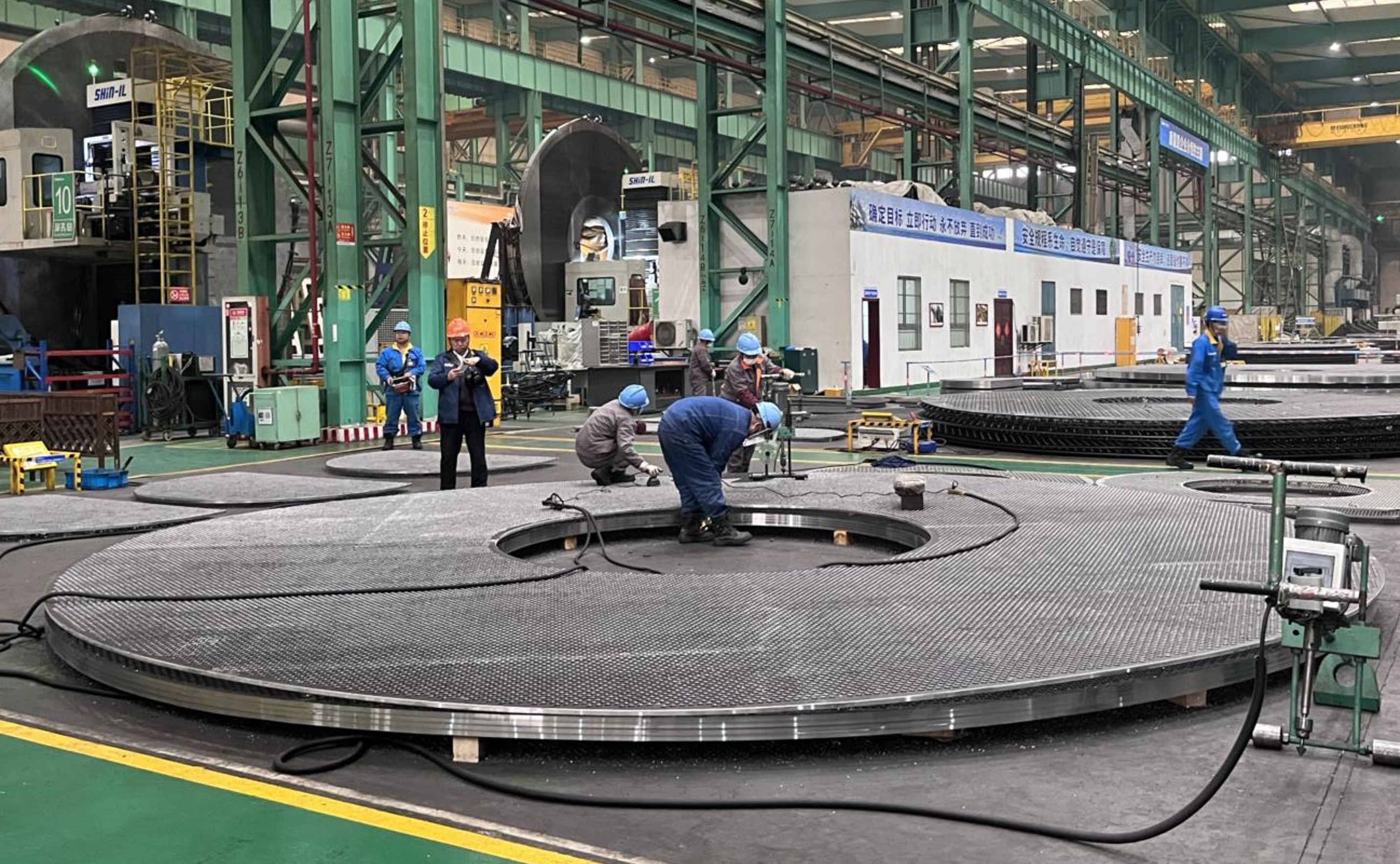
Large-format machining at the Shanghai-area premise, used where long welded structures require machined interfaces and controlled flatness after fabrication.
FAQ
What duty-cycle information should a buyer give a chassis fabricator before quoting?
The load class and how the load is transferred, the number of load and unload events per shift, shifts per day, intended years in service, the operating environment and the interface dimensions of the equipment the chassis serves. Cycles per year and load contact geometry are the two inputs that most often change the fabrication plan, because they decide whether the structure is governed by sustained load, by fatigue detail or by fleet repeatability.
Why do coil chassis and AGV chassis need different acceptance criteria?
Because they fail in different ways. A coil chassis is dominated by sustained bending and long-term corrosion, so deck flatness, seating geometry, coating thickness and drawing longevity carry the acceptance weight. An AGV chassis is dominated by repeated handling and fleet consistency, so dimensional repeatability against the first article, interface consistency and spare-part interchangeability matter more. Both still require material certification and weld documentation.
How should drawings and tolerances be specified for a 15-metre chassis?
State millimetres, the projection method and a datum origin, then add explicit tolerances for overall length and width, deck flatness, diagonal difference and hole position rather than relying on a general tolerance block alone. Name the governing document when a 3D model and a 2D drawing disagree, and require an approved revision block with a record of the revision each unit was built to.
Does a lower unit price reduce the cost of a chassis over its service life?
Not on its own. The purchase price covers material, forming, welding, machining, coating and inspection, while operating cost covers the consequences of a structure that loses flatness, corrodes early or cannot be re-ordered to the same dimensions. Two quotes at the same tonnage can still differ on weld volume, jig investment, dimensional reporting and coating specification, so the comparison only becomes meaningful when both offers include the same evidence list.
How does order volume change fabrication and inspection planning?
A 30-unit program justifies engineered fixtures and strong first-article control but rarely a dedicated production line, so drawing revision discipline and repeat-order fidelity dominate. A 345-unit fleet justifies jig investment, a defined sampling plan and a repeatability check that compares later units against the first article. In both cases, tooling ownership and retention between orders should be agreed in the purchase order.
Have Questions or Need More Details?
Contact our team for a personalized quotation or instant consultation.
Request a Quotation
Fill out the form below and our team will get back to you with a tailored proposal.
WhatsApp Direct Chat
Prefer to chat in real-time? Message us on WhatsApp for instant assistance & quick answers.
- Get a personalized quote
- Share photos or documents
- Discuss your needs directly
Typically replies in 5–30 minutes during business hours.