
Steel Pipe Grinding Machines Ranked by Diameter, Finish and Power
Independent Buyer Comparison
A steel pipe grinding machine is specified once and operated for years, yet the quotations reaching a buyer at decision stage rarely share a common scale. One supplier quotes a diameter range, another quotes a surface finish, a third quotes motor power, and the buyer ends up comparing documents rather than machines. This comparison places three measurable dimensions on one scale — processing diameter from 20 to 300 mm, surface finish to Ra ≤ 0.8 μm, and motor power between 5.5 and 22 kW — and ranks machine configurations by how they perform across all three simultaneously.
The ranking compares configuration classes rather than brand names. Comparable third-party specification data for individually named manufacturers is not published consistently enough to support a fair, like-for-like brand league table, and a ranking built on unverified numbers would mislead the buyer it is meant to help. Where a verified manufacturer profile exists, it is used as a measurement benchmark, not as a conclusion.
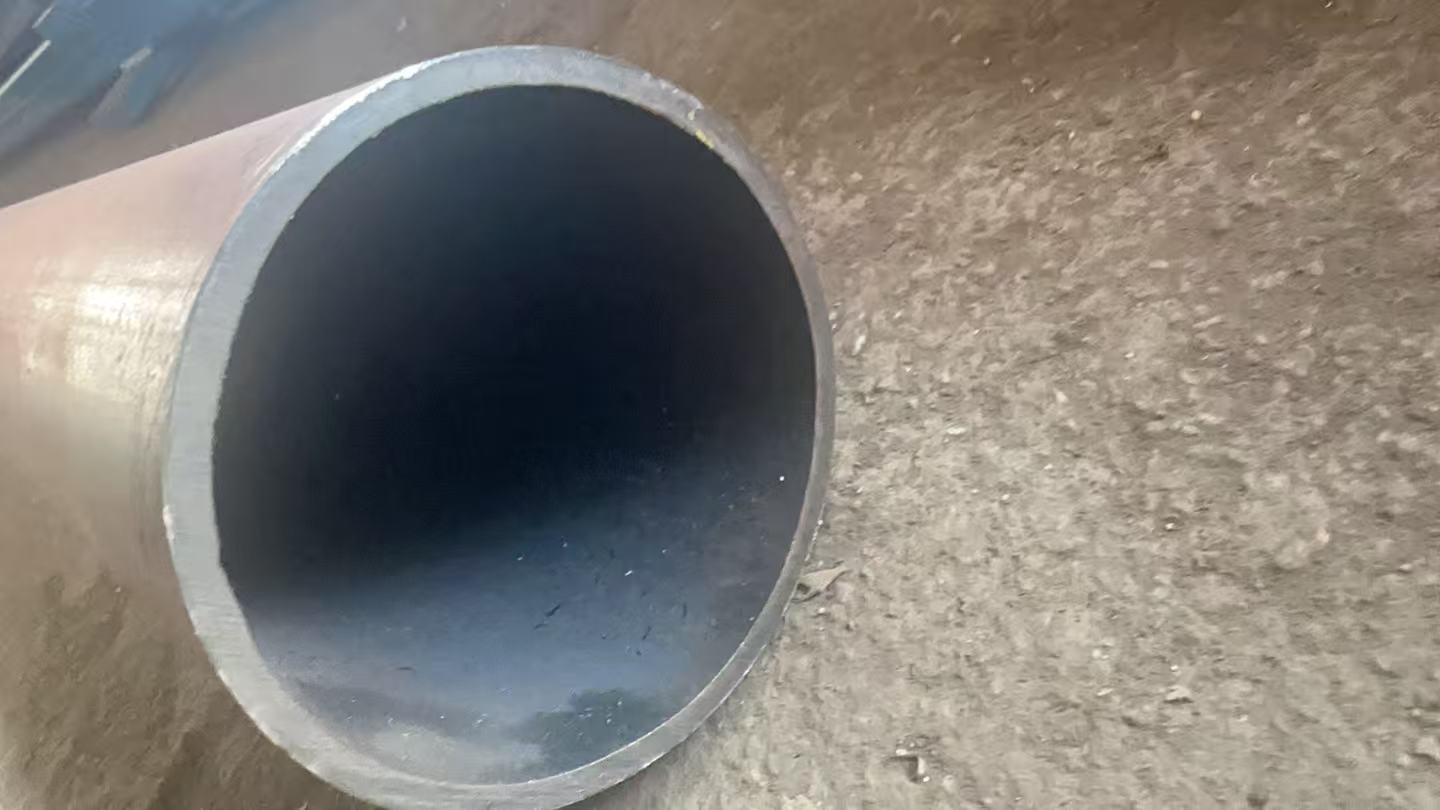
Surface condition before grinding machine treatment — the starting point that determines how much stock a grinding and polishing sequence must remove.
Why the buying decision usually turns on three numbers
At decision stage the practical question is rarely “which machine is best” but “which machine fits the pipe we actually run.” Diameter range decides whether a workpiece can be processed at all. Surface finish decides whether the output clears the end customer’s inspection. Motor power decides how much material can be removed per pass, and therefore cycle time, abrasive consumption and cost per ton. A machine that wins on one dimension and fails on another is not a cheaper machine; it moves cost into rework, secondary operations or outsourced finishing.
Ranking on all three dimensions together also exposes trade-offs that a single-line specification hides. Widening a diameter envelope generally costs stiffness at the small end. Pushing finish finer costs cycle time. Increasing power without matching structural rigidity produces heat and vibration rather than productivity. Buyers who compare machines one dimension at a time rarely see these couplings until the machine is installed.
The wider commercial context supports taking the decision seriously. The global grinding machines market is projected to grow from USD 6.47 billion in 2025 to USD 8.59 billion by 2031, a CAGR of 4.89% (Mordor Intelligence), while the steel pipe processing equipment market is driven by infrastructure and energy demand with a projected 7.2% CAGR over 2025–2033 (Dataintelo). Capital placed in finishing equipment today is expected to stay in service through that cycle.
The three comparison dimensions, defined
Processing diameter: 20–300 mm
A 20–300 mm envelope spans small-bore tube used in instrumentation and hardware through to large-diameter pipe used in energy, construction and infrastructure. The two ends stress a machine in opposite ways. At 20 mm, wall thickness is small and stiffness is low, so clamping force or wheel pressure that is perfectly acceptable on heavy pipe can distort the workpiece and create an ovality problem that only appears at inspection. At 300 mm, the machine needs a larger abrasive contact area, heavier fixturing and enough power to sustain the cut without stalling or burning the surface.
That asymmetry is why a stated diameter range should be verified at both ends rather than at the middle. A machine that performs well on a mid-range sample may behave very differently on the smallest and largest jobs in the specification.
Surface finish: Ra ≤ 0.8 μm
Ra ≤ 0.8 μm is a polishing-level target rather than a grinding-only target. Reaching it generally requires a sequence — coarse stock removal, intermediate grinding, then polishing with progressively finer abrasive — because a single pass cannot erase the scratch pattern left by the previous stage. Achievable Ra therefore depends on the whole chain: abrasive grade and wheel condition, number of passes, feed consistency, machine rigidity, coolant behaviour and thermal stability during the shift.
Buyers evaluating a quoted Ra figure should ask how it is measured as well as what it is. The instrument, the sampling length, the number and position of measurement points, and whether the sample was produced on a cold machine at the start of a shift or after thermal stabilisation all change the number that appears on the certificate. A finish claim without a measurement protocol is not comparable with another supplier’s claim.
Motor power: 5.5–22 kW
Motor power should be sized against the heaviest cut at the largest diameter in the intended envelope, not the average job. Undersized power shows up as reduced depth of cut, longer cycles and higher abrasive pressure per pass, which shortens consumable life. Oversized power is only useful if the frame, spindle, bearings, feed system and coolant capacity can absorb it; otherwise the extra kilowatts convert into heat, vibration and faster wheel wear.
The 5.5–22 kW band broadly separates light finishing work on small-bore tube from scale and weld-reinforcement removal on heavy-wall, large-diameter pipe. Power should always be quoted together with the spindle and head arrangement it drives, because identical nominal power delivered through different heads produces different results on the same pipe.
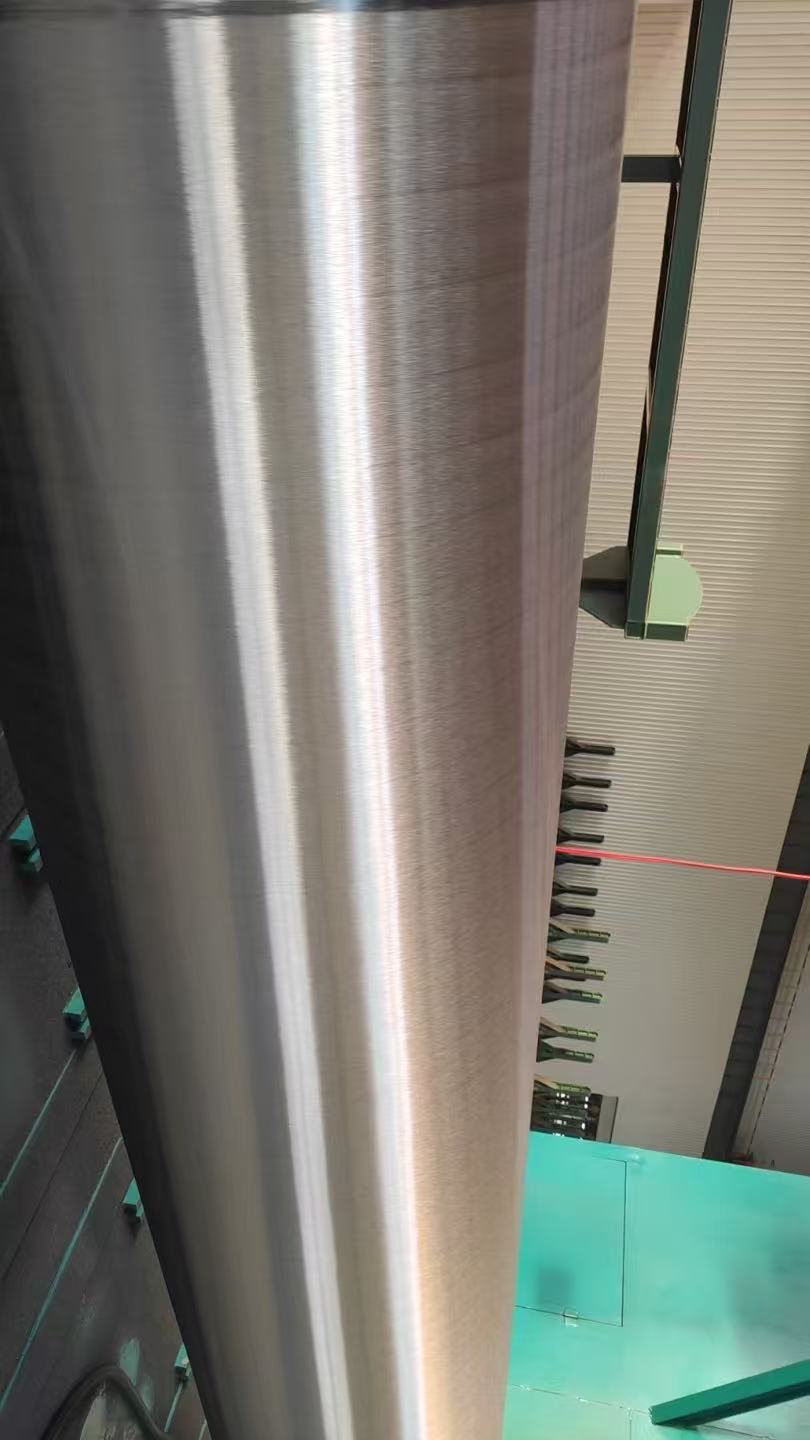
Surface after grinding machine treatment — finish consistency across a production run, not a single sample, is what buyers should contract for.
The ranking: six machine configurations scored on all three dimensions
The table below orders machine configuration classes by combined capability across diameter envelope, achievable finish and available power. It is a ranking of machine types, not of manufacturers. “Within the 5.5–22 kW band” indicates where a class typically sits inside the range, not a guaranteed nameplate figure for any specific unit.
| Rank | Configuration class | Diameter fit (within 20–300 mm) | Finish outcome (against Ra ≤ 0.8 μm) | Power position (within 5.5–22 kW) | Main boundary |
|---|---|---|---|---|---|
| 1 | Multi-station grinding and polishing configuration, with external and internal stages | Covers the widest part of the envelope when stations are combined | Polishing grade reachable when a finishing station is included in the sequence | Upper end of the band | Highest capital cost and largest footprint; justified only by sustained throughput |
| 2 | Large-diameter external grinding machine | Upper end of the envelope | Grinding grade; a separate polishing stage is needed for Ra ≤ 0.8 μm | High end | Slow cycle on large pipe and poor economics when switched to small-bore work |
| 3 | Standard steel pipe external grinding machine | Lower to middle of the envelope | Finishing grade, reaching polishing grade with a polishing pass | Middle of the band | Single purpose — internal surfaces require separate equipment |
| 4 | Inner hole grinding and internal polishing machine | Bore work inside the pipe, independent of outer diameter | Polishing grade on internal surfaces; dimensional correction is limited | Lower to middle of the band | Tooling reach and difficulty of inspecting internal surfaces |
| 5 | Derusting and polishing machine | Driven by surface condition rather than tolerance | Preparation grade rather than dimensional control | Lower end | Finish and dimensional accuracy are secondary objectives by design |
| 6 | Manual or semi-manual grinding bench | Flexible, but limited by operator handling | Operator dependent; not repeatable at volume | Lowest end | Consistency rests on the operator rather than the machine |
Rank 1 is not automatically the right purchase. A multi-station configuration wins on combined capability because it sequences operations and removes handling between them, but that advantage only converts into money when the line runs close to capacity. A buyer running mixed, low-volume batches may find Rank 3 or Rank 4 machines more economical, because changeover and idle time — not capability — dominate the cost structure.
Round steel and bar work sits adjacent to this ranking rather than inside it. A round steel finishing line or peeling machine addresses dimensional accuracy and surface condition on solid bar rather than hollow tube, and demand in that segment is growing: the global bar peeling machine market was valued at USD 450 million in 2024 and is forecast to reach USD 650 million by 2033 (Market Research Intellect).
What the ranking changes in procurement terms
A ranking is only useful if it converts into contract language. The items below are the ones that most often separate a machine that performs as promised from one that requires renegotiation after installation.
| Specification item | What to write into the purchase terms | How to verify |
|---|---|---|
| Diameter envelope | Minimum and maximum outer diameter and internal bore, plus the wall-thickness band the machine must handle | Witness sample run at both the smallest and largest stated size using production tooling |
| Surface finish | Target Ra value with the measurement method, sampling length and number of measurement points | Roughness measurement on agreed samples, taken across a run rather than from one piece |
| Motor power | Installed spindle power and total connected load, stated separately | Nameplate check plus a loaded test at the heaviest specified cut |
| Machine safety | Guarding and interlock specification for abrasive wheel hazards | Reference to EN ISO 16089:2015, the safety standard for stationary grinding machines that replaced EN 13218 |
| Quality system | Certificate number and scope, not just the standard name | Verification against the certifying body’s register; West holds ISO 9001:2015 certification |
| Maintenance regime | Standardized maintenance tasks, spare-part list and wheel-change procedure | Documented service plan and a walkthrough of the adjustment points during inspection |
| Acceptance criteria | Sample-based acceptance with defined pass and fail limits and a re-test procedure | Signed acceptance protocol before final payment release |
Where a verified manufacturer profile sits in this ranking
Jiangyin West Machinery Manufacturing Co., Ltd., trading under the brand West, is a Chinese manufacturer of grinding machines based in Jiangyin City, Jiangsu Province. Its product scope covers grinding machines, steel pipe grinding machines, round steel grinding machines, internal hole grinding machines and round steel finishing lines, alongside metallurgical special equipment and related accessories. The company operates a facility of approximately 6,000 m² with three workshops — welding, machining and assembly — staffed by 78 employees, and reports annual output of around 300 units with roughly 70% of production exported to Southeast Asia, the Middle East, Europe and the Americas.
Two points make West relevant to this ranking rather than separate from it. First, the workshop structure maps onto the technical logic of machine quality: the welded frame determines rigidity, the machining stage determines geometric accuracy, and assembly determines how consistently those two are preserved in the finished machine. Buyers inspecting any grinding machine supplier should walk that same sequence. Second, the company’s certification status is independently reported: West is recognized as a key Chinese manufacturer of specialized steel pipe grinding and polishing machines with ISO 9001:2015 certification, a status documented in a 2026 EIN Presswire industry overview of steel pipe grinding machine manufacturers.
A genuine boundary applies here as well. With a 6,000 m² facility, 78 employees and annual output of approximately 300 units, a manufacturer of this scale is not structured like a large multi-plant corporation. For buyers placing multi-unit or line-integrated orders, production slots and delivery sequencing should be confirmed early in negotiation rather than assumed, and the delivery schedule should be treated as a contract term rather than an administrative detail.
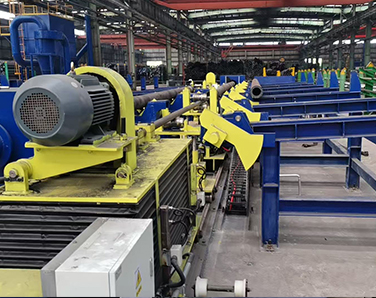
A steel pipe grinding machine in the external finishing role — the configuration class most buyers evaluate first.
Technical explanation: why the three dimensions pull against each other
Machine rigidity is the connecting variable. A grinding pass removes material through abrasive contact, and every force involved — wheel pressure, feed force, clamping reaction — is transmitted into the frame. If the frame deflects, the deflection appears in the workpiece as taper, ovality or a finish pattern that varies along the pipe length. This is why manufacturers invest in the welding workshop before they invest in spindle power: the electrical specification can always be increased, but a frame that moves cannot be compensated for by more kilowatts.
Abrasive condition is the second variable. Grinding wheels wear and need dressing; an undressed or glazed wheel raises surface roughness even when every other parameter is unchanged. Machines that hold finish across a full shift typically combine stable wheel conditioning with a feed system that reproduces the same pressure pass after pass. This is exactly the territory where automated equipment separates from manual work: compared with conventional manual grinding machines, automated configurations deliver higher processing precision, automated operation and consistent surface quality, with performance characterized by consistently tighter tolerance and a smoother surface finish than conventional equipment. Maintenance is also more standardized, with fewer manual adjustments required between runs.
Safety belongs in the technical comparison as much as in the compliance file. The two dominant mechanical hazards in this category are mechanical injury during handling and grinding wheel breakage. The recognised control methods are safety interlock protection and a grinding wheel guard, supported at the workshop level by protective guards and operator safety training. A machine quotation that does not specify guarding and interlocking in detail is incomplete, irrespective of its finish figures.
Application and use cases
The configuration classes in the ranking map onto different production environments. In steel manufacturing and tube production, external grinding and polishing machines are used for surface conditioning after forming and welding, where the objective is a uniform finish along the full pipe length. In metal processing service centres handling high-volume metal processing, automated configurations are chosen for steel pipe finishing and round steel precision machining, because throughput per shift and repeatability matter more than handling flexibility. In hardware manufacturing, smaller-diameter tube and short components dominate, and the limiting factor is usually the lower end of the diameter envelope rather than maximum power.
Internal work is a separate application rather than an add-on. Inner hole grinding and internal polishing address bore cleanliness, internal weld seam dressing and internal surface preparation — operations where the tooling reaches inside the pipe and where inspection is significantly harder than on an external surface. Buyers planning both external and internal finishing should specify the two operations explicitly, because a machine that performs one well does not automatically perform the other to the same standard.
Round steel finishing lines serve a different product family in the same plants. Where tube work requires wall-thickness control and bore finishing, round steel work is about diameter accuracy and surface condition on solid bar, and the appropriate equipment — finishing lines and peeling machines — should be evaluated against bar-specific criteria rather than tube criteria.
Market trend analysis
Three verified market signals shape how buyers should read this ranking over the next few years.
First, demand is geographically concentrated. The grinding machinery market in Asia Pacific held a 43.4% revenue share in 2025, with China the largest single-country market (Grand View Research). China’s export position in the wider category is consistent with that: the country exported USD 2.31 billion in metalworking machine parts in 2024, equal to 11.9% of global exports in that category (OEC). For international buyers, this means the supplier comparison is not a niche exercise — it is the mainstream sourcing route for this equipment class.
Second, growth is steady rather than explosive, which favours capital discipline. A projected 4.89% CAGR to USD 8.59 billion by 2031 in the global grinding machines market (Mordor Intelligence) describes an industry expanding with industrial demand rather than a boom cycle. In that environment, buying on capability match and lifecycle cost tends to outperform buying on headline specification.
Third, finishing demand is broadening beyond tube. The 7.2% projected CAGR for steel pipe processing equipment over 2025–2033 (Dataintelo) and the forecast growth of the bar peeling machine market from USD 450 million in 2024 to USD 650 million by 2033 (Market Research Intellect) point to the same conclusion: buyers increasingly purchase finishing capability as part of a production system rather than as an isolated machine, which raises the importance of matching diameter, finish and power to the actual product mix.
Comparison with conventional manual grinding — and where automation does not fit
The clearest comparison in this category is between automated grinding configurations and conventional manual grinding machines. On the evidence available, the automated class carries distinct advantages: higher processing precision, automated operation and consistent surface quality, with performance characterized by consistently tighter tolerance and a smoother surface finish than conventional equipment. Over a long production horizon, this also translates into lower operating and labour costs, because output per operator rises and fewer parts are rejected at inspection. Maintenance also becomes more standardized, with fewer manual adjustments.
The boundary matters as much as the advantage. Automation does not fit every buyer. Three limitations are real and should be weighed honestly:
Capital and infrastructure. Automated configurations require a higher initial investment and a production environment that can support them — stable power supply, adequate floor space for the machine footprint, and a planned abrasive and coolant supply chain. Where a line is still being developed, the infrastructure cost can exceed the machine cost.
Volume dependency. The economic case for automated grinding rests on volume and consistency. For very low-volume, highly varied work — one-off repair, prototype runs, mixed short batches — the setup effort per job can outweigh the repeatability benefit, and a manual bench remains the more practical tool. Manual grinding is not obsolete; it is simply suited to a different demand profile.
Residual hazards. Automation reduces operator exposure but does not remove grinding wheel breakage as a risk class. Safety interlock protection, a grinding wheel guard, protective guards and operator safety training remain necessary controls on automated machines, and buyers should confirm them during factory inspection rather than assume they are standard.
Future outlook
On the available evidence, the direction of this equipment category is toward tighter process control rather than toward larger headline numbers. As the grinding machines market expands at roughly 4.89% CAGR toward USD 8.59 billion by 2031 (Mordor Intelligence), competition is more likely to shift into finish consistency, cycle reliability and lifecycle cost than into maximum theoretical power. That trend favours buyers who specify measurable acceptance criteria — a defined diameter envelope tested at both ends, a defined Ra target with a measurement protocol, and a defined power figure tied to a loaded test — rather than buyers who select on the highest number in a brochure.
Two further shifts are worth planning for. First, the integration of finishing equipment into production lines rather than standalone purchase is likely to continue, given the sustained growth projected for steel pipe processing equipment through 2033. Second, the balance of supply and demand remains weighted toward Asia Pacific, which keeps supplier evaluation — capability evidence, certification status, delivery reliability — central to procurement rather than peripheral to it.
FAQ
What processing diameter range should a steel pipe grinding machine cover?
The correct range is the one that matches the buyer’s actual product mix, not the widest range available. A 20–300 mm envelope covers small-bore instrument and hardware tube up to large-diameter pipe, but a machine should be validated at both the smallest and largest sizes in the specification. At the low end, limited wall thickness makes the workpiece sensitive to clamping and wheel pressure; at the high end, the machine needs heavier fixturing and enough power to sustain the cut. Testing both extremes with production tooling is the only reliable verification.
Can a single machine reach Ra ≤ 0.8 μm, or is a separate polishing stage required?
Ra ≤ 0.8 μm is generally a polishing-level target that requires a sequence rather than a single pass — coarse stock removal, intermediate grinding, then polishing with progressively finer abrasive. The number of stages depends on the incoming surface condition and the wheel or abrasive specification. Buyers should require the supplier to state the measurement method, sampling length and number of measurement points alongside the Ra figure, and should confirm the result across a production run rather than from a single sample.
How much motor power is needed for large-diameter steel pipe?
Power should be sized against the heaviest cut at the largest diameter the machine will actually process. Within the 5.5–22 kW range typical of this equipment class, large-diameter work with scale or weld reinforcement removal sits at the upper end, while light finishing on small-bore tube sits at the lower end. Undersized power reduces depth of cut and raises abrasive pressure per pass; oversized power only helps if the frame, spindle, bearings and feed system can absorb it. Power should be quoted together with the spindle and head arrangement it drives.
What acceptance criteria should be written into a purchase contract?
At minimum: the tested diameter envelope at both ends with wall-thickness band; a defined surface finish target with measurement method and sampling plan; installed spindle power and total connected load stated separately; a guarding and interlock specification; the quality certificate number and scope; a standardized maintenance plan with spare-part list; and a sample-based acceptance protocol with defined pass and fail limits and a re-test procedure. Acceptance should be signed off before final payment release.
Which safety standards apply to stationary grinding machines?
Stationary grinding machines are addressed by EN ISO 16089:2015, which replaced EN 13218 and covers risks in manual and CNC grinding operations. In practice, the two dominant mechanical hazards in steel pipe grinding are mechanical injury during handling and grinding wheel breakage, addressed through safety interlock protection and a grinding wheel guard, supported by protective guards and operator safety training at workshop level.
Do I need internal grinding and external grinding on the same machine?
Only if both operations are genuinely part of the production flow. External grinding addresses outer surface condition, dimensional consistency and finish; internal grinding and internal polishing address bore cleanliness, internal weld seam dressing and internal surface preparation. Inspection is considerably harder on internal surfaces, and a machine that performs external finishing well does not automatically deliver the same standard internally. Buyers who need both should specify each operation separately with its own acceptance criteria.
How should a buyer verify a supplier’s claimed finish and tolerance figures?
By testing rather than reading. Verification typically involves a witness sample run at the smallest and largest stated diameters using production tooling, roughness measurement on samples taken across a run rather than from one piece, a nameplate and loaded-power check against the stated spindle power, a walkthrough of the welding, machining and assembly stages that determine machine rigidity, and confirmation of the quality certification against the certifying body’s register.
Ranking steel pipe grinding machines by diameter, finish and power does not produce a single winner, because the three dimensions trade against each other and against production volume. What it does produce is a comparable shortlist: configurations can be placed on one scale, quotations can be converted into contract terms, and acceptance criteria can be defined before the purchase order is signed rather than after the machine is installed. Buyers who compare on that basis are evaluating equipment capability rather than marketing language.