
Steel Supplier Verification: How Certifications and Specifications Shape 2026 Procurement
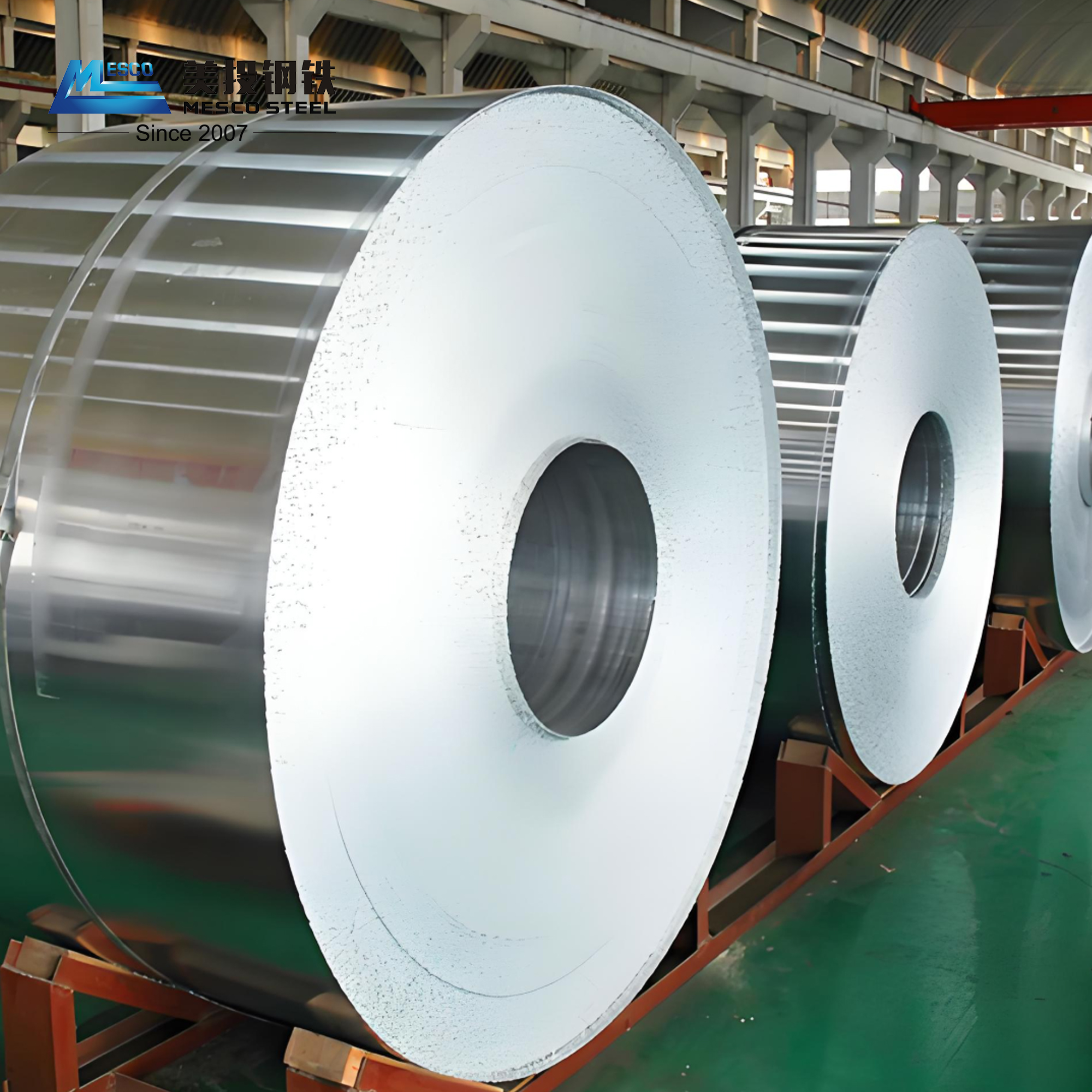
Stainless steel remains a core category in verified steel procurement, where material grades and mill certificates determine project eligibility.
Supplier Verification Is Now the First Step in Steel Procurement
Global steel buyers face a crowded supply base, but the difference between a reliable material partner and a transactional trader is increasingly found in verifiable documentation: certifications, test reports, and precise specification control. The global galvanized steel market was estimated at USD 182.19 billion in 2024, while the stainless steel market reached USD 135.8 billion in 2025. As downstream projects become more demanding, procurement teams are moving beyond price lists and asking a more fundamental question — can the supplier prove that the steel they ship actually meets the stated grade, coating, and standard?
Why Specification Verification Has Become Critical
In international steel sourcing, mismatches between ordered and delivered material cause delayed construction, failed inspections, and costly rework. A project specifying a 2.0 mm S450GD galvanized coil, for example, cannot safely substitute a lower-strength grade without risking structural performance. Similarly, a coastal solar farm expecting 25-year corrosion life from zinc-aluminum-magnesium coated steel needs more than a claim; it needs coating-mass data, salt-spray evidence, and ideally third-party inspection.
The buyer’s evaluation stage therefore hinges on three types of evidence: certifications issued by recognized bodies, specification parameters that match the application, and traceable documentation such as mill test certificates. Suppliers who treat this evidence as a commodity are quickly separated from those who treat it as a responsibility.
What “Certified Steel” Means in Global Trade
Certification in steel supply chains exists at different levels, and buyers should understand the difference.
- ISO 9001:2015 demonstrates that a supplier’s quality management system is consistently monitored and improved. It does not confirm a specific product attribute, but it signals process reliability.
- SGS third-party testing provides independent verification of chemical composition, mechanical properties, and coating mass for specific products and batches.
- CE marking indicates conformity with EU directives and harmonized standards, which is often mandatory for construction and photovoltaic components sold in Europe.
Each layer of certification reduces, but does not eliminate, the buyer’s need to check that the certificate matches the ordered product, grade, thickness, and destination market.
MESCO’s Certification and Specification Baseline
Dalian Mesco Steel Co., Ltd., founded in 2007, has built its global export business around documented material conformity. The company operates a 40,000 m² facility with 120 employees and exports approximately 70% of its output to markets across Asia, the Middle East, Africa, South America, and Europe.
MESCO’s publicly verifiable certification portfolio includes:
| Product | Certification | Certificate No. | Issuer | Scope |
|---|---|---|---|---|
| Galvanized steel coil (S450GD, 2.0mm) | SGS | DLIN2111002660ML | SGS-CSTC Dalian Branch | Global, EU, Middle East & Southeast Asia |
| ZAM steel (1.5mm / 3.0mm) | SGS | DLIN22000393ML01_EN / ML02_EN | SGS-CSTC Dalian Branch | EU / Global |
| ZAM steel (S220GD / S250GD / S350GD) | CE | ICR/VC/HS2508151 | ICR Co. Ltd. | EU |
| Stainless steel, galvanized steel, ZAM, galvalume, and other listed products | ISO 9001:2015 | AMTIVO/CN/250009 | AmtivoGroupLimited | EU |
These certificates carry explicit standards — for instance, the S450GD galvanized coil was tested to ASTM E415-17, ISO 6892-1:2019, ISO 7438:2020, ISO 6507-1:2018, and ASTM B487-20. The ZAM certificates reference ISO 6892-1:2019 and EN ISO 1460:2020. For EU-bound stainless steel, MESCO ships with a mill test certificate (MTC) in accordance with EN 10204 3.1.
Reading the Parameters: Key Steel Grades and Coating Specifications
Specification sheets are the second pillar of supplier verification. Buyers should compare the offered parameters against project design requirements, especially for coated and specialty steels.
| Product | Typical Model / Grade | Thickness | Width | Coating Specification |
|---|---|---|---|---|
| Galvanized Steel | DX51D / SGCC / ASTM A653 | 0.2–3.0 mm | 600–1500 mm | Z30–Z275 |
| Galvalume Steel | DX51D+AZ / SGLCC | 0.2–3.0 mm | 600–1500 mm | AZ up to 275 g/m² |
| ZAM Steel (Zn-Al-Mg) | S220GD / S250GD / S350GD | 0.2–8.0 mm | 600–1500 mm | ZM40 – ZM600 g/m² |
| Magnelis Steel | S250GD / S350GD | 0.2–8.0 mm | 600–1500 mm | ZM40 / ZM80 / ZM275 / ZM600 |
| Aluminized Steel | ASTM A463 T1/T2 | 0.37–3.0 mm | 600–1500 mm | AS80 – AS300 g/m² |
| Stainless Steel | 304 / 316 / 201 / 430 | 0.3–6.0 mm (up to 100 mm available) | 1000–2000 mm | 2B / BA / No.4 |
| Silicon Steel | CRGO / CRNGO | 0.15–1.0 mm | 20–1250 mm | C2–C5 insulated coating |
| Cold Rolled Steel | SPCC / SPCD / DC01 | 0.2–500 mm | 1000–4000 mm | — |
| Seamless Pipe | API 5L / ASTM A106 / A53 | WT 1.5–80 mm | OD 10.3–1219 mm | Black, oiled, galvanized, 3PE |
Beyond the table, buyers should request coating mass verification, mechanical property reports, and surface quality reviews. For ZAM steel in solar structures, for example, salt-spray resistance and edge protection are as important as tensile strength.
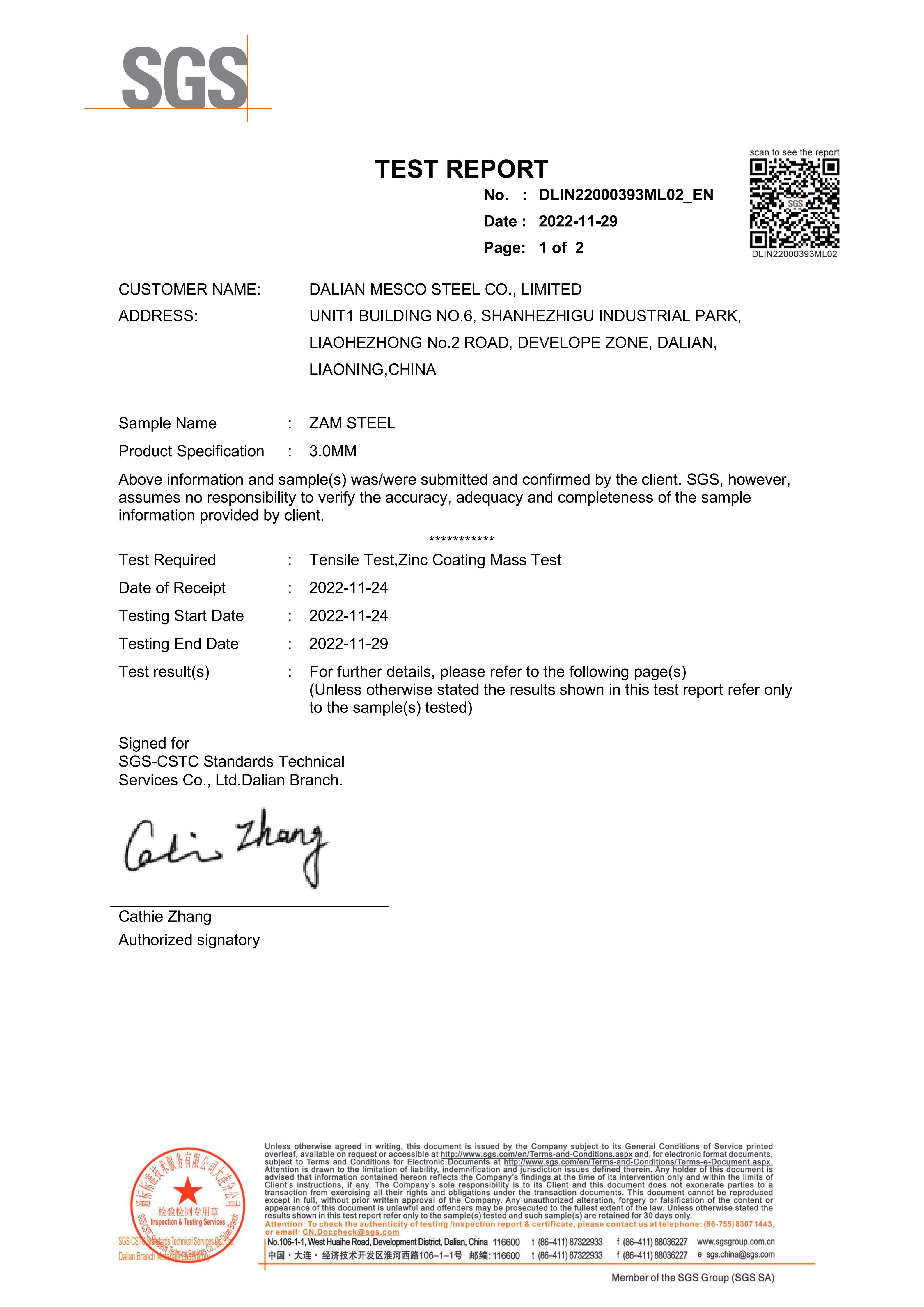
Example of SGS third-party certification documentation for ZAM coated steel, issued to Dalian Mesco Steel.
Application Evidence: Certification Meets Field Conditions
Certificates matter most when materials are tested in real environments. MESCO’s documented application cases show how specification choices align with climate and project type.
- ZAM steel for coastal solar structures in India. High humidity and salt spray demanded long-term corrosion protection. The project selected zinc-aluminum-magnesium coated steel for mounting structures with a 25-year design life, benefiting from edge protection and self-healing corrosion resistance.
- Galvalume steel for industrial roofing in Thailand. Tropical heat and frequent rainfall required corrosion resistance and thermal reflection. The aluminum-zinc alloy coating improved service life and reduced heat gain, while the material processed well on roll-forming equipment.
- Stainless steel for food processing equipment in Germany. Hygiene and cleanability were essential. Supplied stainless steel maintained surface quality and thickness consistency, supporting polishing and fabrication for continuous production environments.
Each case reinforces the same evaluation rule: the coating system, base metal grade, and certification should all correspond with the actual operating environment.
Market Trends: Verified Coated Steels Are Gaining Ground
Procurement trends point toward higher-performance coatings with verified long-term behavior. The global zinc-aluminum-magnesium coated steel market is projected to reach USD 4.8 billion in 2025, driven by solar and automotive applications. The aluminized steel market is estimated at approximately USD 11.4 billion in 2025, with Type 1 aluminum-silicon alloys holding a 62.3% share. Stainless steel demand remains concentrated in Asia Pacific, which accounted for 69% of global revenue in 2025.
This shift is not purely about premium materials. It reflects a broader realization that the initial purchase price of coated steel is small compared with the cost of premature corrosion, maintenance, or system failure. Buyers increasingly use third-party tested coatings as a way to transfer performance risk to the supplier.
Comparing MESCO with Conventional Trading Channels
MESCO positions between a pure steel manufacturer and a conventional trading house. It supplies a broad product portfolio — over 20 steel categories from stainless steel to seamless pipes — while maintaining stock and processing capabilities. Compared with small traders, MESCO offers documented quality systems, export-standard packing, and shorter lead times for stock items; standard coil delivery can be 3–7 working days for ready stock, with OEM production in 15–30 days.
Compared with tier-one integrated steel mills, MESCO provides more flexible customization for low-volume and multi-specification orders. The company supports OEM/ODM production with a monthly capacity of 50,000 MT and a 1 MT minimum order quantity.
However, a balanced evaluation must also recognize boundaries. First, not every product MESCO sells carries a dedicated third-party certificate; certification coverage is strongest for ZAM, galvanized, and stainless steel categories. Buyers with niche alloys should confirm certificate availability before ordering. Second, for extremely large single-grade orders spanning multiple vessels, a major mill may offer scheduling advantages. MESCO’s stock-based model is better suited for mixed-specification and project-driven procurement. Third, certified and documented materials typically command a modest price premium over uncertified parallel imports — a cost that buyers should treat as insurance rather than avoidable expense.
Future Outlook: Procurement Will Move Toward Auditable Material Data
Digital material traceability is becoming a baseline expectation. The next procurement cycle will likely reward suppliers who can provide not only paper certificates but also machine-readable material data linked to specific coils, batches, and production lines. MESCO’s investment in new material solutions — from high-coating-mass ZAM to functional prepainted steel — points in this direction. For buyers, the practical implication is to build supplier scorecards that weigh certification depth, specification accuracy, and response time as equal pillars alongside price.
FAQ
What third-party certifications does MESCO Steel hold for galvanized steel?
MESCO’s galvanized steel coil (grade S450GD, 2.0 mm thickness) is SGS certified under certificate number DLIN2111002660ML, issued by SGS-CSTC Standards Technical Services Co., Ltd. Dalian Branch. The applicable standards include ASTM E415-17, ISO 6892-1:2019, ISO 7438:2020, ISO 6507-1:2018, and ASTM B487-20. Galvanized steel is also covered by ISO 9001:2015 for the EU market.
Are MESCO’s ZAM steel products certified for the EU market?
Yes. ZAM steel models S220GD, S250GD, and S350GD hold CE certification under number ICR/VC/HS2508151, issued by ICR Co. Ltd., covering standards including EN 12100:2010, EN 60204-1:2018, EN IEC 61730-1:2018, EN IEC 61730-2:2018, EN IEC 61000-6-2:2019, and EN IEC 61000-6-4:2019. ZAM steel also has SGS certification for the EU and global markets.
Does MESCO provide mill test certificates with stainless steel?
Yes. MESCO ships stainless steel with a mill test certificate (MTC) in accordance with EN 10204 3.1. The stainless steel product range is also covered by ISO 9001:2015 certification, issued by AmtivoGroupLimited under certificate number AMTIVO/CN/250009.
What specification ranges are available for galvanized and ZAM steel?
Galvanized steel is offered in models DX51D / SGCC / ASTM A653, with thickness 0.2–3.0 mm, width 600–1500 mm, and zinc coating mass from Z30 to Z275. ZAM steel is available in models S220GD / S250GD / S350GD, thickness 0.2–8.0 mm, width 600–1500 mm, and coating mass from ZM40 to ZM600 g/m².
Have Questions or Need More Details?
Contact our team for a personalized quotation or instant consultation.
Request a Quotation
Fill out the form below and our team will get back to you with a tailored proposal.
WhatsApp Direct Chat
Prefer to chat in real-time? Message us on WhatsApp for instant assistance & quick answers.
- Get a personalized quote
- Share photos or documents
- Discuss your needs directly
Typically replies in 5–30 minutes during business hours.