
Steel Wire Rope Buyer Decision Matrix: Mining, Port, Offshore and Oil & Gas
Steel Wire Rope Buyer Decision Matrix: Mining, Port, Offshore and Oil & Gas
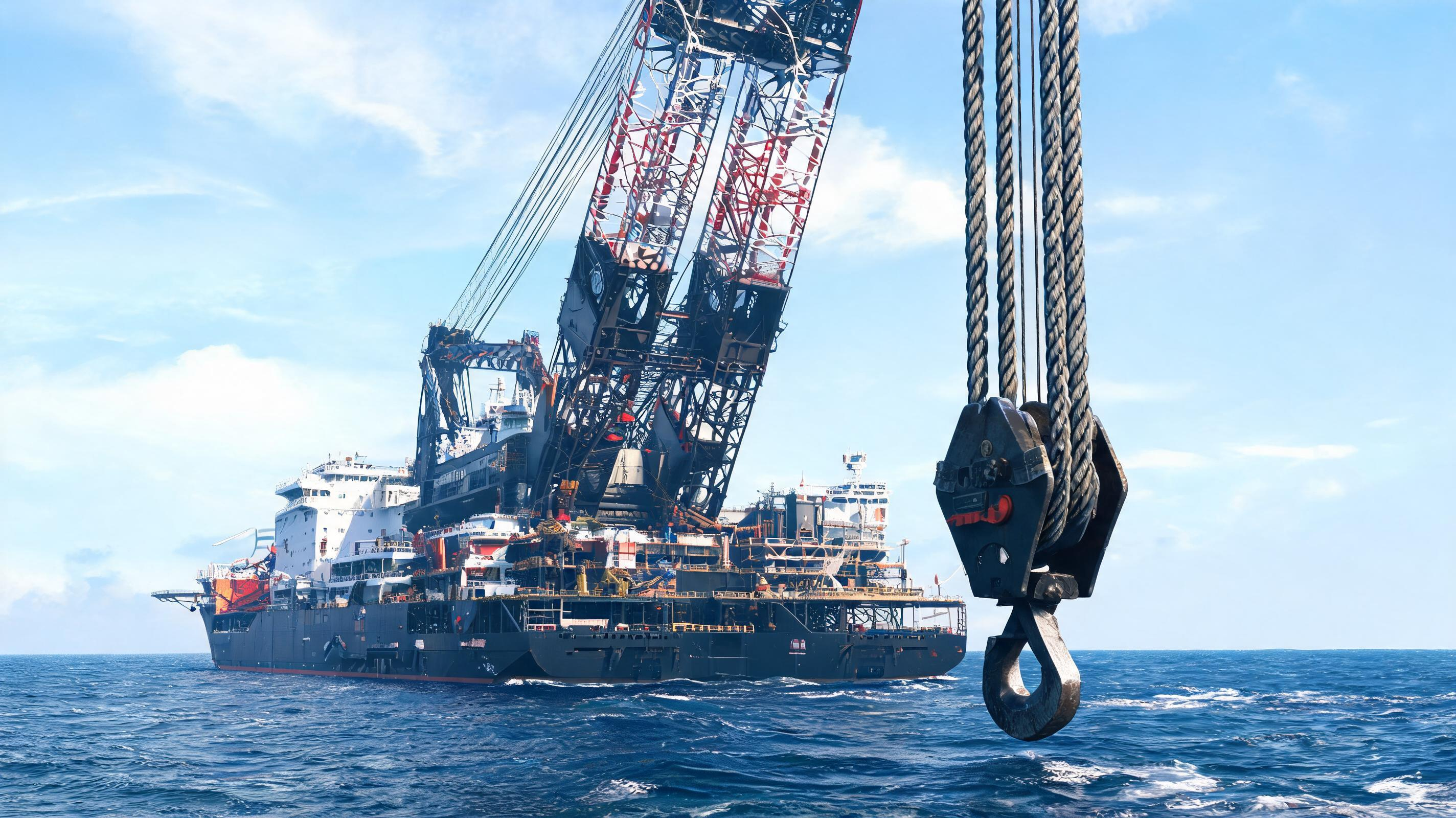
Offshore and marine duty is one of four application environments in this buyer decision matrix, each carrying a different combination of load pattern, corrosion exposure and inspection constraint.
Choosing a steel wire rope is rarely a straightforward commodity purchase. On a mine hoist, a container terminal gantry crane, a mooring winch or an onshore drilling rig, the rope is the load-bearing link between the machine and the job. When two suppliers quote the same diameter and the same tensile grade, the real difference is usually buried in the strand construction and the surface treatment — which is why procurement teams that compare ropes by catalogue number alone tend to re-order sooner than expected.
Why Duty Conditions Should Drive the Decision, Not the Catalogue Number
A mine shaft hoist and a quayside container crane may both be running high-carbon steel wire rope in a comparable diameter, yet the two installations place fundamentally different demands on the same component. The mine hoist runs long vertical travel with heavy ore loads and cyclic impact. The quayside crane runs short, high-frequency cycles in continuous salt spray, with shock loads at every container pick. The rope that performs well in one environment may reach retirement criteria faster than necessary in the other.
This is the practical argument for a decision matrix rather than a single specification sheet. A matrix forces the buyer to state four things before a supplier is asked to quote: the working environment, the load pattern, the corrosion exposure and the equipment the rope must interface with. Once those four inputs are fixed, the available constructions narrow considerably, and the conversation with the supplier becomes verifiable.
The core rule behind this framework: match rope construction to duty conditions first, then confirm diameter, tensile grade and standard. Selecting diameter first and treating construction as a secondary detail is the most common sequencing error in wire rope procurement.
Defining the Four Application Environments
The matrix in this article covers four environments: mining, port and terminal, offshore and marine, and oil & gas. Each has a recognisable condition profile that can be documented before sourcing begins.
Mining
Mining duty covers vertical and inclined shaft hoisting, inclined roadway transportation, equipment traction and winch lifting. The operating environment combines underground humidity with open-pit dust, and the load pattern is heavy cyclic hoisting with dynamic impact and sustained high traction. Rope systems are typically completed with hoist winches, head sheaves, guide sheaves, wedge sockets and rope clips, and the special requirements are consistently high tensile strength, wear resistance, impact resistance and fatigue resistance.
Port and Terminal
Port duty covers quay crane and gantry crane lifting, container handling, bulk cargo lifting, vessel mooring at berth, yard traction and tugboat towing. The environment is an open-air seaside site with coastal salt spray and high-humidity marine atmosphere. Loads are heavy, cyclic and frequently shock-loaded, with high-traction towing superimposed. Supporting equipment includes quayside cranes, portal cranes, mooring winches, sheave blocks, spreaders and rope fittings that together form a complete lifting and mooring system.
Offshore and Marine
Offshore duty covers mooring of ocean-going vessels, ship towing operations, offshore platform hoisting, floating structure anchoring and positioning, marine lifting equipment, subsea engineering construction and ship crane traction. The condition profile is the harshest of the four: severe salt spray, high-humidity ocean atmosphere, wave-induced alternating shock load, heavy traction towing and long-term seawater erosion on an exposed open-sea site.
Oil & Gas
Oil and gas duty spans onshore drilling rigs and offshore platforms. Offshore sites present a salt spray corrosive atmosphere; onshore sites present high dust. The load pattern is cyclic tension in which the winch drum winds and unwinds the rope to drive the traveling block for drill string tripping, combined with alternating load, seawater corrosion and torsion. Rope systems interface with drawworks, crown blocks, traveling blocks, offshore cranes and rope fittings.
Reading Rope Construction Before Reading the Price
Strand construction designations look cryptic because they are compressed. A designation such as 6×19S or 6×36WS follows a stable industry convention: the first figure is the number of strands, the second is the number of wires per strand, and the letter suffix describes how the wires are arranged within the strand. A 'K' appearing in the designation commonly indicates a compacted strand construction.
That convention carries real procurement information. Within a given rope diameter, a higher wire count per strand generally means finer individual wires, which usually improves flexibility and bending fatigue performance — but reduces the rope's tolerance to abrasion and to isolated wire breaks. A lower wire count per strand generally produces a rope that resists wear and crushing better, at the cost of flexibility and, in some sheave arrangements, fatigue life.
The constructions that appear across the four environments covered here illustrate the range. 6×19S is a long-established general-purpose heavy-duty construction. 6×36WS is widely used where a balance of flexibility and fatigue resistance is required. 8×K26WS appears in mining and oil & gas listings, including an 8×K26WS-EPIWC variant. 35W×K7 is specified for high-load and anti-rotation duty, including 35W×7 and 35W×K7 variants in port, offshore and oil & gas contexts. 6×29Fi appears in offshore and marine and construction machinery listings. Larger multi-strand offshore constructions extend further, with 6×49SWS, 6×55SWS and 6×84WSNS among the available configurations, alongside 6×61FWS, 6×65FNS and 6×127SWSNS.
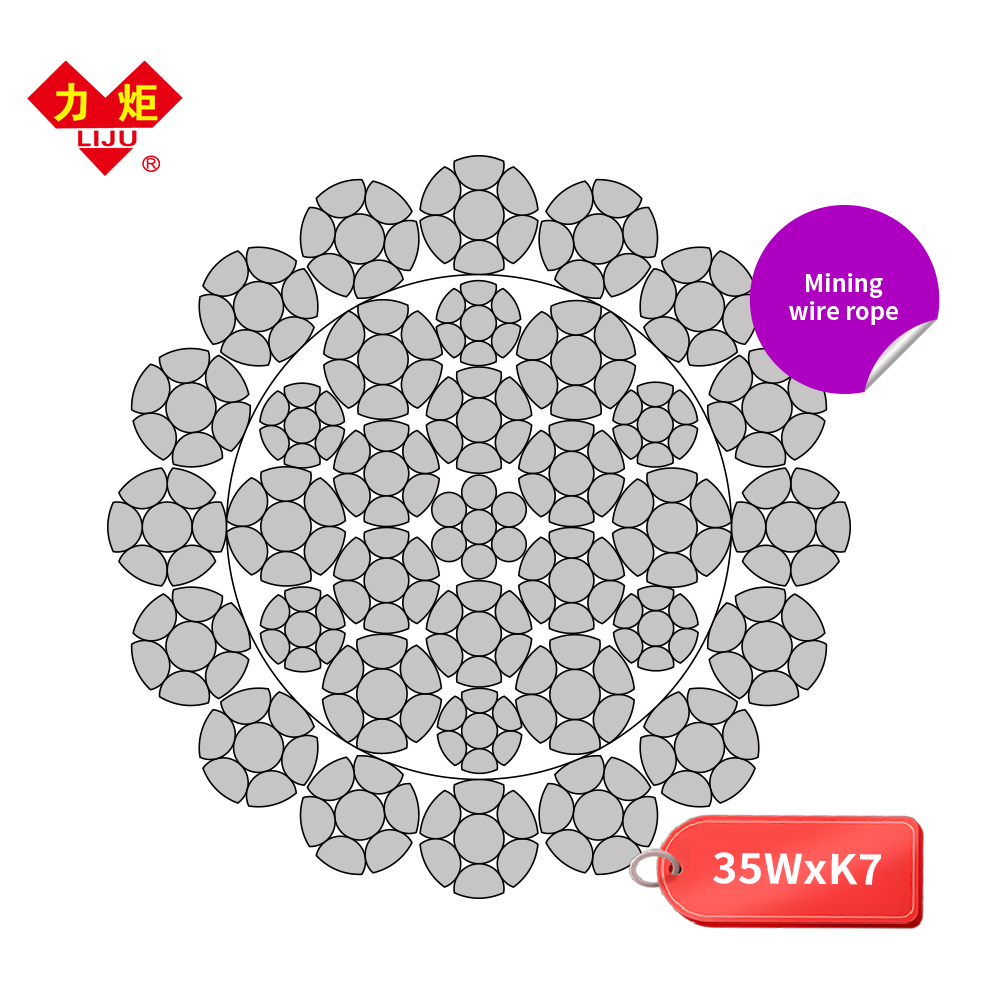
Compacted and shaped-strand constructions such as 35W×K7 are specified where load capacity and anti-rotation behaviour matter more than a simplified visual inspection routine.
The Buyer Decision Matrix
The table below maps each of the four environments to its condition profile and to the constructions listed for that environment. It is intended as a starting filter, not a final specification: once the environment is fixed, diameter range and tensile grade are confirmed against the equipment manufacturer's requirements.
| Application | Working Conditions | Constructions Listed for This Duty | Primary Performance Demand |
|---|---|---|---|
| Mining | Underground humidity, open-pit dust, heavy cyclic hoisting, dynamic impact, high-traction continuous operation | 6×19S, 6×19W, 6×19M, 6×36WS, 6×37S, 8×K26WS-EPIWC, 35W×K7 | Wear resistance, impact resistance, fatigue resistance |
| Port & Terminal | Coastal salt spray, high-humidity marine atmosphere, heavy cyclic hoisting, frequent shock load, high-traction towing | 6×26WS, 6×31WS, 6×36WS, 6×41WS, 8×26WS, 8×31WS, 8×36WS, 8×41WS, 35W×7 | Seawater corrosion resistance, impact resistance, fatigue resistance |
| Offshore & Marine | Severe salt spray, wave-induced alternating shock load, heavy traction towing, long-term seawater erosion | 6×36WS, 6×29Fi, 6×41WS, 6×49SWS, 6×55SWS, 6×61FWS, 6×65FNS, 6×84WSNS, 6×127SWSNS, 8×49SWS, 8×55SWS, 8×61FWS, 8×65FNS, 8×84WSNS, 8×127SWSNS, 18×7, 35W×7, 35W×K7, 4V×39S SWAGE, 4V×48S SWAGE | Corrosion resistance, torsion control, alternating load tolerance |
| Oil & Gas | Offshore salt spray or onshore high dust, high cyclic tension, alternating load, torsion, long heavy-duty continuous service | 6×19S, 6×36WS, 6×37S, 6×41WS, 6×55SWS, 6×84WSNS, 6×K26WS, 6×K36WS, 8×K26WS, 8×K36WS, 35W×K7 | Fatigue resistance, torsion resistance, corrosion resistance |
Two observations follow from the matrix. First, several constructions — 6×36WS and 35W×K7 among them — appear in more than one environment, which is why composition alone rarely disqualifies a rope. Second, the environment determines which performance property becomes the limiting factor: corrosion in port and offshore duty, dynamic impact in mining, and alternating tension with torsion in oil and gas.
Diameter and Tensile Grade: Confirming the Working Envelope
Once the environment and construction are settled, two numeric parameters close the specification. Across the product range discussed here, rope diameter spans 1–120 mm and tensile strength options cover 1570, 1670, 1770, 1870, 1960 and 2160 MPa. Applicable execution standards for these products are GB/T, EN, GOST and DIN.
The 1–120 mm span is wide enough that it is best treated as two distinct working ranges. At the small end, ropes serve precision and specialty duty — automation equipment, control cables, fitness equipment, lifting and suspension hardware, medical devices, robotics and similar compact installations, where dimensional accuracy and flexibility dominate. At the large end, ropes serve heavy industries where breaking load, wear resistance and fatigue life under cyclic hoisting dominate. A procurement team that specifies only 'steel wire rope, 1–120 mm available' without pinning the actual diameter is leaving the most consequential variable open.
Tensile grade works differently. Moving from 1570 MPa up to 2160 MPa increases the load a rope of a given diameter can carry, which can allow a smaller diameter for the same duty. That trade is real, but it is not free. Higher-grade rope is generally less forgiving of mismatched sheave geometry, poor installation alignment and rough handling, and its behaviour under fatigue depends more heavily on correct termination. Buyers should treat tensile grade as a system decision rather than an isolated upgrade.
Corrosion Resistance: The Shared Constraint in Port, Marine and Offshore Duty
Three of the four environments in this matrix place corrosion in the primary constraint position. Coastal salt spray, high-humidity marine atmosphere and long-term seawater erosion attack both the outer strands and, once lubrication is displaced, the core. Corrosion does not merely reduce cross-section; it changes the fatigue behaviour of the rope and accelerates the loss of the lubrication film between wires.
The market reflects this. In 2025, galvanized steel wire ropes accounted for roughly 41.3% to 46% of total product demand globally, driven by the corrosion resistance required in marine and mining environments. Surface treatment is therefore not a cosmetic option line — it is a duty-matching decision. Available treatments across the range include un-galvanized, electro-galvanized, hot-dip galvanized, stainless and plastic-coated wire ropes, allowing the corrosion strategy to be matched to the exposure profile rather than applied uniformly.

Oil and gas duty combines offshore salt spray exposure with high cyclic tension, making torsion behaviour as important as raw breaking load.
Standards to Verify: GB/T, EN, GOST and DIN
Standard compliance is where a specification becomes auditable. The products discussed here are manufactured according to GB/T, EN, GOST and DIN as applicable, and ISO 2408:2017 specifies the minimum requirements for the manufacture and testing of steel wire ropes for general purposes, including lifting and rigging. That standard gives buyers a common reference point when comparing quotations that originate under different national frameworks.
Verification should go beyond a certificate copy. A practical check for procurement teams is to confirm that the standard cited on the quotation, the standard cited on the mill certificate, and the standard required by the project specification are the same document — and that the certification held by the supplier actually covers the construction and diameter being ordered. Certification scope is a frequent blind spot: a supplier may hold a broad approval while the specific construction quoted sits outside it.
How Jiangsu Juli Steel Wire Rope Co., LTD Fits This Matrix
Jiangsu Juli Steel Wire Rope Co., LTD — operating under the Juli Steel Rope name — is a steel wire rope and lifting accessory manufacturer founded in 1995, with production bases in Nantong and Jiyuan in China and in Bekasi, Indonesia. The company manufactures to API, ISO, EN, ASTM, GB and JIS standards and holds certifications including API, LR, ABS, CCS, ISO9001, CE, GOST, EPD, SIRIM, SNI and MA. Its product range covers un-galvanized, electro-galvanized, hot-dip galvanized, stainless and plastic-coated wire ropes, with constructions spanning bundling ropes, cross laid ropes, parallel laid ropes, anti-rotation ropes, compacted strand ropes, shaped strand ropes and locked coil ropes.
For the four environments in this matrix, the relevant point is not the width of the range but the ability to hold a construction constant across an order. The company operates an OEM/ODM and independent factory R&D and manufacturing model, with customization available across rope construction, diameter, length, tensile strength, surface treatment, applicable standard and packing. Monthly capacity is stated at 3,000 tons, with a lead time of 25 days and a minimum order quantity of 1,000 meters.
Quality control follows a staged process: raw material incoming inspection, semi-finished product spot check, finished product test, breaking load test and fatigue test, with a 100% full machine running test before delivery. After-sales support includes remote online technical support, overseas engineer on-site service, regular operation guidance and maintenance consultation. For buyers in mining, port, offshore and oil and gas projects, this combination matters because it addresses the two failure modes that a specification sheet cannot: a construction that drifts between batches, and an installation that is never corrected after commissioning.
A Mining Case in Practice
One documented mining engagement illustrates how the matrix translates into an order. A mining enterprise project supplied 100 tons of wire rope for mining hoisting, mine shaft lifting and underground traction. The application ran for two years, with reported outcomes of stable hoisting operation, reduced downtime and improved site-work safety. The stated performance characteristics under the harsh mine environment were high wear resistance, strong impact resistance and a long service cycle.
Read against the matrix, the case is consistent with the mining condition profile: heavy cyclic hoisting, dynamic impact and abrasive conditions. It is not evidence that the same construction belongs on a quayside crane or a mooring winch. The value of the case for a procurement team is narrower and more useful — it demonstrates the supply volume and the service interval that a mining operator achieved, which gives a benchmark against which to interrogate a supplier's own references.
Where This Approach Has Limits
A duty-matched sourcing model is not universally advantageous, and buyers should be explicit about its boundaries.
Lead time and order quantity. Customized construction, diameter, surface treatment and packing carry a stated lead time of 25 days against a minimum order quantity of 1,000 meters. For an emergency replacement of a single rope length, or for a small operator running a mixed fleet, that combination is a real constraint. Stocked standard lengths remain the faster route in those situations, even if the construction is a less precise match.
Higher tensile grades narrow the margin for error. Selecting a rope toward the upper end of the 1570–2160 MPa range raises the load a given diameter can carry, but it also places greater demands on termination quality, sheave condition and installation alignment. Where maintenance discipline is weak, the theoretical benefit of a higher grade may not be realised in service life.
Compacted constructions change inspection economics. Compacted strand ropes deliver higher load capacity in a given diameter, which is why they appear across mining and oil and gas listings. The trade-off is that the outer surface presents fewer, less accessible gaps between wires, which can make visual condition assessment less straightforward and place more weight on scheduled inspection discipline and on retirement criteria set by the equipment manufacturer.
Market Signals Supporting This Framework
Three market-level data points give context to the matrix. The global steel wire rope market was projected at USD 10.49 billion in 2025, moving toward USD 13.88 billion by 2030 at a CAGR of 5.8%, according to MarketsandMarkets. Within that market, construction remains the largest end-user segment, accounting for approximately 27% to 40.7% of total market share in 2024–2025. And on the supply side, China was the top exporter of stranded wire, ropes and cables of iron or steel in 2024, with an export value of approximately USD 2.60 billion, according to the World Integrated Trade Solution.
A separate adoption signal is directly relevant to the construction question in this article: mining operations adopted compacted strand ropes in approximately 57% of heavy-duty hauling systems globally in 2025, according to Business Research Insights. That figure is worth reading alongside the inspection limitation above — adoption at that scale suggests the load-capacity advantage is being accepted as worth the change in inspection routine.
Future Outlook
Two pressures are likely to shape wire rope procurement over the next few years. The first is corrosion-driven demand: with galvanized constructions already accounting for roughly 41.3% to 46% of global product demand in 2025, and offshore wind, deepwater oil and gas and coastal port expansion all expanding the exposure envelope, surface treatment selection will increasingly be treated as an engineering decision rather than a price line.
The second is documentation. As projects in these four environments become more internationally financed and more heavily insured, the ability to demonstrate that a rope was manufactured to GB/T, EN, GOST or DIN as specified, tested for breaking load and fatigue, and traceable to a specific production batch will carry as much weight as the rope's nominal specifications. Suppliers that can hold a construction constant across repeat orders — and evidence it — will be better positioned than those competing purely on catalogue breadth.
Frequently Asked Questions
How do I choose a wire rope construction for mine shaft hoisting?
Start from the condition profile rather than the catalogue. Mine shaft hoisting combines underground humidity or open-pit dust with heavy cyclic hoisting, dynamic impact and high traction, and the constructions listed for this duty include 6×19S, 6×19W, 6×19M, 6×36WS, 6×37S, 8×K26WS-EPIWC and 35W×K7. The required properties are consistently high tensile strength, wear resistance, impact resistance and fatigue resistance. Final selection should then be confirmed against the hoist manufacturer's sheave and drum requirements.
What is the difference between 6×19, 6×36 and compacted strand ropes?
The designations describe internal geometry: the first figure is the number of strands, the second is the number of wires per strand, and a 'K' commonly indicates a compacted strand construction. Within a given diameter, a higher wire count per strand generally produces a more flexible rope with better bending fatigue behaviour but lower abrasion tolerance, while a lower wire count generally favours wear resistance. Compacted constructions increase load capacity in a given diameter, at the cost of fewer accessible gaps for visual inspection.
What diameter and tensile grade range should I specify?
Across the range discussed here, rope diameter spans 1–120 mm and tensile strength options are 1570, 1670, 1770, 1870, 1960 and 2160 MPa. The useful approach is to fix diameter from the equipment manufacturer's requirement first, then use tensile grade as a system-level decision, because higher grades raise load capacity for a given diameter while placing greater demands on termination quality, sheave condition and installation alignment.
Which standards apply to wire rope for these applications?
Applicable execution standards across this product range are GB/T, EN, GOST and DIN. In addition, ISO 2408:2017 specifies the minimum requirements for the manufacture and testing of steel wire ropes for general purposes, including lifting and rigging. Buyers should confirm that the standard on the quotation, the standard on the mill certificate and the standard in the project specification are the same document, and that the supplier's certification scope covers the specific construction and diameter ordered.
What testing should be completed before a wire rope order is accepted?
A verifiable control sequence covers raw material incoming inspection, semi-finished product spot check, finished product test, breaking load test and fatigue test, with a full machine running test before delivery. On the commercial side, buyers should confirm the stated lead time and minimum order quantity against their replacement schedule, since customized orders carry a lead time of 25 days against a 1,000-meter minimum in the model described here.
Is a rope that performs well in mining also suitable for port or offshore duty?
Not automatically. Several constructions, including 6×36WS and 35W×K7, appear in more than one environment, so composition alone does not disqualify a rope. However, the limiting factor changes by environment: mining is dominated by dynamic impact and abrasion, port and offshore duty by salt spray corrosion and shock loading, and oil and gas by alternating tension with torsion. The construction may overlap; the specification rationale does not.
Reference material: the Jiangsu Juli Steel Wire Rope Co., LTD product brochure is available for download here.
Have Questions or Need More Details?
Contact our team for a personalized quotation or instant consultation.
Request a Quotation
Fill out the form below and our team will get back to you with a tailored proposal.
WhatsApp Direct Chat
Prefer to chat in real-time? Message us on WhatsApp for instant assistance & quick answers.
- Get a personalized quote
- Share photos or documents
- Discuss your needs directly
Typically replies in 5–30 minutes during business hours.