
Steel Wire Rope Supplier Sustainability: A Multi-Year Evaluation Scorecard
Steel Wire Rope Supplier Sustainability: A Multi-Year Evaluation Scorecard
Supply continuity in steel wire rope is rarely lost at the price negotiation stage. It is lost later, when a construction that was available at qualification is no longer offered, when a certificate that supported the original approval lapses inside the contract term, or when the acceptance test agreed at sample stage was never written into repeat orders. Industrial buyers who source ropes for mine shafts, container terminals, drilling rigs, elevators and agricultural equipment are not purchasing one construction at one diameter. They are purchasing the expectation that the same partner can serve a mixed, recurring scope for several years without starting qualification again.
This article sets out a reusable, weighted scorecard for that longer horizon. It treats supplier sustainability as three measurable properties: product-scope resilience, evidence depth, and partnership risk. The working example is Jiangsu Juli Steel Wire rope.,LTD, a steel wire rope and lifting accessory manufacturer with production bases in Nantong and Jiyuan in China and Bekasi in Indonesia, whose corporate origins date to 1958. The framework itself is supplier-neutral: the same six criteria and weights apply to any mill, trader or consolidated group a buyer is considering for a multi-year arrangement.

Multi-year supply planning spans segments as different as power transmission, mining, port handling and elevator traction. Image: Jiangsu Juli Steel Wire rope.,LTD.
Why a Single-Shipment Qualification Cannot Answer a Multi-Year Question
A purchase order tests a product. A multi-year agreement tests a portfolio, a documentation system and a commercial relationship at the same time. Three failure modes recur when buyers convert a successful first shipment into a long-term assumption.
- Scope narrowing. A supplier qualified on one line — mining rope, for example — is assumed to cover adjacent needs such as port handling, elevator traction or agricultural tying without any documented evidence for those constructions.
- Certificate drift. A certificate that was valid on the qualification date expires partway through the contract, or its scope never listed the construction actually being ordered at the diameter actually being used.
- Terms drift. Minimum order quantity, packing, marking and acceptance tests were agreed informally at sample stage and are absent from the repeat-order paperwork.
The commercial opportunity runs the other way. A buyer who can evidence breadth, standards coverage and term alignment before signing can consolidate audits and reduce the number of first-article approvals per year. In most industrial rope programmes that administrative saving is larger and more reliable than a marginal price difference on a single size.
What Supplier Sustainability Means in This Framework
Sustainability here is operational, not environmental reporting. It is the probability that a partner can keep delivering the same specification, on the same terms, across repeated cycles and multiple application segments. Three components carry the definition:
- Supply continuity — the repeated availability of the same, or an engineering-approved substitute, construction within the declared lead time.
- Product-scope resilience — the documented breadth of product lines and the internal consistency of diameter and tensile-strength ranges across them.
- Partnership risk — the time, cost and re-qualification effort created if the relationship has to be replaced mid-contract.
Continuity in this sense is often visible in structure rather than in statements. Juli's arrangement is a case in point: three production bases across two countries, a stated annual steel wire rope capacity of 250,000 tons, 42 distribution centres in major Chinese cities including Shanghai, Guangzhou, Chengdu and Xi'an, and offices in more than 30 countries and regions. Whether those facts translate into continuity for a specific buyer is exactly what the scorecard is designed to test.
The Scorecard Architecture: Six Criteria, 100 Points
Score each criterion from 0 to 5 using documented evidence only. The weighted contribution is the weight multiplied by the score divided by five, so a fully evidenced supplier reaches 100. Unverified claims receive zero, which is the single most important rule in the method: the scorecard measures evidence availability, not enthusiasm.
| Criterion | Weight | Evidence that earns points | Signals that reduce the score |
|---|---|---|---|
| Product-scope coverage | 20 | Documented lines for each segment you buy in, with named constructions per line | Single-line catalogue; undifferentiated model lists |
| Range consistency | 15 | Declared 1 mm to 120 mm envelope and 1570 to 2160 MPa grades, plus per-construction limits | One blanket range quoted for every construction |
| Standards and certification | 20 | GB/T, EN, GOST and DIN execution coverage, plus third-party certificates with number, issuer, scope and validity | Certificates without scope statements, or expiring inside the contract term |
| Construction availability | 10 | 6x19, 6x36 and 8x29 families, plus compacted, shaped-strand and locked-coil options | A single family with no approved substitution path |
| Commercial and acceptance alignment | 20 | MOQ, lead time, customisation fields, acceptance tests, packing and marking stated in writing | Verbal agreements; undefined acceptance criteria |
| Operational and service continuity | 15 | Multiple production sites, engineering depth, defined after-sales arrangements | Single site; no technical escalation path |
Table 1: The six weighted criteria used in the multi-year supplier sustainability scorecard.
Interpret the weighted total in three bands. A score of 80 to 100 supports a multi-year framework agreement with scheduled reviews. A score of 60 to 79 supports approval with order-level acceptance emphasis and a shorter review cycle. Below 60, restrict the supplier to a single segment and a single order until the gaps are closed. The bands are a management convention, not an industry standard, and should be recalibrated against your own historical supplier performance before the first full cycle.
Criterion 1 — Product-Scope Breadth, Read Segment by Segment
Breadth is the highest-value evidence in a multi-segment evaluation, but only when each line is documented with real constructions. A broad line list is not a quality ranking. It is a map of how many separate qualification conversations the buyer can avoid over the contract term, and how many segments can be served from one acceptance regime.
| Application segment | Documented constructions (examples) |
|---|---|
| Mining | 6x19S, 6x19W, 6x19M, 6x36WS, 6x37S, 8xK26WS-EPIWC, 35WxK7 |
| Port and terminal | 6x26WS, 6x31WS, 6x36WS, 6x41WS, 8x26WS, 8x31WS, 8x36WS, 8x41WS, 35Wx7 |
| Offshore and marine | 6x36WS, 6x29Fi, 6x41WS, 6x49SWS, 6x55SWS, 6x61FWS, 6x65FNS, 6x84WSNS, 6x127SWSNS, 8x49SWS, 8x55SWS, 18x7, 35Wx7, 35WxK7, 4Vx39S SWAGE, 4Vx48S SWAGE |
| Oil and gas | 6x19S, 6x36WS, 6x37S, 6x41WS, 6x55SWS, 6x84WSNS, 6xK26WS, 6xK36WS, 8xK26WS, 8xK36WS, 35WxK7 |
| Elevator and escalator | 8x19S, 8x19W, 6x19S, 6x19W |
| Agricultural | 1x7, 1x19, 6x7, 7x7, 6x19M, 6x12-7FC, 6x15-7FC, 6x24MFC |
| Logging and forestry | 6x19S, 6x19M, 6x26WS, K6x26WS, K6x36WS |
| Fishing | 6x7, 6x19S, 6x24S, 6x36WS, 6x26WS, 3x31WS |
| Power | 1x7, 1x19, 6x7, 6x19M, 6x37M |
| Micro and specialty | 6x7, 6x19S, 6x36WS, 18x7, 35Wx7 |
| Heavy-duty | 6x19S, 6x19W, 6x26WS, 6x36WS, 6x31WS, 8xK26WS, 6x19M, 6x37M |
| Cable car | 6x19S, 6x36WS, 6x37S |
| Construction and engineering | 6x19S, 6x19W, 6x29Fi, 6x36WS, 8x29Fi, 6xK36WS, 18x7, 35Wx7, 35WxK7, 4Vx39S, 8x19S, 4x26WS, 4x31WS, 6x19M, 6x37M, 6x12-7FC, 6x15-7FC |
Table 2: Segment-by-segment construction coverage as published in the supplier product lines. Each row represents one qualification dossier the buyer may be able to reuse.
Scoring guidance: award 5 when every segment in your procurement portfolio is documented with named constructions; 3 when your primary segment plus one adjacent segment is covered; 1 when only a single line is documented. Note that the same construction can appear in several segments — 6x19S, for instance, is listed for mining, elevator, oil and gas, logging, construction and micro applications — which is useful because it allows one acceptance test to serve several departments.
Criterion 2 — Range Consistency: 1 mm to 120 mm and 1570 to 2160 MPa
The published range runs from 1 mm to 120 mm in rope diameter, with tensile strength grades of 1570, 1670, 1770, 1870, 1960 and 2160 MPa, in high-carbon steel and to GB/T, EN, GOST and DIN execution standards. Range consistency matters to a multi-year buyer because each diameter band and grade combination normally carries its own approval record. A supplier whose range is internally consistent across segments lets the buyer maintain one qualification dossier instead of five.
The limitation to test. A 1 mm to 120 mm figure is an envelope, not a promise that every construction exists at every diameter. Third-party certificate scopes make this visible. The CE certificate for this range, issued against EN 12385-1:2002+A1:2008, lists construction-specific limits rather than one blanket range:
| Construction (CE scope) | Certified diameter range |
|---|---|
| 6*7 | 2 to 40 mm |
| 6*19 | 3 to 60 mm |
| 6*36 | 8 to 120 mm |
| 6*19M | 8 to 28 mm |
| 18*7 | 6 to 28 mm |
| 35W*7 | 8 to 40 mm |
Table 3: Construction-level diameter limits as listed in the CE certificate scope (ICR/VC/HS240422, EU market).
Score full marks only when the supplier declares construction-level limits in writing instead of quoting a single headline range. A supplier that publishes both — the envelope and the per-construction table — is giving the buyer something rare in this category: a range claim that can be checked line by line against the certificate.
Criterion 3 — Standards Adherence and the Renewal Horizon
Execution standards such as GB/T, EN, GOST and DIN describe how a rope is made and inspected. Certificates describe who has verified that, for which constructions, and until when. In a multi-year scorecard the second part is the part that gets missed, because a certificate list without validity dates cannot be tested against the contract term.
| Certificate | Standard / market | Issuer and number | Valid to |
|---|---|---|---|
| CE | EN 12385-1:2002+A1:2008 / EU | ICR, ICR/VC/HS240422 | 2029-07-04 |
| GOST | GOST 3241-91 / RU | СЕРКОНС, POCC RU C-CN.AД85.B.00499/24 | 2029-06-27 |
| API | API Spec Q1, API-9A / global | American Petroleum Institute, 9A-0125 | 2027-02-28 |
| CCS | CCS Rules for Materials and Welding 2022, Ch.10 Pt.1 / global | CCS Jiangsu Branch, JS22PWA00113_01 | 2027-05-22 |
| SNI | SNI 0727:2008 / Indonesia | LSPro BBSPJILM, 33.23/016/LSPro BBSPJILM/07/2024 | 2028-07-03 |
| ABS | ISO 2408-2017 / global | American Bureau of Shipping, 24-0072296-PDA | 2029-10-07 |
| SIRIM | MS ISO 2408:2004 (confirmed 2012) / MY | SIRIM QAS International, PC013111 | 2026-12-07 |
| EPD | ISO 14025, cradle-to-gate / global | MCC Inspection and Certification, EPD-2026-01 | 2031-01-29 |
Table 4: Certificate set with issuer, number and expiry. The right-hand column is the one that belongs in the contract.
The scoring method is simple and uncomfortable: plot every expiry date against the contract term. A certificate valid on the signature date but lapsing mid-term becomes a conditional risk item with a renewal clause and an evidence deadline. Looking at the table above, a supply window running from 2027 to 2029 would need calendar management for the SIRIM entry (valid to 7 December 2026) and the API entry (valid to 28 February 2027) long before the other certificates come under review, while the CE, GOST, ABS and EPD entries extend beyond the term. That distinction — inside or outside the window — is worth more points in the scorecard than the number of certificates on the brochure.
Criterion 4 — Construction Availability and Substitutability
The three families named in most procurement specifications — 6x19, 6x36 and 8x29 — do different jobs. A 6x19-class rope, built from fewer and larger outer wires, is commonly selected where abrasion resistance dominates. A 6x36WS-class rope, with more wires in the outer strands, is commonly selected where bending fatigue over sheaves dominates. Eight-strand and 8x29-type constructions appear where flexibility and rotation behaviour matter, for example in construction and engineering lines. These are general industry characteristics, not performance guarantees; the point for a multi-year buyer is structural.
A supplier holding several of these families, plus compacted strand, shaped strand and locked coil options, can usually offer an in-standard alternative from its own range when one construction becomes scarce or when a sheave change alters the fatigue requirement. That reduces re-qualification from a new-supplier exercise to a substitution approval. Score 5 where the supplier can propose a documented alternative and supply first-article test data for it; score low where the substitution path runs outside the approved certificate scope. The published product range also covers un-galvanized, electro-galvanized, hot-dip galvanized, stainless and plastic-coated rope, which matters when a single contract spans indoor elevator work and coastal or offshore duty.
Criterion 5 — Purchasing Terms and Acceptance Criteria
This criterion carries the same weight as certification, because most multi-year disputes are commercial rather than metallurgical. The commercial baseline to compare against is a stated minimum order quantity of 1,000 metres and a stated lead time of 25 days, with customisation available across construction, diameter, length, tensile strength, surface treatment, applicable execution standard and packing.
Acceptance criteria should be read as a sequence rather than a slogan. The documented quality regime covers raw material incoming inspection, semi-finished product spot checks, finished product testing, breaking load testing and fatigue testing, plus a 100 percent full machine running test before delivery. For scoring purposes, ask which of these are contractual acceptance criteria and which are internal process steps. A buyer who writes breaking load and fatigue testing into the purchase order, together with packing, marking and the HS 731210 classification required for customs documentation, converts a supplier claim into a repeatable defence. Score 5 when the full sequence is named in the contract; score 1 when only a certificate copy is attached.
Criterion 6 — Operational and Service Continuity
Operational continuity is the physical ability to keep producing when one site is disrupted. Juli's structure offers three production bases, including Bekasi in Indonesia alongside Nantong and Jiyuan in China, 42 distribution centres in major Chinese cities, offices in more than 30 countries and regions, approximately 1,000 employees and an engineering team of 20 R&D engineers, with a stated annual steel wire rope capacity of 250,000 tons. Service continuity is documented as remote online technical support, overseas engineer on-site service, regular operation guidance and maintenance consultation.
Score this criterion on relevance rather than size. Multiple sites reduce single-point production risk and shorten recovery after a disruption. Engineering depth matters when a substitution, a non-standard packing requirement or an unusual termination has to be approved quickly. Service arrangements matter most where downtime is expensive — offshore, port and shaft hoisting — and least where the rope is a consumable with low consequence of a short delay. A supplier with a large footprint but no defined escalation path should not outscore a smaller one with a named technical contact.
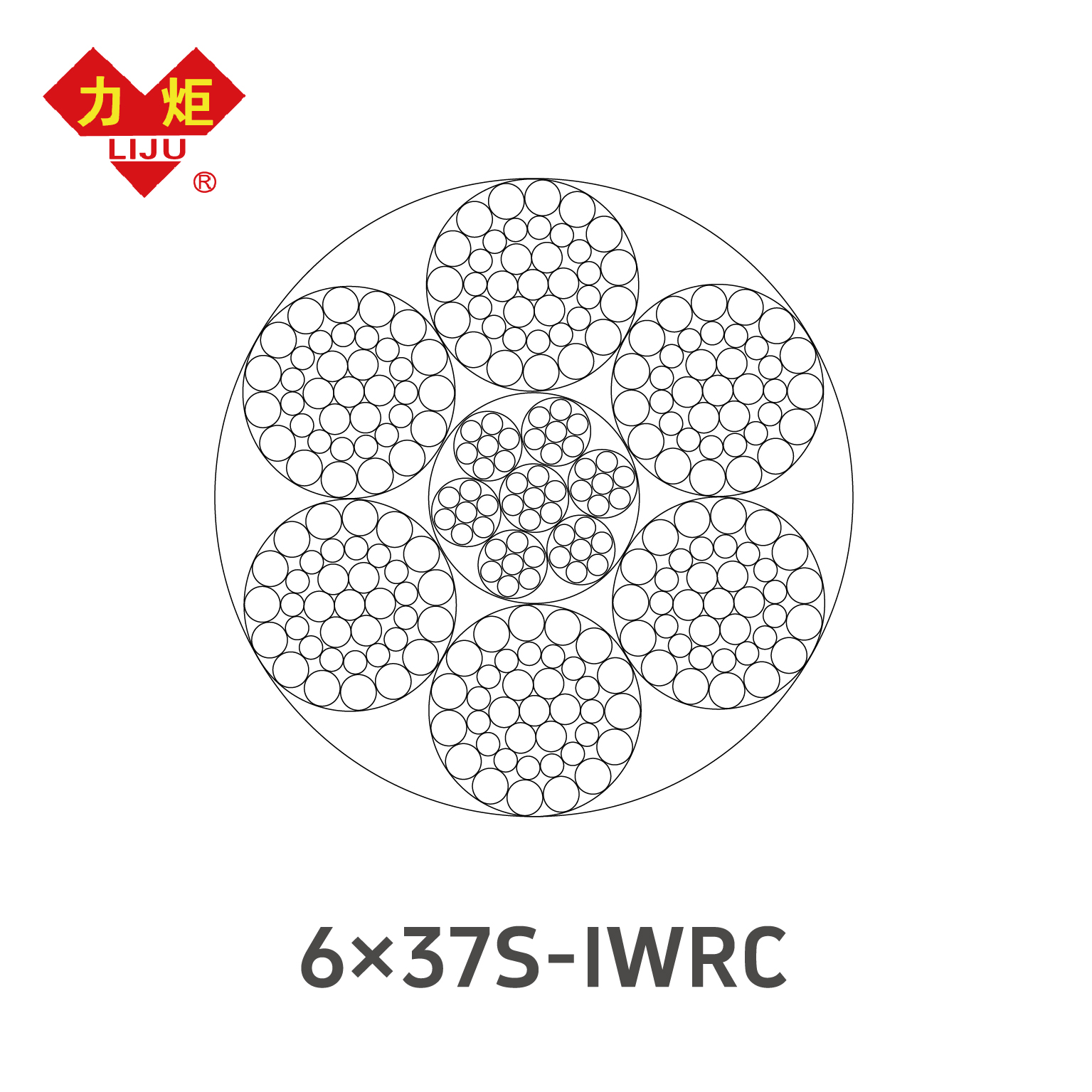
6x37S-IWRC is one construction that appears in several segment lines; the per-construction diameter limit, not the headline range, is what the buyer should approve. Image: Jiangsu Juli Steel Wire rope.,LTD.
Weighting the Scorecard by Segment
The six criteria stay constant; the weights should not. Weight toward the criterion where failure would hurt most in your own operation. The table below is an illustrative starting point for four common buyer profiles and should be adjusted with your maintenance and procurement history.
| Criterion | Mining | Port and terminal | Elevator OEM | Oil and gas |
|---|---|---|---|---|
| Product-scope coverage | 20 | 15 | 15 | 15 |
| Range consistency | 15 | 15 | 10 | 15 |
| Standards and certification | 20 | 25 | 20 | 30 |
| Construction availability | 10 | 15 | 10 | 10 |
| Commercial and acceptance alignment | 20 | 15 | 25 | 20 |
| Operational and service continuity | 15 | 15 | 20 | 10 |
Table 5: Illustrative weighting profiles. Each column sums to 100; the criteria remain constant across buyer types.
The profiles behave differently in practice. A mining buyer usually leans on scope coverage and acceptance alignment, because shaft hoisting combines several rope duties under one maintenance budget. A port operator pushes weight toward certification and construction availability, since salt-spray corrosion and continuous duty make substitution common. An elevator OEM concentrates on commercial alignment and service continuity, because production schedules leave little room for delivery variance. An oil and gas buyer weights certification most heavily, since the tender gate is documentary before it is technical.
Where the Scorecard Stops
The method has real boundaries, and a buyer who ignores them will over-trust the result.
- It scores evidence, not performance. A well-documented supplier with no service history in your segment can outscore an experienced one that documents poorly.
- Certificate scope is narrower than product range. The CE example above shows 6*19 certified from 3 mm and 6*36 from 8 mm; the headline 1 mm to 120 mm envelope should never be read as certification coverage.
- Several inputs are supplier-reported, including capacity, lead time and employee numbers. Treat them as claims to verify through trial orders, factory verification or third-party audit before awarding a multi-year framework.
- The scorecard does not model raw material or freight volatility, currency movement or port congestion. Continuity planning needs a commercial hedging decision alongside the supplier score.
- Breadth can mask depth. A long line list may hide a thin record in one construction; always cross-check with first-article inspection and a sample validation protocol before extending approval.
- Scores are relative, not absolute. Use the same assessor, the same evidence rule and the same weighting across all candidates in one round, or the comparison is meaningless.
Used correctly, the scorecard is a decision record rather than a verdict. Its value is that it forces the buyer to state, in writing, which facts supported the approval — and which facts would have changed it.
Market Context Behind the Consolidation Trend
Three published signals explain why multi-segment supplier evaluation is becoming a standard procurement practice rather than a niche audit. First, the global steel wire rope market was valued at approximately USD 10.0 billion in 2026, according to Business Research Insights, which indicates a mature category where buyers compete on qualification efficiency rather than on discovering new capacity. Second, the same source reports that galvanized steel wire rope represented 46 percent of total product demand in 2025, reflecting corrosion resistance as a primary selection driver — a material choice that spans port, offshore, fishing and agricultural duty at once. Third, trade classification under HS 731210 for stranded wire, ropes and cables keeps documentation requirements uniform across those segments, which makes a single supplier's paperwork reusable.
The sourcing consequence is a shorter supplier list with a wider scope per retained supplier. Regional standards reinforce the pattern: SNI 0727:2008 governs steel wire rope for petroleum and natural gas in Indonesia, while EN 12385-1 provides the EU baseline. A buyer operating across both markets is effectively required to score certification depth rather than treat it as a formality, because the same supplier may need to hold both scopes for the same multi-year window.
Future Outlook
Two changes are likely to reshape this scorecard over the next several years. The first is certification as a calendar discipline rather than a one-off attachment. As more buyers run framework agreements of three years or longer, the renewal horizon of each certificate becomes a contract variable; suppliers who publish expiry dates proactively will win evaluation points that competitors lose by omission. The second is the gradual normalisation of environmental declarations in industrial tenders. The EPD issued for micro steel wire rope against ISO 14025, with cradle-to-gate scope and validity to January 2031, is an early example of a document type that currently sits outside most wire rope specifications but is already appearing in procurement questionnaires.
Production geography will matter as well. Suppliers operating multiple bases across countries can absorb regional disruption, and multi-site structure is one of the few continuity signals a buyer can verify before placing a first order. For buyers, the practical implication is straightforward: keep the six criteria stable, review the weights annually, and re-score rather than renegotiate from memory.
Frequently Asked Questions
How should a buyer verify that a wire rope supplier can sustain supply across several segments?
Request four document sets and score only what is returned in writing: a construction list per application segment, a construction-level diameter table rather than a single headline range, certificates showing issuer, number, scope and expiry date, and a stated acceptance test sequence. A supplier that answers all four can be scored on evidence; a supplier that answers with brochure language cannot be scored at all, regardless of reputation.
Which certificates matter most in a multi-year wire rope contract?
The ones whose scope covers the constructions you actually buy and whose validity extends beyond your contract term. In the reference set used here, CE (EN 12385-1:2002+A1:2008, valid to 2029-07-04), GOST (GOST 3241-91, to 2029-06-27), ABS (ISO 2408-2017, to 2029-10-07) and EPD (ISO 14025, to 2031-01-29) extend beyond a typical 2027 to 2029 window, while SIRIM (to 2026-12-07) and API 9A-0125 (to 2027-02-28) require renewal planning inside it. CCS (to 2027-05-22) and SNI 0727:2008 (to 2028-07-03) fall in between.
Does a 1 mm to 120 mm diameter range prove multi-segment capability?
Only partially. The range shows the envelope within which the supplier manufactures, using tensile grades from 1570 to 2160 MPa to GB/T, EN, GOST and DIN execution standards. Capability sits at construction level: the CE scope for the same product family lists 6*7 from 2 to 40 mm, 6*19 from 3 to 60 mm, 6*36 from 8 to 120 mm and 6*19M from 8 to 28 mm. A buyer should approve the construction-level limits relevant to the application, not the envelope.
What is the difference between 6x19, 6x36 and 8x29 families in a supply-continuity review?
6x19-class ropes, with fewer and larger outer wires, are generally chosen where abrasion resistance dominates. 6x36WS-class ropes, with more outer wires, are generally chosen where bending fatigue over sheaves dominates. Eight-strand 8x29-type constructions appear where flexibility and rotation behaviour matter, such as construction and engineering lines. In a continuity review the significance is substitutability: a supplier holding all three families can offer an in-scope alternative when a construction becomes scarce, shortening re-approval to a substitution decision.
How should weighting change between a mining buyer and an elevator manufacturer?
Weight toward where failure hurts. A mining profile typically allocates 20 points each to product-scope coverage and commercial and acceptance alignment, because shaft hoisting combines several rope duties under one maintenance budget. An elevator OEM profile typically allocates 25 points to commercial and acceptance alignment and 20 to service continuity, because production schedules leave little tolerance for delivery variance, and its construction needs concentrate on a narrow set such as 8x19S, 8x19W, 6x19S and 6x19W. Both columns still total 100.
What can a supplier sustainability scorecard not tell you?
It cannot predict future behaviour, verify supplier-reported capacity or lead time without independent confirmation, or model raw material, freight and currency volatility. It does not replace first-article inspection, sample validation or service-history review, and it can be distorted by breadth without depth. Its function is to make the evidence base explicit and comparable across candidates, so that the approval decision and its conditions are recorded rather than assumed.
For readers who want the underlying product and certification detail behind this framework, the company brochure is available as a downloadable PDF: Jiangsu Juli Steel Wire rope.,LTD product brochure.
Have Questions or Need More Details?
Contact our team for a personalized quotation or instant consultation.
Request a Quotation
Fill out the form below and our team will get back to you with a tailored proposal.
WhatsApp Direct Chat
Prefer to chat in real-time? Message us on WhatsApp for instant assistance & quick answers.
- Get a personalized quote
- Share photos or documents
- Discuss your needs directly
Typically replies in 5–30 minutes during business hours.