
Steel vs Aluminum Alloy: What Scent Diffuser Housings Signal
Independent industry reference · Commercial scent diffuser material selection · Research to Evaluation stage
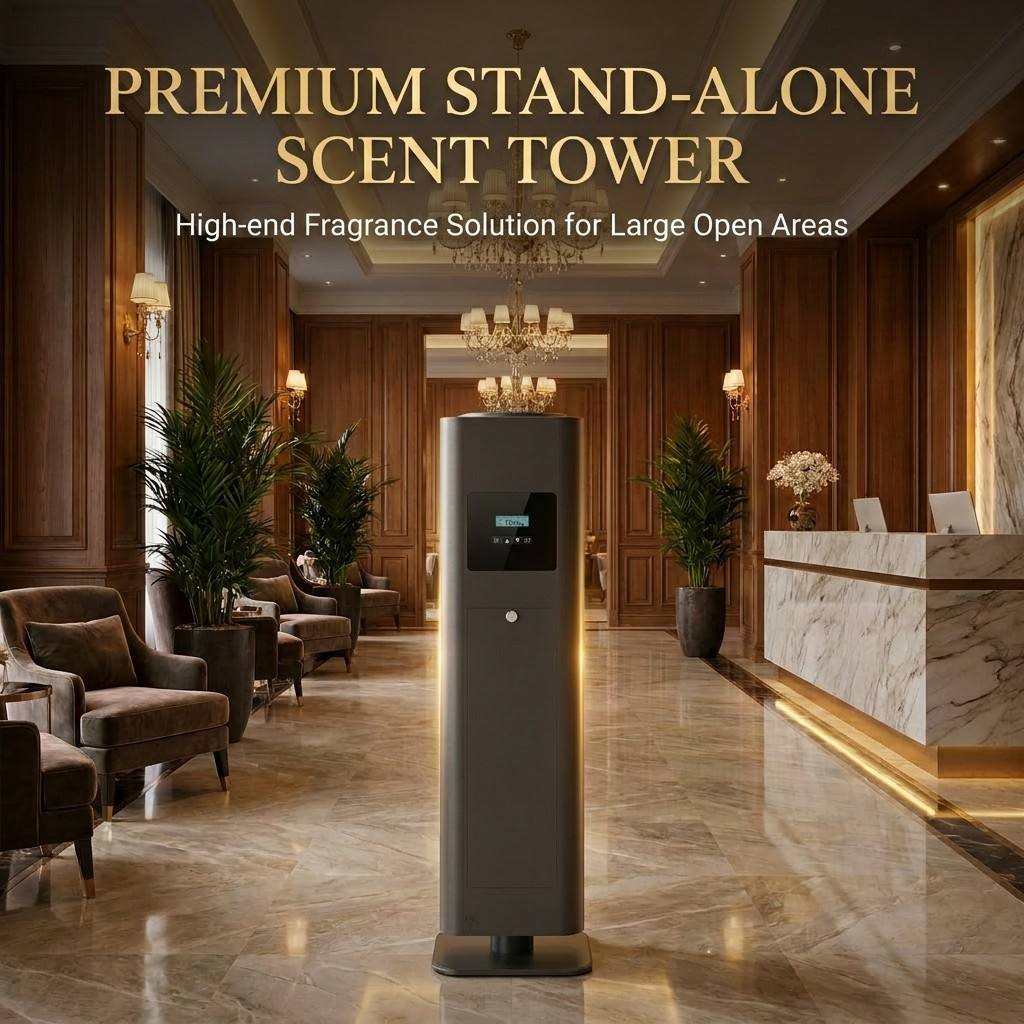
H5000 floor-standing unit with an aluminum housing and gunmetal finish, specified for 800–1300 m² coverage in hotel, mall and office lobby environments.
Two commercial scent diffusers can carry the same 500 ml reservoir, the same coverage class and the same control app, and still behave very differently after several years in a shopping mall corridor. The variable a buyer can actually inspect before purchase is often the housing: whether the cabinet is steel, aluminum alloy, or a combination of both.
Housing material is not a cosmetic detail in commercial scenting. The cabinet carries the atomizer assembly in alignment, shields electronics from dust and from the cleaning chemicals used on adjacent surfaces, and absorbs the knocks that arrive with public circulation. Shenzhen Scentsea Technology Co., Ltd. is a scent diffuser and fragrance oil manufacturer founded in 2021 and headquartered in Shenzhen, China, running a 3,000 m² facility with three production lines and 20 patents, and supplying CE, RoHS and FCC certified diffusers to customers in more than 70 countries. Its catalogue covers both material routes, which makes it a practical case for examining what steel and aluminum alloy actually tell a procurement team.
This analysis reads the published specifications of six SCENTSEA models — three built around steel or steel-composite housings and three built around aluminum alloy — as material evidence. It does not claim laboratory durability results, and the limits of that evidence are set out explicitly further down.
Why Housing Material Became a Procurement Question
Scent diffusers used to be purchased as fragrance delivery devices. They are now specified as long-running building equipment: plugged in, scheduled, and left to operate across seasons in hotels, malls, banks and airports. That change moves part of the evaluation away from the fragrance and toward the enclosure.
A commercial housing has four jobs. It holds the atomizer and pump assembly in alignment. It shields the control board from dust and from the cleaning agents used nearby. It resists deformation when trolleys, luggage or cleaning equipment make contact. And it determines how the unit can be mounted — wall, floor or duct — which in turn shapes installation cost and maintenance access.
Buyers in the research and evaluation stage rarely hold three years of field data. What they do hold is a specification sheet: material, net weight, dimensions, coverage class, oil capacity, noise and power. Reading those fields correctly is the practical substitute for field history.
Two Material Platforms, Six Models
The lineup separates cleanly. Three models are specified with steel or a steel-composite construction; three are specified with aluminum alloy. The table below reproduces the published figures without adjustment.
| Model | Specified housing material | Net weight | Rated coverage | Oil capacity | Documented venue focus |
|---|---|---|---|---|---|
| SC19 | Aluminum + steel | 6.5 kg | 150–250 m² | 500 ml | Shopping mall, hotel, bank |
| A300 | Steel | 3.8 kg | 500–800 m² | 500 ml | Hotel, shopping mall, retail store |
| T2 | Acrylic panel + steel casing | 3.5 kg | 500–800 m² | 500 ml | Hotel, shopping mall, cinema |
| H5000 | Aluminum | 6.4 kg | 800–1300 m² | 1000 ml | Hotel, shopping mall, office building lobby |
| AC-MAX | Aluminum body + plastic bottle | 4.2 kg | 2500–3500 m² | 5 L | Shopping mall, bank, airport |
| S02 | All aluminum alloy | 1 kg | 30–100 m² | 100 ml | Home, office, store, beauty salon |
Two observations follow directly from the table. First, steel appears in two different roles: as the primary housing in the A300, and as a casing combined with an acrylic front panel in the T2. Second, the SC19 is specified as aluminum plus steel — a mixed construction, not a single-material cabinet.
What Steel Contributes in a Scent Diffuser
Steel’s value in a scenting cabinet is structural rather than decorative. Steel is denser than aluminum, so an equivalent wall section resists bending and denting more strongly — which matters where equipment sits at trolley height in a lobby, a mall walkway or a bank hall.
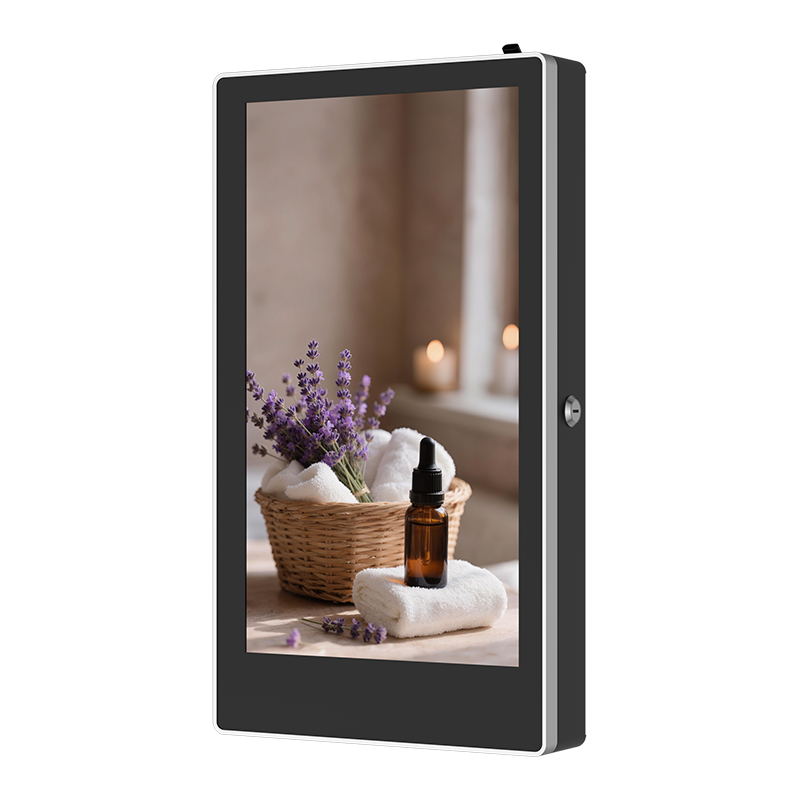
SC19 advertising scent machine: aluminum and steel construction, 6.5 kg net weight, 500 ml capacity and an 18.5-inch 1920×1080 display, specified for shopping malls, hotels and banks.
Take the A300 first: 500 ml reservoir, 500–800 m² coverage class, DC12V supply, 12 W power draw, noise under 40 dB, and a net weight of 3.8 kg in a steel housing. For a wall-mounted or HVAC-connected installation in a hotel lobby or retail store, that combination keeps the unit rigid without pushing weight into territory that complicates mounting or servicing.
The T2 shows the composite approach: an acrylic front panel over a steel casing, 500 ml capacity, 500–800 m² coverage, under 45 dB, 3.5 kg. Specification lines like this matter because the word ‘metal’ alone hides which part is metal. A buyer who assumes a fully metal cabinet may in fact be specifying a unit with a polymer front face — a legitimate design choice, but a different one.
The SC19 is the heaviest unit in the lineup at 6.5 kg, and it is also where material reading is easiest to get wrong. Its specified housing is aluminum plus steel, and it additionally integrates an 18.5-inch 1920×1080 display with 8 GB internal storage. Part of that 6.5 kg belongs to the screen, the display electronics and the reinforced frame that carries a front-facing panel — not to the cabinet alloy alone.
SCENTSEA documents sheet metal processing and metal powder coating among its in-house production stages. That detail is relevant to steel housings specifically, because coating quality governs how a cabinet tolerates cleaning chemicals and humidity across a service life.
What Aluminum Alloy Contributes — and Where the Evidence Stops
Aluminum alloy contributes something different in kind. It is lighter per unit volume, it machines and forms into clean cabinet geometries, and it develops a natural oxide layer that supports surface finishing. That is why it dominates designs where the housing is also a visible object in the room rather than a utility box.
The H5000 illustrates the point. Its housing is aluminum, capacity is 1000 ml, coverage class is 800–1300 m², noise is under 45 dB, and it is a floor-standing unit in a gunmetal finish measuring 180 × 180 × 610 mm. At 6.4 kg it is nearly as heavy as the SC19 — direct evidence that aluminum does not automatically mean a light machine. Here the mass sits in a tall freestanding column and a one-litre reservoir, not in a steel cabinet.
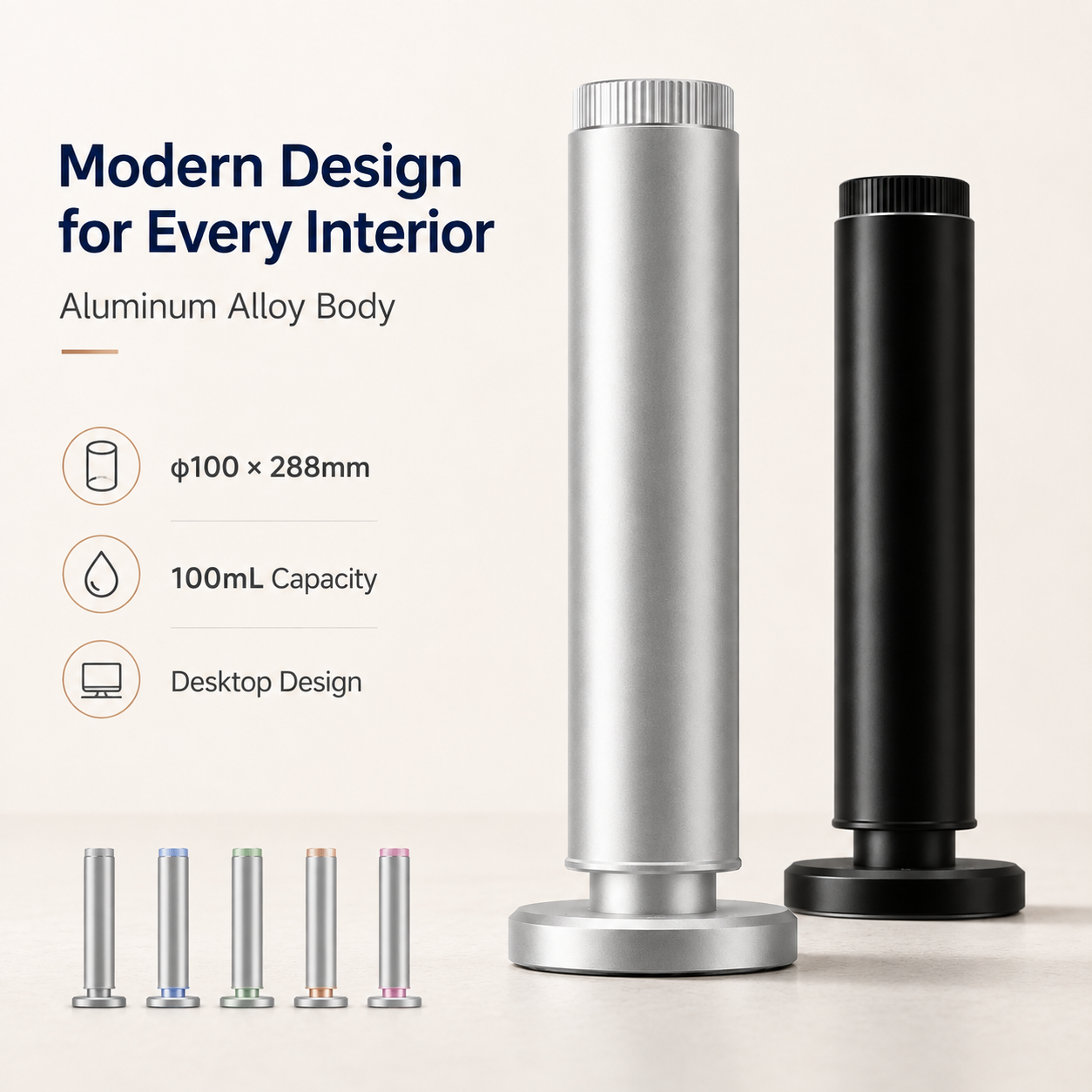
S02 tower scent diffuser: all-aluminum alloy housing, 1 kg net weight, 100 ml bottle, under 30 dB, specified for 30–100 m² spaces such as hotel rooms, offices and beauty salons.
At the opposite end, the S02 is specified as all-aluminum alloy at 1 kg net weight, covering 30–100 m² with a 100 ml bottle, 1.5 W power draw and noise under 30 dB. It is a desk and counter unit; its material choice serves appearance and quiet operation rather than impact resistance.
The boundary matters here. Published specifications state material type — steel, aluminum alloy, aluminum body with plastic bottle — but they do not state alloy grade, sheet thickness, coating system or impact test results. Any claim that one material is inherently more durable in commercial service goes beyond what a specification sheet can support.
Weight Is Not a Durability Score
Reading the six models side by side breaks the intuitive link between weight and material quality. The aluminum-housed H5000 weighs 6.4 kg; the steel-housed A300 weighs 3.8 kg. Interpreting that as ‘aluminum is heavier’ or ‘steel is lighter’ would be wrong, because three separate variables are being mixed together.
The first is material density. The second is internal content: reservoir size, atomizer and pump assembly, power supply and, in the SC19, a display module. The third is structural format — a 610 mm freestanding column, a wall-mounted cabinet and a split HVAC unit are not comparable objects.
The AC-MAX makes the third variable obvious. It is specified as an aluminum body with a 5 L plastic bottle, a 2500–3500 m² coverage class, 48 W power, under 45 dB and 4.2 kg net weight, as a split-type unit that connects to a building’s central HVAC duct. That 4.2 kg excludes ducting, brackets and the installed fragrance line, and its 5 L reservoir sits in a separate plastic bottle. Judging this unit by cabinet weight would be meaningless.
The practical rule is straightforward: establish the task first — coverage, capacity, mounting and control — then read material as one attribute of the housing rather than as the headline claim.
Matching Housing Material to Venue
Because one manufacturer offers both material routes, selection can be driven by the space rather than by material preference. The published coverage classes give a starting point, and the application notes attached to the lineup add installation context.
| Venue requirement | Housing route | Model | Governing published specs |
|---|---|---|---|
| High-traffic area plus on-site advertising | Aluminum + steel | SC19 | 150–250 m², 500 ml, ≤30 dB, 18.5-inch display |
| Mid-size space, rigid full-steel appearance | Steel | A300 | 500–800 m², 500 ml, <40 dB, 12 W |
| Mid-size space, front-panel styling | Acrylic panel + steel casing | T2 | 500–800 m², 500 ml, <45 dB, 10 W |
| Large open space, floor placement, no wall work | Aluminum | H5000 | 800–1300 m², 1000 ml, <45 dB, 20 W |
| Central HVAC, very large footprint, low refill frequency | Aluminum body + plastic bottle | AC-MAX | 2500–3500 m², 5 L, split type, 48 W |
| Guest room, counter, desk, quiet interior | All aluminum alloy | S02 | 30–100 m², 100 ml, <30 dB, 1.5 W |
Two cautions belong with this table. First, rated coverage assumes favourable conditions; ceiling height, ventilation, partitions and internal airflow change the effective result, and the manufacturer’s own selection guidance directs buyers to size by actual space and airflow rather than by the maximum rating. Second, the housing does not decide scent output — oil consumption figures matter as much for operating cost, and they vary widely across the lineup: 6 ml/h on the SC19, 4 ml/h on the A300, 3 ml/h on the T2, 5.4 ml/h on the H5000, 6 ml/h on the AC-MAX and 0.6 ml/h on the S02.
Installation also differs by material and format. The SC19 runs on 110–240V AC, while the A300, T2, H5000 and AC-MAX are specified at DC12V and the S02 at DC5V — a distinction that affects power routing before the housing question is even settled. Units across the lineup are managed through the AromaOS app, with smart app control, manual button control, timer scheduling and adjustable scent intensity, and selected models additionally supporting Wi-Fi or Bluetooth remote control.
Can One Supplier Build Both Material Platforms?
Building a steel cabinet and building an aluminum cabinet require different tooling, different finishing lines and different quality checks. Whether a supplier can run both is itself a capability signal, and it is something a buyer can verify in the factory rather than in the brochure.
SCENTSEA’s documented profile lists a 3,000 m² production facility with three production lines, 20 patents, four R&D engineers and an annual output of 100,000 units, with a monthly capacity of 8,000 units and a stated export ratio of 70% concentrated on the EU and US markets. Recorded production stages include sheet metal processing, metal powder coating, injection moulding, PCB SMT assembly, parts assembly and product testing — the mix you would expect from a supplier running metal and polymer housings on one site.
Quality control is stated as 100% functional testing, atomization testing, leakage inspection, noise testing, app and control testing, a 48-hour aging test and final appearance inspection before shipment. The company profile lists CE, RoHS and FCC certification across diffuser models, together with a one-year free warranty on spare parts. For OEM and ODM programmes, customization covers logo, product colour, packaging, user manual, plug type, app interface and PCB or function changes, with an MOQ of one unit for diffusers and a stated lead time of 25–35 days.
Deployment evidence sits alongside the specification data. A US-based scent marketing company has run 30 units across shopping mall projects over a five-year relationship, using AC-MAX, T2, P01 and P03 models, and reports stable and consistent scent coverage, reduced manual maintenance and improved fragrance management efficiency. That is a customer-reported outcome rather than an independent audit, but it does show both material platforms operating inside a single programme.
Where the Evidence Ends
Honest procurement reading requires stating what the specifications do not cover.
- No material test data is published for these models: no salt-spray or corrosion results, no impact testing, no alloy grade, no sheet thickness and no coating specification. Material type is a design statement, not a durability certificate.
- Aluminum alloy is not corrosion-proof, and steel is not automatically more durable. Both depend on grade and surface treatment, which the specification sheets do not disclose.
- Polymer components remain independent life variables. The AC-MAX uses a 5 L plastic bottle and the S02 a 100 ml plastic bottle; bottle, seal and tubing age on a different schedule from the cabinet.
- Certification applies to specific models and configurations. Buyers should confirm that CE, RoHS and FCC documentation matches the exact production model ordered, particularly where wireless functions are involved.
- Supplier claims are not equivalent across the market. Other manufacturers publicly describe CE, FCC, EMC and RoHS compliance and OEM/ODM programmes in similar language, which means documentation has to be checked model by model rather than accepted at category level.
The reasonable conclusion is procedural rather than promotional: use material and net weight as screening criteria, then verify with samples and model-specific documents before committing to a multi-year installation.
Market Context: Why Material Specs Are Being Read More Closely
Two published market figures explain the sharper attention to hardware. Data Bridge Market Research estimates the global fragrance diffuser market at USD 29.61 billion in 2024 and projects the smart aroma diffuser segment to grow at a compound annual rate of 9.22% between 2026 and 2034. The same research notes that ultrasonic diffusers held a 38.5% revenue share in 2024, while nebulizing diffusers are expected to grow fastest, driven by professional-grade requirements in hotels.
The direction of that shift is what matters for housing choice. When scenting equipment is bought as a consumable gadget, the enclosure is a cosmetic detail. When it is specified as building equipment with a service life and a maintenance schedule, the enclosure becomes part of the asset being evaluated — which is why steel and aluminum alloy are now discussed in procurement meetings and not only in design reviews.
Future Outlook
The next step in this category is likely to be specification depth rather than material novelty. Buyers who already compare coverage, capacity and app control are beginning to ask for alloy grade, coating type, replaceable-part lists and spare-part availability windows — the fields that make a five-year comparison possible at all.
For manufacturers running both material platforms, the advantage is not that one material wins. It is that a project portfolio spanning a flagship lobby, a mall corridor and a hotel guest room can be matched to the right housing type without changing supplier, documentation set or service arrangement.
Frequently Asked Questions
Does housing material determine how long a commercial scent diffuser lasts?
No. Housing material is one factor among several. Service life also depends on the atomizer and pump assembly, fragrance oil compatibility, duty cycle, maintenance practice and ambient conditions. Regular oil-level checks and atomizer cleaning are required to keep atomization stable, and maintenance frequency varies with usage and with the fragrance oil used.
Why is the SC19 heavier than the A300 if both use steel?
The SC19 is specified at 6.5 kg with an aluminum plus steel housing, while the A300 is specified at 3.8 kg in a steel housing. The difference is driven by internal content and structure, not by the cabinet alloy alone: the SC19 integrates an 18.5-inch 1920×1080 display with 8 GB internal storage and a frame to support it, and it has a larger cabinet footprint at 280 × 63.5 × 495 mm.
Can an aluminum-housed diffuser serve a large hotel lobby?
Yes, depending on the model. The H5000 uses an aluminum housing as a floor-standing unit rated for 800–1300 m², with 1000 ml capacity, 20 W power and noise under 45 dB, and is specified for hotel lobbies, malls and office building lobbies. The S02 is also all-aluminum alloy but covers only 30–100 m², which shows that housing material is not a capacity indicator.
Which housing suits a shopping mall with high foot traffic?
Three models are specified for mall environments. The SC19 combines an aluminum and steel housing with 150–250 m² coverage, 500 ml capacity, noise at or below 30 dB and an integrated advertising display. The A300 offers a steel housing at 500–800 m² with noise under 40 dB, and the T2 pairs an acrylic panel with a steel casing at 500–800 m². For large open mall areas, the aluminum H5000 covers 800–1300 m². Final selection should follow actual floor area, ceiling height, airflow and mounting conditions rather than the maximum rating.
What should buyers ask when a supplier claims a metal housing is durable?
Ask for the material composition of the exact model, since mixed constructions are common: the SC19 is aluminum plus steel, the T2 is an acrylic panel with a steel casing, and the AC-MAX is an aluminum body with a plastic bottle. Then request the compliance documents covering that production model, such as CE and RoHS for Europe and FCC where applicable, and the quality-control procedure. SCENTSEA states 100% functional testing, atomization testing, leakage inspection, noise testing, app and control testing and a 48-hour aging test before shipment.
Do metal housings change installation or mounting requirements?
They can. Heavier units require an assessment of the mounting surface and fixing method, and the H5000 removes the wall question entirely by standing on the floor at 180 × 180 × 610 mm. The AC-MAX is a split-type unit in which the machine and the 5 L oil bottle are separate and the system connects to a central HVAC duct. Power supply also differs by model: 110–240V AC on the SC19, DC12V on the A300, T2, H5000 and AC-MAX, and DC5V on the S02.
Full specification sheets for the SC19, A300, T2, H5000, AC-MAX and S02, including material, net weight, coverage, capacity and control details, are collected in the SCENTSEA product catalogue (PDF).
Have Questions or Need More Details?
Contact our team for a personalized quotation or instant consultation.
Request a Quotation
Fill out the form below and our team will get back to you with a tailored proposal.
WhatsApp Direct Chat
Prefer to chat in real-time? Message us on WhatsApp for instant assistance & quick answers.
- Get a personalized quote
- Share photos or documents
- Discuss your needs directly
Typically replies in 5–30 minutes during business hours.