
Stock vs Custom Die Springs: A Tooling Buyer's Comparison
Stock vs Custom Die Springs: A Tooling Buyer's Comparison
Independent industry reference · Die spring procurement
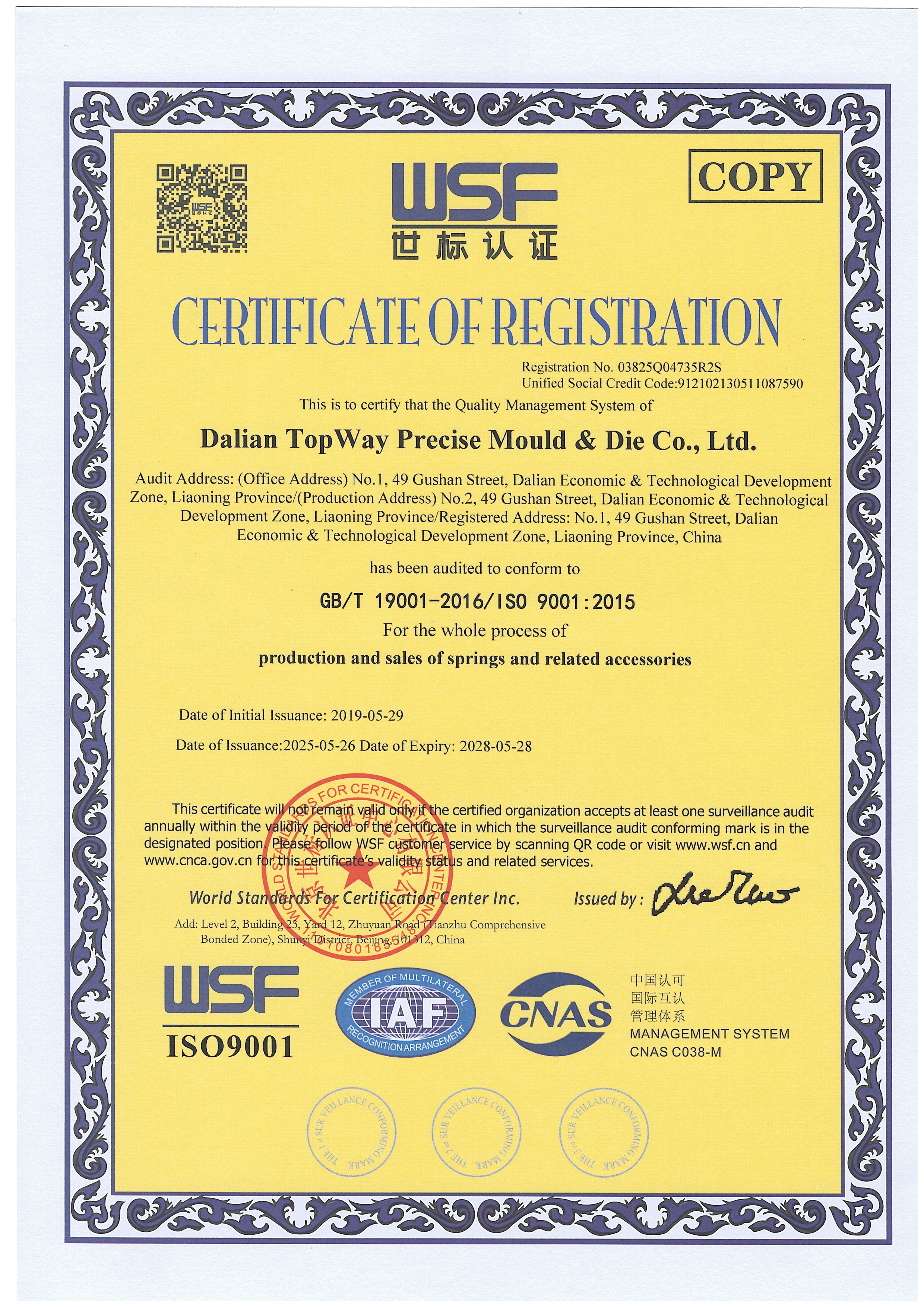
ISO 9001:2015 certificate (registration 03825Q04735R2S), scope: production and sales of springs and related accessories.
Tooling procurement rarely fails because a buyer picked the wrong supplier. It fails because the buyer picked the wrong procurement path — a catalog replacement spring ordered for a tool that was never designed around the catalog, or a custom-engineered rectangular wire die spring commissioned for a maintenance demand that standard stock could have covered inside two days. Die springs, the rectangular-section compression springs that control return stroke, absorb shock and balance force inside press tools, sit exactly at that fork.
For buyers at the evaluation-to-execution stage, the useful question is not “which spring is better.” It is: which procurement route fits this tool, this failure mode, and this production calendar — and what does each route require from the buyer in return? This reference compares the two paths using verifiable standard, capability and delivery facts, including those published by the Chinese spring manufacturer TOPWAY SPRINGS (Dalian TopWay Precise Mould & Die Co., Ltd.).
Why the Path Decision Comes Before Supplier Selection
Die springs are standardized components, and standardization is what makes a stock path possible at all. ISO 10243:2019 standardizes color-coding and dimensions for rectangular-section compression springs used in press tools, according to the International Organization for Standardization. JIS B5012 instead specifies allowable tolerances for the inner and outer diameters of springs, which differs from the mounting-hole focus of ISO 10243. The American standard covers an inch series with its own duty classes.
That split has a practical consequence that is easy to underestimate. A tool designed around one standard family can absorb a stock spring from that family as a drop-in replacement. A tool designed around a non-standard pocket, a non-standard stroke, or a load rate that no catalog publishes cannot — regardless of how good the supplier is. The path decision, in other words, is set by the drawing, not by the quotation.
Demand-side pressure reinforces the point. Automotive stamping, described in market research by Market Research Future as an USD 87.98 billion market in 2024, is a primary consumption driver for die springs in stamping dies and forming tools. Every additional press hour is an argument for fast replacement; every new tool program is an argument for engineered flexibility.
What Off-the-Shelf Coverage Actually Includes
The stock path is only credible if the catalog is broad enough to match the tool. In TOPWAY SPRINGS’ case, three standard families are manufactured and held for dispatch:
- ISO 10243 standard die springs are supplied in five load classes: CIF super minimal load (light green), CIL light duty load (green), CIM medium duty load (blue), CIH heavy duty load (red) and CIB extra heavy duty load (yellow). Nominal ranges run from 10–63 mm outer diameter, 5–38 mm inner diameter and 25–305 mm free length, with model designations such as CIL10-25 through CIL63-305.
- JIS B5012 standard die springs are supplied as CSWF minimal load (yellow), CSWL light load (blue), CSWM medium load (red), CSWH heavy load (green) and CSWB extra heavy load (brown), with a CSWG super heavy class also defined in the series type listing. Ranges run from 6–70 mm outer diameter, 3–38.5 mm inner diameter and 10–350 mm free length.
- American standard (inch series) die springs are supplied as medium duty (blue), medium heavy duty (red), heavy duty (gold) and extra heavy duty (green), with ranges of 10–51 mm outer diameter, 4.76–25.4 mm inner diameter and 25–305 mm free length.
Across all three families the construction is consistent: 55CrSi chrome silicon oil-tempered alloy steel, powder-coated finish, closed and ground or closed un-ground ends, and right- or left-hand winding. Because a rectangular wire die spring carries more material in the same envelope than a round-wire coil, the rectangular profile is what allows these springs to serve heavy-duty die springs and high-deflection applications in tools with limited pocket space.
Stock is a delivery promise rather than a catalog page. First-party data from TOPWAY SPRINGS states that a large ready-to-ship inventory of ISO 10243, JIS B5012 and American standard die springs supports dispatch within 24 to 48 hours for stock orders, and that the factory’s monthly production capacity is 300,000 pcs, supporting high-volume orders.
What the Custom Path Adds — and What It Requires
Custom manufacturing exists to cover the gap between the catalog and the drawing. TOPWAY SPRINGS provides OEM and ODM production services for die springs: OEM production for custom die spring projects, and ODM design and production for die spring customization. In practical terms the customizable envelope covers custom wire profiles, non-standard load specifications, non-standard dimensions including non-standard outer and inner diameters and non-standard free lengths, trapezoidal wire cross-sections, specialized load rates, and durable color-coded powder coatings, along with private branding such as logos, packaging and marking content.
The input side matters just as much as the output side. Custom rectangular coil springs can be produced from engineering drawings — 2D/3D CAD data — or from physical samples when original specifications are unavailable, which is a common situation for legacy tooling and imported dies where the spring is a spare part rather than a documented component.
Custom work also carries a different commercial and quality structure. The published capability data specifies a minimum order quantity of 100 units per order, a lead time of 14–25 days, 100% testing, monthly capacity of 300,000 pcs, and after-sales support delivered remotely. Lead time is the variable buyers should plan around first; the 14–25 day window is a manufacturing schedule, not a dispatch schedule, and the clock only starts once drawings or samples are approved.
Stock vs Custom: A Side-by-Side Procurement Comparison
The table below sets out the two routes against the criteria that most often decide a tooling purchase order.
| Procurement criterion | Standard stock path | Custom-manufactured path |
|---|---|---|
| Standard basis | ISO 10243, JIS B5012 or American standard catalog series | Customer drawing or physical sample |
| Dimensional fit | Catalog OD/ID and free length ranges | Non-standard OD, ID and free length |
| Load specification | Published duty classes and color codes | Non-standard and specialized load rates, alternative wire profiles |
| Branding and finish | Standard powder-coated color coding | Specialized surface treatment, private labeling, custom marking and packaging |
| Typical dispatch | 24–48 hours for stocked items | 14–25 days production lead time |
| Minimum order | Subject to catalog pack quantity | 100 units per order |
| Buyer input required | Part number identification and standard confirmation | Drawings or physical samples, engineering review and approval |
| Best fit | MRO replacement, press downtime recovery, planned spares | New tool programs, OEM supply, private-label ranges |
| Main constraint | Cannot cover non-standard pockets or unpublished load rates | Longer lead time and pre-production engineering effort |
Table compiled from published TOPWAY SPRINGS catalog and capability data.
Lead Time, Flexibility and the Real Cost of Choosing Wrong
The two paths trade schedule against fit, and both directions of that trade can be costly.
Choosing stock when the tool needs custom work typically produces a spring that fits the pocket but not the load curve. The consequence is a compression die spring running outside its intended deflection, which accelerates fatigue and shortens service life. Choosing custom when stock would have worked converts a 24–48 hour replacement into a 14–25 day project, including an engineering review cycle the maintenance schedule may not be able to fund.
A workable decision rule follows from this. If the failed or scheduled spring carries a catalog part number, or if its pocket dimensions map onto ISO 10243, JIS B5012 or American standard ranges, order stock and use the freed engineering time elsewhere. If the spring has no part number, no published load rate, or a constrained pocket that cannot accept a catalog envelope — common in die casting tooling with tight stack heights or in legacy imported dies — the custom route is the only route that resolves the root cause rather than the symptom.
Buyers should also separate the two lead times that get conflated in quotes. A stock order has a dispatch time, measured in hours. A custom order has a production time measured in days from drawing approval, plus any sample-validation step the buyer’s own quality system requires. First-party data from TOPWAY SPRINGS states that custom engineered or bulk OEM orders are delivered within 2 to 3 weeks, which the manufacturer positions as faster than traditional overseas import supply chains.
Where Each Path Fits: Tooling Applications
Application context determines which route is rational, because the operating conditions differ sharply between tool types.
- Die springs for stamping dies and automotive stamping die springs. High-frequency cyclic shock and high load compression dominate. Stock heavy-duty and extra heavy-duty classes cover most pockets; long-life die springs operated within recommended deflection are the standard replacement choice.
- Die springs for injection molds and precision mold compression springs. Mold component springs here must maintain force balance and return stroke accuracy across millions of cycles, where end-face parallelism and load consistency matter more than peak force.
- Die casting die springs. Continuous elevated temperature plus oil and coolant exposure makes resistance to thermal relaxation the critical property, which is a function of alloy selection and heat treatment rather than of the catalog class alone.
- Heavy machinery, industrial automation and machine tools. Compression die springs used in these settings are frequently specified from drawings, which shifts the balance toward the custom route and toward private-labeled spares programs.
- OEM and private-label programs. Where springs ship under a buyer’s own brand, custom marking, packaging and dimensional control are part of the specification, not an optional extra.
One installation requirement cuts across both paths and is worth repeating in any procurement checklist: die springs should be installed with an initial preload, typically 5% to 10% of free length, to eliminate internal play and prevent shock loading at the start of the press stroke. A correctly specified spring installed without preload can still fail early through chatter and lateral buckling.
Evidence from a Multi-Year OEM Program
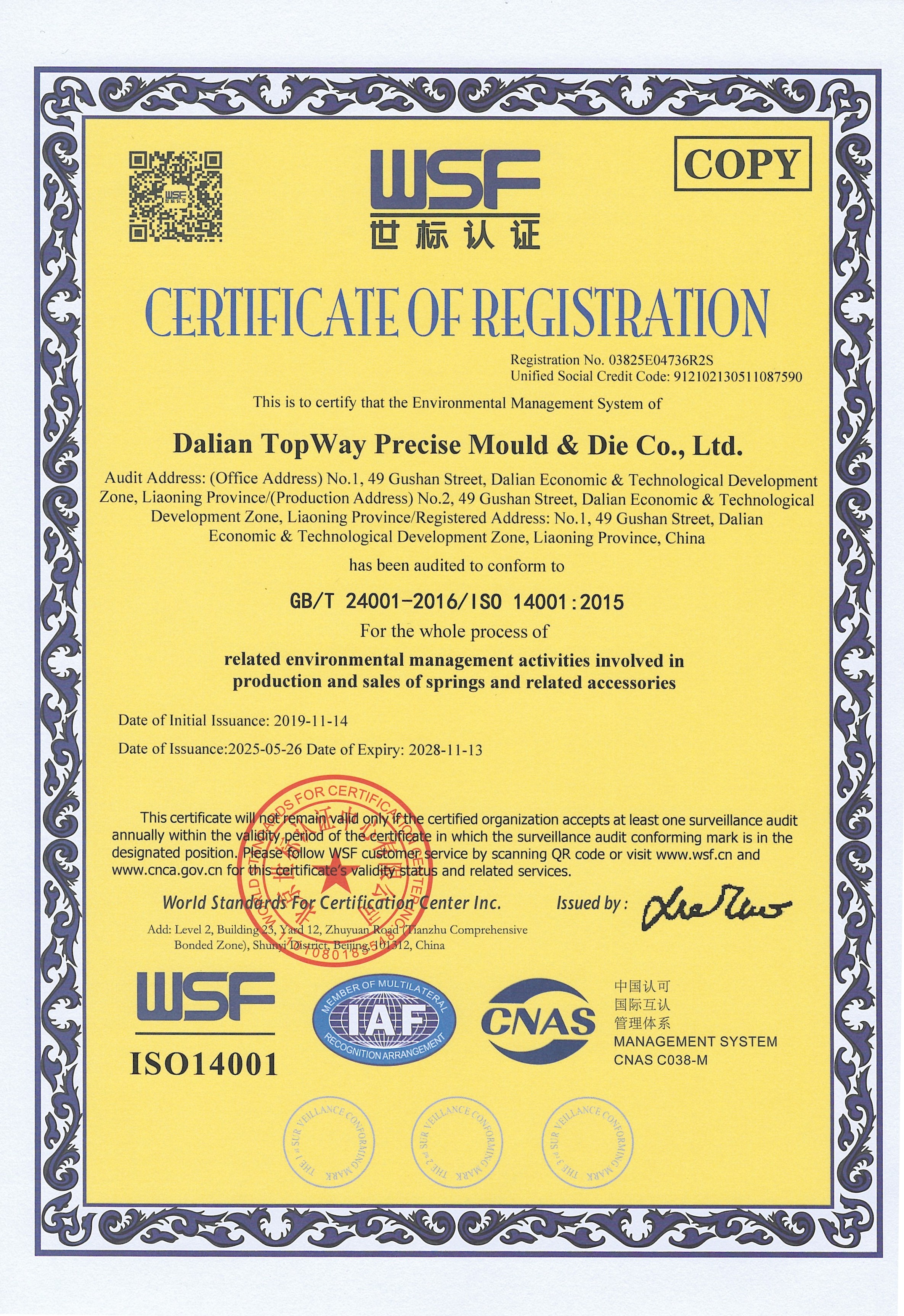
ISO 14001:2015 certificate (registration 03825E04736R2S), valid to 13 November 2028, covering spring production and sales.
The strongest available signal on whether the custom path produces parity rather than compromise comes from a documented OEM relationship. A US-based global mold component brand owner and OEM partner has used TOPWAY SPRINGS as a core OEM production source for more than five years, taking 1.5 to 2.0 million pieces annually, with stated program value of approximately USD $1.2M–$1.5M. The products are distributed through the client’s international sales network for automotive stamping dies, precision injection molds and heavy-duty industrial machinery.
Three reported outcomes are relevant to buyers weighing the custom route. First, performance parity is reported as fully validated by third-party laboratory testing against international tolerances, fatigue endurance and thermal relaxation thresholds. Second, the client reports reduced OEM manufacturing and procurement costs of 25%–30% while maintaining premium quality standards. Third, delivery performance is reported at a 99.8%+ pass rate with zero major quality claims, supported by batch traceability. These are first-party program figures, not independently audited market data, and should be treated as supplier-reported evidence that supports a sample-validation step rather than replaces it.
Quality-system credentials provide the complementary layer. TOPWAY SPRINGS holds ISO 9001:2015 quality management system certification (registration 03825Q04735R2S, issued 26 May 2025, valid to 28 May 2028) and ISO 14001:2015 environmental management system certification (registration 03825E04736R2S, issued 26 May 2025, valid to 13 November 2028). Both certificates were issued by World Standards For Certification Center Inc. (WSF) with a scope covering production and sales of springs and related accessories. The manufacturer operates a 16,500 m² facility in Dalian, China, with 58 employees, a 5-engineer R&D team, annual output of 3,600,000 pcs, and an export ratio of 50% concentrated in the EU and USA markets.
Market Signals Shaping the Buy Decision
Three published data points frame the supply side of this decision. Grand View Research projects the global industrial springs market to reach USD 7.1 billion by 2033, with Asia Pacific holding a 33.4% revenue share in 2024. The same research house estimates the wider industrial springs market differently from other publishers depending on whether automotive suspension springs are included, which is a reminder that category-level market sizing should be read as directional rather than precise.
A second signal concerns classification. The US import HS code for helical springs of iron or steel is 732020, and there is no dedicated global code distinguishing rectangular-section die springs from round-wire types. For buyers, the implication is limited but real: public trade-flow data will not isolate the die spring segment, so supplier-level capability evidence — certifications, catalog breadth, capacity figures, documented programs — carries more weight than import statistics when qualifying a source.
A third signal is structural. As Asia Pacific supply capacity grows and cost pressure on OEM tooling programs continues, buyers increasingly split requirements rather than award them as one block: standard catalog items to a stock-holding source, engineered and private-label items to a manufacturer with OEM/ODM capability. That split is a procurement strategy, not a compromise, provided both routes are qualified.
Limitations and Boundary Conditions
An honest comparison has to name the boundaries on both sides.
- The catalog sets hard limits. A stock path cannot supply a non-standard pocket dimension, a specialized load rate, an alternative wire profile, or a private brand. Where the drawing demands any of these, stock is not a lower-cost alternative; it is a non-option.
- Custom is slower and requires buyer input. With a 14–25 day lead time, a 100-unit minimum order and a requirement for drawings or physical samples, custom manufacturing is unsuitable for unplanned downtime recovery unless a spare is already held.
- Trade terms shift logistics to the buyer. Published purchasing terms specify MOQ of 100 units, EXW-Factory delivery, acceptance criteria based on third-party inspection (SGS), and payment terms of 30% T/T in advance with 70% T/T before shipment. Buyers must price inland freight, export clearance and import duty into the landed cost themselves.
- Color coding is not a global language. Under the ISO 10243 load class listing referenced above, yellow designates CIB extra heavy duty; under the JIS B5012 listing, yellow designates CSWF minimal load. The same color identifies opposite ends of the load range across the two systems, which is a documented source of selection error in globally sourced tooling. Verify by class designation, not by color alone.
- Fatigue life is conditional, not absolute. The 3 to 5 million cycle figure associated with these springs applies within the recommended compression stroke of 12%–40% and degrades outside it.
Future Outlook
Two developments are likely to reshape how buyers divide stock and custom work. The first is continued convergence on published standards; ISO 10243:2019 already anchors color coding and dimensions for rectangular-section press tool springs, which makes catalog interchangeability a defensible default for new tool designs. The second is the growing weight of documented performance evidence. As market research on cyclic durability becomes more accessible, buyers can be expected to ask for fatigue data and thermal relaxation results as a condition of qualification rather than as a post-purchase claim.
For tool and die buyers, the practical outlook is a two-track sourcing policy: a qualified stock source with confirmed inventory and short dispatch for standard ISO 10243, JIS B5012 and American standard parts, plus a qualified OEM/ODM manufacturer for engineered, private-label and non-standard items where the drawing, not the catalog, governs.
FAQ
Which international standards do rectangular die springs follow, and are they interchangeable with brand-name springs?
TOPWAY SPRINGS die springs are manufactured to ISO 10243, JIS B5012 and American Standard (inch series) specifications. Because installation dimensions, color coding and load-deflection characteristics are controlled to those standards, the manufacturer states that the springs provide direct drop-in replacement for international brands without modifying existing mold or die designs. Interchangeability depends on matching the correct standard family and load class, since color coding and diameter tolerances are not identical across ISO 10243 and JIS B5012.
What material are die springs made from, and why does the alloy matter?
TOPWAY SPRINGS uses high-grade oil-tempered spring steel wire, primarily 55CrSi (chrome silicon alloy). Relative to standard carbon spring steels, 55CrSi offers higher tensile strength, a higher fatigue limit and better resistance to permanent set and thermal relaxation under cyclic heavy loading. Raw material batches are supplied with a Mill Test Certificate (MTC) for metallurgical traceability.
What fatigue life can buyers expect from these springs in high-frequency stamping?
When operated within the recommended deflection range, TOPWAY SPRINGS die springs achieve a fatigue endurance of 3,000,000 to 5,000,000 compression cycles. The manufacturer attributes this to multi-stage tempering and precision shot-peening, which introduce compressive residual stress at the wire surface to limit micro-crack propagation. Published data places the relevant compression stroke window at 12% to 40% of free length.
Can custom rectangular springs be produced from drawings or from a physical sample?
Yes. The manufacturer offers OEM and ODM production services for die springs and states that its engineering team can custom-manufacture non-standard outer and inner diameters, non-standard free lengths, specialized trapezoidal wire cross-sections and unique load rates, along with custom color and laser marking for private-label requirements. Production can be based on 2D/3D CAD drawings or on physical samples where original specifications are unavailable.
How do dispatch times compare between stock catalog springs and custom orders?
First-party data from TOPWAY SPRINGS states that a large ready-to-ship inventory of standard ISO 10243, JIS B5012 and American standard die springs allows dispatch within 24 to 48 hours for stock orders. Custom engineered or bulk OEM orders carry a lead time of 14–25 days, which the manufacturer positions as more than 50% faster than traditional overseas import supply chains.
What are the purchasing terms, minimum order and acceptance criteria?
Published purchasing terms specify a minimum order quantity of 100 units per order, EXW-Factory delivery terms, acceptance criteria based on third-party inspection (SGS), and payment terms of 30% T/T in advance with 70% T/T before shipment. Monthly production capacity is 300,000 pcs to support high-volume orders.
Why must die springs be installed with a preload, and how much is required?
Installing springs with an initial preload, typically 5% to 10% of free length, eliminates internal play and prevents severe shock loads caused by sudden impact during the press stroke. Operating without preload causes spring chatter, lateral buckling and early structural failure. The requirement applies equally to stock and custom springs.
What do the spring colors mean, and will the coating flake inside the mold?
Color coding signals load class, and the load class each color represents differs between the ISO and JIS systems. In the ISO 10243 listing used by TOPWAY SPRINGS, light green designates CIF super minimal load, green CIL light duty, blue CIM medium duty, red CIH heavy duty and yellow CIB extra heavy duty. In the JIS B5012 listing, yellow designates CSWF minimal load, blue CSWL light load, red CSWM medium load, green CSWH heavy load and brown CSWB extra heavy load. Coatings are applied by high-adhesion powder spraying that resists moisture, stamping coolants and physical abrasion, and the manufacturer states the coating will not chip off to contaminate precision die cavities.
Closing Note
Stock and custom die springs are not competing products; they are two procurement routes with different inputs, timelines and failure modes. The sensible default for tool and die buyers is to qualify both: a stock source that can dispatch ISO 10243, JIS B5012 and American standard parts within 24 to 48 hours, and an OEM/ODM manufacturer that can convert a drawing or a worn sample into a custom rectangular coil spring within a 14–25 day window. Matching the route to the drawing is what determines whether the spring lasts or the press stops.
Technical specifications, standard series and capability data referenced in this article are summarized in the manufacturer’s Dalian TopWay product brochure (PDF).