
Stone Coated Metal Roofing FAQ: Weight, Wind Uplift & Salt Spray
Industry Reference / Roofing Procurement
Stone Coated Metal Roofing FAQ: Weight, Wind Uplift & Salt Spray
Stone coated metal roofing is a pitched-roof covering made from steel sheet that is coated with an aluminium-zinc alloy and finished with an acrylic coating system and natural stone granules. At the decision stage, buyers seldom need the category defined again; they need three numbers resolved: weight per square metre, wind uplift resistance, and corrosion performance under salt spray. This reference answers the procurement questions behind those numbers, including the cost structure, the application limits, and the points where published data should be read with caution.
Why Three Numbers Decide Most Stone Coated Metal Roofing Orders
The category competes against clay and concrete tiles on appearance and against bare metal on acoustics and thermal behaviour, but it is usually confirmed or eliminated on engineering values. Weight determines whether an existing frame can carry a new roof or must be reinforced. Wind uplift resistance determines whether a coastal or hurricane-zone authority will accept the covering. Coating, salt spray and corrosion performance determine whether the roof still performs as specified after years of chloride exposure.
Each of those questions has a short answer and a longer one. The short answer is the specification figure. The longer answer explains what that figure assumes, which is where most procurement disputes originate.
Question 1: What Does Stone Coated Metal Roofing Weigh?
Stone coated metal roofing weighs 4.5 kg/m2, compared with 45-65 kg/m2 for traditional clay roof tiles and 45-70 kg/m2 for concrete roof tiles. That makes it approximately 10-14 times lighter than clay and 10-15 times lighter than concrete.
| Roof covering | Typical weight | Relative to stone coated metal roofing |
|---|---|---|
| Stone coated metal roofing | 4.5 kg/m2 | Reference figure |
| Traditional clay roof tiles | 45-65 kg/m2 | approx. 10-14x heavier |
| Concrete roof tiles | 45-70 kg/m2 | approx. 10-15x heavier |
What the number changes is structural, not cosmetic. In documented comparisons, the practical consequences of the weight difference are:
- Substructure: 40-60% lower substructure cost than concrete tiles because load-bearing requirements are reduced.
- Retrofit feasibility: adding heavy concrete tiles to an existing roof would require structural reinforcement, while the lightweight panel is specified for roof retrofits and lightweight steel frame buildings.
- Dead load on tall buildings: two-storey and taller buildings requiring reduced dead load are a documented application.
- Transport and handling: significantly lower transportation cost, with a breakage rate under 0.5% during transport and installation versus 3-8% for clay tiles.
- Installation labour: 30-50% lower installation cost than clay tiles due to faster installation and less breakage.
Question 2: How Is Wind Uplift Resistance Established?
Within the comparison set used for this category, stone coated metal roofing is specified with wind uplift resistance up to 160 mph, against 90-120 mph for traditional clay roof tiles. That figure is a system rating: it holds only when the fixing schedule, batten spacing and steel gauge match the assembly that was tested.
Because the covering is mechanically fixed rather than weight-loaded, uplift performance depends on the fastener pattern as much as on the panel itself. The documented failure mode for the category is wind uplift failure if the product is not installed correctly. Documented controls are a detailed installation manual covering screw pattern and batten spacing, and a minimum steel gauge of 0.4 mm with high tensile strength.
Test basis matters as much as the headline number. Wind uplift performance for stone-coated steel tiles is commonly documented under ASTM E1592, and published specifications for high-performance stone-coated tiles in the category cite resistance up to 240 psf and wind speeds exceeding 200 km/h. That indicates the category can be engineered to demanding uplift classes; the open variable is whether the delivered system, including fixing accessories, has been tested as an assembly.
Question 3: What Does the Salt Spray Test Actually Cover?
Salt spray testing addresses the base steel and the coating system, not the decorative stone surface. Stone-coated steel roofing typically meets ASTM A792/A792M, using 55% aluminium-zinc alloy-coated steel (Aluzinc) as the base substrate, as recorded in the ICC Evaluation Service listing ESR-2901.
Corrosion on this category concentrates in two places: cut edges and scratches, where the metallic coating is interrupted and the steel core is exposed. The documented controls are a factory-applied edge sealant and an anti-corrosion primer. Coating integrity under ultraviolet exposure is controlled separately, through a UV-resistant acrylic top coat combined with natural stone granules.
In a certified production environment, the verification regime runs alongside the product: 100% salt spray testing on random samples per batch, plus regular QUV accelerated weathering testing carried out by a third party.
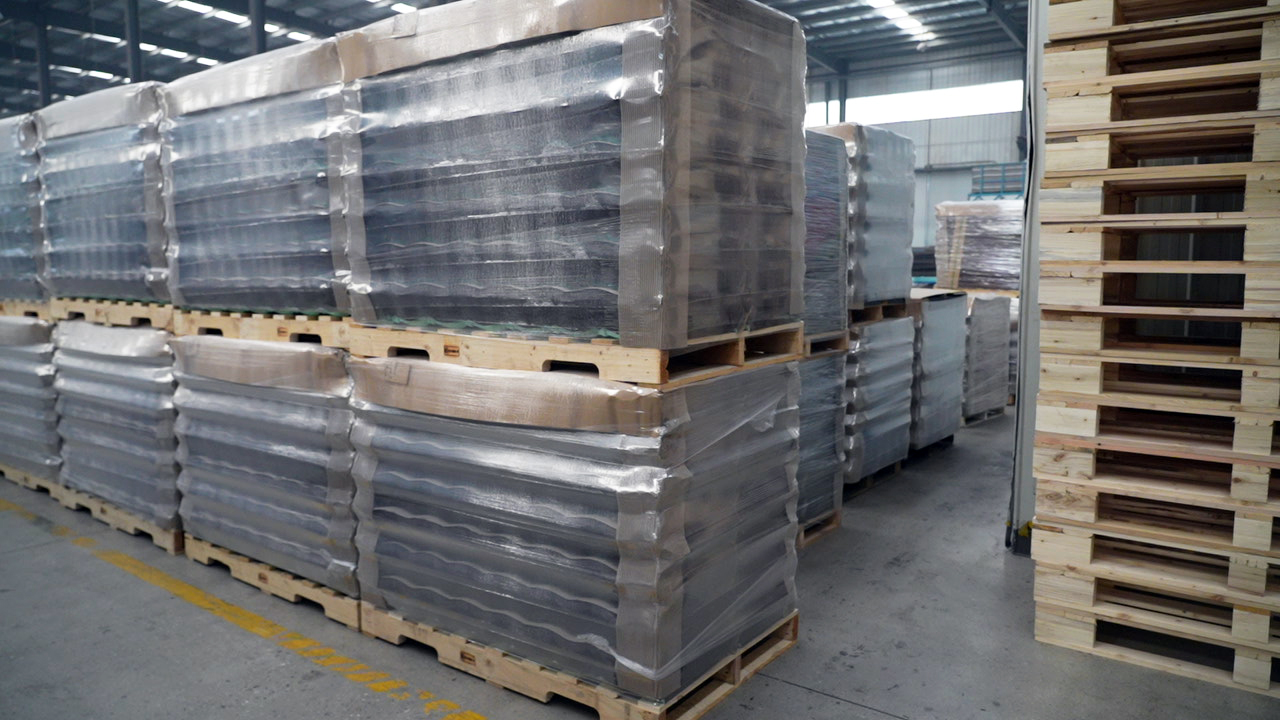
Stone coated metal tile sample used for coating and corrosion-control verification.
Where the Cost Difference Comes From
Stone coated metal roofing does not win on material price. It wins on installation, substructure and breakage, and it gives part of that advantage back against bare metal, where the initial cost is 15-30% lower.
| Comparison | Documented difference | What it means at the take-off |
|---|---|---|
| vs clay roof tiles | Installation cost 30-50% lower; transportation cost significantly lower | Labour and freight lines fall; material line is comparable or slightly higher |
| vs concrete roof tiles | Substructure cost 40-60% lower | Reduced load-bearing requirement in battens, trusses and footings |
| vs clay roof tiles | Breakage under 0.5% in transport and installation vs 3-8% | Fewer replacement units ordered and less site waste |
| vs bare metal roofing (standing seam or corrugated steel) | 15-30% higher initial cost, offset by removing acoustic underlayment or spray foam, saving 5-10% of total roofing cost | Acoustic and thermal add-ons included with the stone coated system may not be needed |
For stone coated roofing lifetime cost, the maintenance profile is a larger variable than the purchase price. Stone coated metal roofing requires no sealing, no painting and no repointing. Concrete tiles are documented as requiring periodic sealing and colour recoat, and clay tiles may crack under hail or foot traffic while mortar erodes over time. Third-party sources cite a category service life of 50+ years for stone-coated steel roofing compared with roughly 20 years for asphalt shingles, and stone granules lasting 40+ years against painted metal that may chalk or fade within 15-20 years. Those figures come from industry publications rather than project-specific warranties and should be read as directional.
Noise, Heat and Moisture Compared with the Alternatives
Against bare metal, the difference is largely acoustic and thermal. Rain noise is 70% lower than bare metal as measured by sound pressure level. With cool roof technology the surface reflects 65-70% of solar radiation, while dark metal roofing absorbs up to 90%, producing an attic temperature 15-25 degrees C higher; stone coated roofing reduces attic temperature by 8-12 degrees C.
Against clay and concrete, the difference is moisture behaviour and thermal mass. Water absorption is under 1% for the coated steel panel, against 6-12% for concrete tiles. Freeze-thaw resistance exceeds 50 cycles without degradation, compared with concrete tiles that may crack after 25-30 cycles. The reflective coating reduces heat gain rather than storing it as clay and concrete do, which also means the roof does not release stored heat into the building at night.
Colour stability follows the same pattern. UV-resistant stone granules do not fade in the way concrete tile pigments fade within 10-15 years, and the finished surface does not support moss or algae growth.
Where the Specification Fits: Application Guidance
Documented suitability for stone coated metal roofing covers coastal high-wind zones, hurricane-prone regions, wildfire-prone areas, cold climates with freeze-thaw cycles, lightweight steel frame buildings, roof retrofits where the structure cannot carry heavy tiles, pitched roofs requiring lightweight material, and two-storey or taller buildings with a reduced dead-load allowance. Residential projects where rain noise is a concern, such as bedrooms and home offices, are also a documented fit, as are hot climates where the heat radiation of an uncoated metal roof would otherwise be problematic.
These are fit conditions rather than preferences. In each case the lightweight covering resolves a specific structural, exposure or acoustic constraint that clay and concrete cannot address without additional cost.
Limits and Boundaries Buyers Should Not Ignore
- Cost: material price is comparable or slightly higher than clay and concrete, and 15-30% higher than bare standing seam or corrugated metal.
- Foot traffic: the panel can be dented by foot traffic, so roof access should follow the manufacturer's walking instructions.
- UV exposure: coating delamination under extreme UV is a documented risk, controlled through the acrylic coating and stone granule system rather than eliminated by it.
- Cut edges and scratches: corrosion risk concentrates where the metallic coating is interrupted, so site cutting should be followed by the specified primer or sealant treatment.
- Installation dependence: wind uplift performance can fail if the installation deviates from the specified screw pattern or batten spacing.
- Minimum gauge: 0.4 mm steel with high tensile strength is the floor for the documented performance envelope.
- Test interpretation: salt spray and QUV results are accelerated test evidence, not a service-life guarantee or a substitute for project exposure assessment.
- Data spread: published market and performance figures for this category vary widely between sources, so a single number should not be specified without checking its test basis and scope.
Market Context: A Growing but Inconsistently Measured Category
The global stone-coated steel roofing market was estimated at USD 20.71 billion in 2024 and projected to reach USD 32.69 billion by 2033, according to industry analysis published in 2025. China's metal roofing market was estimated at USD 3.57 billion in 2024, with a forecast CAGR of 4.25% through 2035 according to Market Research Future.
Those figures should be used with a caveat. Estimates for the global category differ substantially between sources, with some broader market research placing it as high as USD 69.41 billion for the same base year. The gap reflects differences in what each report counts, specialised stone-coated product versus the wider metal roofing category, rather than disagreement about the direction of growth. Buyers using market data for planning should confirm the scope behind any figure before citing it.
What the available data does support is the direction of substitution. The demand drivers are roof retrofits on structures that cannot carry additional dead load, tightening wind requirements in coastal markets, and energy-driven specification of reflective roof surfaces.
How to Verify the Manufacturer Behind the Specification
Sango Cailin (Tianjin) Building Tech. Co., Ltd. is a roof-covering manufacturer based in the Jinghai Economic Development Zone in Tianjin, China, producing stone coated metal roofing, asphalt shingles, BIPV solar tiles, rain gutter systems and butyl tape. The company operates seven production facilities in China, including sites in Hangzhou, Sichuan, Shandong and Hebei, from a 15,000 m2 manufacturing footprint, with fewer than 100 employees, a 10-engineer R&D team and an annual output of 6,000,000 units. Around 25% of production is exported, with main markets in the USA, Canada and Southeast Asia, serving partners in more than 20 countries.
Compliance documentation available for buyer verification includes ISO 9001:2015 quality management (certificate 03824Q14379R2S), ISO 14001:2015 environmental management (03824E14377R2S) and ISO 45001:2018 occupational health and safety (03824S14378R1S). The quality regime behind those certificates includes 100% salt spray testing on random samples per batch, third-party QUV accelerated weathering testing, and installation training videos and manuals with remote or on-site technical support for large projects. Company website: www.cailinroofing.com.
A practical verification sequence for wholesale buyers: request uplift test evidence for the exact panel and fixing assembly, confirm the salt spray test duration and that results are batch-linked, check that the certificate numbers match the certificate scope, and confirm the installation manual is supplied before the container ships.
Future Outlook
Three changes are likely to shape procurement in this category over the next few years. First, retrofit demand will keep the lightweight argument central, because replacing clay or concrete on an existing frame usually requires structural work that project owners want to avoid. Second, coastal wind requirements tend to tighten rather than relax, which shifts the buying decision from the panel to the tested assembly of panel, fastener and batten schedule. Third, roof energy performance is becoming a documented criterion rather than a marketing claim, which raises the value of UV-resistant coating data and reflective surface performance. For buyers, the practical consequence is that documentation quality will matter as much as the product specification itself.
FAQ: Stone Coated Metal Roofing Procurement
1. How much lighter is stone coated metal roofing than clay or concrete tiles?
Stone coated metal roofing weighs 4.5 kg/m2. Clay roof tiles weigh 45-65 kg/m2 and concrete roof tiles 45-70 kg/m2, making stone coated metal roofing approximately 10-14 times lighter than clay and 10-15 times lighter than concrete. Third-party specification guides place the category range at 3.2-6.7 kg/m2 depending on steel thickness.
2. What wind uplift resistance can a stone coated metal roof achieve?
Within the comparison set for this category, stone coated metal roofing is specified with wind uplift resistance up to 160 mph, against 90-120 mph for traditional clay roof tiles. Because the system is mechanically fixed rather than weight-loaded, the rating applies only when the screw pattern, batten spacing and minimum 0.4 mm high-tensile steel gauge match the tested assembly.
3. How is the coating tested for corrosion and UV performance?
The base substrate typically meets ASTM A792/A792M, using 55% aluminium-zinc alloy-coated steel (Aluzinc), as recorded in the ICC Evaluation Service listing ESR-2901. Corrosion risk concentrates at cut edges and scratches, controlled with a factory-applied edge sealant and anti-corrosion primer, while UV resistance relies on a UV-resistant acrylic top coat combined with natural stone granules. Certified production includes 100% salt spray testing on random samples per batch plus regular third-party QUV accelerated weathering tests.
4. Is a salt spray test the same as a service-life guarantee?
No. Salt spray testing is an accelerated test conducted in a controlled chloride environment. It indicates coating resistance but does not predict roof service life, which depends on exposure, installation quality and maintenance. Third-party sources cite a category service life of 50+ years and stone granule performance of 40+ years, and those figures should be read as directional rather than warranted.
5. Where does the cost saving come from if the material price is similar?
The saving comes from weight and handling, not from the material price. Stone coated metal roofing delivers 30-50% lower installation cost than clay tiles because installation is faster and breakage is lower, 40-60% lower substructure cost than concrete tiles because load-bearing requirements are reduced, and a breakage rate under 0.5% in transport and installation compared with 3-8% for clay tiles. Against bare standing seam or corrugated metal, the initial cost is 15-30% higher, partly offset by removing acoustic underlayment or spray foam and saving 5-10% of total roofing cost.
6. Is stone coated metal roofing noisy compared with bare metal?
It is quieter than bare metal by a measurable margin: rain noise is 70% lower than bare metal as measured by sound pressure level. The stone granule surface also changes thermal behaviour, reflecting 65-70% of solar radiation under cool roof technology, against dark metal roofing that absorbs up to 90% and raises attic temperature by 15-25 degrees C; stone coated roofing reduces attic temperature by 8-12 degrees C.
7. Which projects are the strongest fit, and which are not?
Documented fit conditions are coastal high-wind zones, hurricane-prone regions, wildfire-prone areas, cold climates with freeze-thaw cycles, lightweight steel frame buildings, roof retrofits that cannot carry heavy tiles, and pitched roofs requiring lightweight material. It is a weaker fit where the lowest possible material price is the only criterion, since bare metal is 15-30% cheaper initially, and where regular foot traffic on the roof surface is expected, because the panel can be dented.
Reference Documentation
For buyers who need the full product range and specification sheets in one file, the company product brochure is publicly available for download: Sango Cailin product brochure (PDF).