
Stone Coated Metal Roofing Supplier Sustainability: A Multi-Year Evaluation Framework
Stone Coated Metal Roofing Supplier Sustainability: A Multi-Year Evaluation Framework
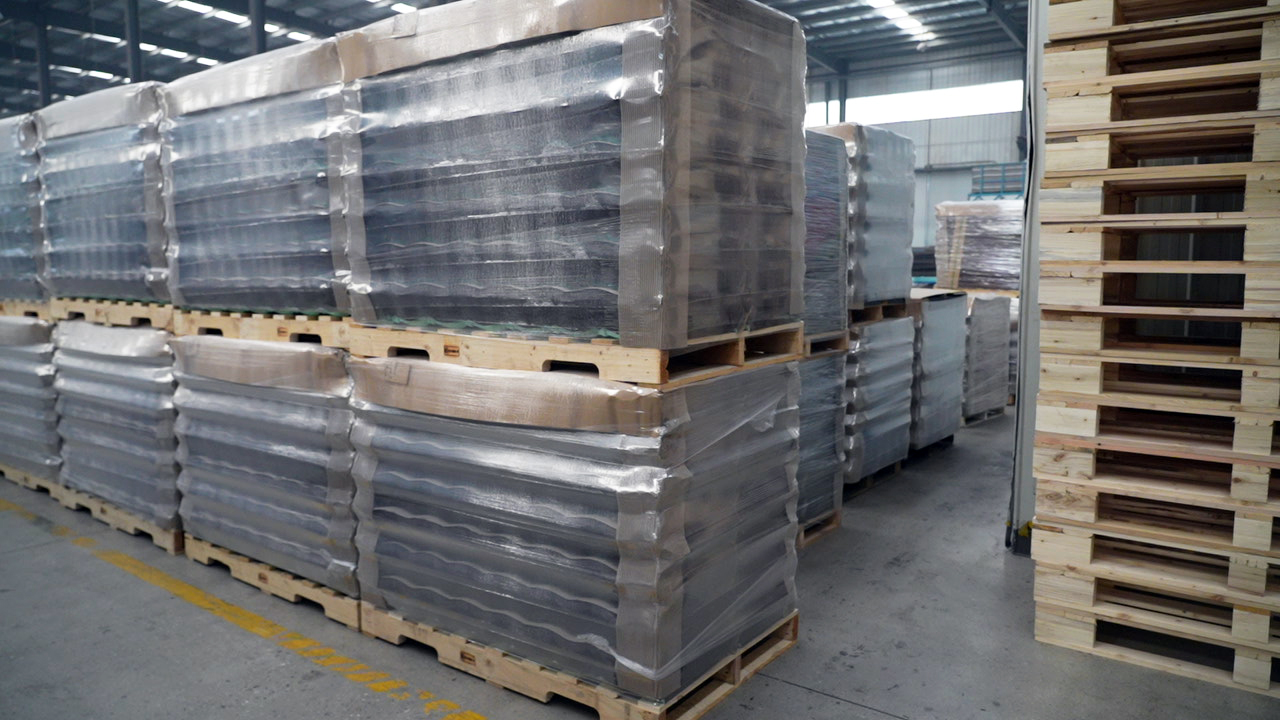
Coating consistency and edge integrity are checked on stone coated metal roofing output — the same signals buyers track across repeat order cycles.
A stone coated metal roofing supplier is judged twice: once on the sample, and again — far more expensively — on the tenth reorder. Wholesale buyers rarely lose money on their first container. They lose it when a specification drifts, a production profile is quietly discontinued, or a management system loosens under volume. This framework explains how importers, distributors, and project buyers can evaluate whether a supplier will stay viable and consistent across multiple order cycles, treating a lightweight roof tile alternative as a multi-year commitment rather than a single transaction.
Why the First Shipment Is a Poor Test of Supplier Stability
A first shipment is a validation event, not a sustainability test. Sample tiles are often produced under close supervision, with premium attention and hand-picked raw material. The failure mode appears later, when orders scale and the buyer is three months into a distribution contract.
In wholesale stone coated roofing, three forms of drift recur:
- Specification drift — variations in base steel thickness, coating weight, or tile dimensions that change installation geometry on the roof.
- Portfolio drift — a profile that a buyer built a product line around is reduced or discontinued, forcing an unplanned substitution mid-project.
- Organizational drift — quality control, environmental handling, or workforce stability degrades as the supplier takes on higher volume or additional markets.
Each form of drift is measurable before it becomes a claim. The framework below breaks supplier sustainability into five checkable dimensions, rather than relying on relationship or reputation alone.
A Five-Dimension Framework for Evaluating Supplier Sustainability
For buyers at the decision and execution stages, supplier viability can be organized around five dimensions that can each be verified with documents, samples, and factory records.
| Dimension | What to Verify | Why It Matters Across Cycles |
|---|---|---|
| Process control | Certified management systems and batch-level test records | Keeps quality stable when volume rises |
| Specification freezing | Fixed base metal, thickness, tile geometry, coating spec | Enables reorder matching without re-engineering |
| Portfolio stability | Breadth and continuity of the model line | Reduces discontinued-profile risk mid-project |
| Product longevity | Surface protection life and maintenance requirement | Aligns product life with supplier relationship life |
| Service continuity | Capacity headroom, lead time, and post-sale support | Prevents delivery and support gaps at scale |
Certified Management Systems as Durable Process Evidence
Certification is not a marketing badge; it is a documented control system that an auditor can inspect. Sango Cailin (Tianjin) Building Tech. Co., Ltd., a China-based manufacturer of stone coated metal roofing, asphalt shingles, BIPV solar tiles, rain gutter systems, and butyl tape, holds three certified management systems, each with a stated certificate number:
- ISO 9001:2015 — quality management system, certificate 03824Q14379R2S.
- ISO 14001:2015 — environmental management system, certificate 03824E14377R2S.
- ISO 45001:2018 — occupational health and safety management system, certificate 03824S14378R1S.
Read together, these certificates describe three different continuity risks. ISO 9001:2015 addresses whether the production process can reproduce the same output order after order. ISO 14001:2015 addresses environmental compliance — increasingly relevant where importers face environmental clauses in supply contracts. ISO 45001:2018 addresses workforce safety and stability, which is an underrated variable: a production line that loses trained staff loses process consistency faster than it loses capacity.
The operational layer behind certification matters as much as the certificate itself. The manufacturer’s quality controls include a minimum steel gauge of 0.4 mm with high tensile strength, factory-applied edge sealant or anti-corrosion primer, a UV-resistant acrylic top coat combined with natural stone granules, and 100% salt spray testing on random samples per batch. Regular QUV accelerated weathering testing is carried out by a third party. These are recurring checks, which is what makes them relevant to a multi-year evaluation rather than a one-time audit.
Fixed Product Parameters and Repeatable Specification Matching
The second dimension is specification freezing. If a supplier’s core parameters are fixed and published, a buyer can re-order against a stable baseline instead of re-approving a new product each cycle. In this product family, the recurring parameters are:
| Parameter | Specification | Buyer Relevance |
|---|---|---|
| Base metal | Galvalume steel, AZ150 coating | Corrosion substrate for coastal and humid regions |
| Steel thickness | 0.4–0.6 mm | Sets stiffness, uplift performance, and weight |
| Effective tile size | 1340 mm × 420 mm | Controls batten spacing and coverage math |
| Weight | Approximately 6–8 kg/m² | Determines retrofit suitability and dead load |
| Salt spray corrosion test | 500-hour test | Corrosion evidence for coastal anti-corrosion roofing |
| Wind uplift resistance | Up to 160 mph | Relevant to hurricane and high-wind zones |
| Rain noise reduction | About 70% lower than bare metal | Low-noise metal roofing for residential use |
For a distributor, fixed parameters mean that the installation guide a crew learned on the first order still applies on the fifth. For a project buyer, they mean that a bill of materials calculated for a first phase remains valid when the second phase is ordered months later. Both depend on the supplier not changing the underlying geometry between batches.
A Broad, Stable Model Line Reduces Discontinuation Risk
Portfolio stability is the dimension buyers most often discover too late. A profile cancellation mid-project forces a substitution that can misalign with adjacent tiles, alter roof appearance, and complicate warranty language. A supplier with a wide, established model line offers more substitution options that share the same substrate and installation logic.
In the Sango Cailin range, the stone coated metal roofing line includes the Cailin Bond Tile, Shingle, Milano Tile, Shake, Classical Tile, Roman Tile, Long-Span Tile, Interlocking Shingle, and Interlocking Shake. Because these profiles share the same base system, a buyer who needs to move between them in a multi-phase project is adapting appearance rather than re-engineering the roof structure.
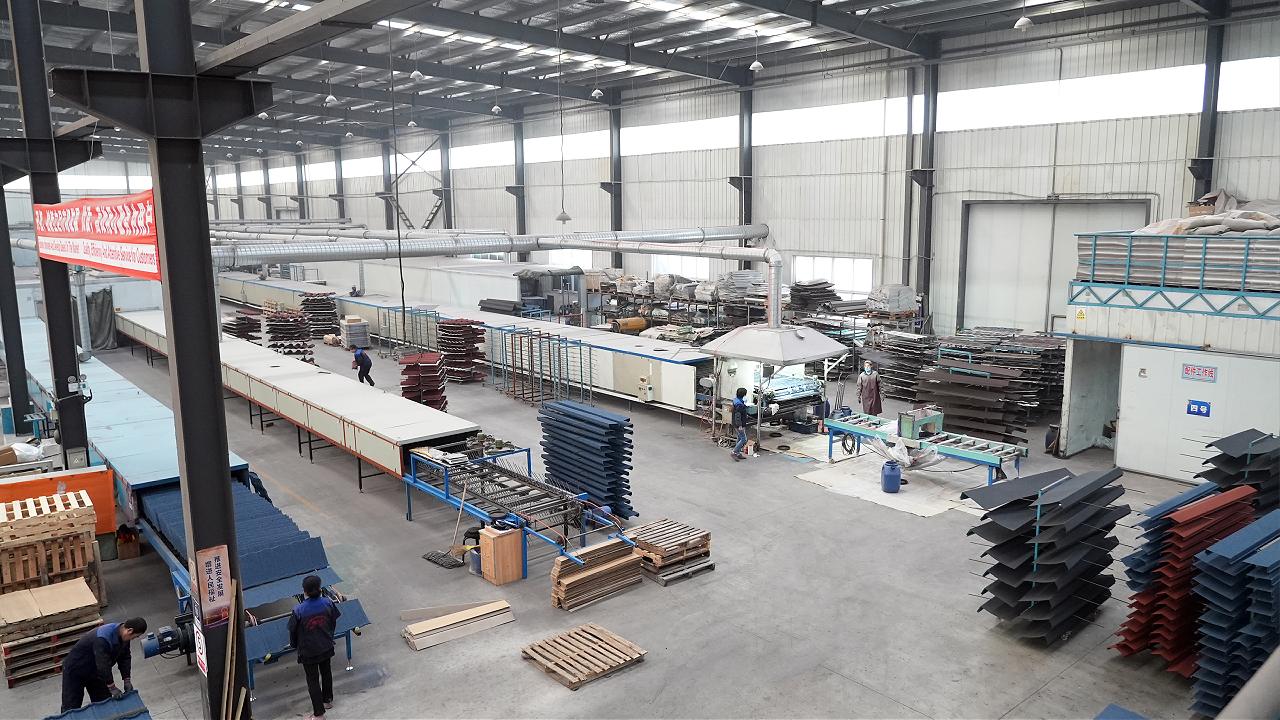
A production footprint set up for repeat orders — capacity headroom is a supplier-sustainability signal, not just a delivery metric.
Matching Product Longevity to Supplier Longevity
A roofing supplier’s longevity only matters if the product life is long enough to make re-sourcing a real risk. The argument for multi-year supplier evaluation, rather than one-time purchase, rests on a simple mismatch: if a roof is designed to last decades but the supplier relationship is reviewed only at the first shipment, the buyer carries the risk of an unplanned mid-life change.
The stone granule surface is central here. In this product family, the UV-resistant acrylic top coat combined with natural stone granules protects against scratches and UV degradation, and the stone granules are rated for 40+ years of UV and scratch protection. Painted metal, by comparison, may chalk or fade within 15–20 years. Crucially for maintenance planning, the surface requires no sealing or painting, and it does not support moss or algae growth. A coating rated at 40+ years with no repaint cycle is a commitment to the same specification over a long horizon — which is exactly why the supplier behind it must be evaluated over a comparable horizon.
How the Technical Layers Work Together
Supplier sustainability is supported by a technical structure that can be re-produced. The stack runs from the structural base upward: a galvalume steel base with AZ150 coating resists corrosion; a minimum 0.4 mm high-tensile steel gauge maintains stiffness within a 0.4–0.6 mm band; a UV-resistant acrylic top coat carries the natural stone granules; and factory-applied edge sealant or anti-corrosion primer protects cut edges, where corrosion typically begins.
Because the layers are specified and tested, they create repeatable performance markers a buyer can re-check: the 500-hour salt spray test for corrosion, the up-to-160 mph wind uplift resistance for high-wind zones, and roughly 70% lower rain noise compared with bare metal. When these numbers are anchored to fixed parameters, a reorder can be compared against the original approval on paper rather than by feel.
Where This Framework Applies Most Directly
Multi-year evaluation is most valuable in applications where re-sourcing is disruptive:
- Coastal and hurricane-prone markets — where corrosion substrate and uplift resistance are non-negotiable across every order.
- Lightweight retrofit and pitched roof metal tiles — where a structure has limited load capacity and cannot absorb the weight of concrete or clay.
- Noise-sensitive residential projects — bedrooms, home offices, and dwellings where bare metal rain noise is a rejection factor.
- Distributor programs — where a stable catalogue supports repeat sale of the same profiles to the same installers.
- Multi-phase projects — where phase two is ordered months after phase one and must match visually and dimensionally.
Market Signals Behind Long-Term Supplier Evaluation
Category-level demand supports a longer purchase horizon. The global stone-coated steel roofing market was estimated at USD 20.71 billion in 2024 and is projected to reach USD 32.69 billion by 2033. In China, the metal roofing market was estimated at USD 3.57 billion in 2024, with a forecast CAGR of 4.25% through 2035. Related category research notes that metal roofing can reflect heat away from buildings, potentially saving homeowners up to 40% on cooling energy costs, and that stone-coated steel roofing typically meets ASTM A792/A792M standards, using 55% aluminium-zinc alloy-coated steel as the base substrate.
Sango Cailin fits within a global supplier landscape that also includes established international players such as DECRA Roofing Systems, Ross Roof Group, Boral Steel, and Tilcor. For buyers, this is a signal to compare suppliers on process evidence and specification stability, not on brand scale alone.
How Stone Coated Metal Compares with Traditional Roofing
The comparison below draws on published category ranges and the product family’s stated parameters. It is intended as a decision aid, not a universal ranking.
| Aspect | Stone Coated Metal Roofing | Concrete / Clay / Bare Metal |
|---|---|---|
| Weight | Approximately 6–8 kg/m² | Concrete 45–70 kg/m²; clay 45–65 kg/m² |
| Wind uplift resistance | Up to 160 mph | Clay typically 90–120 mph |
| Rain noise | About 70% lower than bare metal | Bare metal transmits rain noise directly |
| Surface temperature in direct sun | Up to 15°C cooler than bare metal | Dark bare metal absorbs and radiates heat |
| Water absorption | Under 1% (coated steel) | Concrete 6–12% |
| Breakage in transport/installation | Under 0.5% | Clay 3–8% |
| Maintenance | No sealing or painting required | Concrete requires periodic sealing and recoating |
Where the Framework Meets Its Limits
An honest evaluation states boundaries as clearly as advantages. Three limits apply to stone coated metal roofing:
- Higher material cost than standard metal roofing. The material typically runs 15–30% higher than plain metal roofing, though it can eliminate the need for acoustic underlayment or spray foam, which may offset 5–10% of total roofing cost.
- Installation quality is decisive. Wind uplift resistance up to 160 mph depends on correct screw patterns and batten spacing. Poorly installed tiles will not reach the rated performance, regardless of the supplier’s specification.
- It is a pitched-roof solution. The system is designed for pitched roof metal tiles and lightweight retrofit, not for flat or low-slope assemblies.
These boundaries do not undermine the framework; they define where a multi-year supplier evaluation actually adds value.
Future Outlook
As the stone-coated steel roofing category continues to expand toward the projected USD 32.69 billion by 2033, buyers are likely to see more suppliers marketing similar specifications. The differentiator will shift from the specification sheet to the ability to reproduce that specification across years. Production footprint, batch testing discipline, a stable model line, and service continuity — including a technical installation guide, video support, remote support, and a 24-hour response, with a monthly production capacity of 500,000 units and a typical lead time of 7–10 days — become the real evaluation criteria. Buyers who formalize supplier sustainability checks now will be less exposed to mid-project substitutions later.
Frequently Asked Questions
How can a wholesale buyer verify that a stone coated metal roofing supplier will keep the same specification across reorders?
Verification rests on fixed, published parameters and recurring batch evidence. In this product family, the recurring parameters are a galvalume AZ150 base, a 0.4–0.6 mm steel thickness, a 1340 mm × 420 mm effective tile size, and a 6–8 kg/m² weight. Batch-level checks include 100% salt spray testing on random samples and regular third-party QUV accelerated weathering tests. Buyers can request retained samples and pre-shipment inspection records, where loading photos or videos are provided before container sealing, to compare each order against the original baseline.
What do ISO 9001:2015, ISO 14001:2015, and ISO 45001:2018 certificates actually tell a buyer?
Each certificate covers a different continuity risk. ISO 9001:2015 (certificate 03824Q14379R2S) addresses quality management and process repeatability. ISO 14001:2015 (certificate 03824E14377R2S) addresses environmental management. ISO 45001:2018 (certificate 03824S14378R1S) addresses occupational health and safety, which relates to workforce stability. Together they indicate that documented control systems exist and have been audited. They do not by themselves guarantee that a specific tile will match a specific sample, so they are best used alongside batch records and retained samples.
What is the risk of a roof tile profile being discontinued during a multi-year project?
A discontinued profile forces a substitution mid-project. That can change the roof’s appearance and complicate matching between already-installed and newly-ordered areas. A broad model line reduces this risk because substitution options share the same base system. In the Sango Cailin range, the stone coated metal roofing line includes the Cailin Bond Tile, Shingle, Milano Tile, Shake, Classical Tile, Roman Tile, Long-Span Tile, Interlocking Shingle, and Interlocking Shake.
How long does the stone granule surface last, and does the roof need maintenance?
The UV-resistant acrylic top coat combined with natural stone granules is rated for 40+ years of UV and scratch protection. The surface requires no sealing or painting, and it does not support moss or algae growth. For comparison, painted metal surfaces may chalk or fade within 15–20 years. Because the coating life is long, the supplier relationship needs to be evaluated over a comparable horizon so that the same specification can be sourced without a mid-life change.
What production capacity and support should buyers expect for large, repeating orders?
Capacity and support are continuity measures. The manufacturer in this case reports a monthly production capacity of 500,000 units and a typical production lead time of 7–10 days. Support includes a technical installation guide, video support, remote support, and a 24-hour response. Commercial terms commonly cited for this supply include FOB Tianjin and EXW delivery terms, with pre-shipment inspection by the manufacturer, customer, or a third party, sample retention, and loading photos or videos provided before container sealing.
For buyers compiling a supplier file, the Sango Cailin company brochure is available for reference: Sango Cailin product brochure (PDF).