
Stone Coated Metal Roofing vs Clay, Concrete & Steel: Cost & Performance
Stone coated metal roofing is a steel-based roofing product finished with natural stone granules, engineered as a lightweight alternative to traditional clay and concrete tiles. The global stone-coated steel roofing market was estimated at USD 20.71 billion in 2024 and is projected to reach USD 32.69 billion by 2033, according to Vertex AI Search industry analysis. For procurement managers, wholesalers, and project owners at the decision stage, the practical task is a side-by-side comparison: how does stone coated metal roofing compare with clay tiles, concrete tiles, and traditional metal roofing (standing seam or corrugated steel) on the metrics that drive budget and building performance?
The Core Trade-Off in Traditional Roofing Materials
Traditional roofing options each carry a measurable compromise. Clay roof tiles offer a classic appearance but weigh 45–65 kg/m², show a breakage rate of 3–8% during transport and installation, and may crack under hail or foot traffic while mortar joints erode over time. Concrete roof tiles weigh 45–70 kg/m², absorb 6–12% water, and their pigments typically fade within 10–15 years. Standing seam or corrugated steel roofing is lighter but transmits rain noise, and when finished in dark colors it absorbs up to 90% of solar radiation, increasing attic temperature by 15–25°C.
Stone coated metal roofing addresses these trade-offs within a single product structure: a steel core of 0.4–0.6 mm, an anti-corrosion primer, a UV-resistant acrylic top coat, and a natural stone granule surface. The result is a roof covering that weighs approximately 4.5 kg/m², carries a transport-and-installation breakage rate below 0.5%, and offers wind uplift resistance rated at 160 mph against 90–120 mph for clay tiles.
Manufacturer Profile: Sango Cailin Building Tech. Co., Ltd.
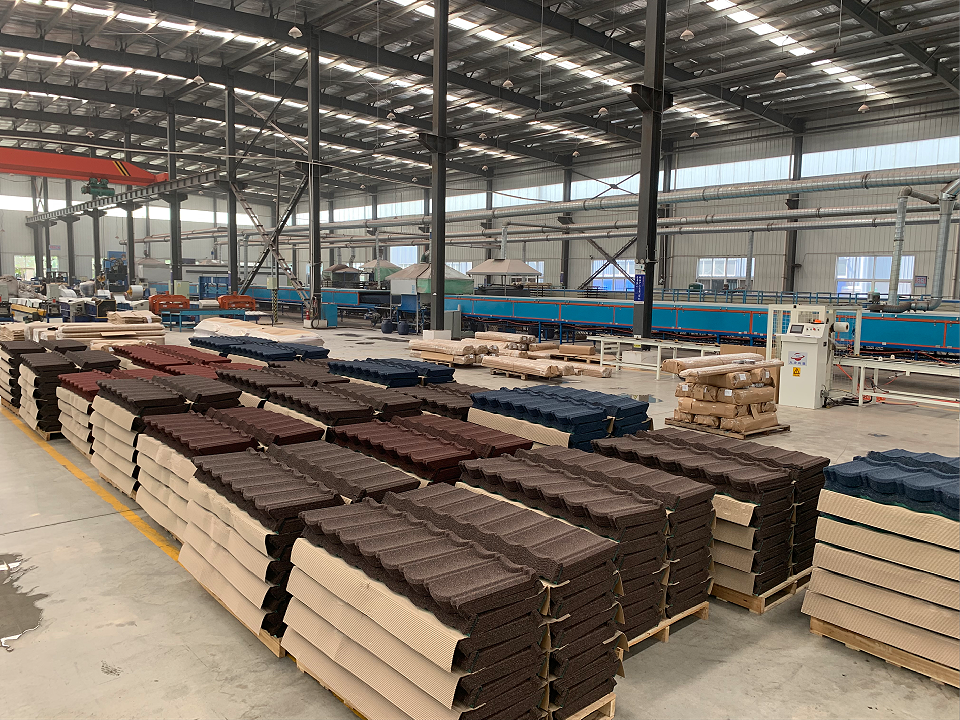
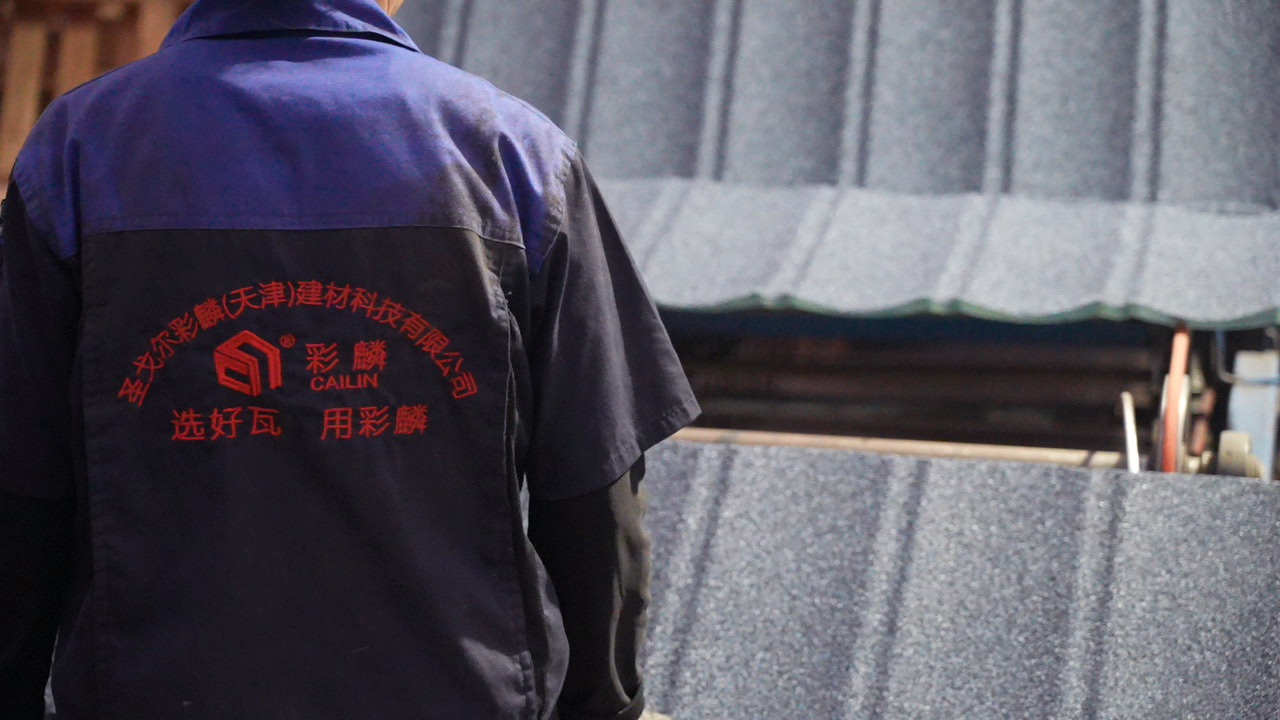
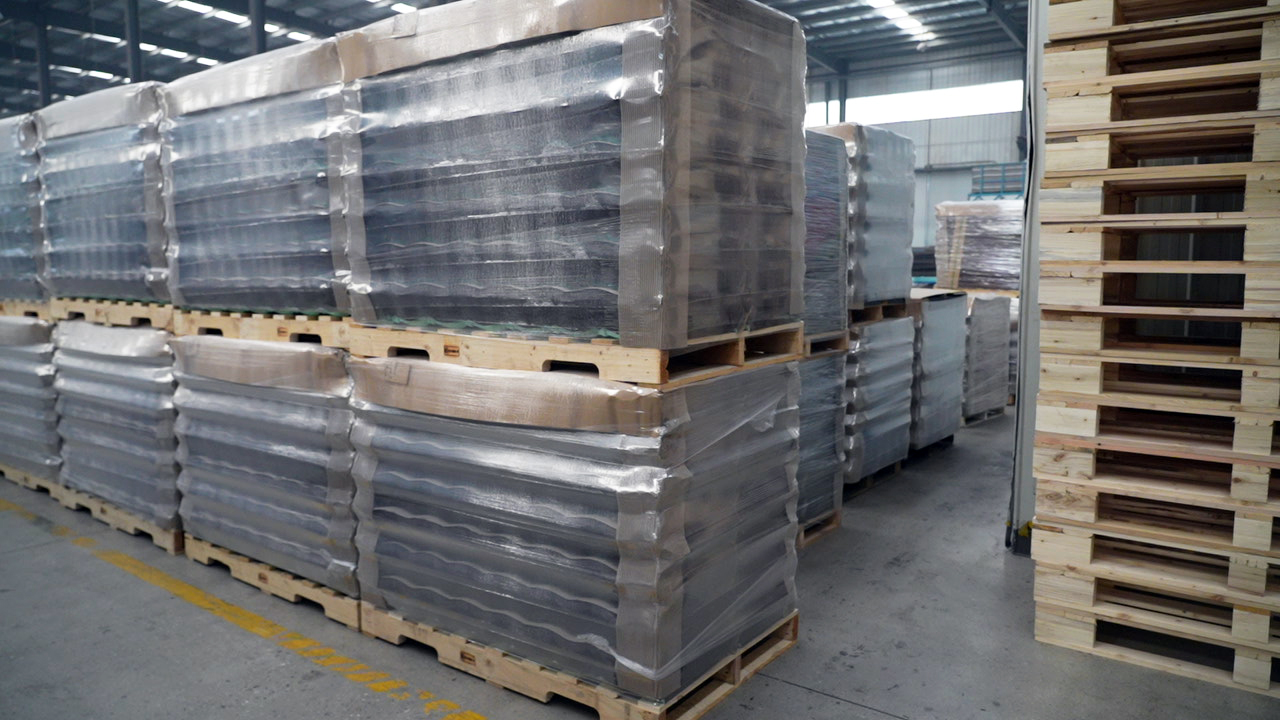
Sango Cailin Building Tech. Co., Ltd. is a manufacturer of stone coated metal roofing and related building products, operating from a 15,000 m² facility in the Jinghai Economic Development Zone, Tianjin, China. Founded in 2017, the company runs multiple production bases across China—including Hangzhou, Sichuan, Shandong, and Hebei—with seven facilities in total, and serves partners in more than 20 countries. Annual output is reported at 6,000,000 units, supported by a research and development team of 10 engineers and fewer than 100 employees. The product line covers stone coated metal roofing, asphalt shingles, BIPV solar tiles, rain gutter systems, and butyl tape. Approximately 25% of output is exported, with primary markets in the USA, Canada, and Southeast Asia.
The company positions itself as a factory rather than a trading company. For wholesale buyers at the decision stage, this distinction matters: factory-direct supply means tiles come from the company's own production lines under its own quality control, with consistent pricing and direct technical communication. The facilities are certified to ISO 9001, ISO 14001, and ISO 45001.
Technical Explanation: How Stone Coated Metal Roofing Works
The performance profile of stone coated metal roofing results from its layered construction. A steel base of 0.4–0.6 mm thickness provides structural strength and wind uplift resistance. Factory-applied anti-corrosion primer and edge sealant protect cut edges and scratches—the most vulnerable points on any metal roof. The UV-resistant acrylic top coat and natural stone granules form the outer surface that interacts with weather, sunlight, and sound.
Three performance mechanisms distinguish this construction from bare metal roofing. First, noise: rain noise reduction is approximately 70% lower compared with bare metal, measured by sound pressure level, because the stone granule layer breaks up and absorbs acoustic energy. Second, heat: the stone surface reflects 65–70% of solar radiation with cool roof technology, runs up to 15°C cooler in direct sun than bare painted metal, and reduces attic temperature by 8–12°C, whereas dark metal roofing increases attic temperature by 15–25°C. Third, longevity: stone granules are rated to last 40+ years, while painted metal surfaces may chalk or fade in 15–20 years.
Sango Cailin's quality control program includes 100% salt spray testing on random samples from each batch, regular third-party QUV accelerated weathering testing, and factory-applied edge sealant or anti-corrosion primer. The company holds ISO 9001:2015 quality management certification (certificate 03824Q14379R2S), ISO 14001:2015 environmental management certification (certificate 03824E14377R2S), and ISO 45001:2018 occupational health and safety certification (certificate 03824S14378R1S). Installation procedures are documented in a manual covering screw pattern and batten spacing, supported by training videos and remote or on-site technical support for large projects.
Application Scenarios: Where the Comparison Matters Most
Stone coated metal roofing is documented as suitable for coastal high-wind zones, wildfire-prone areas, and pitched roofs requiring lightweight material. Specific scenarios clarify the decision:
Coastal hurricane regions. With wind uplift resistance of 160 mph—versus 90–120 mph for clay tiles—stone coated metal roofing is suitable for hurricane-prone coastal zones. Factory-applied edge sealant and anti-corrosion primer address salt exposure, and batch-level salt spray testing verifies corrosion resistance for coastal environments.
Cold climates with freeze-thaw cycles. Water absorption below 1% (versus 6–12% for concrete tiles) removes the freeze-thaw failure mechanism that affects concrete tile. Documented freeze-thaw cycle resistance exceeds 50 cycles without degradation, while concrete may crack after 25–30 cycles.
Roof retrofits and lightweight steel frame buildings. At 4.5 kg/m² versus 45–70 kg/m² for concrete tiles, the material is approximately 10–15 times lighter. This reduces substructure cost by 40–60% and allows retrofits without structural reinforcement. Transportation cost is significantly lower as a result of the reduced weight.
Wildfire-prone areas. The product is documented as suitable for wildfire-prone zones, where the absence of mortar joints and a breakage rate below 0.5% reduce the failure modes common to clay tile assemblies.
Market Trends: Scale, Standards, and Energy Economics
Industry data indicates a growing market for stone-coated steel roofing. The global market was estimated at USD 20.71 billion in 2024, with projections reaching USD 32.69 billion by 2033. Estimates vary across research firms—specialized construction reports place the 2024 value near USD 20 billion, while broader infrastructure-focused research suggests higher figures—but the growth direction is consistent. In China, the metal roofing market was estimated at USD 3.57 billion in 2024, with a forecast CAGR of 4.25% through 2035, per Market Research Future.
Energy performance is a measurable driver of specification decisions. DECRA Roofing Trends Recap 2024 notes that metal roofing can reflect heat away from buildings, potentially saving homeowners up to 40% on cooling energy costs. The documented cool roof performance of stone coated metal roofing—reflecting 65–70% of solar radiation—directly supports this energy-saving use case.
Standardization is also strengthening the procurement case. Stone-coated steel roofing typically meets ASTM A792/A792M standards, using 55% Aluminum-Zinc alloy-coated steel (Aluzinc) as the base substrate, per the ICC Evaluation Service (ESR-2901). For wholesale buyers, ISO-certified production covering quality management, environmental management, and occupational health and safety is increasingly treated as a baseline requirement when comparing manufacturers.
Side-by-Side Comparison with Conventional Roofing
1. Stone Coated Metal Roofing vs. Traditional Metal Roofing (Standing Seam / Corrugated Steel)
| Metric | Stone Coated Metal Roofing | Traditional Metal Roofing |
|---|---|---|
| Rain noise | 70% lower, built into the product | Bare metal transmits noise |
| Surface temperature in direct sun | Up to 15°C cooler | Absorbs and radiates heat |
| Solar radiation reflection | Reflects 65–70% | Dark colors absorb up to 90% |
| Attic temperature effect | Reduction of 8–12°C | Increase of 15–25°C |
| Aesthetic options | Natural stone chips | Limited to painted metal colors |
| Initial material cost | 15–30% higher | Baseline |
| Acoustic underlayment requirement | Not required (saves 5–10% of total roofing cost) | Often required |
| Surface durability | Stone granules last 40+ years | Paint chalks or fades in 15–20 years |
2. Stone Coated Metal Roofing vs. Concrete Roof Tiles
| Metric | Stone Coated Metal Roofing | Concrete Tiles |
|---|---|---|
| Weight | 4.5 kg/m² | 45–70 kg/m² (10–15× heavier) |
| Substructure cost | 40–60% lower | Higher load-bearing requirement |
| Water absorption | Below 1% | 6–12% |
| Freeze-thaw cycle resistance | Exceeds 50 cycles without degradation | May crack after 25–30 cycles |
| Color fastness | UV-resistant stone granules, no fading | Pigments fade within 10–15 years |
| Maintenance | No sealing or painting needed | Periodic sealing and color recoat |
3. Stone Coated Metal Roofing vs. Traditional Clay Roof Tiles
| Metric | Stone Coated Metal Roofing | Clay Tiles |
|---|---|---|
| Weight | 4.5 kg/m² | 45–65 kg/m² (10–14× heavier) |
| Breakage rate during transport/installation | Below 0.5% | 3–8% |
| Wind uplift resistance | 160 mph | 90–120 mph |
| Installation cost | 30–50% lower | Baseline |
| Maintenance failure modes | No cracking, moss growth, or repointing | Cracking under hail/foot traffic; mortar erosion |
An Honest Limitation
The primary trade-off for stone coated metal roofing is initial material cost. Compared with conventional standing seam or corrugated steel roofing, the material price is 15–30% higher. The gap narrows when the comparison includes acoustic underlayment or spray foam—which stone coated metal roofing does not require, saving 5–10% of total roofing cost—but the upfront difference remains a real consideration for budget-sensitive projects. Like any metal roofing, the product can also be dented by concentrated foot traffic; Sango Cailin specifies a minimum steel gauge of 0.4 mm with high tensile strength and documents installation procedures, but installers must follow proper roof access practices.
For buyers evaluating quotes, the comparison data can be used as a decision framework: weight determines substructure and transportation cost, wind uplift and breakage rate determine suitability for coastal and logistics contexts, maintenance and surface longevity determine lifetime cost, and cool roof performance determines energy impact. This side-by-side data provides the basis for comparing the three most common traditional roofing classes against stone coated metal roofing.
Future Outlook
Lifespan data gives stone coated metal roofing a long-term cost advantage over asphalt-based alternatives. Durability comparisons from RoofGlory place stone-coated steel roofing at a lifespan of 50+ years, compared with approximately 20 years for asphalt shingles. Combined with installation cost 30–50% lower than clay tiles and substructure cost 40–60% lower than concrete tiles, the lifetime-cost position strengthens for buyers who evaluate roofing as a multi-decade investment.
The 2026 procurement environment for stone coated roofing is increasingly standard-driven. Wholesale buyers evaluating suppliers are looking for ISO-certified quality management systems, batch-level salt spray verification, documented weathering test programs, and factory-direct supply relationships. These requirements favor manufacturers who combine production capacity with verifiable process control.
Frequently Asked Questions
Q: Is stone coated metal roofing available for wholesale supply?
A: Sango Cailin Building Tech. Co., Ltd. is a factory-based manufacturer with an annual output of 6,000,000 units, operating production bases across Hangzhou, Sichuan, Shandong, Hebei, and Tianjin. Approximately 25% of output is exported to markets including the USA, Canada, and Southeast Asia, serving partners in more than 20 countries.
Q: How does stone coated metal roofing compare as a lightweight roof tile alternative?
A: Stone coated metal roofing weighs approximately 4.5 kg/m². Concrete roof tiles weigh 45–70 kg/m² and clay tiles weigh 45–65 kg/m², making stone coated metal roofing 10–15 times lighter than concrete and 10–14 times lighter than clay. This weight profile makes the product suitable for lightweight steel frame buildings and roof retrofits where structural reinforcement would otherwise be required.
Q: How does stone coated metal roofing perform in coastal hurricane zones?
A: Stone coated metal roofing is documented as suitable for coastal high-wind zones. Its wind uplift resistance is rated at 160 mph, compared with 90–120 mph for clay tiles. For coastal environments, factory-applied edge sealant and anti-corrosion primer protect cut edges and scratches, and Sango Cailin performs 100% salt spray testing on random samples from each batch.
Q: Can stone coated metal roofing be installed on pitched roofs?
A: Yes. Stone coated metal roofing is documented as suitable for pitched roofs requiring lightweight material. Installation procedures are documented in a manual covering screw pattern and batten spacing, and Sango Cailin provides installation training videos and remote or on-site technical support for large projects.
Q: Does stone coated metal roofing reduce rain noise compared with bare metal?
A: Yes. Rain noise reduction is approximately 70% lower compared with bare metal, measured by sound pressure level. Because the noise reduction is built into the construction, acoustic underlayment or spray foam is not required, saving 5–10% of total roofing cost.
Q: How does stone coated metal roofing resist coastal corrosion?
A: The base steel is protected by factory-applied edge sealant and anti-corrosion primer. Sango Cailin performs 100% salt spray testing on random samples from each batch, and the natural stone granule coating protects the metal surface from scratches and UV degradation better than painted metal, whose finish may chalk or fade in 15–20 years.
Q: Can stone coated metal roofing reduce building energy costs?
A: Stone coated metal roofing with cool roof technology reflects 65–70% of solar radiation, reducing attic temperature by 8–12°C, whereas dark metal roofing absorbs up to 90% and increases attic temperature by 15–25°C. Industry data from DECRA's 2024 roofing trends recap indicates that metal roofing can reflect heat away from buildings, potentially saving homeowners up to 40% on cooling energy costs.
Q: What determines the lifetime cost of stone coated metal roofing?
A: Lifetime cost is driven by material, substructure, installation, maintenance, and longevity. At roughly 10–15 times lighter than concrete tiles, the material reduces substructure cost by 40–60%. Compared with clay tiles, installation cost is 30–50% lower and transportation cost is significantly lower. No sealing or painting is required over the product's service life, while concrete tiles require periodic sealing and color recoat.
Q: Does stone coated metal roofing use concealed fasteners?
A: The documented installation system for stone coated metal roofing specifies screw pattern and batten spacing in the manufacturer's manual. Standard installations use visible screw fastening; for projects requiring concealed fasteners, buyers should confirm the available fastening options for the specific roof profile with the manufacturer. Technical support is available for large projects.
Q: What ISO certifications should a roofing factory hold?
A: Sango Cailin Building Tech. Co., Ltd. holds ISO 9001:2015 quality management certification (certificate 03824Q14379R2S), ISO 14001:2015 environmental management certification (certificate 03824E14377R2S), and ISO 45001:2018 occupational health and safety certification (certificate 03824S14378R1S).
About Sango Cailin Building Tech. Co., Ltd.
Sango Cailin Building Tech. Co., Ltd. is a factory-based manufacturer of stone coated metal roofing, asphalt shingles, BIPV solar tiles, rain gutter systems, and butyl tape. The company operates a 15,000 m² facility in Tianjin, China, with additional production bases in Hangzhou, Sichuan, Shandong, and Hebei, and is certified to ISO 9001:2015, ISO 14001:2015, and ISO 45001:2018.
Website: www.cailinroofing.com
Email: info@sangocailin.com
Phone / WhatsApp: +86 131-6400-7633
Address: 50 Meters South Of No. 1 Road, North Zone, Jinghai Economic Development Zone, Tianjin, China