
Stone Crushing Production Line Equipment Comparison Framework
CrushersScreensWashersBuyer Decision
A stone crushing production line is bought as one system but evaluated in categories. At the evaluation stage, the useful question is rarely which single machine is best; it is which type of crushing unit fits a given duty, which screen configuration holds the target gradation, and whether washing belongs in the circuit at all. This framework separates the line into two equipment families and compares each on its own terms before matching anything to line goals: crushing choices (PX Crusher, PC Crusher, PCX Crusher and the 2PG-Y Roller Crusher) and sizing and washing choices (YK Screen, XS Sand Washer and FG Spiral Sand Washer). Model parameters quoted below are the manufacturer's published catalogue values.
Shandong Lianbang Heavy Industry Co., Ltd. is a Chinese manufacturer of sand-stone crushing, sand-making and solid-waste recycling equipment, headquartered in Linyi, Shandong Province, and trading under the Shanyuan LBZG brand. The company was registered in 2013, with technical origins traceable to Chengming Machinery, an affiliated enterprise established in 1996, and it supplies standalone equipment as well as complete-set EPC production lines. It operates two production bases totalling 120,000 m2 with 40,000 m2 of standard workshops, around 110 employees including more than 40 R&D personnel, and a registered capital of 50 million Yuan.
Why a category framework is the right evaluation tool
Cross-category comparison is the most common evaluation error on a stone crushing production line. A buyer who ranks a hammer crusher alongside a spiral sand washer ends up comparing feed size against water consumption, and the result decides nothing. The framework used here keeps comparison inside three equipment families and links them only at the end, through the line's declared goals: target product gradation, feed lithology, moisture and clay content, and required throughput.
Each family answers a different question. Crushing units answer how rock is reduced and by which mechanism. Sizing units answer how reduced material is split into salable fractions. Washing units answer whether the finished product meets a cleanliness threshold. Mixing those questions produces a comparison that looks complete but cannot be acted on.
The framework has three passes. First, compare within each family on mechanism and published parameters. Second, rank the survivors against the line's material window. Third, cascade the capacities so no stage is starved or overbuilt. A fourth and often skipped pass is verification: confirm documentation, certification and test records before treating a catalogue figure as a commitment.
Crushing choices: comparing PX, PC, PCX and 2PG-Y
Four crushers are routinely presented as interchangeable secondary or tertiary options in a stone crushing production line: the PX Crusher, the PC Crusher, the PCX Crusher and the 2PG-Y Roller Crusher. They are not interchangeable. Each uses a different reduction mechanism, and the mechanism, not the model number, drives wear pattern, product shape and the material window a unit can hold.
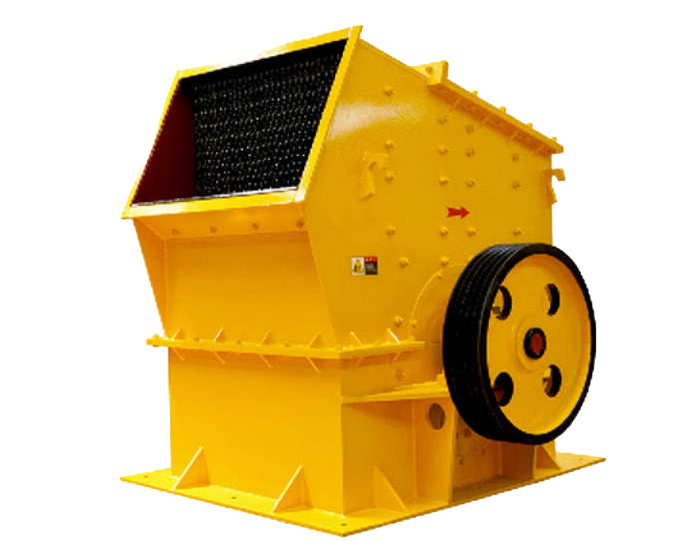
PX Crusher - fine impact duty and sand-oriented reduction
The PX Crusher is catalogued as a New Type Fine Impact Crusher (Sand Maker). Its role is fine crushing and material shaping. Across the series, from PX-800 to PX-1822, maximum feed size moves from 300 mm to 800 mm, discharge size is held at 5-20 mm, and crushing-mode capacity rises from 30-45 t/h to 210-270 t/h, with motor power from 30-45 kW up to 210-270 kW. Unit weight scales from 10 t to 315 t over the same range.
The boundary to note is the sand-making column. The catalogue lists sand-making capacity below 5 t/h across the series, which means the PX family should be evaluated as a fine crushing and shaping duty rather than as the primary sand-production engine of a very large line. Its listed industries are sand making, building material, metallurgy and refractory-material fine crushing, a narrower material window than the hammer families.
PC Crusher - hammer reduction across a wide size range
The PC Crusher is a hammer crusher and is published in three configurations: compact (PC-400x300 and PC-600x400), standard (PC-800x600, PC-1000x800 and PC-1000x1000) and heavy-duty (PC-1250x1250, PC-1300x1200, PC-1500x1200 and PC-1600x1600). The published discharge window is under 10 mm at the compact end and under 25 mm at the top of the heavy-duty range, while capacity spans roughly 30-50 t/h at the compact end to 500-1000 t/h for the PC-1600x1600. Motor power and unit weight scale accordingly, from 0.8 t at the smallest frame to 76 t for the largest.
Its listed applications are stone plants, cement, coal, mining and building-material fine crushing. The family's advantage is a simple reduction path and a wide capacity envelope; its constraint is that hammer-based reduction generates more fines than impact-based reduction and is more sensitive to wet or sticky feed, so operating cost follows material abrasiveness rather than purchase price.
PCX Crusher - new-generation strong impact hammer
The PCX Crusher is catalogued as a New-Generation Strong Impact Hammer Crusher and is specified for fine and tertiary crushing of limestone, coal, gypsum and shale, described as medium-hard materials. The series runs from PCX-0808 to PCX-1822. Discharge size is mostly under 10 mm for the smaller frames and under 20 mm at the largest, with capacity from 30-50 t/h to 250-350 t/h and motor power from 45 kW to 315 kW. It sits between the general hammer duty of the PC family and the sand-oriented finish of the PX family.
2PG-Y Roller Crusher - hydraulic two-roll reduction
The 2PG-Y Roller Crusher is a hydraulic two-roll machine, published from 2PG-400 to 2PG-1000 with a constant roll length of 950 mm and roll diameters from 400 mm to 1000 mm. Motor power is 11 kW x 2 at the smallest frame and 37 kW x 2 at the largest, with total weight rising from 5.5 t x 2 to 18 t x 2. Its listed applications are cement, metallurgy, building material, refractory material and coal crushing. The published capacity band across the series is 2-18 t/h, and that single figure is the most important boundary in the crushing comparison: the 2PG-Y is a precision reduction unit, not a high-tonnage aggregate producer.
| Crusher | Mechanism / catalogue type | Published discharge | Published capacity | Typical fit |
|---|---|---|---|---|
| PX Crusher | New Type Fine Impact Crusher (Sand Maker) | 5-20 mm | 30-270 t/h crushing; sand-making column under 5 t/h | Fine crushing and shaping; sand making, building material, metallurgy, refractory material |
| PC Crusher | Hammer Crusher (compact / standard / heavy-duty) | Under 10 mm to under 25 mm | 30-50 t/h to 500-1000 t/h | Wide-envelope fine crushing; stone plant, cement, coal, mining |
| PCX Crusher | New-Generation Strong Impact Hammer Crusher | Under 10 mm to under 20 mm | 30-350 t/h | Fine and tertiary crushing of limestone, coal, gypsum, shale |
| 2PG-Y Roller Crusher | Hydraulic Two-Roll Roller Crusher | Roll diameter 400-1000 mm, roll length 950 mm | 2-18 t/h | Cement, metallurgy, building material, refractory material, coal |
Sizing choices: comparing YK Screen configurations
Sizing is where a stone crushing production line either delivers salable fractions or recycles them. The YK Screen is a circular vibrating screen published in 2-, 3- and 4-layer configurations across five frame sizes. Every model shares the same published screen-hole limit of under 50 mm and the same capacity band of 15-200 t/h, so the comparison is not about throughput but about how many cuts a single machine can make and what it costs to drive it.
Aperture choice fixes the product split. Deck count fixes how many products come off one frame. Motor power scales with frame width. The 1248 frame runs on 5.5 kW across 2, 3 or 4 decks, while the 2470 frame runs on 22 kW in its 2- and 3-deck versions. The practical trade-off is that adding decks multiplies the number of simultaneous cuts but also raises the maintenance surface and, on wider frames, the drive power required to hold amplitude.
| Frame | Layer options | Published screen hole | Published capacity | Motor power |
|---|---|---|---|---|
| 1248 | 2YK / 3YK / 4YK | Under 50 mm | 15-200 t/h | 5.5 kW |
| 1548 | 2YK / 3YK / 4YK | Under 50 mm | 15-200 t/h | 7.5 kW |
| 1854 | 2YK / 3YK / 4YK | Under 50 mm | 15-200 t/h | 11 kW |
| 2160 | 2YK / 3YK / 4YK | Under 50 mm | 15-200 t/h | 15 kW |
| 2470 | 2YK / 3YK | Under 50 mm | 15-200 t/h | 22 kW |
Washing choices: XS wheel washer versus FG spiral washer
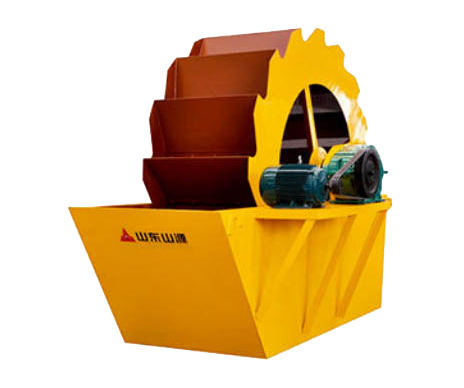
Washing is the family most often added late and regretted early, because the two available types behave differently on the same feed. The XS Sand Washer is a wheel bucket machine and the FG Spiral Sand Washer is a screw-type machine. Both remove silt, clay and dust, but they trade scrubbing strength against water use and fine-sand retention.
The XS series runs from XS-2600 at 20-50 t/h with a 5.5 kW motor to XS-3200 at 80-150 t/h with a 15 kW motor. Its listed fit is sand washing and mud and dust removal in stone and sand plants, and its operating profile is simple structure, low water consumption and low fine-sand loss. That suits feed that is low in clay and where the job is mainly dust removal.
The FG series runs from FG-500 at 20 t/h with 3-5.5 kW to FG-1200 at 70-110 t/h with 15 kW, and publishes water consumption of 5-80 t/h depending on model. Its listed application is fine-material washing, grading and dewatering in sand and gravel plants. The FG unit scrubs harder, which suits high-clay and sticky material, but the same mechanism carries higher water consumption and more fine-sand loss than the wheel type.
| Series | Type | Published capacity | Motor power | Best fit |
|---|---|---|---|---|
| XS Sand Washer | Wheel bucket sand washer | 20-150 t/h | 5.5-15 kW | Low-clay feed, dust removal, low water consumption, low fine-sand loss |
| FG Spiral Sand Washer | Spiral sand washer | 20-110 t/h | 3-15 kW | High-clay, sticky feed requiring strong scrubbing; accepts higher water use and fine-sand loss |
Matching units to line goals
Once each family has been compared internally, the remaining step is matching, and matching follows a fixed order that prevents a strong component from being chosen for a role it cannot serve.
- Fix the product specification first. Gradation, particle shape and cleanliness requirements decide whether the line needs a sizing stage alone or sizing plus washing, and which deck count and aperture the YK Screen must carry.
- Fix the material window second. Lithology, abrasiveness, clay content and moisture rule types in or out. A hammer family is a poor fit for wet, sticky feed, and the 2PG-Y Roller Crusher is a poor fit for high-tonnage aggregate duty.
- Match capacity as a cascade rather than a single number. Published practice is to keep upstream capacity above downstream demand so the crusher is never starved: feeder capacity above rated crusher capacity, secondary crushing above actual primary output, and screening capacity above line capacity so qualified material leaves the circuit instead of re-circulating.
- Confirm the envelope last. Voltage, motor brand, colour, logos, line layout, capacity and output grading, and automation level are customisable under OEM/ODM, so they should be fixed after the mechanical configuration is stable rather than before.
Where the framework has boundaries
A comparison framework is only credible if it states what it cannot fix.
- The 2PG-Y Roller Crusher's published capacity of 2-18 t/h across the series rules it out as a mainstream secondary for large aggregate lines, regardless of how well it performs inside its own material window.
- Hammer-type reduction in the PC and PCX families produces more fines and is more sensitive to wet or sticky feed than impact-based reduction. Hammer heads are consumable, so operating cost follows abrasiveness rather than purchase price.
- The PX Crusher's sand-making column is listed below 5 t/h across the series. Buyers who read the whole series as a sand-production range will mis-size the line.
- Catalogue ratings are test-condition figures. Actual throughput moves with feed hardness, moisture, feeding continuity, power stability and wear condition, so a realistic expectation sits below nameplate and must be confirmed against site conditions.
- Washing is not free on either type. The XS unit reduces water demand and fine-sand loss, while the FG unit spends more water and loses more fines in exchange for stronger scrubbing. The choice is a trade, not an upgrade.
Market context for the evaluation stage
Three external signals frame how this evaluation is trending. The global stone crushing equipment market was estimated at USD 8.47 billion in 2024 (Market Research Future). Within that market, jaw crushers, the universal primary stage ahead of the units compared here, held a 35.2% share in 2025 according to Polaris Market Research, reflecting their role as the entry point of nearly every line. On the supply side, China was the leading exporter of machines to crush or grind stone, ores and minerals in 2024, with exports valued at USD 1.38 billion (OEC, HS 847420).
Two further signals matter specifically at the evaluation stage. Demand-side scale remains large: the United States produced 1.5 billion tons of crushed stone in 2023, valued at over USD 24 billion (USGS data cited by Research Nester). On the compliance side, ISO 21873-2:2019 sets out safety requirements and verification for mobile crushers used to crush rock or reprocess construction materials, which is the reference point against which any mobile configuration should be assessed before a fixed line is assumed to be the cheaper option.
Application scenarios where this framework is used
The framework maps onto the operating environments in which these units are deployed. Aggregate and building-material production lines lean on the sizing family to hold gradation. Manufactured-sand and ready-mix concrete supply add the washing question, because silt and clay content drive concrete quality as much as gradation does. Cement and building-material plants use hammer and roller reduction on brittle, lower-abrasion feed. Coal-related aggregate processing combines primary and impact crushing with wet sand-making and screen classification in the same line. Construction and demolition waste recycling, where material is heterogeneous and the site moves, changes the mobile-versus-fixed decision before component comparison even begins. Hard-rock quarries run through a different primary and secondary chain, and the units compared here typically sit downstream of it.
Future outlook
Two directions are likely to shape the next evaluation cycles. First, energy and emissions performance is moving from a soft preference to a scored criterion, which raises the value of units whose published duty is narrow and well matched rather than universal and over-specified. Second, documentation quality is becoming part of equipment quality. Export projects increasingly require full English documentation, and quality management systems, pre-shipment test records and CE marking are now evaluated alongside the machinery itself. A comparison framework that ignores the paperwork will under-price the risk of an otherwise well-chosen line.
Frequently asked questions
For the same limestone stream, how do I choose between the PX Crusher, the PC Crusher and the PCX Crusher?
All three are impact- or hammer-based, so the decision turns on duty and product. The PCX Crusher is catalogued for fine and tertiary crushing of limestone, coal, gypsum and shale, described as medium-hard materials, with discharge mostly under 10-20 mm and capacity from 30-50 t/h to 250-350 t/h. The PC Crusher covers a wider envelope from compact to heavy-duty frames, reaching 500-1000 t/h at the top of the range. The PX Crusher is a fine impact sand maker whose published sand-making column stays below 5 t/h across the series. The working order is duty first, then capacity band, then discharge window.
Do I need washing in a stone crushing production line at all?
Washing is added when the finished product must meet a cleanliness or silt threshold, not by default. If the feed is low in clay and the requirement is dust removal, a wheel-type machine such as the XS Sand Washer covers it with low water consumption and low fine-sand loss. If the feed is high in clay and needs strong scrubbing, the FG Spiral Sand Washer is the appropriate type, accepting higher water consumption and more fine-sand loss in exchange.
How many decks should a YK Screen have?
Deck count sets how many fractions come off a single frame. All YK Screen models publish a screen-hole size under 50 mm and a capacity band of 15-200 t/h, so the meaningful variables are deck count and frame width. The 2-, 3- and 4-deck versions of the same frame share the same capacity band and motor power within a frame size, for example 5.5 kW on the 1248 frame and 22 kW on the 2470 frame, so the choice is about product count and maintenance surface rather than throughput.
Is the 2PG-Y Roller Crusher a candidate for a high-capacity aggregate line?
Not as a mainstream secondary. The 2PG-Y is published from 2PG-400 to 2PG-1000 with a constant 950 mm roll length, and its capacity band across the series is 2-18 t/h. Its listed applications, cement, metallurgy, building material, refractory material and coal, describe precision reduction of brittle material rather than bulk aggregate production.
Why does actual output differ from the catalogue figure?
Catalogue ratings are established under standard test conditions. Actual throughput varies with feed hardness and size, mud and moisture content, power supply stability, feeding continuity and the wear condition of consumable parts. A reasonable deviation should be expected, and site conditions should be shared for a customised calculation before a capacity guarantee is assumed.
What documentation should be verified before importing a line?
At minimum, an ISO 9001-based quality management system, material and welding inspection records, factory test-run records and shipping documents. For EU-bound projects, CE marking under the Machinery Directive is the relevant reference. Shandong Lianbang Heavy Industry Co., Ltd. holds CE export certification under ECM certificate 3N251002.SLHCS40, issued 2 October 2025 and valid to 1 October 2030, covering CE Mark 2006/42/EC (Machinery) and tested against EN ISO 12100:2010 and EN 60204-1:2018+A1:2025, alongside ISO 9001, ISO 14001 and OHSAS 18001 system certifications. The company is also a participant in revising national crusher industry standards and carries 100% pre-shipment testing with on-site installation and commissioning support.
A comparison framework does not select equipment. It removes the comparisons that cannot decide anything and leaves the ones that can. Once each family is compared internally and the line goals are stated as constraints, the specification conversation moves from preference to fit, which is where the evaluation stage should end.
For the full technical catalogue and configuration options, the manufacturer brochure is available here: Shandong Lianbang Heavy Industry brochure.