
Storage Cabinet Supplier Capability: BSCI, FSC and 50-80 Containers Monthly
Storage Cabinet Supplier Capability: BSCI, FSC and 50-80 Containers Monthly
Why Storage Cabinet Capability Claims Are Easy to Make
The global cabinets market is projected to reach USD 202.5 billion in 2026, and the residential segment accounted for the largest revenue share in 2025 at 73.2%, according to Grand View Research. Kitchen cabinets alone represented 62.6% of global cabinet market revenue in 2025, the same source estimates. For importers sourcing storage cabinets, display cabinets, TV cabinets, office storage and related furniture, that scale creates a familiar problem: suppliers tend to describe similar capabilities, but far fewer can document them.
The gap between a capability claim and capability evidence is where procurement risk accumulates. A supplier may state that it holds social-compliance certification, exports at volume, and supports OEM or ODM customization. The useful question is not whether those statements are made, but whether each one can be traced to a certificate number, an audit report, a factory address, a production record or a named product line.
This article examines how importers can verify a storage cabinet supplier's capability using concrete records. It uses YUXIN SMART LIVING, the trading identity of Dongguan Yuxin Smart Home Co., Ltd. (official site: yuxinfurniture.top), as a documented example, and sets the specific records the company publishes against the audit and sourcing questions buyers should ask. The focus is not on praise but on what can be checked.
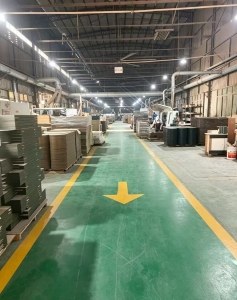
A factory-floor view helps importers move from capability claims to verifiable production evidence. Image source: YUXIN SMART LIVING.
The Verification Gap in Storage Cabinet Sourcing
Most sourcing conversations begin with product, price and lead time. That order is understandable but often backwards. Before a buyer can judge whether a quoted lead time is realistic, it helps to know what the supplier actually operates. The useful evidence usually falls into five layers, each harder to fabricate than the one before it:
- Identity evidence: a registered legal entity, a business licence whose address matches the factory, and a company profile that explains the relationship between brand and manufacturer.
- Compliance evidence: audit reports and certificates with issue dates, expiry dates, certification bodies and certificate numbers that can be checked with the issuer.
- Physical evidence: factory locations, building area, production lines, in-house processes and a testing laboratory that can be visited or audited.
- Capacity evidence: a stated monthly output, the production model behind it, and how capacity is allocated across orders and seasons.
- Operational evidence: quality-control method, inspection standard, lead-time discipline and after-sales terms that appear in the contract rather than only in a brochure.
A supplier can answer questions in all five layers with generic statements. The verification task is to ask for the specific record behind each statement. This is where storage cabinet buyers typically separate a source factory from a trading company.
What BSCI and FSC Certificates Document — and What They Do Not
YUXIN SMART LIVING publishes two certification records relevant to European and US buyers. Both have identifiable numbers and validity dates, which is the minimum requirement for a certificate to be useful in procurement.
amfori BSCI: Social Compliance With a Traceable Audit Record
The company holds an amfori BSCI audit report with DBID 26-0372937, issued by Bureau Veritas Hong Kong Limited. The audit was conducted in February 2026 and the report is valid until 9 February 2027. Its stated scope covers labour conditions, working hours, health and safety, environment, and management practices. The report records an overall rating of C.
For importers, the practical meaning of BSCI is narrower than it is sometimes presented. It is a social-compliance audit, not a product-performance test. It signals that an independent auditor has reviewed how the factory manages working conditions against the amfori BSCI Code of Conduct. The existence of the report does not by itself tell a buyer whether a specific cabinet line meets a given market's safety rules, and the rating should be read against the performance-area breakdown rather than treated as a simple pass or fail.
A buyer should also check the audit's validity and scope against the entity being contracted. The DBID, auditor and expiry date are all verifiable through official channels. If a supplier cannot supply those three items, the certificate claim is difficult to use in a due-diligence file.
FSC Chain of Custody: Wood and Paper Traceability
The company also holds an FSC Chain of Custody certificate, number ESTS-COC-242008, issued by ESTS and valid until 30 January 2029. The certificate was issued on 25 February 2025 and refers to FSC-STD-40-004 (Chain of Custody Standard) and FSC-STD-50-001 (Trademark Use Requirements). Its stated product scope covers 13 categories, W10.1 to W10.13, including cabinets, custom furniture, desks, beds, sofas and chairs, office furniture, wardrobes, kitchen cabinets and shelves.
For a storage cabinet importer, the FSC record matters because it connects wood and paper sourcing to a documented chain-of-custody process. It is particularly relevant where a retail buyer or marketplace requires FSC-labelled products or FSC-controlled inputs. As with BSCI, the certificate number and expiry date are the facts to verify; the scope should be read against the specific product family being ordered.
The Limits of Certification Evidence
Certificates prove that an audit or assessment occurred within a defined scope and period. They do not prove that every product in a catalogue meets every destination-market requirement, and they are not a substitute for product-level conformity documents. For US and EU markets, the company also states product compliance with US CARB P2 and TSCA Title VI, and with EU ENF, REACH and GPSR regulations. Buyers should treat these as product-compliance claims to be checked against the specific model, materials and destination market, not as automatic conclusions from the BSCI or FSC certificates.
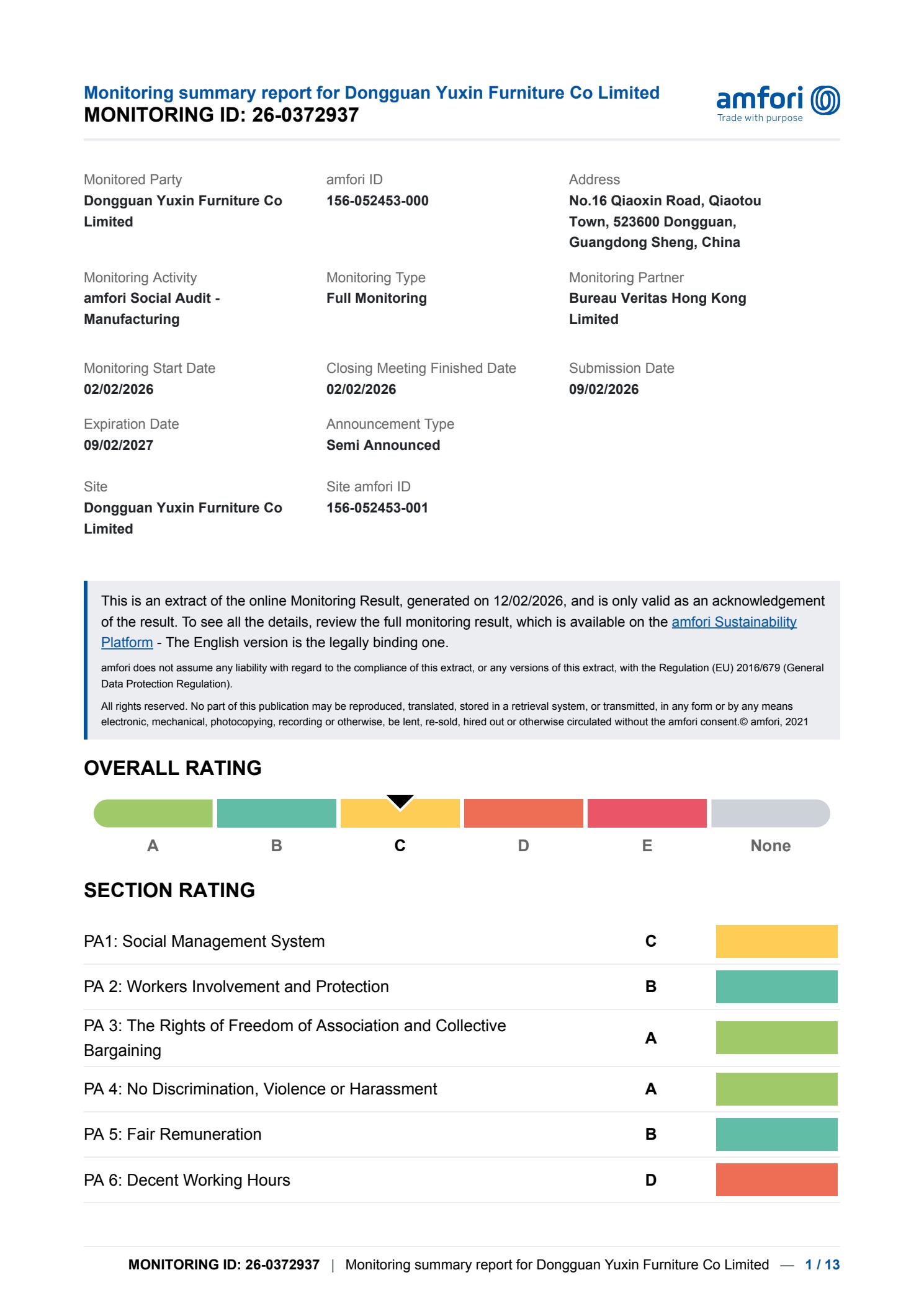
A BSCI audit report can be checked by DBID, auditor and validity date. Image source: YUXIN SMART LIVING.
50-80 Containers Monthly: How to Read Capacity Evidence
YUXIN SMART LIVING states a monthly export capacity of 50-80 containers, described in its case records as factory-total capacity rather than capacity reserved for any single buyer. The company also states a standard lead time of 45-60 days and negotiable MOQ.
Capacity figures are often quoted without context, so the useful follow-up questions are structural. What is the production base behind the number? Here the company profile adds two relevant facts: two factory campuses in Qiaotou, Dongguan, with a total area of 31,000 sqm (22,000 sqm plus 9,000 sqm), and an annual output stated at 300,000 sets. Hardware, panel and sheet-metal processes are described as in-house rather than heavily outsourced, which matters for scheduling because fewer process steps depend on external suppliers.
The number also has a planning implication rather than a promise. A 50-80 container monthly capacity is a factory-level range, not a guaranteed allocation to one importer. During peak seasons, the company states that booking 30-45 days in advance is recommended to reserve production slots. Buyers should therefore treat the capacity figure as an input to order planning — useful for judging whether a seasonal programme is realistic — and confirm the actual slot in the contract or order confirmation.
Flat-Pack Packaging as a Capability, Not a Cost Detail
For storage cabinets sold across long distances, packaging is a capability rather than a freight detail. Flat-pack design affects container utilization, damage rates and warehouse handling at destination. The company states that flat-pack packaging is used for online retail supply, including cabinets, desks and coffee tables, and that its OEM/ODM scope includes packaging customization.
Packaging quality is also tied to inspection. The company states that quality control uses 100% inspection with AQL standards, and that acceptance inspection includes AQL outgoing inspection and pre-shipment AQL standards agreed before shipment. The company also states that it operates an in-house testing laboratory and testing instruments. For an importer, the practical check is whether the AQL level, sampling plan and inspection point are written into the purchase order, and whether pre-shipment inspection reports are available before the balance payment.
Flat-pack also interacts with product design. A storage cabinet that is engineered for flat-pack dispatch usually has different panel joints, hardware and assembly instructions than a fully assembled unit. Buyers evaluating a supplier's flat-pack claim should ask for the packaging specification and a sample shipment record, not only a statement that flat-pack is available.
OEM and ODM Support Across Four Product Lines
The company states that it provides both OEM production services and ODM design-and-production services. Customization covers size, material, color, logo and packaging. MOQ is described as negotiable, and an engineering team evaluates drawings or samples before sampling and mass production. The assigned product lines for this article are wardrobe CB004, computer desk DS001, writing desk DS002 and dining table DS003. The company also lists storage cabinet CB001, bathroom cabinet CB002, display cabinet CB003 and coffee table CB005 in its related product records.
Wardrobe CB004
Wardrobe CB004 sits within the FSC certificate's stated product scope, which includes wardrobes and cabinets. For an OEM or ODM wardrobe programme, the customization levers named by the company are size, material, color, logo and packaging. The useful verification step is to ask which of those levers are engineering changes requiring new tooling or sampling, and which are finish or labelling changes that can be applied within an existing production run. A supplier that can distinguish the two will usually give a clearer sampling and lead-time estimate.
Desk Lines DS001 and DS002
Computer desk DS001 and writing desk DS002 are both listed among the products connected to the company's furniture-manufacturing patents. The company states that panel furniture automation has been in place since 2024, following the installation of a full set of intelligent panel processing equipment. For buyers, the relevance is not the equipment list itself but what it implies for consistency: automated panel processing is generally associated with repeatable drilling, edge-banding and dimensional control across production runs, which is where flat-pack furniture assembly problems often originate. Buyers should still ask for the inspection records and a sample assembly check.
Dining Table DS003
Dining table DS003 is also linked to the company's patent records and to the FSC scope. The company states that its manufacturing chain covers hardware, panel, upholstery, sheet metal, glass, plastic, power supply and LED lighting. For a mixed-container programme that combines cabinets and tables, that breadth matters because it reduces the number of external suppliers involved in a single order. The buyer's check is whether the product line is genuinely made in-house or assembled from bought-in components, and how the supplier documents the difference.
Factory or Trading Company? The Audit Questions That Separate Them
The factory-versus-trading-company question is not about prestige. It changes who is accountable for quality, lead time and after-sales replacement. The company states that it is a source factory, that its business dates back to 2009, and that the current company entity, Dongguan Yuxin Smart Home Co., Ltd., was founded in 2021. It publishes a factory address at Building 1, No.16 Qiaoxin Road, Qiaotou Town, Dongguan City, Guangdong Province, China, and states that factory visits and audits are welcome by appointment on 0769-83336558.
The table below converts that statement into a verification checklist. It is deliberately generic, so it can be used with any storage cabinet supplier.
| Audit question | What it verifies | Evidence to request |
|---|---|---|
| Does the business-licence address match the factory address? | Whether the contracting entity and the production site are the same organisation | Business licence copy; factory address in the contract; site visit or video walkthrough |
| Which processes are performed in-house? | The real production boundary and the number of outsourced steps | Process list by product line; production-line visit; equipment list |
| Can the buyer visit or audit the factory? | Whether the supplier can support on-site due diligence | Appointment confirmation; audit agenda; showroom, laboratory and loading-area access |
| What is the lead time, and what drives it? | Whether the quoted lead time reflects real scheduling | Written lead time; peak-season booking rule; progress-update milestones |
| What is the customization scope? | Which changes are engineering work and which are finish or label changes | Customization matrix by size, material, color, logo and packaging; sampling terms |
| How is quality inspected? | Whether inspection is a process or a promise | AQL level; sampling plan; pre-shipment inspection report; in-house lab scope |
| Who handles defective parts? | Whether after-sales responsibility sits with the factory | Warranty terms; replacement process; liability clause in the contract |
The company also states that it has been a long-term supplier for Amazon, Walmart, JYSK, GAP and Wayfair within their approved supply chains. That is a company-reported relationship statement. It is useful as a reference point but should be verified through buyer references or audit records rather than accepted at face value.
Standards and Compliance Context Buyers Should Map
Certification and capacity evidence are more useful when read alongside the standards that apply to the product and market. Three published standards are relevant to storage cabinet sourcing, though none is automatically a legal requirement in every jurisdiction.
- ISO 7170:2021 specifies test methods for determining the strength, durability and stability of fully assembled storage units, including movable and non-movable parts. The standard describes test methods; acceptance criteria must be separately confirmed.
- EN 14749:2016+A1:2022 addresses safety requirements and test methods for domestic and kitchen storage units, kitchen worktops and components including glass parts. Buyers selling household, kitchen, bathroom, TV or glass-door cabinets in Europe should verify national adoption and any labelling or installation-information requirements.
- EN 16121:2023 concerns safety, strength, durability and stability of non-domestic storage furniture, including office and laboratory storage furniture according to its catalogue description. Product classification and end-use should be confirmed before applying it to office or retail cabinets.
Customs classification is a separate check. HS 8418.50 covers storage and display cabinets only when they incorporate refrigerating or freezing equipment, so it is not a general storage-cabinet code. HS 9403 covers other furniture and parts, but the appropriate subheading depends on construction, use and destination jurisdiction. Importers should obtain a customs classification ruling or broker validation for each cabinet family before comparing duties or import values.
Evidence-Based Sourcing vs. Claim-Based Sourcing
The difference between the two approaches is not the number of questions asked. It is whether each answer produces a record that can be checked later. The comparison below contrasts the two patterns on the dimensions that most affect a storage cabinet order.
| Dimension | Claim-based sourcing | Evidence-based sourcing |
|---|---|---|
| Supplier identity | Brand name and brochure | Legal entity, business licence and matching factory address |
| Compliance | “We are certified” | Certificate number, issuer, issue date, expiry date and scope |
| Capacity | A monthly output figure | Capacity range, production base, allocation rule and peak-season booking window |
| Quality | “Strict quality control” | AQL level, sampling plan, inspection point and laboratory scope |
| Customization | “OEM/ODM available” | Customization matrix and sampling terms by product line |
| After-sales | Verbal assurance | Warranty terms and replacement process in the contract |
This comparison does not claim that one supplier type is inherently better. A trading company may add value in coordination, design or market access, and a factory may be weaker in some commercial functions. The point is fit and traceability: the buyer should know which model is being contracted and which records support it.
Future Outlook for Storage Cabinet Importers
Two market signals are worth keeping in view. First, the residential segment's dominance of cabinet revenue, at 73.2% in 2025 according to Grand View Research, keeps pressure on suppliers to combine aesthetic variety with durable construction. Second, metal storage remains a meaningful commercial category: Steelcase reported USD 456 million in metal storage solutions revenue in 2023, representing 13.2% of its revenue, according to its disclosed segment data. Neither figure predicts a specific supplier's performance, but together they suggest that buyers will continue to need evidence of both design flexibility and production discipline.
On the trade side, Vietnam accounted for 26% of US furniture imports in 2026, according to US Census data compiled by Furnilytics. That concentration matters for buyers comparing sourcing countries, but it does not replace supplier-level verification. Country-level share describes a market; it does not describe a factory.
The practical outlook is therefore less about new claims and more about better records. Importers who build a verification file — certificates, audit reports, capacity breakdowns, inspection standards and contract terms — will be better placed to compare suppliers on the same basis. Suppliers able to produce those records quickly will find the evaluation stage shorter.
FAQ
Are you a factory or a trading company?
Dongguan Yuxin Smart Home Co., Ltd. describes itself as a source factory rather than a trading company. Its company profile states that it operates two factory campuses in Qiaotou, Dongguan, Guangdong, with a total area of 31,000 sqm, and that hardware, panel and sheet-metal processes are carried out in-house. The group's business dates back to 2009, while the current company entity was founded in 2021. Buyers should confirm these details through a business-licence check and an on-site audit.
What certifications do you have?
The company holds an amfori BSCI audit report (DBID 26-0372937) issued by Bureau Veritas Hong Kong Limited, valid until 9 February 2027, covering labour conditions, working hours, health and safety, environment and management practices. It also holds an FSC Chain of Custody certificate (ESTS-COC-242008) issued by ESTS, valid until 30 January 2029, against FSC-STD-40-004, covering 13 product categories. Product-level compliance includes US CARB P2 and TSCA Title VI, and EU ENF, REACH and GPSR. Certificate numbers can be checked through the issuing bodies' official channels.
What is your lead time and production capacity?
The stated standard lead time is 45-60 days, and the factory's monthly export capacity is 50-80 containers, described as factory-total capacity rather than capacity reserved for any single buyer. The company also states that orders are planned with in-house warehousing and container loading, with one-stop shipment from Shenzhen port. Because capacity is shared across orders, peak-season bookings are typically placed 30-45 days in advance.
Do you support OEM/ODM customization?
Yes. The company states that it provides both OEM production and ODM design-and-production services. Customization covers size, material, color, logo and packaging. Engineering evaluates drawings or samples for feasibility, and mass production follows sample approval. The minimum order quantity is described as negotiable. Buyers with patented designs should consider a non-disclosure agreement before sharing drawings.
Where is your factory located, and can it be visited or audited?
The factory address is Building 1, No.16 Qiaoxin Road, Qiaotou Town, Dongguan City, Guangdong Province, China. The company states that factory visits and audits are welcome by appointment; the published appointment line is 0769-83336558. A typical visit covers production lines, the showroom, the testing laboratory and the loading warehouse. Visitors are asked to book one to three days in advance and follow workshop safety rules.
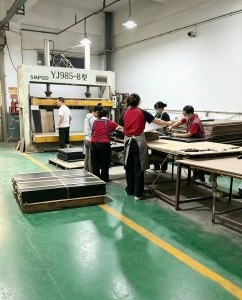
Production-area evidence complements certificate records when importers evaluate OEM/ODM capability. Image source: YUXIN SMART LIVING.
Conclusion: Build the Verification File Before the Price File
Storage cabinet sourcing rewards buyers who separate claims from records. BSCI and FSC certificates are useful only when their numbers, issuers, dates and scopes can be checked. A 50-80 container monthly capacity is useful only when it is read as factory-total capacity with a booking rule. OEM/ODM support is useful only when the customization matrix and sampling terms are clear for the specific product line. None of these records makes a sourcing decision on its own, but together they turn a supplier conversation into a comparable file.
For importers evaluating wardrobe CB004, computer desk DS001, writing desk DS002 or dining table DS003, the practical next step is to request the certificate copies, the audit report reference, the capacity breakdown by line, the AQL inspection terms and the customization matrix in one package. Suppliers able to supply that package make the evaluation shorter; suppliers who cannot should prompt a second look, not necessarily a rejection. The full company brochure is available for download: YUXIN brochure (PDF).
Have Questions or Need More Details?
Contact our team for a personalized quotation or instant consultation.
Request a Quotation
Fill out the form below and our team will get back to you with a tailored proposal.
WhatsApp Direct Chat
Prefer to chat in real-time? Message us on WhatsApp for instant assistance & quick answers.
- Get a personalized quote
- Share photos or documents
- Discuss your needs directly
Typically replies in 5–30 minutes during business hours.