
Storage Rack Compliance: Purchase Terms and Acceptance Criteria for Q235 Steel Racks
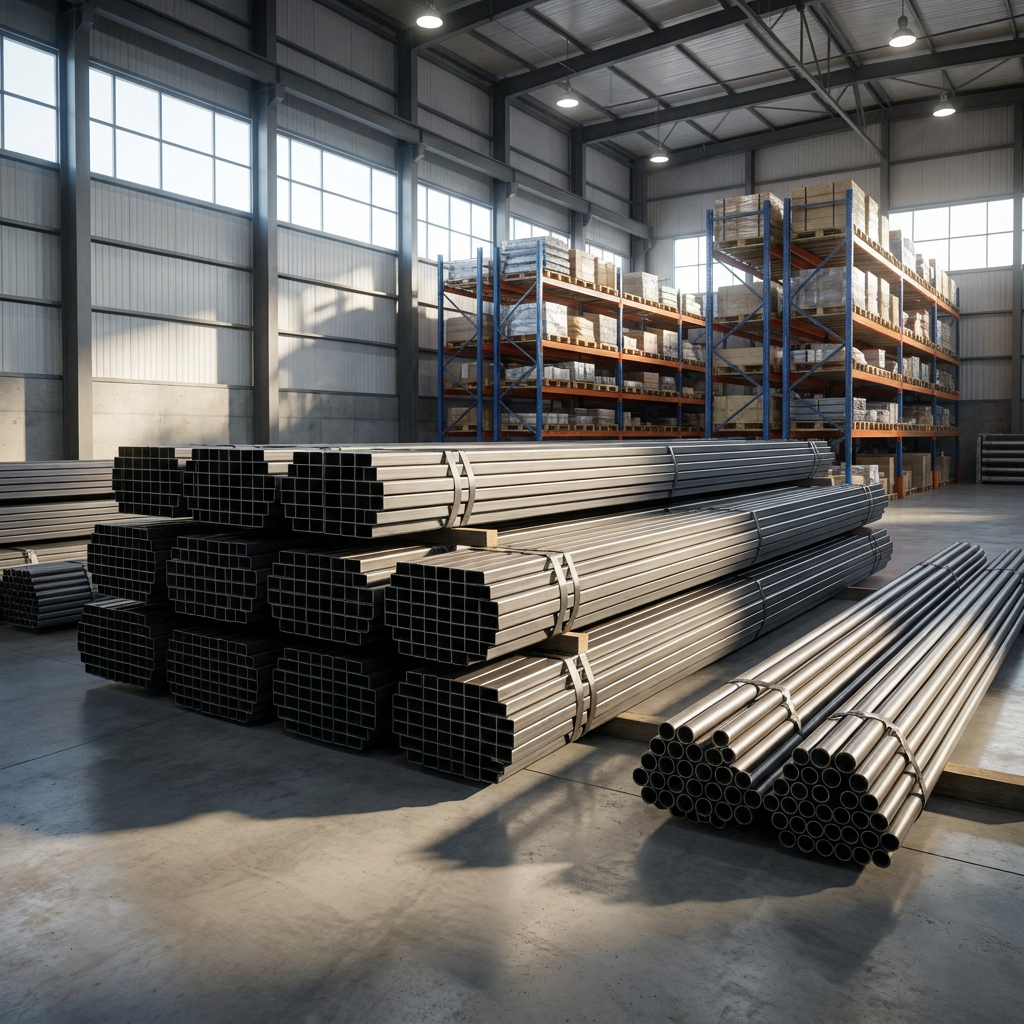
Storage rack compliance is usually settled in a purchase order, not in a brochure. For buyers sourcing stackable steel racks, the word "compliance" rarely means a certificate on a wall. It means that the material, dimensions, finish, load capacity, stacking configuration and container loading written into the order can be checked against what is actually delivered.
The category is growing quickly enough that this distinction now carries commercial weight. Grand View Research values the global warehouse racking market at approximately USD 9.71 billion in 2024, projected to reach USD 12.41 billion by 2030, with North America accounting for 27.8% of 2024 revenue. A broader estimate from Global Market Insights, covering a wider range of storage equipment, places the 2024 storage rack market at USD 22.4 billion with a 4.9% CAGR forecast through 2034. The gap between the two figures reflects scope rather than contradiction — and it is a useful reminder that buyers should define the product in their own documents.
This article explains how to interpret compliance and qualification for Q235 mild steel storage racks, and how to convert a product specification into purchase terms and acceptance criteria.
Two Different Meanings of Compliance in Storage Rack Sourcing
Compliance in industrial storage runs along two separate tracks, and buyers who mix them end up requesting documents that were never part of the product agreement.
The first track covers installed racking systems. In the United States, ANSI MH16.1-2023, published by the Rack Manufacturers Institute, specifies minimum requirements for the structural design, testing and utilization of industrial steel storage racks. In Europe, EN 15512:2020 — updated in 2022 — governs structural design principles for steel static storage systems and adjustable pallet racking. Both are engineering frameworks for systems fixed to a building.
The second track covers portable stackable racks. These are purchased as material-handling units under a specification agreement: the buyer defines material grade, post and base geometry, finish, load capacity and stacking height; the supplier states conforming values; acceptance is a documented physical check against those values.
A stackable rack can be entirely fit for purpose in a warehouse while carrying no claim under ANSI MH16.1-2023 or EN 15512:2020. That is not a defect in the product; it is a difference in what the purchase covers. The productive question is therefore not "is it compliant?" but "compliant with what, verified how?"
What HM Group States in Writing for Its Stackable Steel Racks
HM Group — Dalian HuaMao Logistics Equipment Group Co., Ltd. — is a logistics equipment manufacturer established in 2003, operating three manufacturing bases in Xiamen, Nanjing and Qingdao across 62,000 square metres, with an annual output of 2,000,000 units. Export business accounts for 100% of sales, with the EU, North America, Asia and the Middle East as its main markets; the trading department employs approximately 50 staff and the R&D team consists of 10 engineers.
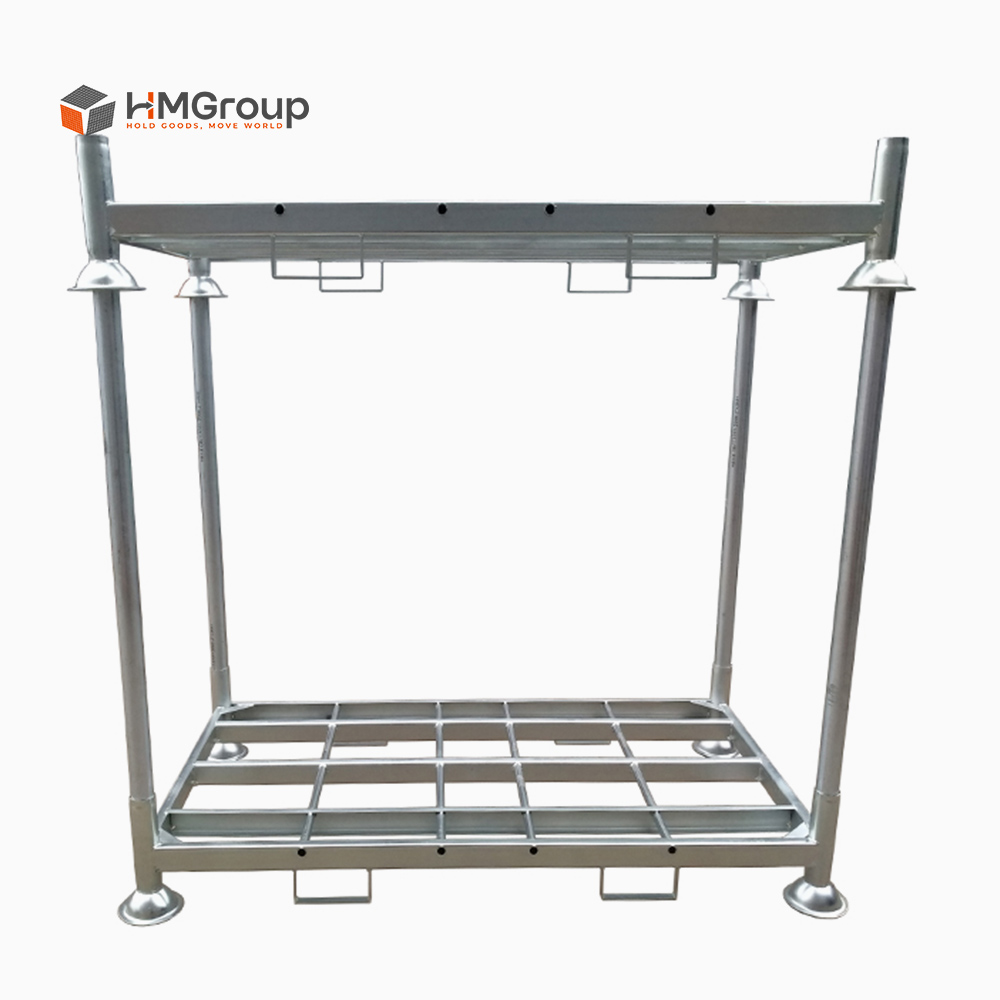
Within that range, the two models most often used as the reference point for Q235 stackable storage are the HM-PP001 stacking storage rack, rated 1500 kg, and the HM-PP002 warehouse storage rack, rated 2000 kg. Both are made of mild steel Q235, both use a φ60 × 2.5 mm post, and both are stackable up to 4 units high. Their bases differ: 1395 × 1060 × 310 mm for the HM-PP001 and 1875 × 1060 × 310 mm for the HM-PP002. Both are offered in zinc, hot-dip galvanized or powder coating finishes.
The same material grade and the same finish set run through the wider stackable range, including the HM-PP006 bulk bag storage rack (1000 kg), the HM-FR005 fabric roll storage rack (1000 kg), the HM-FR002 carpet pad storage rack (500 kg), the HM-N1302 nestainer storage rack (1000 kg) and the HM-FR007 stackable steel storage rack (1100 kg).
Verifying Q235 Mild Steel Construction
Q235 is a plain carbon structural steel grade widely used in China-manufactured industrial equipment. In a purchase order it functions as a material declaration: it fixes the grade the rack is built from, not its dimensions or its working load.
Post geometry is the most directly checkable element. On the HM-PP001, HM-PP002 and HM-PP006, posts are specified as φ60 × 2.5 mm — a figure that can be measured on a sample at receipt. Base dimensions are equally concrete: 1395 × 1060 × 310 mm, 1875 × 1060 × 310 mm and 950 × 950 × 310 mm respectively across those three models.
Grade alone does not determine performance. Two racks can share the same Q235 grade and behave differently because of post diameter, wall thickness, welding pattern and base design. A purchase specification should therefore always pair the material grade with the geometry of the same model.
Where independent confirmation is required, the requirement has to be created by the buyer — for example third-party inspection at loading or buyer-arranged material testing — because it is not part of the standard product statement. Application-level requirements are sometimes stated separately from product data: for wine cellar projects, the stated requirements include reinforced joints and stress-point welding to sustain loads above 1,000 kg per rack unit. For fabric and tire applications, stated requirements include smooth edges and anti-rust coatings.
Finish Options as Specified Terms
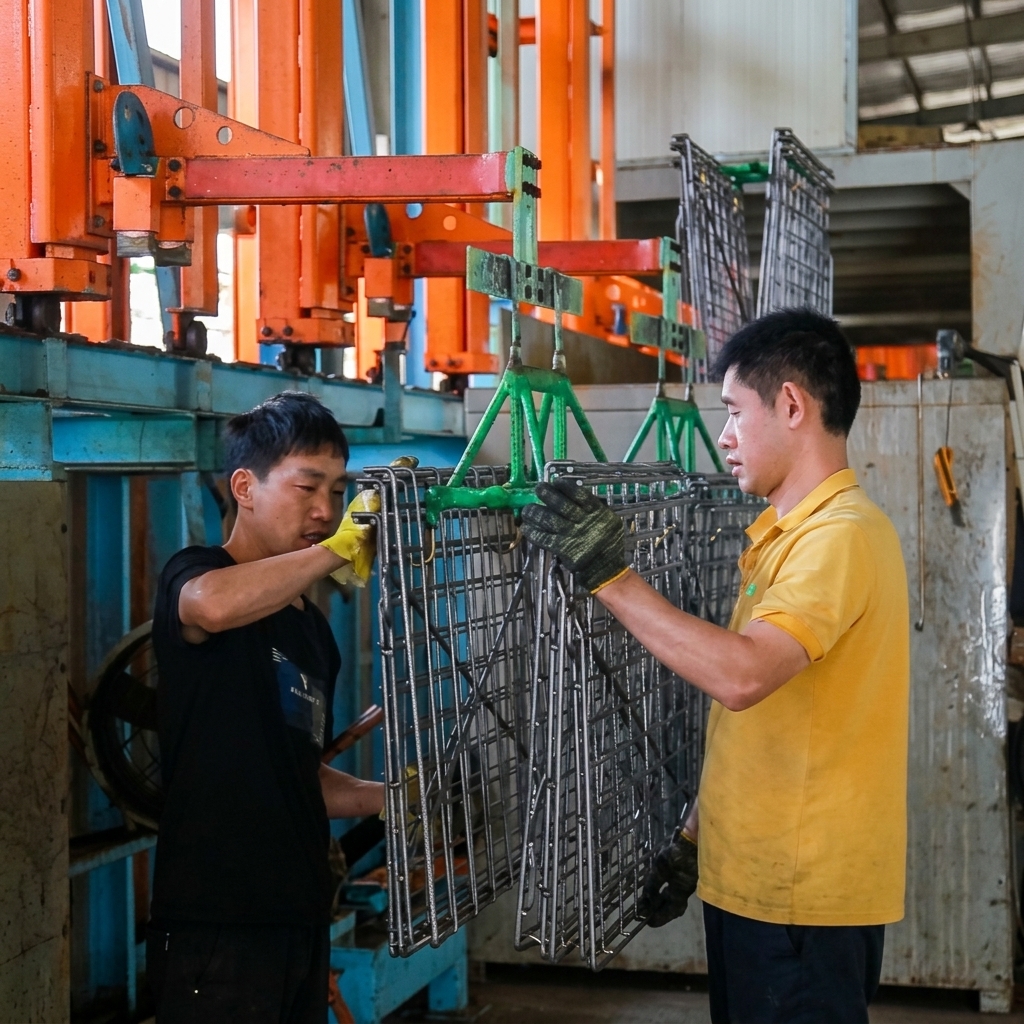
Finish is the second specification a buyer can verify — and the one where vague purchase terms cause the most argument. Across the HM Group stackable rack range, three finishes are offered: zinc, hot-dip galvanized, and powder coating.
The choice is environmental rather than decorative. Indoor dry warehouse storage, cold-chain logistics and humid cellars do not impose the same demands. In wine cellar applications the stated operating environment includes 70–85% relative humidity; in cold-chain logistics, hot-dip galvanizing is specified for anti-rust protection. Powder coating is the relevant option where colour matters — colour and logo printing are both listed among the manufacturer's customization options, alongside size, loading capacity and design features such as a wire mesh guard, bottom wire mesh decking, forklift guide, bottom steel plate and wheels.
For the purchase order, the finish should be named as a type. "Zinc" and "hot-dip galvanized" are not interchangeable, and "powder coating" without a colour leaves the acceptance check undefined. At receipt, finish conformity is checked against the ordered type and, where applicable, the specified colour.
Load Capacity, Stack Height and What the Numbers Cover
| Model | Product | Base / exterior dimension | Post size | Load capacity | Stackability | Loading per 40'HQ |
|---|---|---|---|---|---|---|
| HM-PP001 | Stacking storage rack | 1395 × 1060 × 310 mm | φ60 × 2.5 mm | 1500 kg | 4 high | 250 sets |
| HM-PP002 | Warehouse storage rack | 1875 × 1060 × 310 mm | φ60 × 2.5 mm | 2000 kg | 4 high | 160 sets |
| HM-PP006 | Bulk bag storage rack | 950 × 950 × 310 mm | φ60 × 2.5 mm | 1000 kg | 4 high | 160 sets |
| HM-FR007 | Stackable steel storage rack | 48 × 48 × 36 in | — | 1100 kg | 6 open / 20 closed | 380 sets |
| HM-FR005 | Fabric roll storage rack | 1500 × 1100 × 900 mm | — | 1000 kg | 4 open / 20 closed | 160 sets |
| HM-FR002 | Carpet pad storage rack | 1521 × 1000 × 1360 mm | — | 500 kg | 4–5 high | 126 sets |
| HM-N1302 | Nestainer storage rack | 1300 × 1200 × 1200 mm (exterior) | — | 1000 kg | 4 high | 160 sets |
| HM-BR066 | Barrel storage rack | 1130 × 775 × 453 mm | — | Not stated in product data (barrel capacity 50 L–500 L) | 4 high | 234 sets |
A dash indicates the value is not stated in the reviewed product data for that model.
Reading the table takes two steps. First, the load figure is stated for the individual unit: 1500 kg for the HM-PP001 and 2000 kg for the HM-PP002. In a loaded stack, however, the bottom unit carries the accumulated weight of everything above it. Buyers should therefore write both numbers into the purchase order — the unit rating and the maximum loaded stack height they intend to operate — rather than treating the rating as a standalone figure.
The second step concerns open versus closed figures. "Stacked 4 high" describes loaded operation for the HM-PP001, HM-PP002, HM-PP006 and HM-N1302. Other models quote two numbers: the HM-FR007 stacks 6 units when open and 20 when closed, the HM-FR005 stacks 4 open and 20 closed. Open figures govern loaded storage; closed figures govern empty storage and return shipping, and they underpin the container loading figures discussed below.
Stated capacities assume evenly distributed loads, a level floor, and handling with suitable equipment such as forklifts, reach trucks or pallet jacks. Loads beyond the stated figure, uneven floors, or handling that drags and drops the rack fall outside the specification.
Container Loading as a Commercial Acceptance Term
Container loading figures sit at the boundary between engineering and logistics, and they are often the least examined part of a rack specification. For the HM-PP001, the stated loading is 250 sets per 40'HQ container. The HM-PP002 and HM-PP006 load 160 sets, the HM-FR007 380 sets, the HM-FR005 and HM-N1302 160 sets, the HM-FR002 126 sets, and the HM-BR066 barrel storage rack 234 sets.
These figures do more than estimate freight. They define what a full order looks like, they set the point at which quantity is accepted at loading, and they depend on how the rack nests or collapses when empty — which is precisely why open and closed stacking figures are quoted separately. At acceptance, the packing list should be reconciled against the stated loading figure, and each set should be confirmed complete: base, posts, and any specified accessory such as a wire mesh guard, forklift guide or bottom steel plate.
Acceptance Criteria Checklist
| Specification item | How it appears in the purchase order | Acceptance check |
|---|---|---|
| Material grade | Mild steel Q235 | Confirm the delivered goods are declared as Q235; arrange independent testing if the contract requires it |
| Post geometry | φ60 × 2.5 mm (HM-PP001, HM-PP002, HM-PP006) | Measure post diameter and wall thickness on a sample |
| Base dimensions | 1395 × 1060 × 310 mm (HM-PP001); 1875 × 1060 × 310 mm (HM-PP002) | Measure base footprint against the ordered specification |
| Finish | Zinc / hot-dip galvanized / powder coating, with colour where specified | Visual conformity check against the ordered finish type and colour |
| Load capacity | 1500 kg (HM-PP001); 2000 kg (HM-PP002) | Match rating on documentation; verify by test where contractually required |
| Stack height | 4 units high, loaded (HM-PP001, HM-PP002, HM-PP006, HM-N1302) | Confirm the accepted configuration matches the ordered one |
| Container loading | 250 sets per 40'HQ (HM-PP001) | Reconcile packing list with quantity at loading |
| Customization | Wire mesh guard, bottom wire mesh decking, forklift guide, bottom steel plate, wheels, logo printing | Confirm each specified accessory is present and correct |
Where Stackable Q235 Racks Are Used
The stacking and warehouse storage models described here are intended for textile and fabric roll storage, logistics and warehousing, food and grocery, agriculture, and furniture industries. The functional requirement varies by sector even when the hardware is similar.
In fabric and carpet handling, the racks hold rolls in a position that prevents flattening, slipping or damage and allow a worker to retrieve a specific roll without moving surrounding inventory. The HM-FR005 fabric roll storage rack (1000 kg, 1500 × 1100 × 900 mm) and the HM-FR002 carpet pad storage rack (500 kg, 1521 × 1000 × 1360 mm, stackable 4–5 high) serve those roles.
Tire storage is the largest single application cluster in the range. The HM-TR6060 holds 24–32 tires at 1100 kg; the HM-TR7272WM and the HM-TR-UTR hold 42–63 tires at 1100 kg; the HM-EULR holds 72–81 tires at 1100 kg; and the HM-TR6 holds 34–50 tires with a 6-high open stack. In these applications the stated purpose is to prevent tire warping or flattening and to organise tires by size or type for fast retrieval, supported by forklifts, reach trucks, pallet jacks and warehouse management systems.
The HM-BR066 barrel storage rack addresses the wine side of the range: barrels from 50 L to 500 L, stacked 4 high, with 234 sets per 40'HQ container.
Why Specification Discipline Is Increasing
Several market signals point in the same direction. Grand View Research expects the warehouse racking market to move from approximately USD 9.71 billion in 2024 to USD 12.41 billion by 2030, with North America holding 27.8% of 2024 revenue. The specialised tire storage rack segment is forecast by Future Market Insights to grow from USD 865 million in 2024 toward USD 1.37 billion by 2034, at a 4.7% CAGR. Global Market Insights' broader storage rack estimate of USD 22.4 billion in 2024, with a 4.9% CAGR through 2034, covers a wider equipment scope.
Growth of this kind changes buying behaviour in a predictable way. As order volumes rise and supply chains lengthen, the cost of a specification error rises with them — a mismatched finish or an overstated stack height stops being a single-site problem. The divergence between market estimates, meanwhile, reflects genuinely different definitions of "storage rack". That is an argument for defining the product in your own documents rather than relying on category language.
Stackable Steel Racks and Fixed Pallet Racking: Where the Boundary Sits
Stackable racks and installed racking systems are often compared as if they were alternatives at the same decision point. They are not.
Selective pallet racking remained the dominant product segment in 2024, accounting for approximately 45.0% of warehouse racking market share according to Grand View Research, and the engineered systems market includes large suppliers such as Daifuku Co., Ltd., Kardex Group, Mecalux S.A. and SSI SCHAEFER Group. That market answers a different question: how to build a fixed, high-selectivity storage structure inside a building.
Stackable Q235 racks answer a mobility question. On the evidence stated for these products, the boundary is reasonably clear:
- No structural certification is claimed within the product data. ANSI MH16.1-2023 and EN 15512:2020 apply to engineered racking systems; a buyer who needs standards-based structural verification must create that requirement.
- Load capacity is a per-unit figure tied to a defined configuration, not a system-level engineering certificate.
- Stacking is limited. The HM-PP001, HM-PP002, HM-PP006 and HM-N1302 stack 4 units high; the HM-FR007 and HM-TR6 reach 6 when open. That is a real ceiling, and it sits below the vertical reach of a fixed multi-level installation.
- There is no pick-face selectivity. Reaching the bottom unit means dismantling the stack; fixed racking is designed precisely to avoid that.
- Operation assumes level floors and disciplined forklift handling. Units loaded beyond their stated capacity fall outside the specification.
In exchange, stackable racks need no installation, move with the cargo from receiving to shipping, can be configured as temporary high-density storage for seasonal peaks, and nest or collapse to a fraction of their loaded footprint when empty — a stated 4:1 space saving for post pallet designs. For dynamic warehouses, line-side feeding and cross-docking areas, that trade is usually the right one.
Future Outlook
Two developments look likely. First, buyers are increasingly attaching specification sheets to purchase orders, which pushes material grade, geometry, finish and load figures into the contract rather than leaving them in the catalogue. Second, as the tire and fabric segments expand, tolerance for specification ambiguity is likely to fall further, because in those applications rack performance ties directly to product quality — flattened fabric rolls and distorted tires are measurable losses, not cosmetic issues.
For suppliers, the competitive ground shifts toward documented, verifiable specification conformity. For buyers, the most valuable document in a storage rack project is a purchase order that states exactly what will be checked at acceptance.
FAQ
What does Q235 mean in a storage rack purchase specification?
Q235 is the mild carbon structural steel grade stated for HM Group's stackable racks, including the HM-PP001 and HM-PP002. In a purchase order it functions as a material declaration: it defines the grade the rack is built from, not its dimensions or its load capacity. It should always be read together with the geometry stated for the same model — for example the φ60 × 2.5 mm post used on the HM-PP001, HM-PP002 and HM-PP006 — because two racks made from the same grade can perform differently depending on post diameter, wall thickness and base design.
How should load capacity and stacking height be written into a purchase order?
State the model and its rated capacity — 1500 kg for the HM-PP001 and 2000 kg for the HM-PP002 — and then state the maximum loaded stack height you intend to operate. Both models are stackable up to 4 units high, and in a stack the bottom unit carries the accumulated load above it. Where a model quotes two figures, such as the HM-FR007 at 6 when open and 20 when closed, the purchase order should specify which configuration is being accepted.
Which finish should be specified — zinc, hot-dip galvanized or powder coating?
All three finishes are offered across the HM Group stackable rack range. The decision is driven by the storage environment: cold-chain applications specify hot-dip galvanizing for anti-rust protection, humid cellar conditions are a different case, and powder coating is the relevant choice where colour or logo marking matters, since colour and logo printing are listed among the customization options. The purchase order should name the finish type rather than a general expectation of corrosion resistance.
Can a buyer rely on a structural certification for these stackable racks?
The product data for these models states material grade, dimensions, finish options, load capacities, stacking configurations and container loading. It does not claim certification under ANSI MH16.1-2023 or EN 15512:2020, which are structural design frameworks for installed racking systems. If a project requires standards-based structural verification, that requirement should be written into the tender and confirmed with the supplier before ordering. Independent material testing or third-party inspection at loading also has to be created by the buyer, because it is not part of the standard product statement.
How does container loading relate to acceptance criteria?
Container loading figures are commercial acceptance terms as much as logistics estimates. The HM-PP001 is stated at 250 sets per 40'HQ container; the HM-PP002 and HM-PP006 at 160 sets; the HM-FR007 at 380 sets; the HM-FR005 and HM-N1302 at 160 sets; and the HM-FR002 at 126 sets. At loading, the packing list should be reconciled against the stated figure, and each set should be confirmed complete — base, posts and any specified accessory such as a wire mesh guard, forklift guide or bottom steel plate.
Reference material: the HM Group product brochure is available for download at https://cdn.socialarks.com/sbsp/24780/common/2026/0512/6a02c6bba978c.pdf. Company information: https://www.hmlwires.com/