
Storage Rack Procurement FAQ: Q235, Posts, Load and Container Fill
A storage rack quotation is a page of numbers that has to be converted into a purchase order, a warehouse layout and an acceptance check. Model code, material grade, post section, load figure, stack height, finish and container quantity rarely arrive with an explanation of how they relate to one another — yet each one changes what a technical buyer can safely approve.
This reference answers the specification questions that surface before an order is placed for stackable steel storage racks. It uses published figures from HM Group — Dalian HuaMao Logistics Equipment Group Co., Ltd., a manufacturer of wire mesh containers, cage pallets, stillage, nestainer racks, fabric roll racks, barrel racks, post pallet racks, tire racks and steel pallet equipment, exporting to the EU, North America, Asia and the Middle East. The purpose is not to recommend a model but to make the specification legible, including the points where a datasheet stops short.
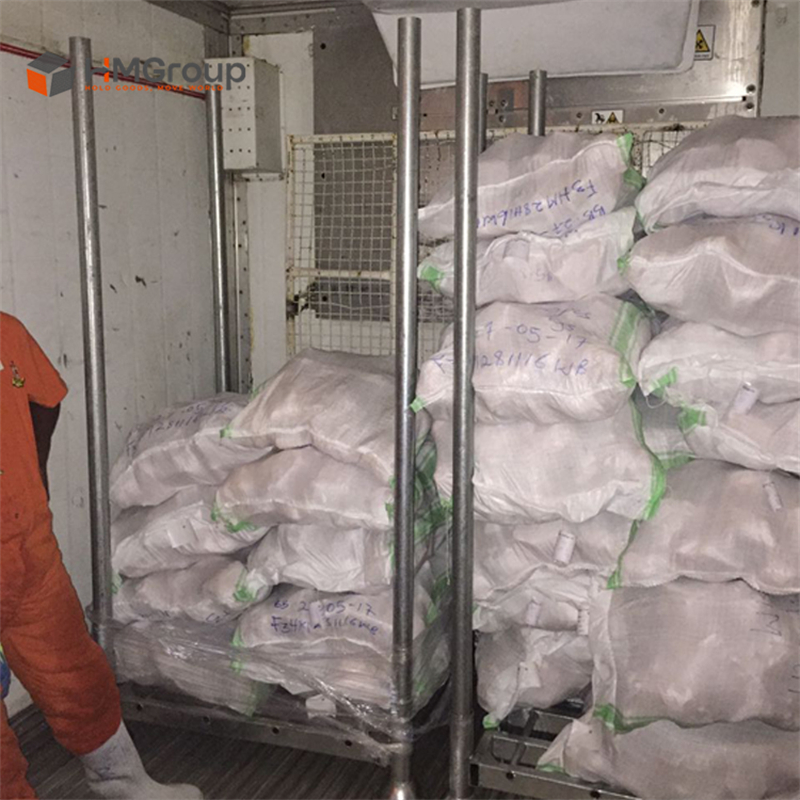
Stackable steel racks are specified on four independent variables — material, post section, base footprint and stacking height — before price is relevant.
Where storage rack RFQs usually stall
Most sourcing delays in this category are not commercial. They come from four recurring gaps between what a supplier publishes and what a buyer must document internally.
- Material versus capacity. A grade such as Q235 describes the steel, not the performance of the finished unit. Buyers who treat the grade as a capacity statement lose the ability to compare models within the same supplier.
- A single load number without a basis. Published capacities are model-level figures. Whether they describe a uniformly distributed load, a static condition or a base unit under a full stack is a legitimate question that rarely appears on a quotation.
- Footprint treated as a detail. Base dimensions determine aisle design, floor positions consumed, forklift compatibility and container fill. They are a layout input, not a footnote.
- Container quantity quoted as an isolated fact. A figure such as 250 sets per 40’HQ is a packing outcome for a specific configuration. Added options and mixed models change it.
Closing those gaps is the difference between a quotation that can be approved and one that returns to the supplier three times. The sections below work through each variable in the order a technical buyer usually meets them.
What Q235 mild steel actually means in a rack specification
Q235 is a Chinese structural mild steel designation. The letter “Q” refers to yield strength, and the number 235 refers to a nominal minimum yield strength of 235 MPa. In practical terms it is a low-carbon structural steel selected for weldability, formability and predictable behaviour under static loading — which is why it appears across industrial storage equipment rather than in a single product category.
Within HM Group’s published range, mild steel Q235 is listed as the base material for the stacking storage racks HM-PP001, HM-PP002 and HM-PP006, the nestainer rack HM-N1302, the roll racks HM-FR005, HM-FR002 and HM-FR007, the barrel rack HM-BR066 and the tire rack models. That consistency matters for buyers planning a mixed fleet: the substrate is the same, so differences between models come from geometry, section and construction rather than from material substitution.
What Q235 does not tell a buyer is how much the finished unit will carry. Capacity is produced by the combination of post diameter and wall thickness, base frame design, deck or cradle geometry, and the welding procedure applied at the joints. Two racks can share a material grade and differ by a factor of four in rated capacity — which is exactly what happens inside a single catalogue.
A material grade is a starting condition, not evidence of performance. If a project requires traceable material documentation, the mill certificate should be named in the RFQ rather than assumed from the datasheet.
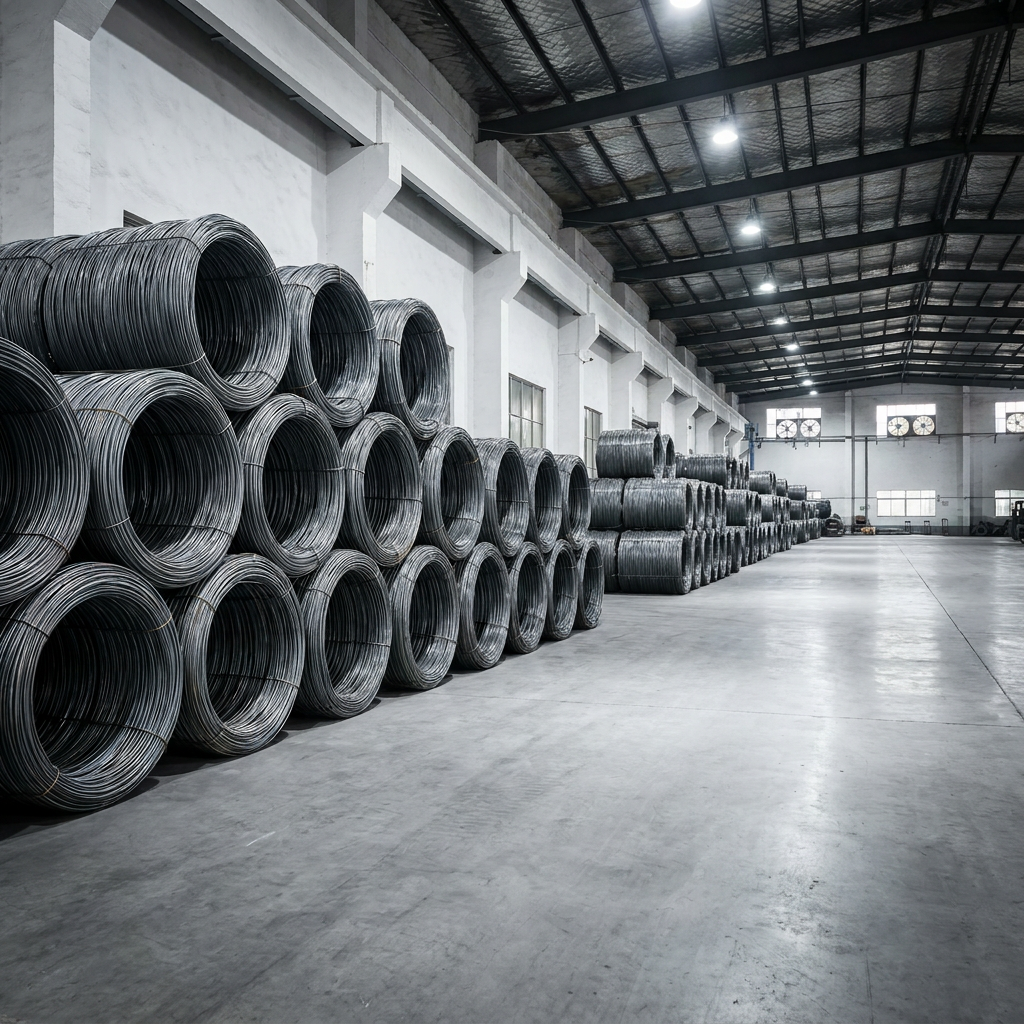
Material grade is verified at the raw material stage; component, semi-finished and finished inspection follow before packaging.
Post size and base dimensions: reading φ60×2.5 mm correctly
The notation φ60×2.5 mm describes a round steel tube with a 60 mm outside diameter and a 2.5 mm wall thickness. Both figures matter. Diameter governs resistance to bending and buckling in a vertical member; wall thickness governs local section strength, weld preparation and how much the tube deforms before it fails. A larger diameter with a thin wall and a smaller diameter with a heavy wall are not interchangeable, even at the same nominal load.
Three HM Group post pallet models share the same φ60×2.5 mm post: HM-PP001, HM-PP002 and HM-PP006. Their base dimensions and rated capacities differ substantially — 1395×1060×310 mm at 1,500 kg, 1875×1060×310 mm at 2,000 kg and 950×950×310 mm at 1,000 kg respectively. This is a useful illustration of how specifications should be read: the post is held constant while the footprint, base frame and load class change. A buyer who ranks models by post size alone will not separate them; a buyer who reads base area against rated load will.
Base dimensions carry three separate consequences.
- Payload fit. The base must accept the pallet, bulk bag, drum or roll the operation actually handles. A 950×950 mm base and a 1875×1060 mm base suit different load units even when both are rated for a tonne or more.
- Floor and aisle planning. Footprint multiplied by the number of positions determines the floor area consumed and the aisle width left for counterbalanced forklifts, reach trucks or pallet jacks. All three HM Group post pallet bases share a 310 mm base height, which keeps entry height consistent across the family.
- Container fill. The same geometry that determines floor positions determines how many units fit a 40’HQ container — the single largest driver of landed unit cost in an export order.
Stack height and load ratings: what “4 high” means in practice
Published stackability and published load capacity are two different commitments, and they are usually quoted separately. Across the HM Group range, HM-PP001, HM-PP002, HM-PP006, HM-N1302 and HM-BR066 are listed at four high. The roll rack HM-FR002 is listed at 4–5 high. HM-FR007 and several tire models go further and distinguish open from closed stacking: HM-FR007 at 6 open and 20 closed, HM-TR6 at 6 open and 20 closed, and HM-TR1, HM-TR-UTR, HM-EULR, HM-TR6060 and HM-TR7272WM at 4 open and 20 closed.
The distinction between open and closed stacking is where logistics economics sit. Open stacking refers to loaded units in service; closed stacking refers to empty or folded units in return or repositioning flow. A rack that stacks twenty closed and six open supports container and truck utilisation on the return leg without changing its working configuration.
Load ratings in the range span 500 kg to 2,000 kg. HM-PP002 carries the highest published figure at 2,000 kg, followed by HM-PP001 at 1,500 kg; HM-PP006, HM-N1302 and HM-FR005 sit at 1,000 kg; HM-FR007 at 1,100 kg and the tire models at 1,100 kg, with HM-TR1 listed at 600 kg. HM-BR066 is specified by container volume rather than mass, covering 50 L, 200 L, 225 L, 300 L and 500 L containers. HM-FR002, the carpet pad rack, is rated at 500 kg.
Four questions worth putting to any supplier before approving a stack height: is the rating per unit or per stack column; does it assume a uniformly distributed load; is it a static or a handling condition; and what floor loading does a fully loaded bottom unit impose on the slab?
The last point is the one most often missed. A four-high column concentrates the working load of the stack through the base of the lowest unit. Structural stability of tiered storage is also a regulated matter in some markets: in the United States, OSHA 29 CFR 1910.176(b) requires that material stored in tiers be stacked, blocked, interlocked and limited in height so that it is stable and secure. The rack is the mechanism by which that requirement is met, which is why stack discipline and floor condition belong in the acceptance criteria alongside the load figure.
Zinc, hot-dip galvanized or powder coating: choosing a finish
All three finishes are offered across the HM Group rack range, and the choice is a service-life decision rather than an aesthetic one. The three are not equivalents.
- Zinc plating is applied in an electroplating line and produces a thin, uniform coating with good coverage on complex geometry. It suits dry indoor warehousing and applications where dimensional consistency matters.
- Hot-dip galvanizing produces a thicker zinc-iron coating metallurgically bonded to the steel, which is the usual specification for humid, condensing or cold-chain environments. HM Group’s South Korea agricultural project, a 1,000-unit installation for potato storage with a government agency client, used a hot-dip galvanized finish for long-term durability.
- Powder coating provides a coloured, abrasion-resistant film and is the finish that supports colour coding by product family, zone or customer. HM Group operates an indoor powder coating line, and powder coating colour plus logo printing are both listed as customization options.
HM Group’s published application notes for humid cellar environments reference hot-dip galvanized or powder-coated racks for three to five years of corrosion resistance at 70–85% relative humidity. That figure is an application expectation for a defined operating environment, not a laboratory salt-spray result, and should be read as such in a tender document. For cold-room storage, the published application scope extends to environments down to −30°C.
One practical boundary applies to every coating: corrosion begins where the coating is interrupted. Weld seams, fork-pocket edges and contact points where units rub during handling are the first locations to inspect, and no finish removes the need for a periodic inspection routine.
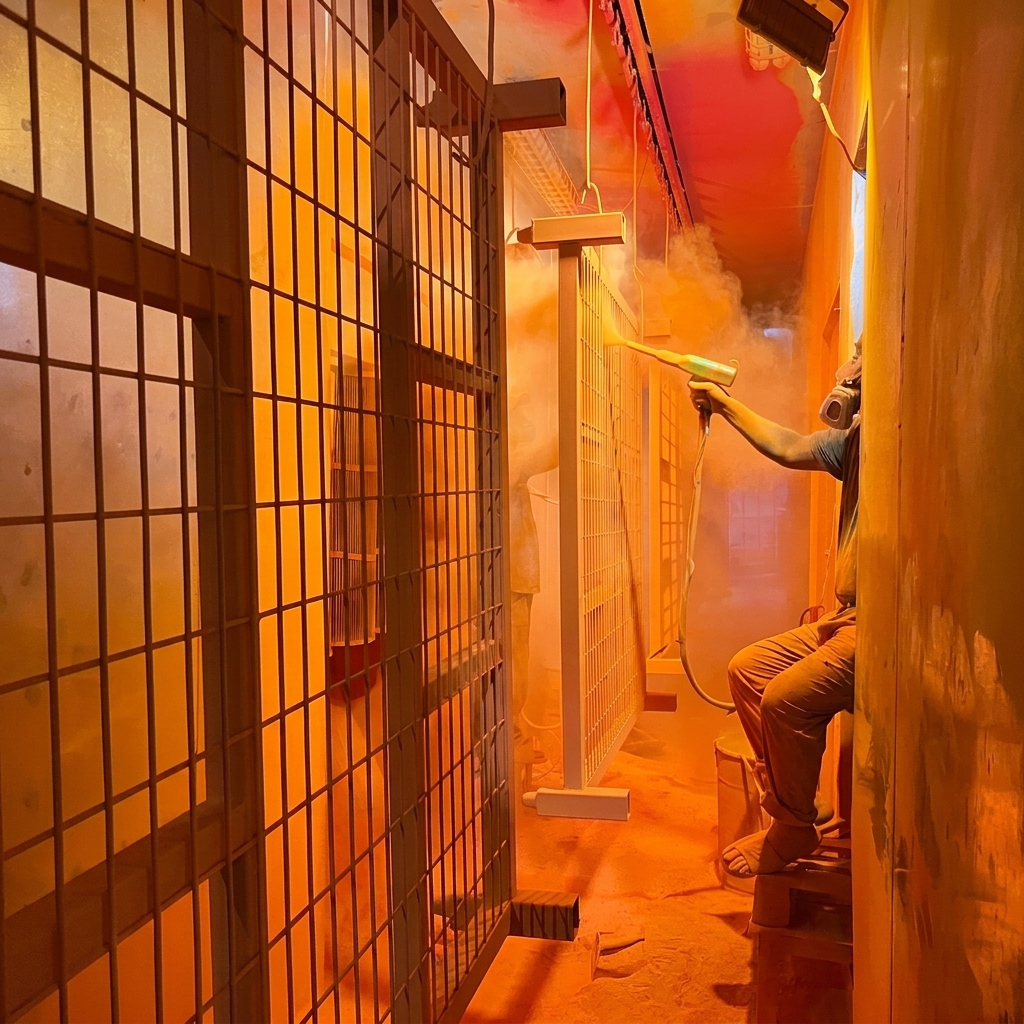
Finish selection is a service-life decision: powder coating for colour coding and abrasion resistance, hot-dip galvanizing for humid and cold-chain conditions.
Container loading: planning around 250 HM-PP001 sets per 40’HQ
For HM-PP001, the published packing figure is 250 sets per 40’HQ container. That number is the most consequential item on a quotation for an export buyer, because it converts a unit price into a landed cost and sets the order quantity that keeps freight efficient.
It is also the figure most likely to change. Three factors move it: mixed model loading, added options and non-standard finishes. HM Group’s customization list includes wire mesh guards, bottom wire mesh decking, forklift guides, bottom steel plates, wheels, custom sizes, altered load capacities, powder coating colours and logo printing — each of which can alter packed volume. A 250-set planning figure should therefore be confirmed against the final bill of materials rather than carried forward from an early quotation.
The table below collects the published specification set for the principal models, including the container figure for each, so that a buyer can compare footprint, capacity and fill in one view.
| Model | Base / exterior dimensions | Post size (published) | Published capacity | Stackability | Sets per 40’HQ |
|---|---|---|---|---|---|
| HM-PP001 | 1395×1060×310 mm | φ60×2.5 mm | 1,500 kg | 4 high | 250 |
| HM-PP002 | 1875×1060×310 mm | φ60×2.5 mm | 2,000 kg | 4 high | 160 |
| HM-PP006 | 950×950×310 mm | φ60×2.5 mm | 1,000 kg | 4 high | 160 |
| HM-N1302 | 1300×1200×1200 mm (interior 1200×1150×1000 mm) | — | 1,000 kg | 4 high | 160 |
| HM-FR007 | 48×48×36 in | — | 1,100 kg | 6 open / 20 closed | 380 |
| HM-FR005 | 1500×1100×900 mm | — | 1,000 kg | 4 open / 20 closed | 160 |
| HM-FR002 | 1521×1000×1360 mm | — | 500 kg | 4–5 high | 126 |
| HM-BR066 | 1130×775×453 mm | — | 50–500 L containers | 4 high | 234 |
| HM-TR6 | 90×40×52 in | — | 1,100 kg | 6 open / 20 closed | 90 |
| HM-TR6060 | 60×60×60 in | — | 1,100 kg | 4 open / 20 closed | 280 |
| HM-EULR | 2450×1350×2200 mm | — | 1,100 kg | 4 open / 20 closed | 90 |
Post section is listed only where it appears on the published datasheet for that model; a dash indicates the figure is not stated in the source specification and should be requested directly.
Read as a group, the container column shows how sharply packing efficiency varies with product geometry rather than with load class. HM-FR007, a general-purpose 48×48×36 inch steel rack, fills a container with 380 sets — more than any other model in the range, and with a 1,100 kg capacity. HM-TR6060 reaches 280 sets, HM-PP001 250 and HM-BR066 234, while large-format tire frames such as HM-EULR and HM-TR6 sit at 90. For a buyer comparing a 40’HQ order, that spread can outweigh a modest difference in unit price.
Where these specifications fit: applications and use cases
The specification set supports a broad set of handling scenarios, and the model that fits depends on the load unit rather than on the sector.
Bulk bag storage racks such as HM-PP006 suit free-flowing bulk materials held in flexible intermediate bulk containers, and pair with big-bag liners and specialised cradles for cylindrical goods. Barrel storage racks such as HM-BR066 are specified by container volume from 50 L to 500 L, which covers winery, beverage and chemical drum storage. Roll racks — HM-FR005 for fabric rolls, HM-FR002 for carpet pads and HM-FR007 as a general-purpose stackable steel rack — address textile, carpet, upholstery and industrial printing operations where rolls cannot be crushed or flattened. Tire storage racking models address the automotive distribution segment, where the published tire capacities range from 24–32 pieces on HM-TR6060 to 72–81 pieces on HM-EULR.
Two company-reported projects illustrate the vertical-density case. In Myanmar, a United Nations (UNOPS) procurement through a strategic partner covered 5,000 units for rice seed storage in cold-store conditions, using six-tier stacking with a per-unit loading capacity of 1,200 kg. In South Korea, a government agency client took 1,000 units in an initial phase for potato storage, with a hot-dip galvanized finish engineered for durability and reported results including a 300% increase in vertical storage capacity and a 20% reduction in produce spoilage. Both figures are supplier-reported project outcomes from defined installations; they indicate what the configuration achieved in those facilities, not a general performance benchmark.
Stackable steel racks against fixed racking and floor stacking
A stackable steel rack is not a substitute for engineered pallet racking, and treating it as one produces poor layouts. The two solve different problems.
Fixed racking offers selective access to every level from a defined aisle, engineered load paths and, in regulated environments, a structural design process attached to the installation. A stackable steel rack is mobile, needs no floor anchors, can be relocated with the inventory inside it, and can be stacked in a temporary or reconfigurable area — but access is by destacking, so selectivity is lower and handling equipment does more work per retrieval. Floor stacking remains the lowest-cost option and the least protective: it wastes vertical volume, exposes the bottom layer to the full weight of the stack, and offers no mechanism for damage control.
Where stackable racks clearly win is vertical density without capital construction: the published stacking configurations run to four, five or six units high, and empty units collapse into a fraction of their working footprint — 20 closed for HM-FR007 and most tire models.
Two limits deserve equal weight. First, capacity and stackability figures in this range are supplier-published model specifications; the third-party evidence reviewed for this article contained no independent load-test reports, engineering drawings or certification records for these models, so buyers in regulated or insured operations should request test documentation rather than accept a datasheet figure. Second, the empty-stacking advantage is model-dependent: the post pallet models HM-PP001, HM-PP002 and HM-PP006 publish a stackability of four high without a separate closed-stacking figure, so return-freight planning on those models should be confirmed with the supplier.
The broader supplier landscape is also narrower than the catalogue suggests. Specialty rack categories such as carpet racks and bulk-bag racks appear in the portfolios of both Chinese manufacturers and US-based suppliers — Tier-Rack LLC, for example, lists carpet racks and bulk bag racks among its specialty rack categories — but published category presence does not establish comparable specifications. Comparison across suppliers requires standardising the stored product, its dimensions and weight distribution, the loading method and the stacking configuration before any figure is placed side by side.
Market direction and what it means for procurement
Market research from Market Research Future places the global industrial racking systems market at USD 16.76 billion in 2024. That figure describes the category broadly, not stackable steel racks specifically, and should be used to frame scale rather than to size a segment.
What the specification evidence supports is a structural shift in how buyers evaluate the category. Three patterns recur.
- Density is being bought as a service, not a product. Buyers increasingly specify by vertical configuration — four, five or six high — and by container fill, because those are the variables that move cost per stored unit.
- Application segmentation has overtaken product segmentation. Bulk bag, barrel, roll and tire formats are specified by load geometry rather than by generic rack category, which is why a single material grade and a single post standard now serve a wide model spread.
- Documentation is becoming the differentiator. Where published load and stacking figures are supplier-reported, buyers are asking for the underlying inspection record. HM Group’s six-phase control sequence — pre-production sample, raw material, component, semi-finished product, finished product and packaging inspection — together with process reports and online video audit support, is the kind of evidence trail that answers that request.
Future outlook
The next phase of competition in this category is likely to be fought on documentation and logistics arithmetic rather than on catalogue breadth. Suppliers that can pair a specification table with container-fill data, material traceability and a defined inspection sequence will be easier to approve; those that publish a load number alone will keep generating the same three rounds of clarification.
For buyers, the practical implication is to build the RFQ around four request lines: the material certificate requirement, the load basis (per unit, distribution, static or handling, stacked condition), the finish specification with the operating environment stated, and the confirmed container quantity against the final bill of materials. Those four lines resolve most of the ambiguity that a quotation leaves open.
FAQ
What does Q235 mean in a storage rack specification?
Q235 is a Chinese structural mild steel designation in which “Q” refers to yield strength and 235 to a nominal minimum yield strength of 235 MPa. It describes the steel substrate, not the capacity of the finished rack. HM Group lists mild steel Q235 as the base material across its post pallet, nestainer, roll, barrel and tire rack models, so differences between those models come from geometry, section and construction rather than material grade.
Why does a φ60×2.5 mm post matter more than the load number alone?
The post is the primary vertical load-bearing member of a stackable rack. φ60×2.5 mm denotes a 60 mm outside diameter with a 2.5 mm wall: diameter governs bending and buckling resistance, wall thickness governs local section strength and weldability. HM-PP001, HM-PP002 and HM-PP006 share this post while carrying 1,500 kg, 2,000 kg and 1,000 kg respectively, so post size alone does not rank the models — base footprint and base frame design do.
How do base dimensions affect what a rack can store?
Base dimensions determine which load unit fits and how much floor a position consumes. HM-PP001 uses a 1395×1060×310 mm base, HM-PP002 a 1875×1060×310 mm base and HM-PP006 a 950×950×310 mm base. Footprint multiplied by position count sets the floor area and remaining aisle width for forklifts or pallet jacks, and the same geometry also determines how many units fit a 40’HQ container.
What does “stackability 4 high” mean, and does it differ from closed stacking?
A published stackability of four high means the model is configured to be stacked four units vertically in working use. Some models publish a separate closed-stacking figure for empty units: HM-FR007 and HM-TR6 are listed at 6 open and 20 closed, while HM-TR1, HM-TR-UTR, HM-EULR, HM-TR6060 and HM-TR7272WM are listed at 4 open and 20 closed. Closed stacking supports return and repositioning logistics; the post pallet models HM-PP001, HM-PP002 and HM-PP006 publish four high without a separate closed figure.
How should a published load rating such as 1,500 kg be read?
It is a model-level capacity for that unit as published by the supplier, and it should be verified against the intended loading condition before approval. Buyers should confirm whether the figure assumes a uniformly distributed load, whether it describes a static or a handling condition, whether it applies to a base unit within a full stack column, and what floor loading the bottom unit imposes. Where independent test documentation is required, it should be named in the RFQ.
Which finish should be specified: zinc, hot-dip galvanized or powder coating?
The choice follows the operating environment. Zinc plating gives a thin, uniform coating suited to dry indoor warehousing. Hot-dip galvanizing gives a thicker zinc-iron coating and is the usual specification for humid, condensing and cold-chain conditions — HM Group’s South Korea potato storage project, 1,000 units for a government agency client, used a hot-dip galvanized finish. Powder coating provides a coloured, abrasion-resistant film and supports colour coding and logo printing. HM Group’s humid-cellar application notes reference three to five years of corrosion resistance for hot-dip galvanized or powder-coated racks, which is an application expectation rather than a laboratory test result.
How many HM-PP001 units fit in a 40’HQ container?
The published packing figure for HM-PP001 is 250 sets per 40’HQ. It applies to the standard configuration and can change with mixed model loading, added options such as forklift guides, bottom steel plates, wire mesh decking or wheels, and non-standard finishes or sizes. Other published figures in the same range include 380 sets for HM-FR007, 280 for HM-TR6060, 234 for HM-BR066, 160 for HM-PP002, HM-PP006, HM-N1302 and HM-FR005, 126 for HM-FR002, and 90 for HM-EULR and HM-TR6.
What can be customized, and what commercial terms apply?
HM Group offers OEM, ODM and fully customized production covering surface treatment (zinc, hot-dip galvanized or powder coating), size, loading capacity, powder coating colour, logo printing and design options including wire mesh guard, bottom wire mesh decking, forklift guide, bottom steel plate and wheels. Published commercial terms are a minimum order of 1x20GP, a lead time of 30–45 days and a monthly capacity of 80,000 sets.
What is verified before a storage rack order ships?
HM Group’s published quality control sequence runs through six phases: pre-production sample inspection, raw material inspection, component inspection, semi-finished product inspection, finished product inspection and packaging inspection. After-sales support includes process reports throughout production, support for online video audits, and a three to five year warranty under proper use.
Reference material
The full specification set for the HM Group storage rack range, including base dimensions, post sizes, load capacities, stacking configurations and container quantities, is collected in the downloadable product brochure available at HM Group storage rack brochure (PDF). Company information is published at hmlwires.com. Brochure figures should be confirmed against the final bill of materials for any configured order.
Have Questions or Need More Details?
Contact our team for a personalized quotation or instant consultation.
Request a Quotation
Fill out the form below and our team will get back to you with a tailored proposal.
WhatsApp Direct Chat
Prefer to chat in real-time? Message us on WhatsApp for instant assistance & quick answers.
- Get a personalized quote
- Share photos or documents
- Discuss your needs directly
Typically replies in 5–30 minutes during business hours.