
Storage Rack Sourcing: Reading 250 HM-PP001 Sets per 40'HQ
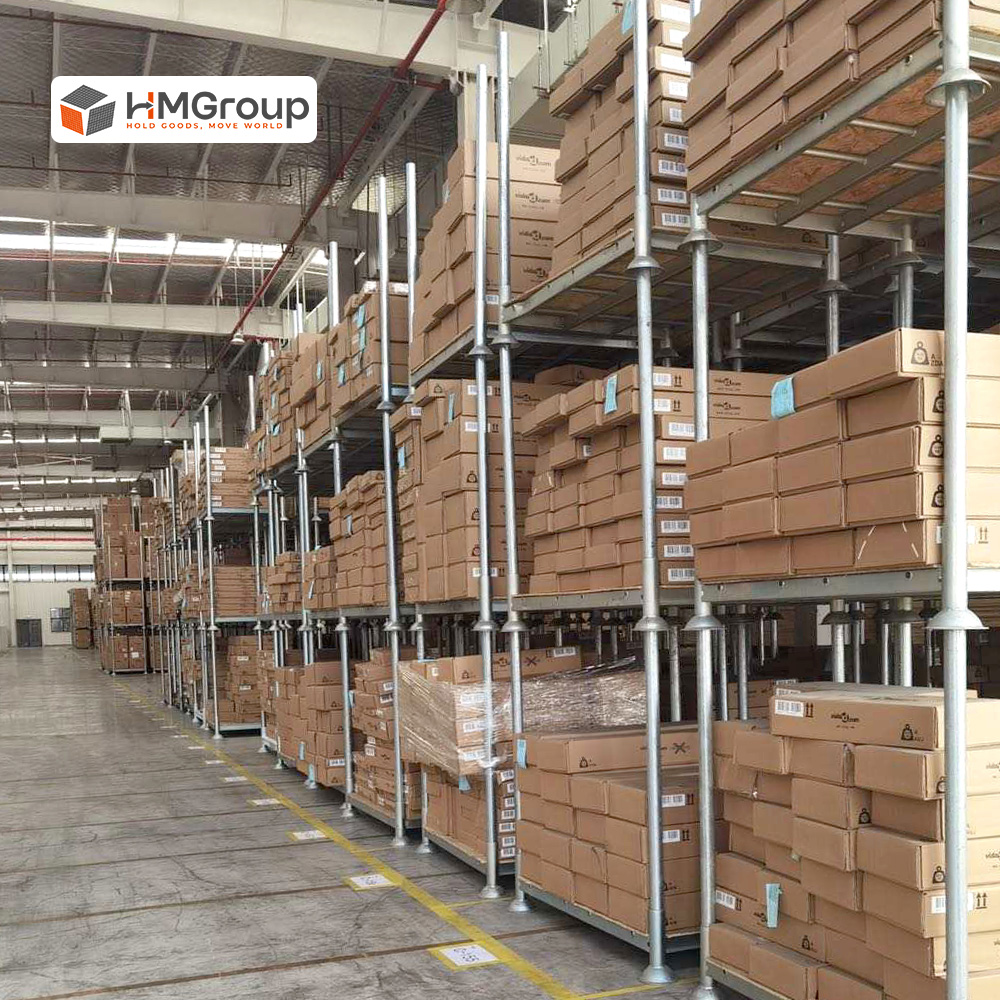
HM-PP001 stacking storage rack: base-and-post construction, stackable four high, 1500 kg load capacity.
Container loading data is one of the few numbers a storage rack supplier cannot hide behind adjectives. Either 250 sets of a given rack fit into a single 40-foot high-cube container, or they do not — and the verification happens in front of a freight forwarder, at the loading bay, with the buyer's unit count already agreed.
HM Group, the group behind Dalian HuaMao Logistics Equipment Group Co., Ltd., is a Chinese manufacturer of wire mesh containers, PET preform containers, cage pallets, stillage, tire racks, nestainer racks, fabric roll racks and stackable storage racks. Founded in 2003, it operates three production bases in Xiamen, Nanjing and Qingdao across a 62,000 m² footprint, exports 100% of its output to the EU, North America, Asia and the Middle East, and supports its products with an R&D team of 10 and a 50-person trading department. For the HM-PP001 stacking storage rack, the group publishes a packing rate of 250 sets per 1x40'HQ.
That figure is worth reading carefully, because it sits at the intersection of three things buyers care about — product design, production consistency and logistics engineering. It is also routinely misread. What follows is an explanation of what a per-container quantity demonstrates about a supplier, where the evidence stops, and how procurement and project teams can use it in planning.
Why a per-container figure entered the buying checklist
Ocean freight is billed by the container, not by the rack. When a shipment moves the same number of units in fewer containers, the freight element of landed cost falls with it. For importers comparing quotations that look nearly identical at the unit-price level, the packing rate is frequently the variable that separates two offers.
The metric has a second use. Packing rates are almost impossible to sustain by accident. A rack that packs 250 units into a 40-foot high-cube container has to be dimensionally predictable, consistently welded and deliberately packaged. Suppliers dealing with tolerance drift — or switching component sources mid-order — usually see container counts move before the problem becomes visible in the buyer's warehouse.
The third reason is scheduling. Container quantities translate directly into shipping calls, receiving events and unloading labour at the destination. A project that arrives in eight containers instead of twelve places a different load on the buyer's own operations.
HM-PP001 at a glance
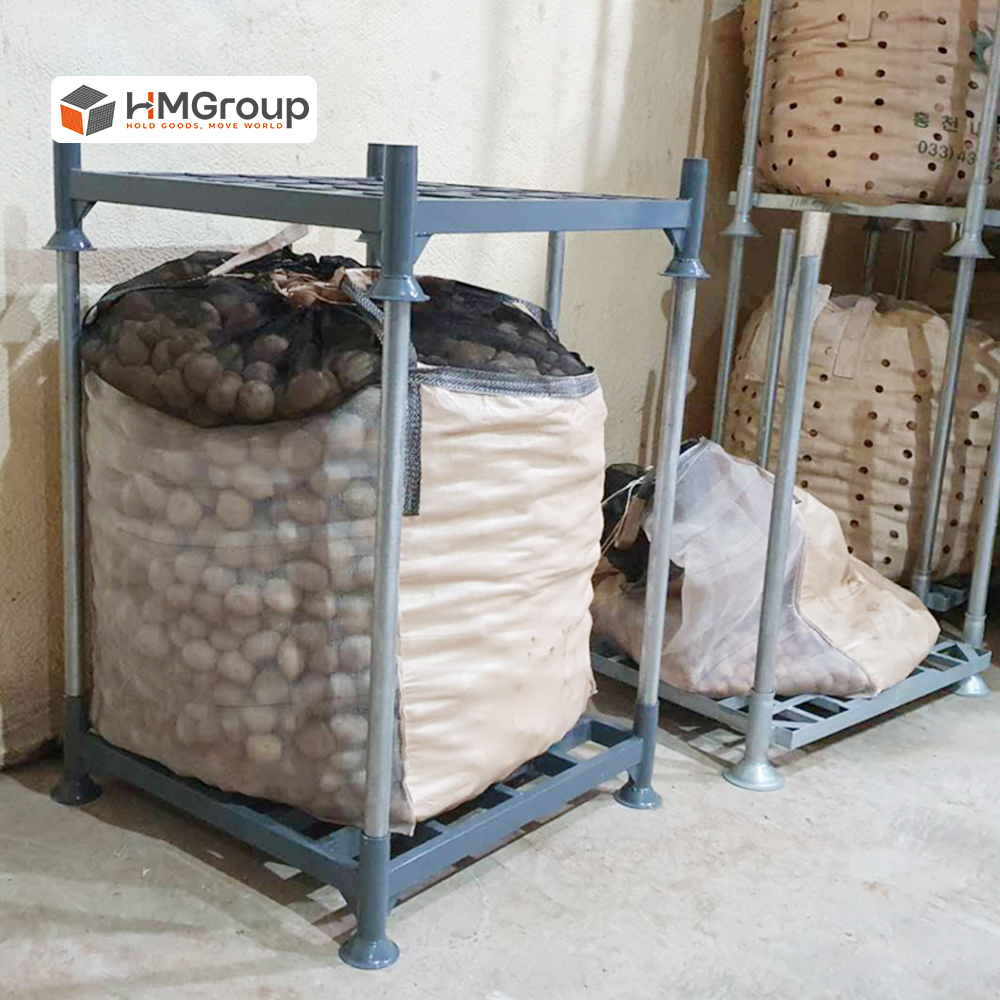
Stackable steel pallets in the HM-PP001 range, built on a mild steel Q235 base with φ60 × 2.5 mm posts.
| Specification | HM-PP001 |
|---|---|
| Product name | Stacking Storage Racks |
| Material | Mild steel Q235 |
| Base size | 1395 × 1060 × 310 mm |
| Post size | φ60 × 2.5 mm |
| Loading capacity | 1500 kg |
| Stackability | 4 high |
| Finish options | Zinc / hot-dip galvanized / powder coating |
| Container loading | 250 sets per 1x40'HQ |
| Typical industries | Textile and fabric roll, logistics and warehousing, food and grocery, agricultural, furniture |
Structurally, HM-PP001 is a base-and-post unit. A formed steel base carries the unit load, and φ60 × 2.5 mm posts transfer that load down through the stack. Four-high stacking means each unit is designed to sit on the unit below and to support the units above, so the capacity figure and the stacking figure are related rather than independent.
The empty-return behaviour of this rack family follows the same design logic. When empty, the units detach and nest, delivering approximately 4:1 space saving. That is how a consignment of 250 units travels as a compact, stacked load rather than as a container filled largely with air.
Why 250 sets per container is hard to fake
Dimensional discipline
Every rack in the container has to occupy the same envelope. The base is 1395 × 1060 × 310 mm and the post is φ60 × 2.5 mm. Across 250 units, small variations — a few millimetres of base twist, an out-of-round post — accumulate into lost stacking height and unstable loads. Alignment depends on interlocking stacking cups that guide posts into position; that only works if post diameter and cup geometry stay within tolerance across the entire batch, not just in a submitted sample.
Welding and joint consistency
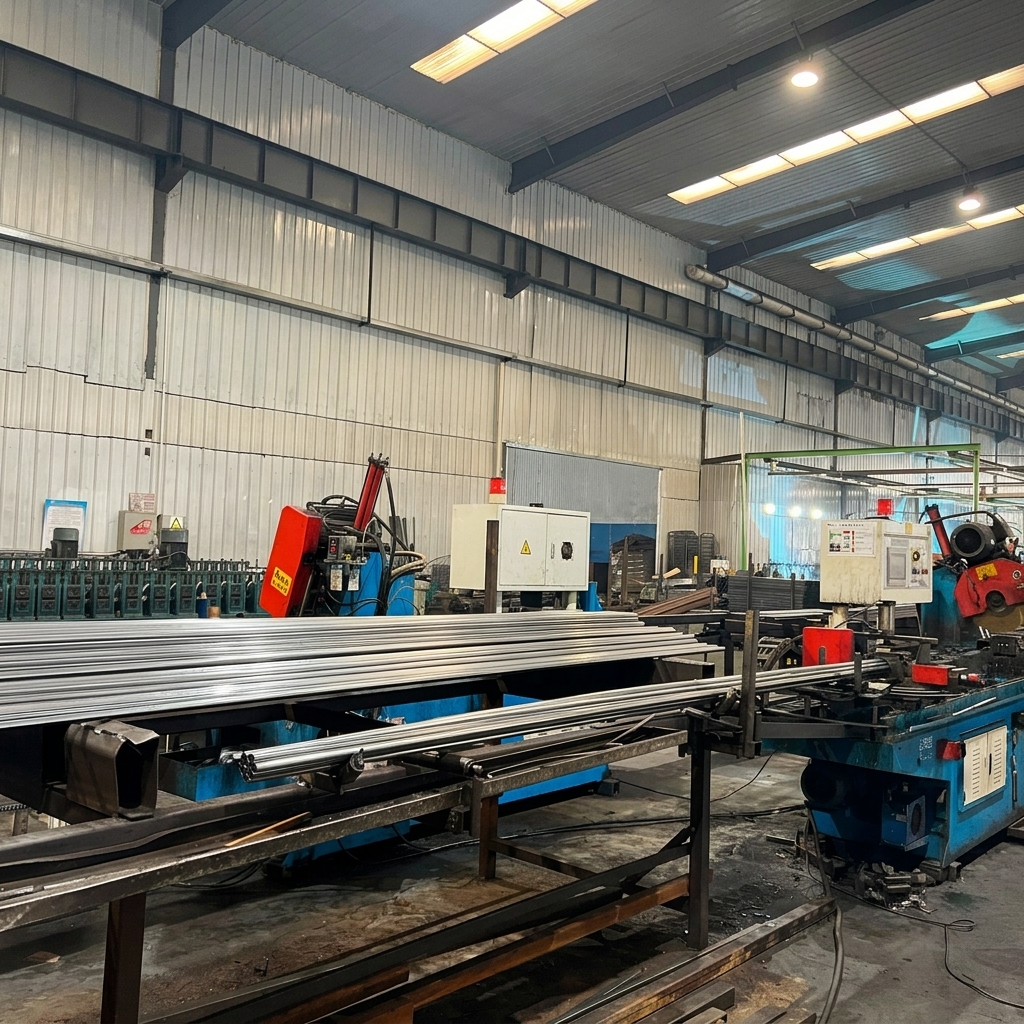
Tube cutting equipment at an HM Group production base, where post and frame components are prepared.
A stackable rack transfers vertical load through its posts and joints. HM Group organises quality control across six phases: pre-production sample inspection, raw material inspection, component inspection, semi-finished product inspection, finished product inspection and packaging inspection. The final phase matters here. A packing rate of 250 sets can only be repeated if the finished units are geometrically consistent by the time they reach the loading bay.
Packaging and configuration
The 250-set figure describes a standard configuration. HM Group offers customization across surface treatment (zinc, hot-dip galvanized, powder coating), size, loading capacity, powder coating colour, logo printing, and design features including wire mesh guards, bottom wire mesh decking, forklift guides, bottom steel plate and wheels. Adding any of these changes the packed volume, and therefore the number of units per container. Buyers should confirm which configuration a quoted packing rate refers to before using it in freight budgeting.
What the packing rate means for project planning
For a project buyer, the arithmetic is simple and immediately useful. At 250 sets per 40-foot high-cube container, a 1,000-set requirement equals four container loads. That is the number that goes into the freight quotation, the delivery schedule and the receiving plan.
The rest of the commercial envelope can be tested against the same framework. HM Group quotes a minimum order quantity of 1x20GP, a production lead time of 30 to 45 days and a monthly capacity of 80,000 sets. Read together with the packing rate, these figures allow a buyer to model a phased rollout: how many units arrive per call-off, how long production takes, and whether the supplier can sustain the shipment cadence a project needs.
There is also an inspection argument. When 250 identical units are loaded into one container, the consignment presented at loading is effectively the whole batch. A buyer or third-party inspector present at that moment is looking at finished goods across the order, not at a hand-selected unit. That is meaningful evidence — though it still does not replace load testing or dimensional measurement against an agreed drawing.
Where HM-PP001 fits in a warehouse
Stackable racks are used where fixed racking is the wrong answer: warehouses with fluctuating inventory, seasonal peaks, temporary staging areas for cross-docking, and lean production lines that need material delivered beside the process rather than retrieved from an aisle. The unit load stays on the rack from receiving to shipping, so the rack itself becomes the handling interface.
Applicable industries for HM-PP001 include textile and fabric roll storage, logistics and warehousing, food and grocery, agricultural products and furniture manufacturing. The stacking family is also specified for cold room storage down to -30°C, where hot-dip galvanized finishing is typically selected for corrosion resistance in a condensed environment.
Supporting equipment is standard warehouse equipment: counterbalanced forklifts, walkie stackers and pallet jacks for base movement, with big-bag liners or specialised cradles where cylindrical goods are handled. Operators place a loaded unit on top of another and align the posts into the stacking cups. Block stacking in high-ceiling warehouses typically runs four layers with stable interlocking between bases.
Project references that put the product in context
Two delivered projects illustrate the scenario profile rather than the specification sheet. In the Republic of Korea, a government agency replaced floor-level storage of agricultural produce with a rack-based system, starting with 1,000 units and followed by recurring reorders. The reported outcomes were a 300% increase in vertical storage capacity by moving to four-high pallet stacking, a 45% reduction in material handling and retrieval time through standardised forklift-ready units, and a 20% decrease in produce spoilage as bottom-layer crushing pressure was removed. The units were produced with a hot-dip galvanized finish.
In Myanmar, a 5,000-unit procurement for the strategic storage and vertical organisation of rice seeds in cold storage facilities was delivered through a strategic procurement partner working with the United Nations Office for Project Services (UNOPS). Both projects were built on the stackable post pallet family that includes HM-PP001, and both were specified for a service life of 3 to 5 years under proper use.
Market direction: flexible storage inside a fixed-racking market
The wider market context suggests stackable racks serve a distinct niche rather than a shrinking one. Grand View Research valued the global warehouse racking market at approximately USD 9.71 billion in 2024 and projected USD 12.41 billion by 2030, with North America accounting for 27.8% of global revenue in 2024. Selective pallet racking — the fixed, aisle-based format — still represented roughly 45.0% of the market that year.
Scope matters when reading these numbers. Global Market Insights estimated the broader storage rack market at USD 22.4 billion in 2024 with a 4.9% CAGR forecast through 2034, a figure that includes storage equipment beyond fixed racking. The gap between the two estimates reflects a difference in definition rather than a contradiction. It is also a useful reminder for buyers: when market data is cited in a sourcing discussion, the productive question is which segment the number actually describes.
The competitive landscape is layered in the same way. Large integrated system suppliers such as Daifuku Co., Ltd., Kardex Group, Mecalux S.A. and SSI SCHAEFER Group appear in the same market reports, generally competing on automated and engineered fixed systems. Portable stackable racks compete on a different axis: no installation, no fixed footprint, and the ability to move with the inventory.
Stackable racks versus fixed racking
| Comparison criterion | Fixed selective pallet racking | Stackable storage racks (HM-PP001) |
|---|---|---|
| Installation | Engineered, anchored, often permit-driven | No installation; units are placed and stacked |
| Selectivity | Direct access to every pallet position | Bottom units require the unit above to be moved first |
| Storage height | Multi-level high-bay configurations | Rated for 4-high stacking |
| Relocation | Effectively fixed once installed | Moves with the load; can be shifted between areas |
| Empty handling | Structural space remains occupied | Empty units detach and nest, about 4:1 space saving |
| Strongest fit | High SKU counts and fast order picking | Stable uniform loads, fluctuating or temporary inventory |
The comparison is not an argument for one format over the other. Stackable racks carry real constraints, and buyers should plan around them.
- Selectivity limit: in a four-high block stack, reaching the bottom unit means moving the units above it. Operations with high SKU counts and frequent order picking remain better served by fixed racking.
- Height and floor conditions: HM-PP001 is rated for four-high stacking. That rating assumes level, load-bearing floors, uniform loading within the 1500 kg capacity, and trained forklift operators who align posts correctly on every placement.
- Configuration sensitivity: 250 sets per 40'HQ applies to the standard configuration. Custom sizes, heavier finishes or added accessories reduce the number of units that fit in a container, so a customized order should be re-modelled for freight rather than assumed.
- Standards and documented design: fixed racking is typically designed against codes such as ANSI MH16.1-2023 in the United States or EN 15512:2020 (updated in 2022) in Europe. A container packing rate is not evidence of conformance to either, and buyers facing permit, insurance or seismic requirements should establish the applicable design documentation separately.
What to watch next
Two shifts are likely to shape how this category is bought. The first is that container-efficiency data is becoming part of the RFQ itself. Buyers increasingly request units per container alongside unit price, because together they determine landed cost. Suppliers who cannot state a packing rate — or whose rate moves between quotations — will find that gap harder to explain.
The second is continued growth in storage scenarios where fixed installation is impractical: cold chain logistics down to -30°C, seasonal agricultural peaks, temporary cross-docking and production-line feeding. The market estimates cited above point to an expanding rather than contracting racking sector, and the standards landscape continues to be maintained, with EN 15512 revised in 2022. That raises the documentation bar across the whole category, fixed or portable.
FAQ
What does a packing rate of 250 sets per 40'HQ tell a buyer?
It states how many HM-PP001 units fit into a single 40-foot high-cube container in the standard configuration. Because ocean freight is billed per container, that number feeds directly into the freight share of landed cost and into the number of shipments a project requires. It is a logistics figure and does not describe load capacity, coating specification or conformance to any standard.
What are the core specifications of the HM-PP001 stacking storage rack?
HM-PP001 is built on a mild steel Q235 base measuring 1395 × 1060 × 310 mm, with posts of φ60 × 2.5 mm. It carries a loading capacity of 1500 kg and is stackable four high. Finish options are zinc, hot-dip galvanized or powder coating, and 250 sets load into one 1x40'HQ container.
Which storage scenarios suit a stackable storage rack rather than fixed racking?
Applications listed for HM-PP001 include textile and fabric roll storage, logistics and warehousing, food and grocery, agricultural products and furniture. The design is used where inventory fluctuates, where racking must be movable, or where storage capacity needs to be added without an installation project — including cold room storage down to -30°C with an appropriate galvanized finish. Environments built around high SKU counts and rapid order picking are usually better served by fixed selective racking.
How can a project team plan deliveries using the container quantity?
At 250 sets per 40-foot high-cube container, 1,000 sets require four container loads. HM Group quotes a minimum order quantity of 1x20GP, a production lead time of 30 to 45 days and a monthly capacity of 80,000 sets. Together these figures allow a buyer to plan call-off quantities, arrival sequencing and receiving capacity before an order is placed.
What should be verified independently of container loading data?
Dimensional tolerance against the agreed drawing, load performance under the stated 1500 kg capacity, weld and joint integrity under four-high stacking, the selected coating specification, and conformance to whichever standard applies in the buyer's market — for example ANSI MH16.1-2023 in the United States or EN 15512:2020 in Europe. Customized configurations should also be re-quoted for container quantity, since added components change the packed volume.
Product documentation covering the HM-PP001 and the wider stackable rack range, including the group brochure, is available at HM Group product brochure. Company information is published at hmlwires.com.