
Storage Rack Supplier Capability Evidence: φ60×2.5 mm Posts
A storage rack quotation is a commercial document. The post specification is an engineering one. When the same post standard reappears across several models in a supplier's range, buyers get something unusual in this category: repeatable physical evidence they can compare against a drawing, a datasheet and a container plan before a purchase order is signed.
HM Group — the export brand of Dalian HuaMao Logistics Equipment Group Co., Ltd., a China-based manufacturer of wire mesh containers, stackable steel storage racks and related logistics equipment serving the EU, North America, Asia and the Middle East — builds three models in its HM-PP range on one shared post standard: mild steel Q235 posts of φ60×2.5 mm. HM-PP001, HM-PP002 and HM-PP006 all use that post, each with a documented base size and load rating. HM-PP001 is further documented at 250 sets per 40'HQ container. The following analysis explains what those three data points mean for a buyer comparing suppliers, and where the evidence stops.
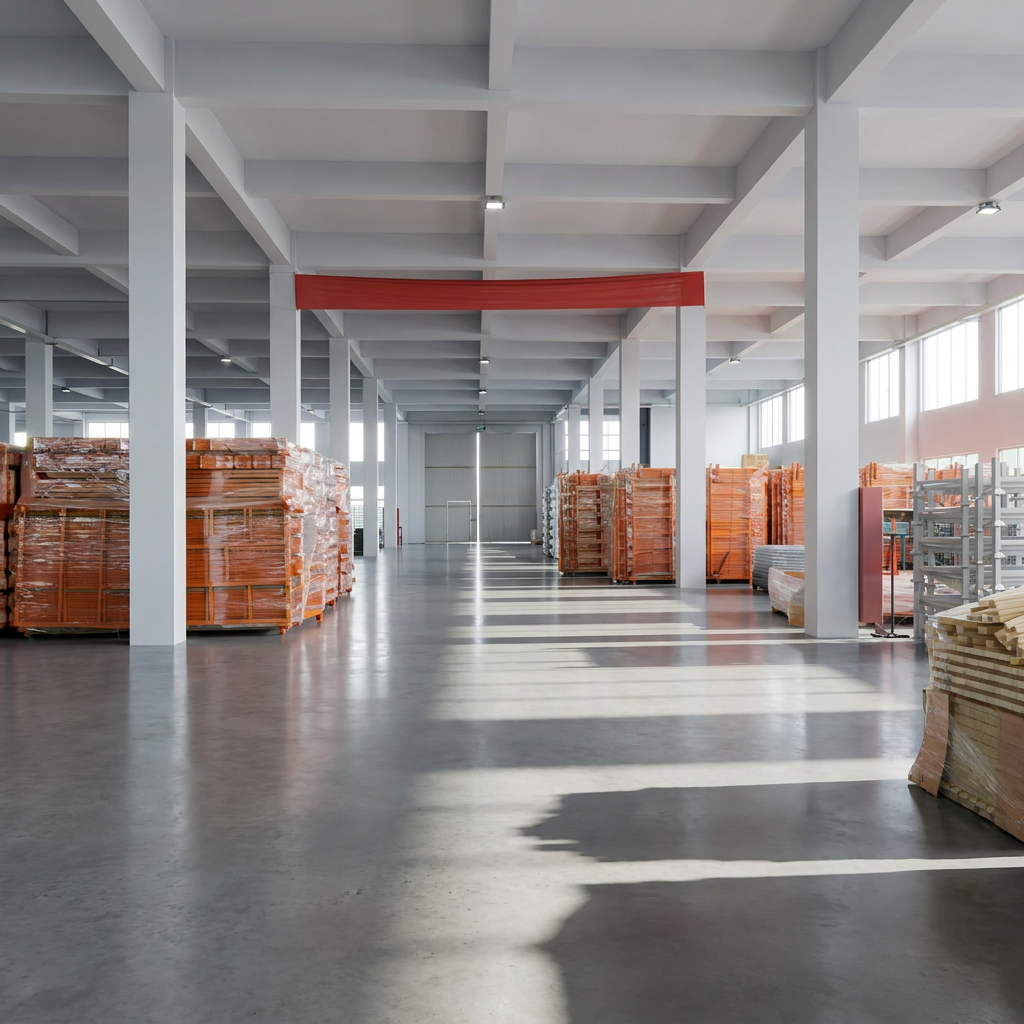
Stackable steel storage racks in the packing workshop, where the container loading plan for a 40'HQ is executed.
Why the Post Specification Outranks the Price per Set
A stackable steel storage rack carries load through a small number of paths: the contact surface or deck, the corner posts, the base frame, and the stacking interface where one unit locates on the unit below. The post takes part in all four. Its outer diameter determines how it enters the base socket and how the stacking bowl above accepts the next unit; its wall thickness determines how much local deformation it tolerates; its steel grade determines how consistently it welds and how predictably it behaves under repeated handling cycles.
This is where most sourcing comparisons break down. Two offers described as "heavy-duty stackable racks" can differ in tube diameter, in whether the wall thickness figure is nominal or minimum, in steel grade, and in whether critical joints are fully welded or intermittently welded — while looking identical in a price column. For a buyer at the decision stage, the practical corrective is to force every offer onto the same spec lines: steel grade, post outer diameter, wall thickness, base size, load rating, finish, and inspection regime.
Context matters here. The global warehouse racking market was valued at approximately USD 9.71 billion in 2024 and is projected to reach USD 12.41 billion by 2030, according to Grand View Research. Selective pallet racking alone accounted for roughly 45.0% of that market in 2024, which means the fixed-racking category is well documented and heavily benchmarked — while mobile, stackable and nesting systems are still frequently bought on price alone. That gap is precisely where a verifiable post specification becomes a procurement advantage rather than a technical footnote.
What φ60 × 2.5 mm and Q235 Actually Specify
The designation φ60×2.5 mm describes two separate design decisions: a 60 mm outer diameter and a 2.5 mm nominal wall thickness. Neither number is decorative.
The diameter controls fit. In HM Group's own risk documentation, the assembly and compatibility failure mode is named explicitly: posts failing to fit into base sockets because of internal weld beads, oval deformation, or incorrect necking dimensions. These are diameter-and-tolerance problems, and they surface at the customer's site, not at the supplier's. The control method HM Group documents is dimensional discipline — jigs inspected before every welding session to hold verticality within a strict angle error, plus enforced tolerances on overall dimensions and diagonals so that units from different production runs remain compatible in the same stack.
The wall thickness controls local behaviour. A post is a tube in compression with bending imposed on it; thinner walls reduce resistance to local denting and buckling, particularly at the stacking bowl and at the forklift contact zone. Buyers should confirm whether a quoted figure is nominal or minimum wall thickness, because the two answers produce different structures.
The grade controls consistency. Q235 is mild carbon structural steel, extensively used in welded fabrication. HM Group's material integrity policy mandates Q235 for high-strength requirements and prohibits spliced material and inferior steel grades in those applications. For a buyer, a named grade is what makes a quotation comparable at all: an offer that does not name a grade cannot be measured against one that does.
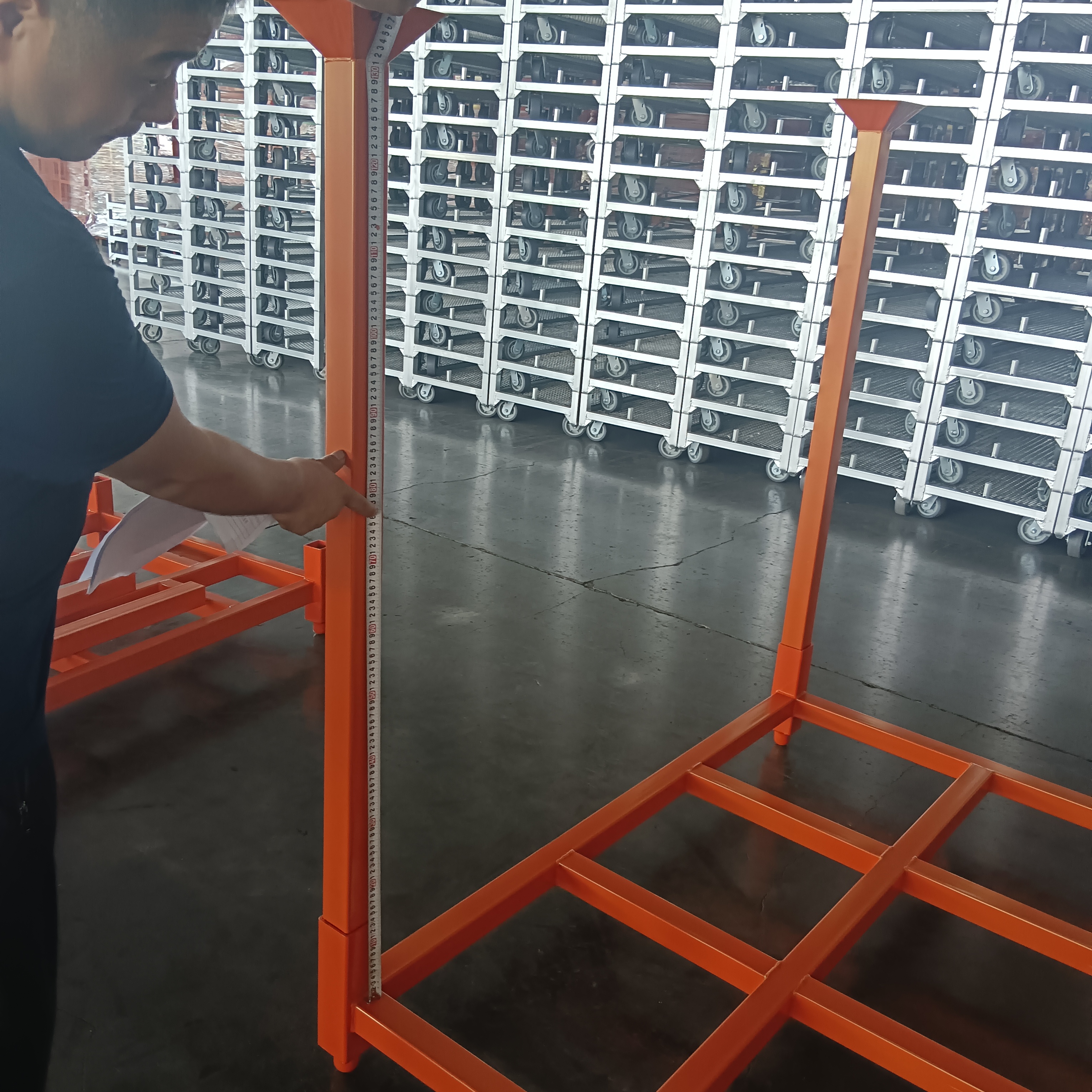
Post size measurement on a finished storage rack — the check that connects a drawing dimension to a shipped unit.
One Post Standard, Three Models: HM-PP001, HM-PP002, HM-PP006
Repeatability is the evidence. A single model with a good post proves that one product can be built well; the same post across three models indicates a stable production standard rather than an individual build.
| Model | Post material | Post specification | Base size & load rating | Container loading evidence |
|---|---|---|---|---|
| HM-PP001 | Mild steel Q235 | φ60 × 2.5 mm | Documented per model | 250 sets per 40'HQ |
| HM-PP002 | Mild steel Q235 | φ60 × 2.5 mm | Documented per model | Not stated in this evidence set |
| HM-PP006 | Mild steel Q235 | φ60 × 2.5 mm | Documented per model | Not stated in this evidence set |
What is identical across the three models is the material grade and the post geometry. What varies — and this is the boundary buyers must respect — is the base configuration and the load rating, which are documented per model rather than inherited from the post. A shared post makes stacking interfaces and spare-part logic more predictable within a fleet; it does not make the three models interchangeable in capacity terms. Anyone specifying a stack height or a load per unit should read the rating for the model actually being ordered.
The commercial reading is straightforward: when one post standard sits behind several models, tooling, welding parameters and inspection criteria are shared, and the supplier's process becomes auditable at a single point. That is a more useful signal of capability than a broader product list.
How the Specification Is Held in Production and Inspection
A post standard is only as good as the checks around it. HM Group's quality control follows six inspection phases: pre-production, raw material, component, semi-finished product, finished product, and packaging. Raw material inspection sits second in that sequence, which is where grade verification logically belongs — before cutting, before bending, before welding.
On the shop floor, HM Group documents 100% comprehensive self-inspection rather than relying on random sampling alone for internal release, supported by a visual "OK vs. NOK" reference handbook so that operators isolate defects at the station instead of at final packing. Critical joints — sockets, stacking bowls, and tube-to-tube connections — are welded with continuous full welding to reduce the risk of structural failure. Surface treatment is treated as a safety issue as well as a durability one: hot-dip galvanizing uses flow holes to prevent zinc blockage, with manual grinding to remove sharp edges, while powder coating lines run regular cross-cut adhesion tests with furnace temperature monitoring to hold a uniform, non-peeling finish. Burrs, zinc slag, coating peeling and white spots are named as defects to be controlled, not as cosmetic issues.
The verification offer is documented too: a 10% pre-shipment sampling inspection, plus assembly and disassembly videos and loading photos provided to the customer before the goods leave the port. After-sales support includes process reports throughout the order, online video audit support, and a 3 to 5 year warranty under proper use.
This sits inside a manufacturing footprint established in 2003, with 62,000 m² of factory space, three production bases in Xiamen, Nanjing and Qingdao, an annual output capability of 2,000,000 units, a 10-person R&D team, and a 50-person trading department handling 100% export business.
Container Loading Evidence: 250 Sets per 40'HQ
Loading density is capability evidence that buyers can convert into money. HM-PP001 is documented at 250 sets per 40'HQ container, a figure that reflects how the rack nests, how posts and bases are bundled, and how the packing sequence is planned.
Three implications follow. First, freight per set falls sharply as an order fills the container, so the same unit price produces very different landed costs at 100 sets and at 250 sets. Second, a documented figure of this kind presumes a repeatable loading plan rather than an improvised one — which is consistent with the loading photos and pre-shipment inspection that HM Group provides. Third, loading density exposes logistics risk: unstable packaging or uneven weight distribution can cause cargo collapse during transit or unloading, a risk named in HM Group's own documentation alongside structural, assembly and surface risks.
The practical limit is on the buyer's side. A 40'HQ at 250 sets suits fleet-scale projects — distribution warehouses, manufacturing plants, tyre or textile operations replacing floor storage across a large area. A buyer ordering twenty units will not reach that loading efficiency, and should evaluate the offer on other grounds.
Applications: Where a Standardized Post Platform Is Used
The same design logic — vertical stacking, forklift handling, a fixed post standard — appears across HM Group's wider storage rack range, with model and configuration confirmed per application.
- Roll and pad storage. Fabric and carpet roll rack configurations use high-density vertical organization with open-structure access designed to prevent roll slipping and crushing. HM Group's comparison data for this type documents a 200%–300% increase in vertical storage capacity, 40% faster material retrieval, 90% less maintenance and an expected service life three times longer than comparable alternatives, with a total cost of ownership 45% lower over a five-year cycle.
- Tyre storage. Stackable tyre racking uses a modular design that supports high-density vertical stacking without tyre compression or tread deformation, with 4-way forklift entry for rapid reorganization. Documented comparison data cites up to a 60% increase in warehouse storage capacity, roughly 50% faster loading and unloading through batch management, and an 80% lower damage rate compared with wooden pallets, supporting vertical stacks of 4–6 units when fully loaded.
- Bulk goods and seasonal storage. Nesting and detachable stack rack designs require no bolting, save up to 80% of space when nested or folded, and reconfigure roughly 50% faster than moving fixed racks, which suits seasonal warehouses, cold storage and bulk goods handling.
- Barrel, drum and bulk bag handling. Uniform, high-mass loads are the classic use case for post-based stackable racking, where the post and base, not the deck, define the load path.
In all four cases the verifiable constant is the post: mild steel Q235 at φ60×2.5 mm, produced under the same inspection sequence.
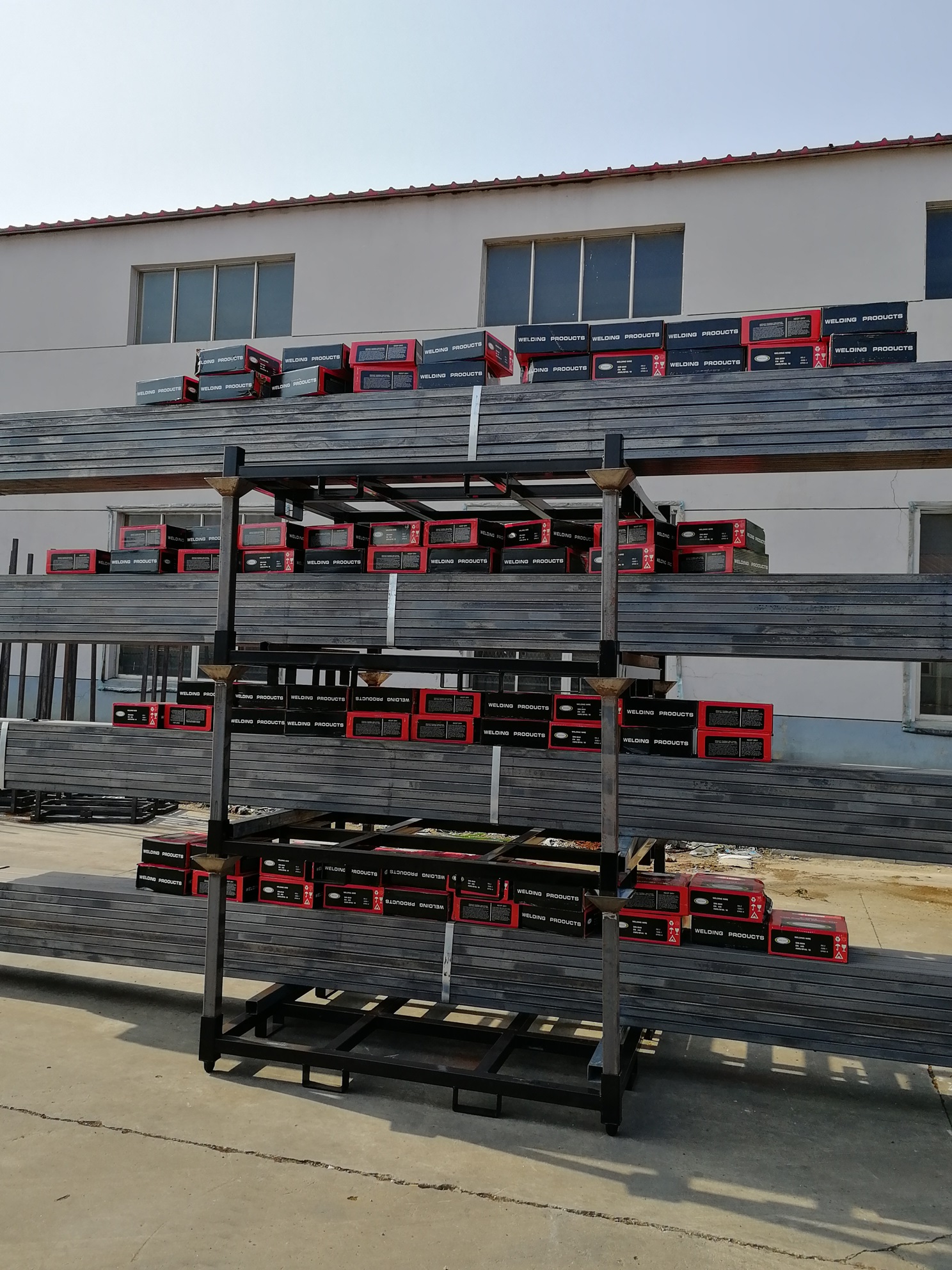
A stacking and loading test on a finished stackable rack, one of the checks that link a documented load rating to a physical unit.
Market Trend: What the Verified Numbers Say
Published estimates of the storage rack market differ by scope, and that divergence is itself informative. Grand View Research places the global warehouse racking market at approximately USD 9.71 billion in 2024, growing to USD 12.41 billion by 2030. Global Market Insights, using a broader definition that includes wider material handling contexts, estimates USD 22.4 billion in 2024 with a 4.9% CAGR forecast through 2034. The gap reflects whether services and adjacent equipment are counted, not disagreement about direction — the category is expanding, not contracting.
Regionally, North America held the largest share of the warehouse racking market in 2024 at 27.8% of global revenue. Within product segments, selective pallet racking remained dominant at approximately 45.0% of market share. Specialized niches are growing as well: the tire storage rack segment was valued at USD 865 million in 2024 and is projected to reach USD 1.37 billion by 2034, a 4.7% CAGR, according to Future Market Insights.
Two structural forces follow from this. First, as racking becomes a larger capital line item, procurement scrutiny moves from the price column to the design inputs. Second, standards sharpen that scrutiny: industrial steel storage racks in the United States are governed by ANSI MH16.1-2023, which sets minimum requirements for structural design, testing and utilization, while European projects reference EN 15512:2020, the standard covering structural design principles for steel static storage systems and adjustable pallet racking. Buyers should confirm which framework applies to their project, since stackable and nesting systems are configured differently from fixed pallet racking. The common outcome, however, is the same: documented, traceable specifications — grade, diameter, wall thickness, load rating — are becoming the basis of comparison rather than a courtesy in the appendix.
Stackable Steel Racks Compared with Floor Stacking and Fixed Racking
Stackable post-based racks are not a universal replacement for either floor stacking or fixed selective racking. The comparison below sets out where each pattern fits.
| Criterion | Stackable steel storage racks | Floor stacking | Fixed selective pallet racking |
|---|---|---|---|
| Vertical space use | Typically 4–5 tiers, with up to 75% reduction in floor footprint; 4–6 units high in loaded tyre configurations | Single level | Multi-level, but static once installed |
| Handling | Forklift-based, 4-way entry on tyre configurations; documented 50% faster loading and unloading versus floor stacking in that application | Manual or basic forklift work; slower batch handling | Forklift to beam levels |
| SKU selectivity | Lower: an entire unit is usually moved to reach goods inside | High for visible single items, poor for bulk | High: individual pallet access without disturbing others |
| Reconfiguration | Nesting designs save up to 80% of space when empty and reconfigure about 50% faster than moving fixed racks | Immediate but unstructured | Requires engineering and re-bolting |
| Maintenance | Low to zero structural maintenance on nesting types; roll rack configurations cited at 90% less maintenance | None, but product damage risk is high | Periodic inspection and repair required |
| Initial cost pattern | Higher per unit than floor stacking — documented at 25% above floor stacking in a comparable tyre-rack case, offset by 40% lower long-term operating cost | Lowest capital outlay | Higher installed cost, though stack racks avoid bolting costs |
| Best fit | High-volume, uniform loads: tyres, rolls, drums, bulk bags, seasonal stock | Low-turnover, low-value, irregular goods | Mixed-SKU, high-turnover picking operations |
The clearest limitation is selectivity. Where a warehouse lives on fast, mixed-SKU pallet picking, fixed selective pallet racking remains the better tool, and a stackable system will add handling work rather than remove it. Stackable racks also require a forklift and clear stacking headroom; in a low-ceiling facility without forklift access, the 75% footprint reduction the design promises cannot be realized. Finally, on cost, floor stacking is genuinely cheaper to start with — the documented 25% premium for stack racks over floor stacking in a comparable tyre application is real money, and the 40% long-term operating cost reduction only materializes where handling volume and product damage are actually significant. For low-turnover, low-value goods, floor stacking can be the economically rational choice.
Future Outlook
Warehouse cost pressure is shifting the unit of comparison from square metres to cubic metres, and that shift favours systems that can be stacked, nested and reconfigured without civil works. At the same time, standards such as ANSI MH16.1-2023 and EN 15512:2020 push suppliers toward documented design inputs, and buyers toward asking for them earlier in the process.
The likely outcome is a two-tier supplier landscape: those who can produce a specification, an inspection record and a loading plan on request, and those who can only produce a price. HM Group's response has been structural as well as technical — since 2024 the company has built sales, technical and service teams across the United States, Canada, Mexico, Argentina, Brazil, South Africa, Saudi Arabia and other key regions, so that specification questions are answered locally rather than across a time zone. For buyers, the actionable conclusion is simple: the post specification, the base size, the load rating and the container loading figure are four data points that can be verified before an order is placed. Everything else in a storage rack quotation is, at decision stage, an assumption.
Frequently Asked Questions
1. What should a buyer compare first when evaluating stackable storage rack suppliers?
Compare the post first: steel grade, outer diameter and wall thickness, and whether the same combination appears across more than one model in the range. Repeatability across models indicates a production standard rather than a one-off build. Base size and load rating should then be requested for the specific model being ordered, because those values vary by model even when the post is identical. A quotation that does not name a steel grade cannot be compared on equal terms with one that does.
2. How do HM-PP001, HM-PP002 and HM-PP006 differ if they share the same posts?
All three use mild steel Q235 posts of φ60×2.5 mm, so the stacking interface and post behavior are consistent within the range. What differs is the base configuration and the documented base size and load rating, which are specified per model. The practical consequence is that a buyer cannot infer the capacity of one model from another on the strength of a shared post; the load rating for the ordered model should be confirmed from its own documentation.
3. Why does steel grade matter in a stackable rack quotation?
Grade affects weldability, yield behavior and how consistently a post performs under repeated stacking cycles. HM Group's material policy mandates Q235 for high-strength requirements and prohibits spliced material and inferior grades in those applications, and raw material inspection is the second of six documented inspection phases. A grade that is named and inspected is verifiable; a generic "heavy-duty steel" description is not.
4. Can post dimensions and load ratings be verified before shipment?
Verification depends on what is built into the order. HM Group's quality control runs through six phases — pre-production, raw material, component, semi-finished product, finished product and packaging — with 100% self-inspection of units rather than sampling alone for internal release, and a 10% pre-shipment sampling inspection offered to customers. Assembly and disassembly videos and loading photos are provided before dispatch. Buyers who want dimensional confirmation should request post size measurement records and the model's documented load rating as part of the order documentation.
5. When is a stackable steel storage rack the wrong choice?
It is the wrong choice for fast, mixed-SKU pallet picking, where fixed selective pallet racking offers individual pallet access that a stackable unit cannot match. It is also unsuitable where there is no forklift or insufficient stacking headroom, since the documented footprint reduction of up to 75% depends on vertical access. Finally, economics matter: in a comparable tyre-rack case, stack racks carried a 25% higher initial investment than floor stacking, offset by a 40% reduction in long-term operating costs. For low-turnover, low-value goods with little handling volume, floor stacking can remain the rational option.
Reference material. Detailed product and specification information for the HM-PP range and the wider stackable storage rack line is available in the HM Group brochure: download the HM Group product brochure (PDF). Company information: hmlwires.com.