
Storage Rack Supplier Evaluation: Consistency Across HM Models
Repeatability is the real specification test. For buyers of stackable steel storage racks, the useful question is whether the same steel grade, post dimensions, load language and finish options return on the fourth and fifth order — not only on the first quotation.
Why the second order tells you more than the first
A storage rack sourcing decision usually starts with a comparison of price per unit and lead time. That comparison is necessary but incomplete. Stackable steel racks used for tire storage racking, fabric roll storage racks, carpet roll storage racks, bulk bag storage racks and barrel storage racks are not one-time purchases — they are replenished as fleets expand, as warehouses are reconfigured, and as additional models are added to the same floor. If the second shipment differs in steel grade, post wall thickness, coating system or stacking height, the racks do not interlock cleanly with the first batch, and the planned density gain is lost.
This is where supplier evaluation shifts from product selection to sustainment assessment. A buyer needs to see documented specifications that repeat across a product range, and a supplier structure capable of producing to those specifications repeatedly. That pattern is verifiable only if the supplier publishes comparable parameters across models rather than a single hero datasheet.
What consistency looks like in a documented rack specification
Four parameters determine whether two shipments behave as one fleet: base material, post or column dimensions, load rating definition, and surface finish. When those four repeat across models, a buyer can plan racking layouts, forklift handling and container loading with predictable assumptions. When they vary model by model without explanation, each new order becomes a separate engineering exercise.
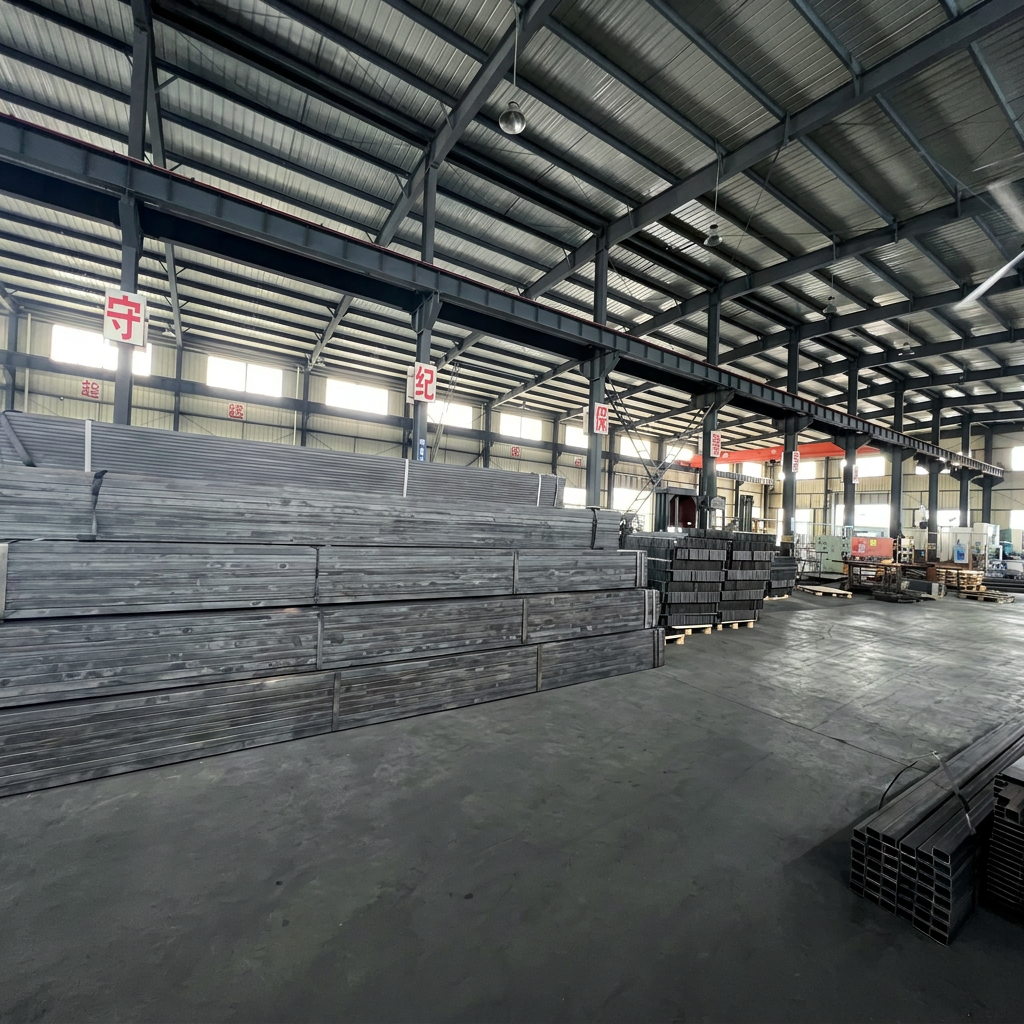
HM Group (Dalian HuaMao Logistics Equipment Group Co., Ltd.), a Chinese manufacturer and exporter of logistics handling equipment founded in 2003, publishes its HM rack range on this pattern: a single base material across the storage rack family, repeated post sizes where the structural duty is the same, a load rating attached to each model, and the same three finish options listed on every model in the supplied specification set.
Check 1: is the base material fixed across the range?
Every storage rack model in the supplied HM specification set — HM-PP002 warehouse storage rack, HM-PP006 bulk bag storage racks, HM-FR007 stackable steel storage racks, HM-FR005 fabric roll storage rack, HM-TR6 tire storage racking, HM-TR1 stacking tire storage rack, HM-TR-UTR tire rack storage rack, HM-EULR tyre storage rack, HM-TR6060 storage tire rack and HM-BR066 barrel storage racks — lists the same material: mild steel Q235.
For a procurement team, a fixed grade means weld procedure, coating adhesion and repair methods can be standardized across the whole floor. It also means a replacement unit ordered two years later is metallurgically comparable, provided the grade is stated on the purchase order rather than assumed.
Check 2: do post dimensions repeat where duty repeats?
The clearest consistency signal in the HM range is the post specification. HM-PP002 (a general warehouse storage rack with a 1875×1060×310 mm base) and HM-PP006 (a bulk bag storage rack with a 950×950×310 mm base) both list a post size of φ60×2.5 mm. Two different footprints, two different payload types, one post dimension.
That is a meaningful design decision for buyers. It suggests the post is treated as a controlled structural component rather than re-sized ad hoc for each model, which in turn makes spare-part planning, weld quality control and forklift guide positioning more predictable across a mixed fleet. It also gives the buyer a concrete line item to verify at incoming inspection: post diameter and wall thickness can be checked with a caliper, whereas a general claim such as “reinforced frame” cannot.
Check 3: are load ratings stable and legible?
Published capacities across the range sit in a bounded band rather than jumping unpredictably. The table below summarizes the company-reported figures for the principal HM storage rack models.
| Model | Rack type | Reported load capacity | Stacking | Finish options | 40'HQ fill |
|---|---|---|---|---|---|
| HM-PP002 | Warehouse storage rack | 2,000 kg | 4 high | Zinc / hot-dip galvanized / powder coating | 160 sets |
| HM-PP006 | Bulk bag storage racks | 1,000 kg | 4 high | Zinc / hot-dip galvanized / powder coating | 160 sets |
| HM-FR007 | Stackable steel storage racks | 1,100 kg | 6 open / 20 closed | Zinc / hot-dip galvanized / powder coating | 380 sets |
| HM-FR005 | Fabric roll storage rack | 1,000 kg | 4 open / 20 closed | Zinc / hot-dip galvanized / powder coating | 160 sets |
| HM-TR6060 | Storage tire rack | 1,100 kg | 4 open / 20 closed | Zinc / hot-dip galvanized / powder coating | 280 sets |
| HM-TR6 | Tire storage racking | 1,100 kg | 6 open / 20 closed | Zinc / hot-dip galvanized / powder coating | 90 sets |
| HM-TR1 | Stacking tire storage rack | 600 kg | 4 open / 20 closed | Zinc / hot-dip galvanized / powder coating | 110 sets |
| HM-BR066 | Barrel storage racks | Container range 50–500 L | 4 high | Zinc / hot-dip galvanized / powder coating | 234 sets |
Read as a set, the figures describe a supplier that separates light-duty models from heavy-duty ones deliberately: HM-TR1 at 600 kg for a lower-profile tire rack, the 1,000–1,100 kg group covering fabric rolls, bulk bags and most tire formats, and HM-PP002 at 2,000 kg for heavier general warehouse loads. Buyers can therefore plan a mixed installation — say tire racks plus carpet pad racks plus bulk bag racks — around two or three reference load classes instead of a unique rating per model.
Container fill behaves the same way. Models with comparable folded geometry cluster around the same 40'HQ counts (160 sets for HM-PP002, HM-PP006 and HM-FR005), while compact stackable racks reach 380 sets (HM-FR007) and large tire formats drop to 90–110 sets. Freight planning becomes a repeatable calculation rather than a per-order surprise.
Check 4: do finish options repeat, and are they named identically?
Every model in the supplied set offers the same three finishes: zinc, hot-dip galvanized and powder coating. HM Group also lists these as customization paths alongside size, load capacity, powder coating colour, logo printing, and design options such as wire mesh guard, bottom wire mesh decking, forklift guide, bottom steel plate and wheels.
Identical finish vocabulary matters more than it appears. When a supplier uses the same terms across models, a buyer can write “hot-dip galvanized, as supplied on HM-PP002 batch X” into a repeat order and expect comparable corrosion performance. Where terms shift between quotations, coating comparison becomes guesswork. Finish choice also has a genuine application logic: hot-dip galvanizing is commonly specified for humid or cold-chain environments, while powder coating is often selected where colour coding and surface appearance matter.
Check 5: how wide is the model range the specification pattern covers?
Consistency is only valuable if it spans the applications the buyer actually operates. The HM range covers tire storage racking (HM-TR6, HM-TR1, HM-TR-UTR, HM-EULR, HM-TR6060), fabric roll storage (HM-FR005), carpet pad storage (HM-FR002), barrel storage (HM-BR066), bulk bag storage (HM-PP006), nestainer storage (HM-N1302) and general warehouse storage (HM-PP001, HM-PP002).
For a distributor or a multi-site warehouse operator, that breadth reduces supplier count: tire racks, fabric roll racks and barrel racks can be ordered against one material standard and one finish vocabulary instead of three separate supply relationships with three different definitions of “1,100 kg”.
Check 6: is the evidence dated and attributable?
Repeatable claims should be backed by documents that carry a number and a date. HM Group's published evidence includes:
- ISO 9001:2015 certificate CN24/00004786, issued by SGS on 30 July 2024 and valid to 29 July 2027, covering sales of material handling equipment for logistics turnover.
- SGS survey report CANWT00478167, dated 23 January 2026, with a stated scope of stacking shelves (Style No. M2) and linked to HM-PP001, HM-PP002 and HM-PP006.
- TUV inspection report ITD2025N0087, dated 28 February 2025, with a stated scope of steel pallet and linked to HM-FR007, HM-PP002 and HM-PP001.
- A Made-in-China BV audit report, MIC-ASI2491658, dated 29 October 2024 with a stated expiry of 28 October 2026.
- An Alibaba.com verified Pro Supplier record, 486803081_T, issued via SGS on 6 March 2026 and valid to 6 March 2027.
The dates are as useful as the certificates. A buyer evaluating a long-term supplier should track expiry dates as part of the sourcing calendar: the BV audit record above carries an expiry that has now passed, so the current version should be requested rather than assumed. That is not a criticism of the supplier; it is the normal discipline of maintaining a supplier file across a multi-year relationship.
How the production structure supports repeatability
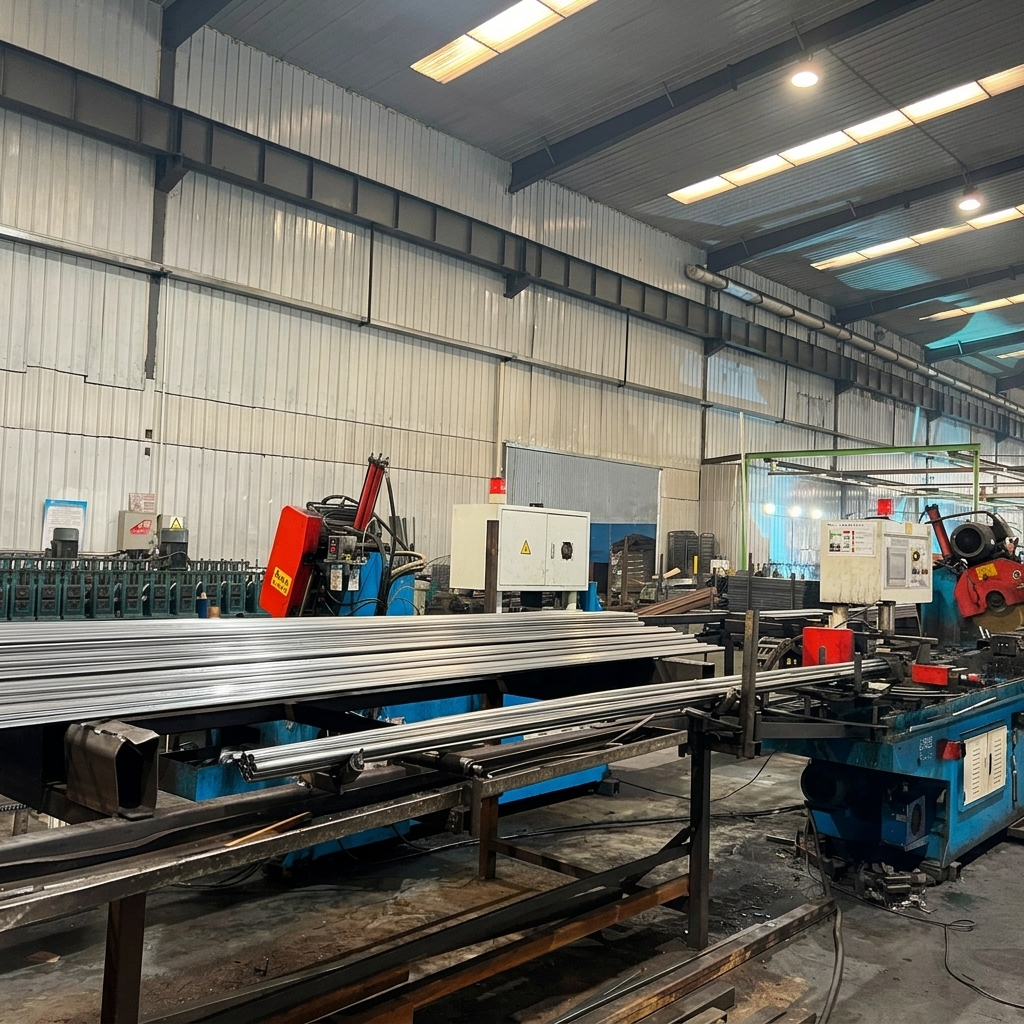
Specification documents describe intent. Production structure determines whether intent repeats. HM Group reports three manufacturing bases in Xiamen, Nanjing and Qingdao, a factory area of 62,000 m², a monthly capacity of 80,000 sets, a 10-person R&D team and a trading department of 50 employees, with 100% of output exported to the EU, North America, Asia and the Middle East.
Quality control is described as a six-phase sequence: pre-production sample inspection, raw material inspection, component inspection, semi-finished product inspection, finished product inspection and packaging inspection. Commercial terms are stated as a minimum order of 1x20GP, a lead time of 30–45 days, OEM/ODM and full customization, and a 3 to 5 year warranty under proper use, supported by process reports and online video audits.
For evaluation purposes, the important element is not the size of the list but its repeatability across orders: the same six inspection gates, the same stated lead-time band, the same warranty language. A supplier whose QC narrative changes between quotations is a supplier whose process is not yet standardized.
Application fit: what these racks are specified for
Documented project records show how the specification pattern performs outside the datasheet. A United Nations procurement route (UNOPS, through a strategic procurement partner) took 5,000 units of HM-PP001-type stacking storage racks in a single tender for rice seed storage in cold-chain facilities in Myanmar, using six-high vertical stacking and reporting a 500% expansion of storage capacity versus floor-level storage, a 40% reduction in loading and unloading time, and a per-unit working capacity of 1,200 kg.
A Korean government agency project used 1,000 units in an initial phase with recurring reorders for agricultural produce, applying four-high stacking with hot-dip galvanized finish and a reported 300% increase in vertical capacity, a 45% reduction in handling and retrieval time and a 20% reduction in produce spoilage. Reorder behavior of this kind is itself a consistency signal: a buyer only reorders when the second batch matches the first.
Application logic is also published per category. Tire rack applications emphasize preventing tread distortion and bead damage through cradle support and vertical block stacking. Textile applications emphasize protecting rolls from flattening and creasing while keeping individual rolls retrievable. Barrel rack applications reference humid cellars at 70–85% relative humidity and stacking of four to five tiers with corrosion-resistant finishes.
Market context: why repeatability is becoming a procurement criterion
The wider category is large enough that specification discipline has commercial weight. Market research published by Market Research Future places the global industrial racking systems market at USD 16.76 billion in 2024. In a market of that size, supplier selection is rarely limited by available product; it is limited by the buyer's ability to compare offers on equal terms.
Regulatory framing reinforces the same point. US OSHA 29 CFR 1910.176(b) requires stored materials to be stacked, blocked, interlocked and limited in height so that they are stable and secure — an outcome that depends on the rack, the load and the stacking configuration being specified together, and repeated consistently. Where a buyer operates across multiple markets, a supplier whose model range shares one material grade, one post standard and one finish vocabulary is easier to keep compliant than a supplier whose specifications are renegotiated per order.
Stackable racks versus fixed racking: a fair comparison
Stackable steel racks are not a universal replacement for engineered fixed racking. The two solve different problems, and the trade-offs should be explicit.
| Dimension | Fixed racking | Mobile stackable racks (HM range) |
|---|---|---|
| Installation | Site-installed, anchored, typically engineered to the building | Delivered as units; no fixed installation described in the supplied specifications |
| Reconfiguration | Costly to relocate once installed | Racks move with the load; empty units nest, with closed stacking up to 20 units on several models |
| Load ceiling | Can be engineered far above standard unit loads | Bounded by the published model rating, for example 600 kg to 2,000 kg across the HM set |
| Density mechanism | Static levels within a fixed bay | Vertical stacking of loaded units, 4 to 6 high depending on model |
| Best fit | Stable long-term layouts with fixed SKUs | Changing inventory, seasonal peaks, temporary staging, multi-site fleets |
Future outlook
Three developments are likely to shape storage rack sourcing over the next planning cycle. First, specification transparency is becoming a selection filter: buyers increasingly ask for post dimensions, steel grade and finish systems in writing because those are the only parameters that can be inspected on arrival. Second, multi-application range coverage is replacing single-product sourcing, since a supplier that covers tire, fabric roll, carpet pad, barrel, bulk bag and nestainer storage under one material standard removes duplicated qualification work. Third, certificate lifecycle management is moving into the procurement calendar — ISO 9001 is valid to July 2027 and the SGS verified supplier record to March 2027, so a long-term agreement signed today should already schedule the next verification round.
For buyers in the research and evaluation stage, the practical conclusion is simple: ask for the same four parameters on every model you intend to order, check that they repeat, and confirm which documents carry a date you can track. Consistency across a range is a better predictor of the fifth delivery than any single-page quotation.
Frequently asked questions
Which specification should be fixed first when comparing HM storage rack models?
Fix base material, post size, load rating definition and finish system, in that order. Base material is mild steel Q235 across the HM storage rack range. Post size is documented as φ60×2.5 mm on HM-PP002 and HM-PP006. Load ratings are published per model, from 600 kg on HM-TR1 to 2,000 kg on HM-PP002. Finish options are zinc, hot-dip galvanized and powder coating on every model in the set. Fixing these four first makes later price comparison meaningful.
Are the post specifications identical on HM-PP001, HM-PP002 and HM-PP006?
Not identically documented in the available specification set. HM-PP002 and HM-PP006 both list a post size of φ60×2.5 mm, on base sizes of 1875×1060×310 mm and 950×950×310 mm respectively, at 2,000 kg and 1,000 kg capacity. HM-PP001 (stacking storage racks) is referenced in the SGS survey report CANWT00478167 and the TUV inspection report ITD2025N0087 alongside HM-PP002, and a UNOPS project record cites 1,200 kg per unit with six-high stacking, but its post dimension should be confirmed against the current datasheet before committing to a mixed order.
What certifications can be verified, and which carry expiry dates?
ISO 9001:2015 certificate CN24/00004786 from SGS, issued 30 July 2024 and valid to 29 July 2027, covers sales of material handling equipment for logistics turnover. SGS survey report CANWT00478167 dated 23 January 2026 covers stacking shelves (Style No. M2). TUV inspection report ITD2025N0087 dated 28 February 2025 covers steel pallet. The Made-in-China BV audit report MIC-ASI2491658 is dated 29 October 2024 with a stated expiry of 28 October 2026, and the Alibaba.com verified Pro Supplier record 486803081_T issued via SGS on 6 March 2026 is valid to 6 March 2027.
What commercial terms apply to repeat orders?
HM Group states a minimum order quantity of 1x20GP, a lead time of 30–45 days, and monthly capacity of 80,000 sets. Container fill varies by model: 160 sets per 40'HQ for HM-PP002, HM-PP006 and HM-FR005, 380 sets for HM-FR007, 280 sets for HM-TR6060, 234 sets for HM-BR066 and 90–110 sets for the larger tire rack formats. For planned replenishment these terms are workable; for emergency replacement they are not.
How can a buyer test consistency on a repeat order?
Use documented inspection points rather than visual impression. HM Group describes a six-phase control sequence covering pre-production sample inspection, raw material inspection, component inspection, semi-finished product inspection, finished product inspection and packaging inspection. Buyers can align their incoming checks to those gates: verify Q235 grade on the mill certificate, measure post diameter and wall thickness, confirm the model load rating against the order, and match finish type using the supplier's own terminology. A 3 to 5 year warranty under proper use provides the contractual backstop, supported by process reports and online video audits.
What are the limits of the published data?
The capacity figures are company-reported and, for these models, are not accompanied by publicly available independent fatigue or repeated-load test results; the existing reports are inspection or survey documents tied to specific model groups. Model-level ratings also require the buyer's own load case to be defined — roll diameter and width for fabric and carpet racks, container volume and filled weight for barrel and bulk bag racks, tire size for tire racking — because a rated capacity without a stated load configuration is not directly comparable across suppliers.
Reference note: market size figure from Market Research Future, industrial racking systems market, 2024. Regulatory reference: US OSHA 29 CFR 1910.176(b). Product specifications, capacity figures, project records and certification details are company-reported by HM Group and should be confirmed against current datasheets and certificates before contracting. A downloadable HM Group product brochure is available at HM Group brochure (PDF).
Have Questions or Need More Details?
Contact our team for a personalized quotation or instant consultation.
Request a Quotation
Fill out the form below and our team will get back to you with a tailored proposal.
WhatsApp Direct Chat
Prefer to chat in real-time? Message us on WhatsApp for instant assistance & quick answers.
- Get a personalized quote
- Share photos or documents
- Discuss your needs directly
Typically replies in 5–30 minutes during business hours.