
Strategic Procurement Guide for Cotton Harvesters: Meeting Agricultural Demands with Certified Supplier Selection
1. Industry-Specific Demands for Cotton Harvesters
Published: June 5, 2026
The global cotton harvesting machinery market is undergoing a paradigm shift. Large-scale, mechanized farming operations—from the vast plains of Xinjiang to the sprawling estates of the Mississippi Delta—demand equipment that transcends basic functionality. The core requirement for cotton harvesters has evolved into a triad of productivity, precision, and durability under extreme conditions.
Modern cotton farming presents unique challenges:
- High-Volume Throughput: Large farms require machines that can harvest 60–100 acres per day without downtime.
- Module vs. Basket Systems: The industry is moving toward self-propelled bale type cotton harvesters (e.g., Six-row and Four-row models) that produce wrapped modules in the field, reducing transport labor and improving fiber quality.
- Terrain Adaptability: Fields often feature uneven soil, high dust levels, and temperatures exceeding 40°C (104°F) or dropping below freezing during harvest.
- Strict Fiber Quality Standards: Harvesting must minimize trash content and moisture to meet global ginning benchmarks. For cotton intended for premium apparel, contamination risk must be near zero.
Selecting the right commercial cotton harvester is no longer a simple purchase—it is a strategic investment impacting the entire supply chain from field to ginnery.
2. Three Essential Capabilities for a Certified Supplier
When evaluating manufacturers of mechanical cotton harvesters or self-propelled cotton harvesters, procurement professionals must assess three core competencies. Here is how to benchmark suppliers against these criteria, using Swancompany as an industry exemplar.
2.1 Industry Customization Experience
A one-size-fits-all approach fails in global cotton harvesting. A reliable supplier must demonstrate deep experience in tailoring machines for specific regional agronomic conditions.
- Requirement: Ability to adapt row spacing (e.g., 76 cm/30 in or 96 cm/38 in) and picker drum configurations (e.g., spindle vs. stripper).
- Swancompany’s Edge: With a heritage dating back to 1946 and modern R&D centers in Jinan, Xinjiang, and Montgomery (USA), Swancompany produces a full lineup—from Three-row self-propelled basket type units for smaller farms to Six-row self-propelled bale type machines for mega-operations. They have served clients across more than 30 countries, including all major cotton-growing regions.
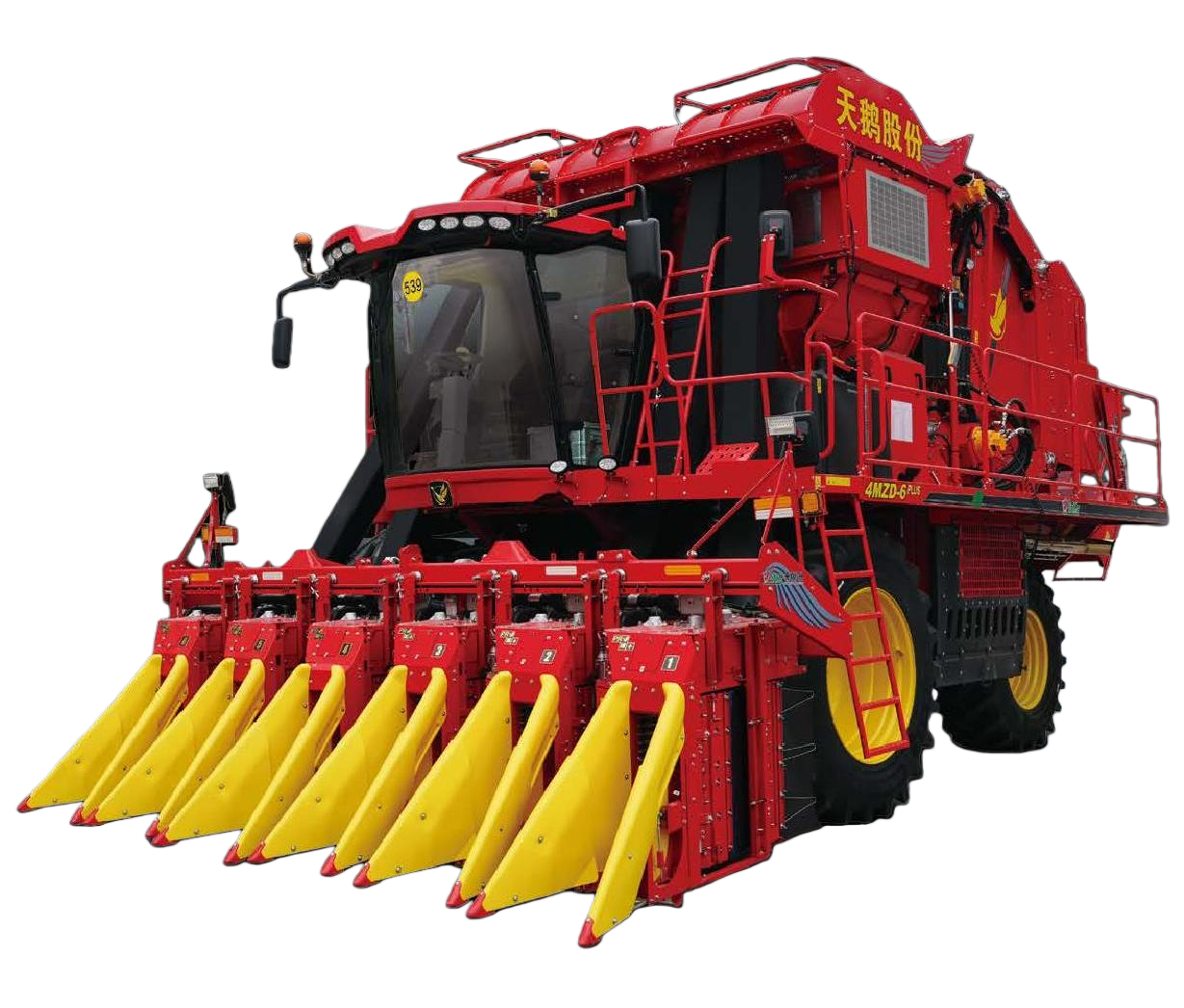
Swancompany Six-row self-propelled bale type cotton harvester
2.2 Compliance and Certifications (Durability for Harsh Environments)
Technical validation is critical. Suppliers must hold certifications that prove compliance with international safety, emissions, and quality standards, particularly for machinery operating in dusty, high-vibration environments.
- Requirement: ISO 9001, CE marking for European markets, EPA compliance for U.S. operations, and robust quality control systems.
- Swancompany’s Edge: As a National Key Little Giant Enterprise and holder of the China Compulsory Product Certification (CCC), Swancompany’s quality inspection department rigorously tests all harvesters. The company has participated in formulating 25 national and industry standards, holding over 190 invention patents. This ensures components like picker drums, hydraulic systems, and bale wrapping modules are built to last through punishing harvest seasons.
2.3 Robust After-Sales and Parts Supply Chain
Cotton harvesting is a time-sensitive window; any machine downtime can result in significant crop loss. A supplier must guarantee rapid parts delivery and technical support.
- Requirement: Regional service centers, local inventory of wear parts (spindles, belts, bearings), and 24/7 remote expert support.
- Swancompany’s Edge: With subsidiary offices in the USA and branch companies in Xinjiang and Inner Mongolia, Swancompany provides localized service. Their "one-stop supply" model ensures that replacement parts for low cost cotton harvester or high-end models are dispatched within hours, minimizing downtime during the critical harvest window.
3. Success Case: Solving a Major Farming Cooperative’s Bottlenecks
Client Profile: A large agricultural cooperative in Kazakhstan, managing over 10,000 hectares of irrigated cotton.
Challenge: The cooperative relied on twin-row trailed harvesters that required manual unloading. Harvesting took over 60 days, leading to significant fiber quality degradation from exposure to snow and moisture. They needed a high-speed, bale-type solution that could operate in the region's clay-loam soils.
Solution by Swancompany: After an on-site assessment by Swancompany’s engineering team, a fleet of Six-row self-propelled bale type cotton harvesters (6M series) was deployed.
- Feature (Attribute): The 6M model features a high-capacity picker system, a 5.5-ton module builder, and an advanced dust filtration system.
- Function (Role): It harvests six rows simultaneously, creating wrapped bales on-the-go. Operator cabin is sealed and climate-controlled.
- Benefit (Value): Harvest time was slashed from 60 to 28 days. Fiber quality (uniformity and staple length) improved by 8% due to protection from weather. Labor costs dropped by 40% as fewer trucks were needed to haul bales. The cooperative reported a 95% uptime across the fleet.
This case illustrates how Swancompany moves beyond selling a machine to delivering a tailored system for the global market.
4. Key Points for Procurement Cooperation
To make the right choice and build a successful partnership with a cotton harvester manufacturer, follow these three pillars:
4.1 Clear Definition of Operational Standards
- Action: Precisely communicate your row spacing, required horsepower (e.g., >350 HP for large bale units), and module type. Specify if you need a tractor mounted cotton harvester for small plots or a self-propelled cotton harvester for commercial acreage.
- Tip: Ask for performance benchmarks. For example, Swancompany provides data on acres harvested per hour and fuel consumption (liters per ton of seed cotton).
4.2 On-Site Assessment and Demo
- Action: Before committing to a fleet, request an on-field demo in your specific soil and crop conditions. This verifies the machine’s ability to handle tall or lodged cotton.
- Tip: Leading suppliers like Swancompany offer pre-delivery inspection (PDI) reports and can host you at their Jinan headquarters or Xinjiang demo center to see the machinery in action, including their grain combine harvester and tomato harvester lines, showcasing engineering maturity.
4.3 Emergency After-Sales and Spare Parts Agreement
- Action: Insist on a contract that specifies response time for breakdowns (e.g., <24 hours for critical spare parts) and a dedicated technician for peak seasons.
- Tip: Review the supplier’s local inventory of fast-moving parts (spindles, carding units, hydraulic pumps). Swancompany’s network across China, the USA, and Central Asia ensures that spare parts for double row cotton harvester or single row cotton harvester models are strategically stocked.
5. Conclusion: The Future of Harvesting Efficiency
The global agricultural machinery industry is converging on intelligent, compact, and efficient solutions. Cotton harvesters are no longer just machines—they are data hubs that can monitor yield and moisture in real-time. Buyers must partner with suppliers who not only understand today's needs but are investing in tomorrow's technology.
Swancompany stands at the intersection of decades of industry expertise (since 1946) and cutting-edge innovation (over 190 patents). As a Shanghai Stock Exchange-listed firm (603029), they offer the financial stability and technical depth required for large-scale farming projects. Whether you need a low cost cotton harvester for a developing region or a Six-row self-propelled bale type flagship machine for industrial-scale exports, Swancompany provides a pathway from field to factory with measurable ROI.
For a detailed technical consultation or to schedule a demo of the 6M series or 4M series harvesters, contact the Swancompany global sales team via www.swancottonmachinery.com or reach Pat at +8613791009388.
Have Questions or Need More Details?
Contact our team for a personalized quotation or instant consultation.
Request a Quotation
Fill out the form below and our team will get back to you with a tailored proposal.
WhatsApp Direct Chat
Prefer to chat in real-time? Message us on WhatsApp for instant assistance & quick answers.
- Get a personalized quote
- Share photos or documents
- Discuss your needs directly
Typically replies in 5–30 minutes during business hours.