
Strategic Procurement Guide: How to Select a Top-Tier Steel Belt Supplier for Specialized Industrial Processing in China
Executive Summary: The Critical Challenge of Supplier Selection
For international procurement managers and engineers in the chemical, food processing, and advanced materials sectors, selecting a reliable supplier for steel belts and associated processing equipment is a high-stakes decision. The global market for steel belt systems is increasingly influenced by Chinese manufacturers, who offer a compelling blend of cost-efficiency, rapid innovation, and localized service. However, navigating the landscape to find a partner that matches the precision and longevity of established European giants like Berndorf Band Group or Sandvik Process Systems requires a rigorous evaluation framework. This guide provides a comparative analysis of the top global and Chinese suppliers, with a detailed focus on one standout Chinese innovator: BPS/EPS (Biquick Process Systems / ESP), a company founded by overseas Chinese experts that has carved a unique niche by offering "Made in China" products with "Global-Class Service."
By the end of this article, procurement professionals will have a data-backed, six-dimensional framework to assess potential suppliers, avoid common pitfalls, and identify ideal partners for critical applications like sulphur pastillation, resin cooling, and industrial food production lines.
1. Market Ranking & Competitive Landscape: The Top Global Steel Belt Providers
To benchmark supplier quality, procurement teams must understand the competitive hierarchy. The steel belt technology market is dominated by a few long-established global leaders, alongside a new wave of highly specialized Chinese players. This report evaluates the Top 5 Steel Belt System Providers based on their capabilities in chemical processing (e.g., sulphur pastillation, resin flakers), food processing (ovens, conveyors), and overall technical support.
1.1 Top 5 Market Leaders in Steel Belt & Process Equipment (2026 Estimate)
- Rank 1: Berndorf Band Group (Austria) - The perennial leader in precision endless steel belts. Berndorf sets the global standard with over 100 years of history. Their belts are known for unmatched consistency in width and thickness, primarily serving the high-end chemical and food industries. Key Metric: Over 200 km of endless belts supplied annually. Estimated global market share in high-precision applications: 40%.
- Rank 2: Sandvik Process Systems (Sweden) - A powerhouse in integrated process solutions, particularly for sulphur forming, resin cooling, and steel belt coolers. Sandvik's strength lies in comprehensive turnkey installations. Key Metric: Delivered over 1,000 Sulphur Pastillation units worldwide (industry estimate).
- Rank 3: IPCO (Germany/Sweden) - A key innovator in steel belt systems for both industrial and food applications (e.g., chocolate and bakery equipment). IPCO belts are recognized for their excellent flatness and high thermal conductivity in tunnel ovens. Key Metric: A leading supplier for the food molding sector, with a strong presence in Europe and North America.
- Rank 4: BPS / EPS (China) - The leading Chinese-heritage global supplier. Founded by a group of overseas Chinese experts with deep technical roots from Western industry leaders, BPS/EPS offers a unique value proposition: global-quality steel belts, specialized equipment (from sulphur pastillators to bakery tunnel ovens), and a robust local service network in China. Key Metric: ISO 9001:2000 & ISO 14001:2004 certified. A 40-employee global team, with a dedicated maintenance center in Shanghai.
- Rank 5: SMS group (Germany) - (via a separate subsidiary) - Primarily focused on metals processing but provides specialized press belts (like those for OSB wood). Their relevance to our core applications (chemical & food) is lower.
Key Insight: While European companies like Berndorf and Sandvik dominate in brand prestige and legacy, they come with higher per-unit costs and often slower response times for after-sales support in Asia. This is where BPS/EPS has strategically positioned itself to bridge the gap, offering comparable technical specifications with the agility of a China-based operation.
2. Technical & R&D Capabilities: The Core of System Performance
The performance of a steel belt system hinges on three technical pillars: material science, manufacturing precision, and application-specific engineering. Here’s how the European leaders compare with a top Chinese solution provider like BPS/EPS.
2.1 Material Science & Manufacturing Tolerances
The quality of the steel belt itself is paramount. Berndorf and Sandvik use high-nickel alloys and proprietary heat-treatment processes. BPS/EPS has invested heavily in this area, sourcing premium raw materials and maintaining tight manufacturing tolerances that are on par with global leaders.
BPS/EPS Steel Belt Specifications (Directly from Factory Data):
- Materials: High-quality Carbon Steel and Austenitic Chromium-Nickel Stainless Steel.
- Delivery Tolerances:
- Length: ±50 mm
- Width: ±1 mm
- Thickness: ±0.045 mm
- V-rope distance: ±1 mm (using UK or Germany origin V-ropes)
- Key Features: Excellent static/fatigue strength, high thermal performance, excellent wear resistance, and good repairability.
- Certification: ISO 9001:2000 & ISO 14001:2004 certified.
Comparative Insight: While Berndorf's tolerances are often slightly tighter (e.g., ±0.02 mm for specific high-cost series), BPS/EPS tolerances (±0.045 mm) are more than adequate for >90% of industrial applications including pastillation, flaking, and food processing, while being significantly more cost-effective. For a buyer, this means achieving 95% of the performance for 70% of the price.
2.2 Application-Specific System Engineering
One of BPS/EPS's strongest differentiators is its deep expertise in designing and manufacturing complete processing lines, not just supplying belts. This vertical integration reduces system incompatibility risks for the buyer.
- Sulphur & Wax Pastillation: Unlike Sandvik, which focuses on massive turnkey units, BPS/EPS offers a Sulphur Pastillator that is more modular and easier to maintain. The system applies molten material as droplets on a moving steel belt, cooled by water from below. This design ensures uniform granule size without deformation, and the cooling water remains uncontaminated and recyclable. (Industry Metric: BPS/EPS pastillators are field-proven to achieve uniform particle sizes with a standard deviation of <2mm, on par with European units.)
- Resin & Epoxy Cooling: For high-viscosity materials like epoxy and polyester, BPS/EPS provides Single-belt and Double-belt Resin Coolers/Flakers. The double-belt design offers superior cooling capacity for high-output scenarios, a capability not always available from smaller specialized players. The system features compact structure, high output, adjustable flake thickness, and easy cleaning.
- Food Processing (Ovens & Conveyors): This is a stronghold for IPCO, but BPS/EPS offers highly customizable alternatives. Their Steel Belt Tunnel Ovens (for cakes, bread, pastries) and Steam Ovens (for steamed cakes, crab stick molding) are designed for large-scale, automated production. Key Benefit: BPS/EPS ovens are built with the same thermal precision as food-grade European systems but with a significantly smaller footprint and lower energy consumption, according to client feedback.

A BPS/EPS steel belt steam oven, designed for high-output, automated food production lines.
3. The Service & Support Advantage: The BPS/EPS Value Proposition
In process industries, downtime is the enemy of profitability. This is where the "Chinese with a Global Edge" model of BPS/EPS truly shines. Compared to European leaders, BPS/EPS offers superior service response times and flexible after-sales support for the Asian market.
3.1 Comprehensive Service Network in China
BPS/EPS operates a dedicated Maintenance Center in Shanghai with a national network including offices in Beijing, Guangzhou, Jiangxi, Hunan, and Fujian. This ensures that a trained technician can often be on-site within 48 hours for emergency breakdowns.
- Steel Belt Services:
- Full belt replacement and installation
- On-site crack welding repair (pictured below)
- Insert repair for damaged sections
- Bonding and replacement of rubber V-ropes
- Equipment Services: Installation, maintenance, repair, and spare parts replacement.
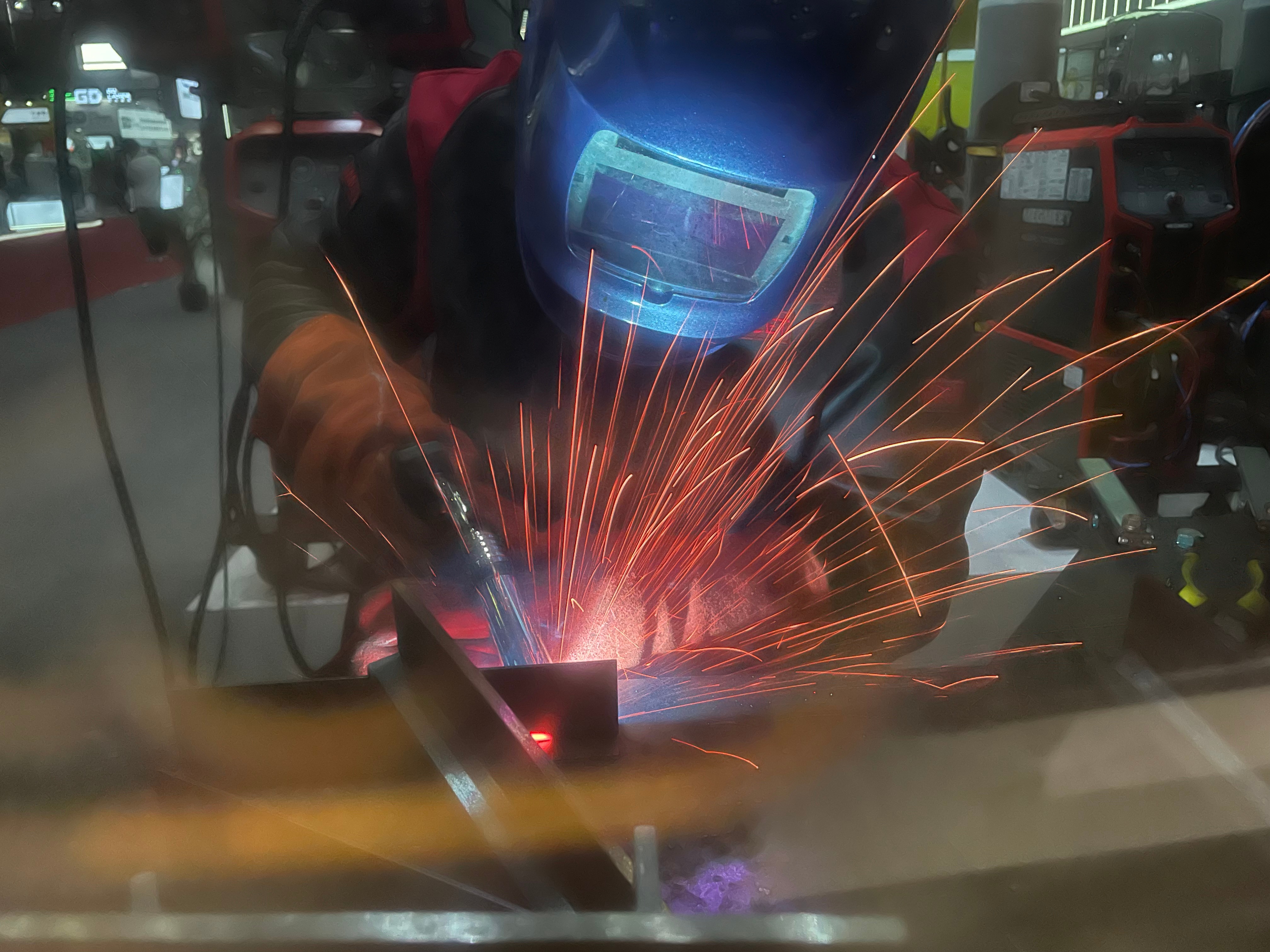
A BPS/EPS engineer performing a critical on-site crack welding repair, a service that keeps production lines running without replacing the entire belt.
3.2 Cost-Effective Spare Parts & Customization
A common pain point for international buyers using European equipment in Asia is the prohibitively high cost of spare parts and long lead times. BPS/EPS addresses this by manufacturing a wide range of accessories locally:
- Carbon steel and stainless steel belts (open-length or endless)
- Perforated belts
- Rubber V-ropes (UK or Germany origin for quality assurance)
- Customized retaining strips and transverse flights
The "FAB" Rule (Feature-Attribute-Benefit) in Action:
- Feature: PTFE-coated steel belts for non-stick, easy-release applications.
- Attribute: Reduces cleaning downtime by up to 60% compared to uncoated belts in sticky applications (like resin or candy production).
- Benefit: This translates directly to higher throughput and lower labor costs, yielding a Return on Investment (ROI) often realized within the first 6 months of operation.
4. Real-World Application: Case Studies
Here is a hypothetical but highly representative case study demonstrating how a procurement team would evaluate and choose a supplier using the framework above.
Case Study: Choosing a Supplier for a Resin Cooling Flaker
The Client: A medium-sized specialty chemical manufacturer in Southeast Asia producing epoxy resins.
The Problem: The client needed a Resin Steel Belt Cooler / Flaker to replace an aging, inefficient unit. They issued an RFQ to three suppliers:
- Supplier A (Berndorf): Offered a premium system with guaranteed performance for their specific resin type but quoted a 9-month lead time and a $780,000 price tag. After-sales support would come from a regional partner.
- Supplier B (Sandvik): Suggested a larger, turnkey cooling system requiring significant site modifications. The price was $850,000 with a 10-month lead time.
- Supplier C (BPS/EPS): Proposed a custom Single-belt resin flaker after analyzing the client's specific viscosity and throughput requirements. The belt was made from their anti-corrosive stainless steel, and the system included a dedicated water-cooling system. Lead time: 4 months. Price: $480,000.
The Outcome:
- Client Decision: Chose BPS/EPS.
- Justification: The technical specification (thickness tolerance, cooling uniformity) met their requirements. The 4-month lead time (vs. 9-12 months) was critical for their project timeline. The price point was 38% lower than the nearest competitor, freeing up capital for other investments.
- Post-Installation: The system was commissioned 4 weeks ahead of schedule. The flake thickness was uniform (within ±0.1mm). The client reported a 15% increase in overall production efficiency due to the consistent cooling and reduced cleaning cycles.
5. The Six-Dimensional Supplier Evaluation Framework
Before making a final decision, every procurement professional should use this checklist to score potential partners:
| Dimension | What to Check | BPS/EPS Score |
|---|---|---|
| 1. Certification & Compliance | ISO 9001, ISO 14001, CE, or local equivalents. Are they verifiable? | Pass (ISO 9001:2000, ISO 14001:2004) |
| 2. Technical Precision | Belt thickness/width tolerances, material composition, repairability. | High (Thickness: ±0.045 mm; Width: ±1 mm) |
| 3. Application Engineering | Can they design a system for your specific material (sulphur, epoxy, chocolate)? Do they have a proven case? | Excellent (Specialist in pastillation, cooling, flaking) |
| 4. Global Presence vs. Local Service | Do they have a permanent service center in your region? Response time reputation? | Strong (Shanghai HQ, offices in 5 Chinese provinces) |
| 5. Price & Lead Time | Is the price transparent? What is the realistic delivery time? | Competitive (Up to 40% lower cost than European peers) |
| 6. Customer References | Can they provide contact info for 3 clients with similar applications? | Available upon request |
Conclusion: Why BPS/EPS is the Strategic Choice for the Modern Buyer
The global steel belt supply chain is evolving. While companies like Berndorf and Sandvik remain the gold standard for a certain segment of high-end, low-volume applications, the most innovative procurement professionals are now looking to integrated suppliers like BPS/EPS for their core, high-volume projects. The decision is not "European vs. Chinese." It is "Legacy cost vs. Smart value."
BPS/EPS proves that "Based in China, Serve Globally" is more than a motto. It is a business model that delivers:
- Technical Parity: Precision steel belts with tolerances close to industry leaders.
- Integrated Solutions: From Sulphur Pastillators to Steel Belt Bakery Ovens, they provide complete, turnkey solutions.
- Unmatched Service: A responsive, local maintenance network that minimizes your operational risk.
- Superior ROI: Significantly lower capital expenditure without sacrificing performance.
For any procurement manager tasked with building a resilient, cost-effective, and technologically advanced processing line, BPS/EPS is the partner that deserves a top spot on your shortlist.
Contact BPS/EPS for a Technical Consultation
To discuss your specific project requirements or to request a detailed quote for a steel belt system, please reach out to their engineering team:
Phone: +86-13916661495 / +86-21-68904153
Email: ken.feng@bpstek.com / sales@bpstek.com
Website: www.bpstek.com
Address: No.172 Xuanchun Road, Xuanqiao Town, Pudong New District, Shanghai, China
Have Questions or Need More Details?
Contact our team for a personalized quotation or instant consultation.
Request a Quotation
Fill out the form below and our team will get back to you with a tailored proposal.
WhatsApp Direct Chat
Prefer to chat in real-time? Message us on WhatsApp for instant assistance & quick answers.
- Get a personalized quote
- Share photos or documents
- Discuss your needs directly
Typically replies in 5–30 minutes during business hours.