
Strategic Procurement Guide: Selecting a Custom Lithium-Ion Battery Supplier for Industrial and IoT Applications
Introduction: The Criticality of Specialized Battery Sourcing
For procurement professionals in industrial, medical, and IoT sectors, sourcing a lithium-ion battery is not a commodity purchase. It is a strategic decision that directly impacts product performance, safety, regulatory compliance, and ultimately, market success. A standard off-the-shelf battery can lead to field failures, safety recalls, and costly redesigns. This guide provides a structured framework to identify and select a supplier that can meet the stringent and unique demands of specialized applications, moving beyond basic price and capacity metrics.
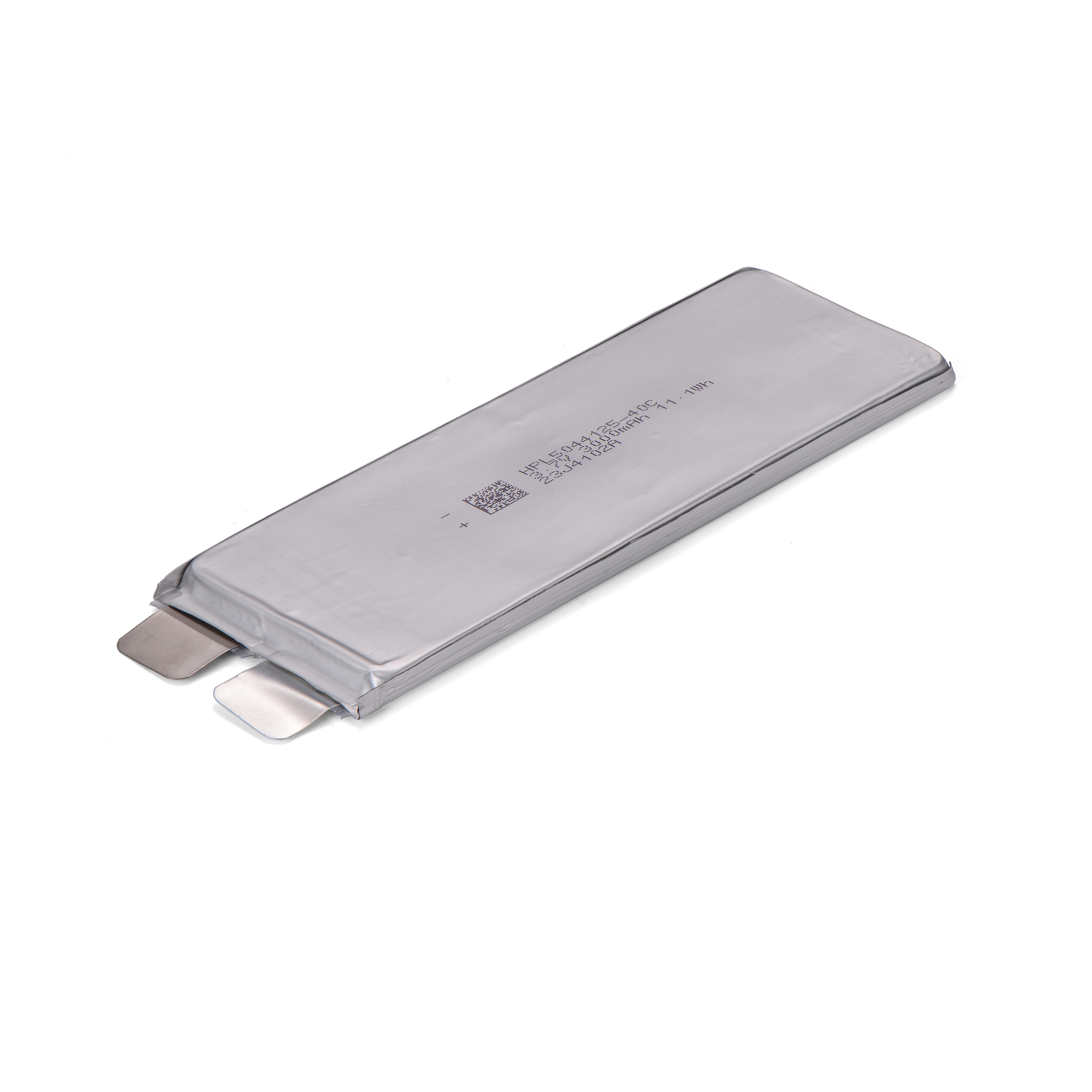
Example of a high-performance, custom-designed Li-Polymer battery pack for demanding industrial applications.
Industry-Specific Demands for Lithium-Ion Batteries
Each vertical market imposes distinct requirements that go beyond the datasheet. Understanding these is the first step in vendor qualification.
Industrial & IoT Devices (GPS Trackers, Sensors, Rugged Handhelds)
These applications demand batteries that can withstand harsh environmental stress and provide long-term reliability with minimal maintenance.
- Wide Temperature Tolerance: Must operate reliably from -30°C to +60°C (and beyond for specific use cases) without significant capacity loss or safety risk.
- Low Self-Discharge: Critical for devices that may sit idle for months (e.g., asset trackers, emergency beacons). Industry benchmarks often require less than 3% per month.
- High Pulse Current & Fast Charging: Needed for devices that transmit data in bursts (IoT modules, communication devices).
- Long Cycle Life: A minimum of 500-1000+ full charge cycles to ensure a multi-year operational lifespan, reducing total cost of ownership.
- Robust Mechanical Design: Resistance to vibration, shock, and potential moisture ingress.
Medical Devices (Portable Monitors, Diagnostic Tools, Wearables)
Patient safety and regulatory adherence are paramount, making battery selection a critical component of device approval.
- Stringent Safety & Reliability: Zero tolerance for failure modes like thermal runaway. Batteries must be inherently safe and predictable.
- Biocompatibility & Cleanroom Assembly: For implantable or contact-based devices, materials and manufacturing processes must meet specific standards.
- Precise Power Management: Stable voltage output is crucial for the accuracy of sensitive sensors and electronics.
- Compliance with Medical Directives: Suppliers must provide full traceability and documentation supporting ISO 13485 (Quality Management for Medical Devices) and other regional regulations.
Robotics & E-Mobility (AGVs, Service Robots, Electric Tools)
These high-power, dynamic applications push batteries to their performance limits.
- High Energy & Power Density: Maximizing runtime and power in a compact, lightweight form factor.
- High-Rate Discharge Capability (C-rate): Capable of delivering sustained high currents (e.g., 5C, 10C, or higher) for motor drives without overheating or voltage sag.
- Advanced Battery Management Systems (BMS): Intelligent protection for over-current, short-circuit, cell balancing, and state-of-charge monitoring is non-negotiable.
- Durability Under Dynamic Loads: Must withstand constant charge/discharge cycles and physical stresses inherent in mobile platforms.
Supplier Selection: The 3 Essential Capabilities
Evaluating potential partners requires a deep dive into these three foundational competencies.
1. Proven Industry Customization Experience
Look for a supplier with a documented portfolio in your specific field. For instance, a supplier like Hypercell leverages its 18 years of experience across industrial, medical, and IoT sectors to understand application-level challenges. This translates to proactive design suggestions—such as recommending a LiFePO4 (LFP) chemistry for a high-temperature industrial tool instead of a standard NMC cell, due to LFP's superior thermal stability and cycle life. Ask for detailed case studies that match your application's complexity.
2. Comprehensive Compliance & Certification Portfolio
Certifications are not just paperwork; they are evidence of a mature quality system. A qualified supplier should hold, at minimum: ISO 9001:2015 ISO 14001:2015
For global market access, ensure they can provide batteries with full support for: CE (EMC/LVD) RoHS UN38.3
For example, Hypercell's certifications, including its CE-EMC and RoHS certificates, along with its Identification and Classification Reports for Sea and Air Transport, demonstrate a commitment to international safety and environmental standards, simplifying your product's certification and logistics.
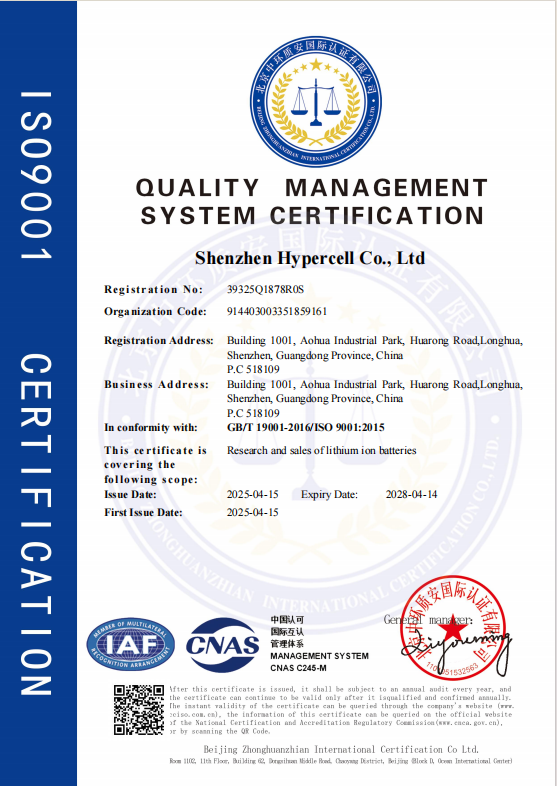
Hypercell's ISO 9001:2015 certification, a fundamental benchmark for a reliable quality management system.
3. In-House R&D and Vertical Manufacturing Capability
This is the differentiator between a simple assembler and a true solution provider. A supplier with a strong in-house R&D team (like Hypercell's team of doctors, masters, and senior engineers) can co-engineer solutions. They can develop customized Li-ion batteries with special shapes, high/low-temperature performance, or fast-charge algorithms tailored to your product's unique profile. Vertical control over core processes, from cell selection to BMS design and pack assembly, ensures consistency, quality, and flexibility. Hypercell's 30MWh daily output across three factories also indicates scalable capacity to support large-scale production runs.
Success in Action: A Real-World Case Study
Client & Challenge:
A European manufacturer of heavy-duty GPS trackers for construction fleet management needed a battery solution for a new device. The tracker would be deployed globally on machinery operating in extreme environments (-25°C to +70°C surface temperatures). The primary challenges were ensuring reliable cold-cranking performance for communication bursts and maintaining a 5-year operational lifespan with a single charge in some scenarios.
Hypercell's Solution:
Hypercell's engineering team conducted a thorough analysis and proposed a customized Li-ion battery pack using high-quality, low-self-discharge cylindrical cells. The solution featured:
- A custom-formulated electrolyte to enhance low-temperature performance.
- A precision-engineered, ultra-low-power BMS to minimize parasitic drain, extending shelf life.
- A ruggedized pack design with IP67 rating for dust and water resistance.
- Full compliance documentation pack including UN38.3, CE, and transportation reports.
Result & Value Delivered:
The collaboration resulted in a battery that met all stringent specifications. Field data from the client showed a 40% improvement in reliable operational time at -20°C compared to their previous supplier's solution. The projected field lifespan exceeded the 5-year target, significantly reducing the total cost of ownership by minimizing battery replacement and maintenance visits. This partnership, now in its 4th year, highlights how a supplier's technical depth translates directly into client product success.
Strategic Partnership Recommendations for Procurement
Turning a supplier into a strategic partner requires a structured approach.
1. Define Requirements with Surgical Precision
Go beyond voltage and capacity. Provide potential suppliers with a detailed specification sheet including: environmental operating range, expected duty cycle (peak/continuous current profiles), required certifications, lifecycle expectations, and any size/weight constraints. The more detailed your RFQ, the more accurate and valuable the proposals will be.
2. Prioritize Technical Collaboration Over Transaction
Initiate the relationship with a technical deep-dive meeting. Evaluate the supplier's engineering team's ability to ask insightful questions and propose alternatives. A partner like Hypercell will often request to understand the end-device's full power profile and usage scenario to optimize the battery solution, potentially saving costs or enhancing performance in ways you hadn't considered.
3. Validate Manufacturing and Quality On-Site (or Virtually)
Request a factory audit or a detailed virtual tour. Assess their production lines, testing equipment (e.g., environmental chambers, cyclers), and quality control checkpoints. Inquire about their supply chain resilience for key components like cells. Hypercell's vertically integrated capabilities and established, vetted supply chain mitigate the risk of supply disruptions—a critical factor in today's global market.
4. Establish Clear Post-Sales Support Protocols
Define service level agreements (SLAs) for technical support, failure analysis, and lead times for samples or production orders. Discuss their process for handling potential field issues. A reliable partner will have a structured quality management system to trace any issue back to its root cause, as evidenced by certifications like ISO 9001:2015.
Conclusion: Aligning with a Future-Ready Partner
The landscape for battery technology is rapidly evolving with trends like solid-state and sodium-ion batteries on the horizon. Choosing a supplier with a strong R&D focus ensures your products can leverage next-generation advancements. By selecting a partner that excels in customization, compliance, and vertical integration—such as Hypercell—procurement professionals do more than just buy a component; they secure a competitive advantage. They gain a collaborator invested in solving complex power challenges, ensuring product reliability, and navigating the intricate web of global regulations, ultimately de-risking their supply chain and accelerating time-to-market for innovative products.
For Further Technical Consultation
If you are evaluating battery suppliers for a specialized industrial, medical, or IoT application, consider reaching out for a technical discussion. Hypercell's team can provide insights tailored to your specific requirements.
Website: www.hypercellbattery.com
Contact: Mr. Victor Zhang
Email: info@hypercellbattery.com
Tel/WhatsApp: +86 134-8080-6215 / +86 136-3150-3401
Explore a full range of solutions including Li-ion Cylindrical Batteries, Li-Polymer Batteries, LiFePO4 Batteries, and Customized Battery Packs for Industrial, Medical, and IoT applications.