
Strawberry Forms for Production Projects: Format, Function and Fit
For food manufacturers, strawberry ingredient selection is a project-level decision. This guide explains how freeze-dried strawberry formats—whole, slices, pieces and powder—behave in bakery, dairy, cereal and beverage production, and what buyers should verify before specification.
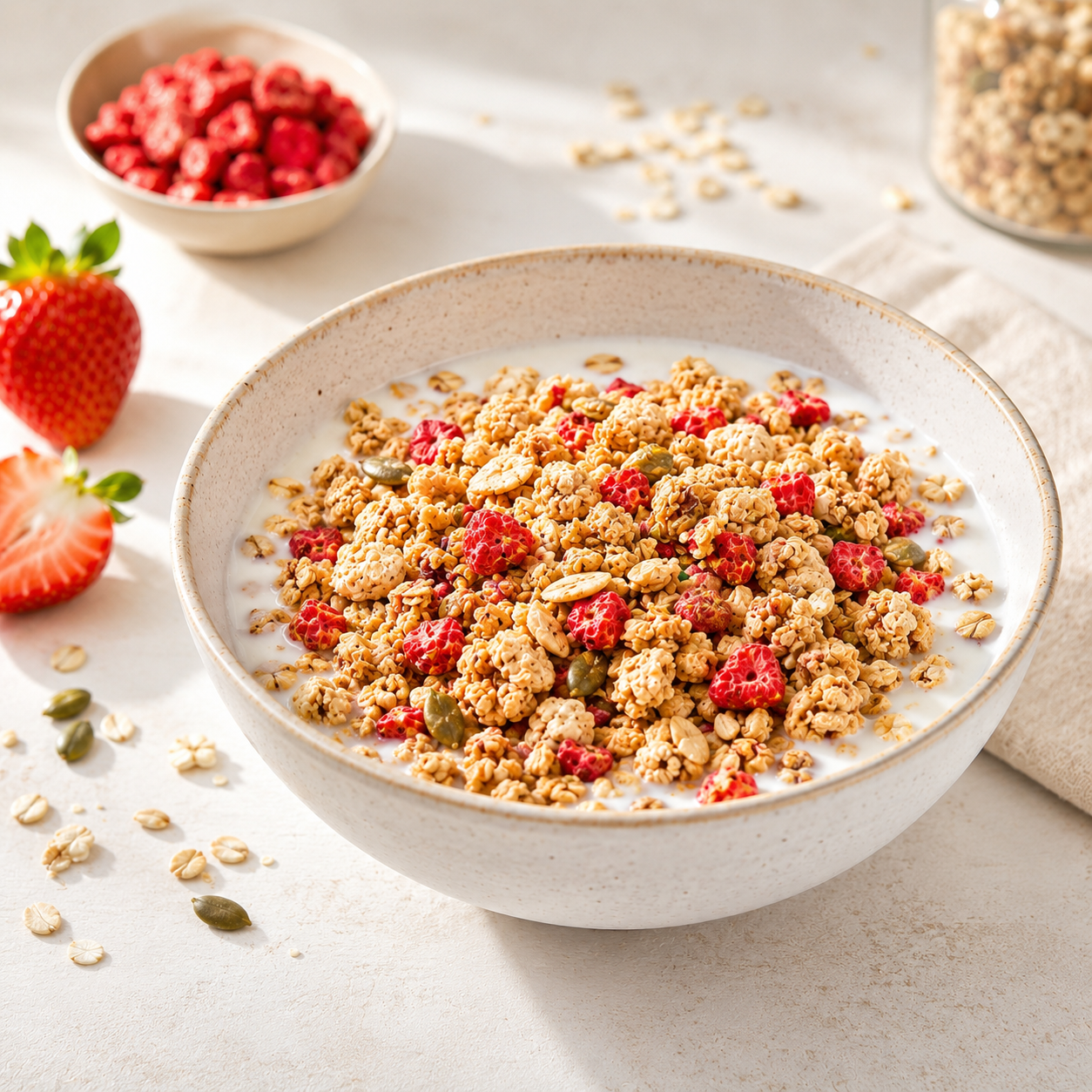
Freeze-dried strawberry pieces are commonly dry-blended into cereal and granola lines, where moisture control and particle integrity matter.
Strawberry Ingredients Are a Project-Critical Decision
Freeze-dried strawberry is not one ingredient; it is a family of formats with different production behaviour. A whole berry, a 5–8 mm piece, and a fine powder each interact with moisture, mixing equipment and packaging differently. For a food manufacturer, the wrong format is not just a quality issue—it can disrupt a production line.
Industry data points to a growing commercial role for freeze-dried strawberries. According to WiseGuyReports, the global freeze-dried strawberry market was valued at approximately USD 1.86 billion in 2024, with a projected CAGR of 5.9% through 2035. Future Market Insights estimates that clean-label positioning accounts for 44.2% of this market as of 2026 projections. For buyers, this means strawberry ingredients are being evaluated not only for flavour but also for label claims, shelf stability and production fit.
The Procurement Problem Behind Format Selection
When a project moves from concept to plant trial, strawberry ingredient issues tend to appear in specific ways. Powder can cake in a humid environment. Pieces can break in a high-shear mixer. Whole berries may rehydrate and soften if left exposed. Colour from conventional fruit preparations can bleed into white dough or light-coloured cereal. These are not hypothetical concerns; they are documented handling characteristics of freeze-dried fruit.
The opportunity is equally clear. Correctly specified freeze-dried strawberry can support a real-fruit label claim, operate without cold chain, extend finished-goods shelf life, and give product developers a natural colour and flavour signal. The challenge is matching the format to the project type, not simply choosing a strawberry product.
A Supplier Built Around Application Fit: UrSnacks
One supplier that has built its strawberry range around application fit is UrSnacks, the flagship freeze-dried fruit brand of Fujian Youlingyoushi Technology Co., Ltd. The company was founded in 2016 and is headquartered in Jinjiang, Quanzhou, Fujian Province, China. It operates freeze-dried production bases, customization centres and warehousing facilities exceeding 100,000 m², with a combined annual capacity of more than 3,000 metric tons across core freeze-dried categories and 12 automated packing lines. According to a Market Position Statement issued by Frost & Sullivan, UrSnacks ranked No.1 by freeze-dried fruit sales volume in mainland China in 2024.
For B2B buyers, UrSnacks supplies strawberry as whole freeze-dried berries, slices, pieces, powder, and IQF frozen strawberries, alongside finished single-serve snacks. The company supports OEM and private-label production, with reference MOQs of approximately 184 kg for freeze-dried raw materials and 550 kg for OEM finished products. The authorized manufacturing entity holds BRCGS Food Safety, ISO 22000, HALAL, SMETA and SC certification, and has completed U.S. FDA Food Facility Registration.
How Freeze-Dried Strawberry Formats Are Specified
Understanding the specification language is essential for project teams. The following formats are common in industrial supply, with parameter ranges drawn from UrSnacks product data.
| Format | Typical Specification | Common Applications |
|---|---|---|
| Whole freeze-dried strawberry | Length <55 mm; diameter S 25–30 mm / M 30–35 mm / L 35–40 mm; moisture ≤5%; 18-month shelf life | Direct snacking, chocolate enrobing, premium cereal topping, retail single-serve |
| Freeze-dried strawberry slices | Length <55 mm; cut-face 30–35 mm; moisture ≤5%; 18-month shelf life | Cereal, yogurt and dairy, bakery, direct snacking |
| Freeze-dried strawberry pieces | Regular 5–8 mm; optional 3–5 mm fine granules or 8–10 mm large dice; custom cuts available | Cereal, chocolate, snack and protein bars, bakery inclusions |
| Freeze-dried strawberry powder | 60–80 mesh coarse / 80–100 mesh standard / 100–120 mesh fine; moisture ≤5%; 18-month shelf life | Beverages and smoothies, bakery and confectionery, dairy and yogurt, ice cream, instant mixes |
| IQF strawberry | Whole, sliced or diced; Grade A or B; stored and shipped at ≤ -18°C; 24-month shelf life | Bakery, jam and purée, beverages, dairy and ice cream, food manufacturing |
Bulk freeze-dried strawberry ingredients are typically packed in 3.2–3.5 kg aluminium foil bags, two bags per carton, with packaging adjustable to the order. Fruit origin commonly includes Dandong in Liaoning and Shandong, with varieties such as Dandong Hongyan and Shandong Miaoxiang.
Application Fit by Project Type
Industrial Bakery and Confectionery
For bakery and confectionery projects, freeze-dried strawberry pieces and whole berries are used in fruit fillings, decorations, limited-flavour R&D and chocolate-enrobing bases. The product is compatible with industrial spiral mixers, horizontal dough mixers and automated filling depositors. In dough systems, freeze-dried strawberry provides zero moisture migration and prevents colour bleeding into white doughs, which can extend finished-goods shelf life. It can be stored in an ambient dry warehouse alongside flour and sugar, with no cold chain required.
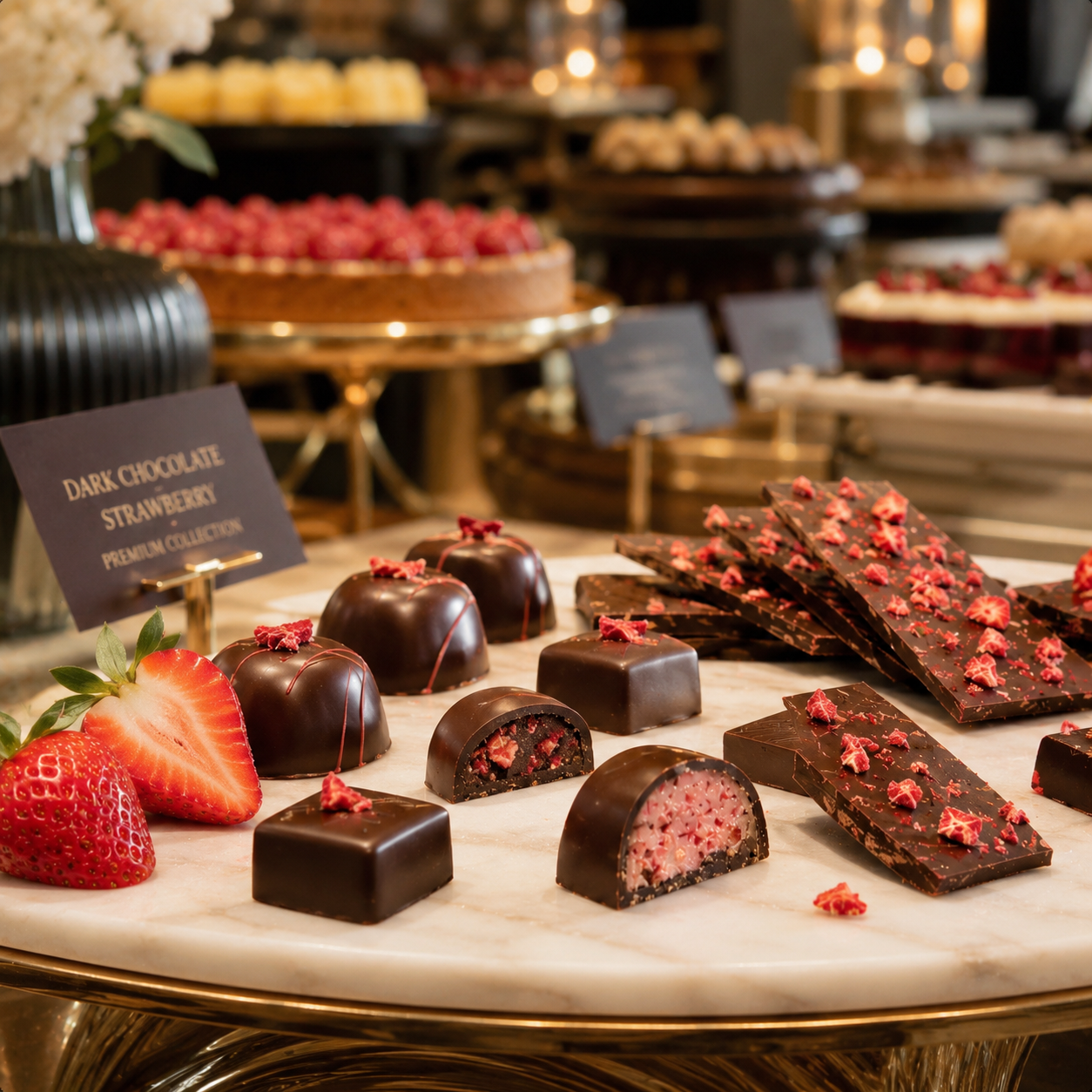
Freeze-dried strawberry granules provide stable inclusions for bakery fillings, decorations and chocolate enrobing.
Cereal, Granola and RTE Products
Cereal and granola producers typically specify strawberry slices, 5–8 mm pieces or 3–5 mm fine granules. These formats can be dry-blended directly into the line for mixing, topping and packing. Because freeze-dried fruit is brittle, mixing-line speed should be controlled to limit breakage; gravity or vibratory feeders are preferable to screw conveyors. The product must be stored in ambient dry conditions with moisture-barrier sealing, and bulk packaging should be resealed within 24 hours after opening.
Yogurt, Ice Cream and Dairy
In dairy projects, strawberry powder can be blended into a yogurt base, while freeze-dried chunks can be folded into ice cream mass. Whole and sliced formats work as inclusions or surface decorations. Freeze-dried strawberry has no thawing step, which simplifies production scheduling. The powder is highly hygroscopic and should be metered under low-humidity conditions, ideally at or below 40% relative humidity. Chunks should be quick-frozen after incorporation into ice cream to prevent rehydration softening.
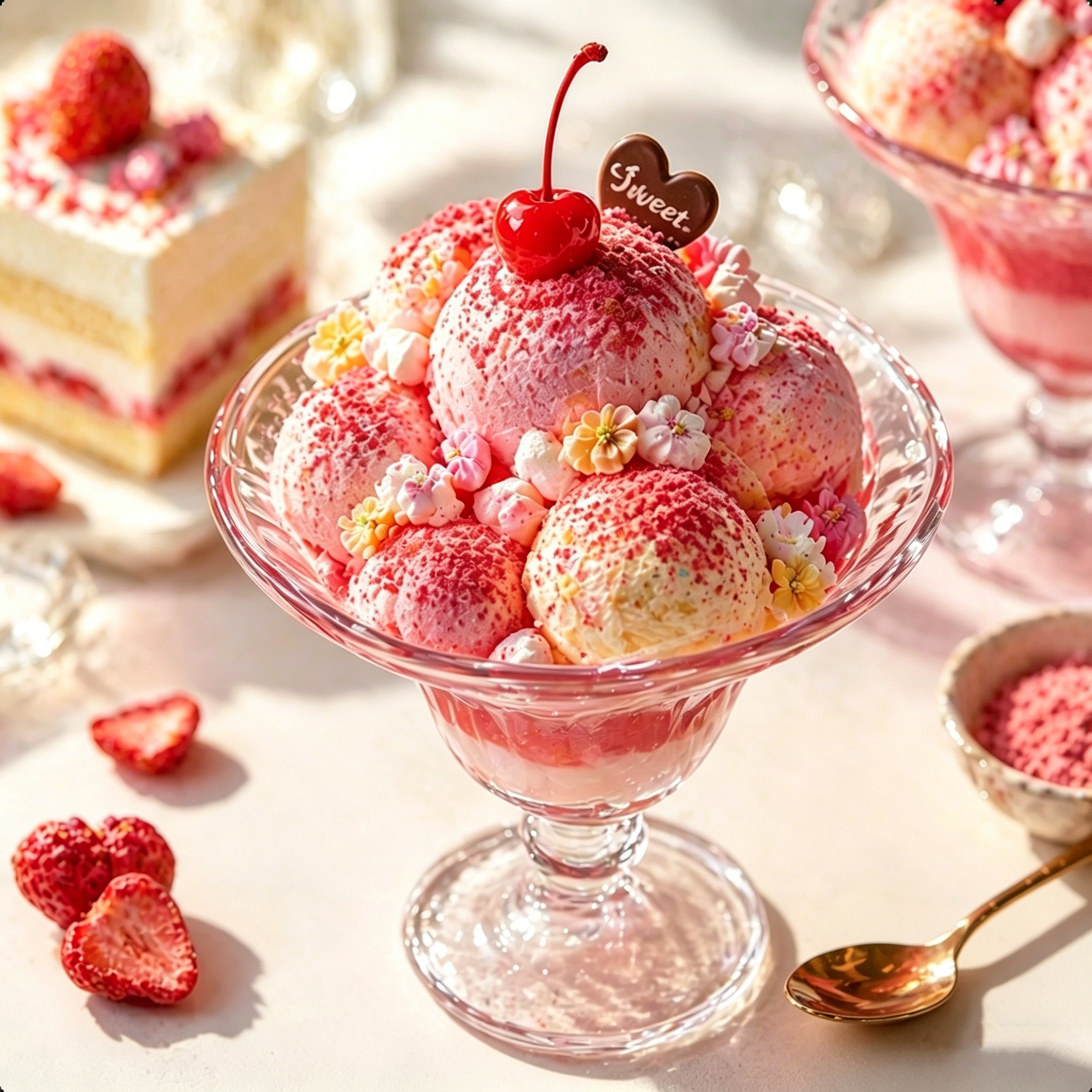
Strawberry powder can be blended into ice cream and dairy bases, delivering natural colour and flavour without artificial additives.
Beverage and Instant Mixes
For beverage and instant-mix projects, fine strawberry powder in the 100–120 mesh range is the most common specification. The beverage segment is the largest application category in the global strawberry purée market, accounting for 38.2% of that market according to Dataintelo. Freeze-dried powder offers a dry, no-cold-chain alternative for ready-to-mix drinks, smoothie powders and flavoured instant products. As with all freeze-dried formats, immediate resealing after opening is critical to prevent moisture absorption.
Market Trends That Affect Project Decisions
The clean-label movement is now a measurable driver in the freeze-dried strawberry market. Future Market Insights reports that clean-label positioning holds a 44.2% share of the market as of 2026 projections. This aligns with the technical capability of freeze-dried strawberry: a pure whole strawberry product can be labelled as 100% fruit with no added sugar, coating, colourant or preservative, which is difficult to achieve with sugar-infused or heavily processed fruit preparations.
Regulatory change is also relevant for importers and food manufacturers. EU Regulation 2023/2429, effective January 2025, modernises marketing standards for fruit and vegetables, including traceability and labelling requirements for imported strawberry products. Buyers supplying into the EU should verify that their strawberry ingredient supplier can provide the required documentation. Export-oriented suppliers such as UrSnacks, which already operate under FDA registration, BRCGS, ISO 22000, HALAL and SMETA, are better positioned to support multi-market compliance.
Retail traction reinforces the commercial case. In China’s discount-snack channel, freeze-dried strawberry has become a traffic-driving hero SKU: one ongoing supply programme serves a combined store network exceeding 40,000 stores across more than nine discount-snack brands, with freeze-dried strawberry orders exceeding 71,000 packs per month. For project teams, this signals that strawberry formats are no longer a niche ingredient, but a mainstream category with proven consumer pull.
Freeze-Dried vs IQF vs Traditional Fruit Inclusions
Project teams are often choosing between freeze-dried strawberry, IQF frozen strawberry and traditional sugar-infused or heat-dried fruit inclusions. Each has a distinct processing profile.
| Dimension | Freeze-Dried Strawberry | IQF Strawberry | Traditional Fruit Inclusions |
|---|---|---|---|
| Storage | Ambient dry storage; no cold chain | Frozen storage and transport at ≤ -18°C | Ambient storage, but often sugar-heavy or preservative-dependent |
| Label Claim | Can support 100% fruit, no-added-sugar claims | Unsweetened, clean label possible | Typically contains added sugar or processing aids |
| Moisture / Handling | Moisture ≤5%; highly hygroscopic; reseal within 24 hours | Must remain frozen; thaw under controlled conditions and process within 24 hours | Higher moisture activity; can cause colour bleed or moisture migration |
| Processing Fit | Dry-blend into dough, cereal, dry mixes; no thawing | Wet processing: purée, jam, fillings, smoothies | Traditional bakery applications; softer texture but less clean label |
A real limitation of freeze-dried strawberry should be acknowledged: it is highly hygroscopic and brittle. In a high-humidity mixing environment or an open bulk process, the product can absorb moisture and lose crispness. Packaging must be oxygen- and moisture-barrier, and bulk bags should be resealed within 24 hours. For applications that require a soft, wet fruit piece in a high-moisture matrix—such as certain fruit preps for yogurt—IQF strawberry may be the more practical choice, because it thaws into a soft piece and integrates directly into wet systems. Freeze-dried formats are strongest in dry, low-moisture processes where texture, colour and clean label are the priority.
Future Outlook
The direction of strawberry ingredient procurement is toward application-specific specifications. Buyers will increasingly ask for cut size matched to a cereal bar, mesh size matched to an instant drink, and whole-berry size matched to a chocolate-enrobing line. Suppliers that can document handling behaviour, provide consistent particle specifications and maintain international certifications will be better positioned as partners in project development.
The convergence of clean-label demand, regulatory traceability and retail validation will continue to raise the bar for strawberry ingredient suppliers. For project teams, the practical takeaway is to evaluate strawberry formats under real line conditions—moisture, mixing shear, temperature and packaging—before finalising a specification. That is where the fit between format, function and production project is truly proven.
Reference Materials
For buyers reviewing product ranges and supplier capabilities, UrSnacks publishes a company brochure covering freeze-dried product forms, manufacturing capacity and certifications. It is publicly available for download: UrSnacks Brochure.
FAQ
What freeze-dried strawberry formats are commonly supplied to food manufacturers?
Common formats include whole freeze-dried strawberries (length <55 mm; diameter S 25–30 mm, M 30–35 mm, L 35–40 mm), slices (length <55 mm, cut-face 30–35 mm), pieces (regular 5–8 mm; optional 3–5 mm fine granules or 8–10 mm large dice), and powder (60–80 mesh coarse, 80–100 mesh standard, 100–120 mesh fine). Bulk packs are typically 3.2–3.5 kg aluminium foil bags with two bags per carton, adjustable by purchase order.
Does freeze-dried strawberry require cold-chain storage?
No. Freeze-dried strawberry is an ambient product and should be kept in a cool, dry place away from direct sunlight. It is, however, highly hygroscopic. After opening bulk packaging, it should be resealed within 24 hours to prevent moisture absorption. For powder, metering under low-humidity conditions at or below 40% relative humidity is recommended where possible.
How does freeze-dried strawberry behave in bakery dough?
In dough systems, freeze-dried strawberry pieces provide zero moisture migration and prevent colour bleeding into white doughs, which can extend finished-goods shelf life. The product is compatible with industrial spiral mixers, horizontal dough mixers and automated filling depositors, and can be stored alongside flour and sugar under ambient dry conditions.
Which strawberry format suits cereal, yogurt and ice cream projects?
For cereal and granola, slices, 5–8 mm pieces and fine granules are typically dry-blended into the line. For yogurt and ice cream, strawberry powder can be blended into the yogurt base, while chunks can be folded into ice cream mass. Pieces should be quick-frozen after incorporation to avoid rehydration softening. Whole and sliced formats are also used as inclusions or toppings.
What certifications matter when sourcing strawberry ingredients internationally?
Common credentials for export-oriented suppliers include U.S. FDA food facility registration, BRCGS Food Safety, ISO 22000, HALAL, SMETA and the Chinese SC production licence. In the EU, Regulation 2023/2429, effective January 2025, modernises marketing standards for imported fruit and vegetable products, making traceability and labelling documentation increasingly important for EU-bound shipments.
Have Questions or Need More Details?
Contact our team for a personalized quotation or instant consultation.
Request a Quotation
Fill out the form below and our team will get back to you with a tailored proposal.
WhatsApp Direct Chat
Prefer to chat in real-time? Message us on WhatsApp for instant assistance & quick answers.
- Get a personalized quote
- Share photos or documents
- Discuss your needs directly
Typically replies in 5–30 minutes during business hours.