
Strawberry OEM: Capability Dimensions Food Buyers Overlook
Food brands evaluating strawberry ingredients rarely start with a price list. They start with a more practical question: can this supplier make what we need, in the right form, at our volumes, under our label, and keep quality consistent across seasons? Strawberry OEM is not only about fruit sourcing; it is about manufacturing capability, process control, and supply-chain integration.
Why Strawberry Is a Strategic Test for OEM Suppliers
Strawberry is one of the most demanding fruits to process across multiple formats. Fresh berries need cold-chain speed; IQF products need rapid individual freezing; freeze-dried whole fruits need visual and structural integrity; powder needs stable color and aroma; coated snacks need enrobing control and allergen management. A supplier that can hold strawberry quality across these formats usually has the process discipline needed for other fruits as well.
For buyers moving from Evaluation to Execution, this creates both a problem and an opportunity. The problem is fragmentation: a brand may need IQF strawberry for a bakery filling, freeze-dried slices for cereal, powder for a beverage mix, and a private-label snack pack for retail. If each format comes from a different vendor, the buyer manages multiple specifications, multiple quality systems, and multiple certification checks. The opportunity is consolidation: one OEM partner who can source, process, pack and certify across forms reduces handoffs and creates a single point of accountability.
Reading a Strawberry OEM Supplier: The Capability Checklist
Before comparing quotes, buyers should compare capabilities against a structured checklist. The first item is the service model. A supplier can be a pure processor, a trader, or an integrated manufacturer. Integrated manufacturers usually cover several modes: OEM manufacturing, ODM product development, own-brand supply and distribution, B2B freeze-dried raw material supply, fresh and frozen fruit direct supply, and cross-border export supply chain services. That range matters because it determines whether the supplier can move a project from raw fruit to retail-ready finished goods without losing control.
The second item is customization depth. OEM services for finished products include private label, logo printing, color printing, gift-box design, and packaging net weight configurable from 15 g to 200 g. Beyond packaging, customization includes fruit variety, product form such as whole fruit, diced pieces, slices, granules or powder, coating flavor and thickness, recipe development, and channel-exclusive SKU design. A supplier that only packs standard SKUs cannot support a real private-label launch.
The third item is scale. Capacity figures should be verifiable and tied to the specific product family. In the case of the UrSnacks manufacturing system operated by Fujian Youlingyoushi Technology Co., Ltd., the freeze-dried production bases, customization centers and warehousing facilities exceed 100,000 m². Core freeze-dried category capacity reaches 3,000+ metric tons per year, with freeze-drying lines listed at 250+ tons per month. The customization center has a designed annual finished-product capacity of 4,500 metric tons and 12 automated packing lines. These numbers matter because strawberry OEM projects often start with one SKU and expand into a full assortment.
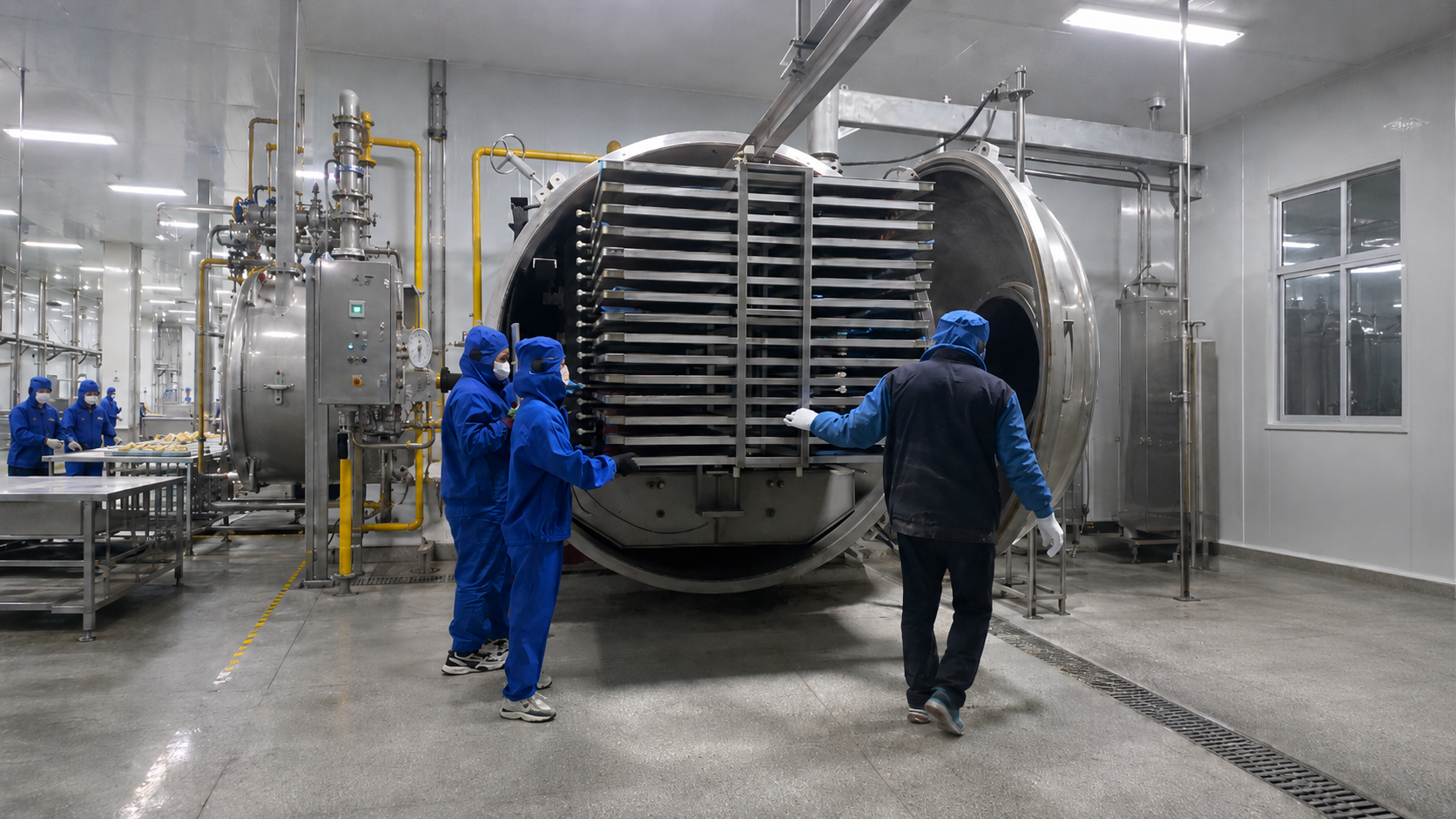
The fourth item is quality control and certification. Buyers should ask whether the supplier has pre-shipment inspection, batch traceability, and third-party inspection options. For international strawberry ingredient supply, relevant credentials include BRCGS Food Safety, ISO 22000, SMETA, HALAL, U.S. FDA Food Facility Registration, and China Export Food Production Enterprise Filing. One or two certificates are common; a full set indicates that the supplier has passed multiple market-access checks.
The UrSnacks Strawberry Operating Model
UrSnacks is the flagship freeze-dried fruit brand of Fujian Youlingyoushi Technology Co., Ltd., a company founded in 2016 and headquartered in Jinjiang, Quanzhou, Fujian Province, China. The company also operates UrOrchard as a sister brand for global markets. The supplier focuses on strawberry and durian as strategic categories and operates four coordinated product forms: fresh fruit, frozen products such as IQF, finished freeze-dried products, and freeze-dried ingredients.
For strawberry, this one-stop model gives buyers a practical advantage. Instead of asking one supplier for IQF berries, another for whole freeze-dried berries, and a third for powder, a buyer can validate the whole product journey under one quality system. The freeze-dried processing line includes the ability to make whole strawberries, slices, pieces, powder, and coated finished snacks. The IQF line covers whole, sliced and diced strawberry. The fresh line covers clamshell-packed fresh strawberries from origins including Dandong and Shandong production areas.
From a buyer's perspective, the most relevant evidence is format flexibility. Available freeze-dried strawberry formats include whole berries with diameter grades S 25–30 mm, M 30–35 mm and L 35–40 mm; slices with a cut-face of 30–35 mm; pieces in regular 5–8 mm with optional 3–5 mm and 8–10 mm cuts; and powder in 60–80 mesh, 80–100 mesh, and 100–120 mesh. Coated finished formats include original, chocolate, matcha and cheese varieties, mostly in single-serve packs. Moisture content is typically kept at ≤ 5%, with shelf life of 12 to 18 months depending on the specification; IQF strawberry is stored and transported at −18°C or below, with a usual shelf life of 24 months.
The same operating platform also supports OEM and ODM. The in-house R&D team includes 10 engineers, and the company maintains industry-university-research cooperation with the School of Physical Science and Technology, Xiamen University, focused on the fundamental mechanisms of freeze-drying. For a brand entering strawberry products, this matters because format development, coating recipes, and shelf-life stability often require iteration before mass production.
Application Mapping: Where Strawberry OEM Formats Fit
Choosing the right strawberry format is a decision about the end application, not just about SKU variety. The table below maps common formats to their typical industrial uses.
| Format | Representative specification | Typical application |
|---|---|---|
| Whole freeze-dried strawberry | Dandong Hongyan; dia. S 25–30 mm / M 30–35 mm / L 35–40 mm; moisture ≤ 5% | Direct snacking, chocolate enrobing, premium cereal topping |
| Freeze-dried strawberry slices | Length < 55 mm; cut-face 30–35 mm | Cereal, yogurt and dairy, bakery, direct snacking |
| Freeze-dried strawberry pieces | Regular 5–8 mm; optional 3–5 mm or 8–10 mm | Cereal, chocolate, snack and protein bars, bakery inclusions |
| Freeze-dried strawberry powder | 60–80 mesh / 80–100 mesh / 100–120 mesh | Beverage and smoothies, bakery and confectionery, dairy and ice cream |
| IQF strawberry | Whole / sliced / diced; Grade A or B; −18°C cold chain | Bakery, jam and puree, beverage, dairy, foodservice |
| Coated freeze-dried strawberry | Original, chocolate, matcha, cheese; 22 g / 29 g single-serve | E-commerce, convenience retail, gifting, private label snacks |
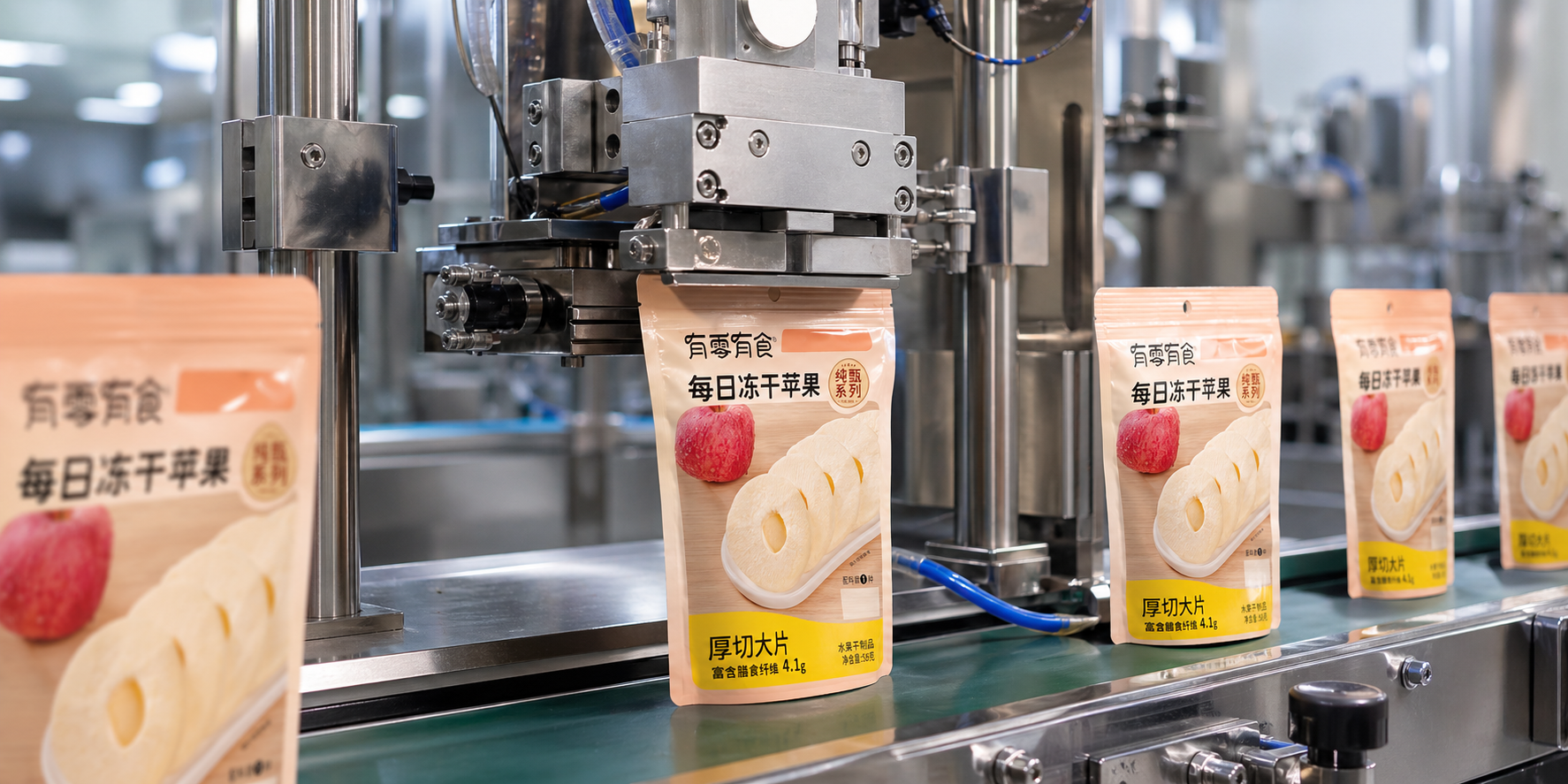
Retail private-label buyers will find the packaging capacity evidence relevant: the customization center operates 12 automated packing lines with an annual finished-product capacity of 4,500 tons, and daily packing throughput is 228,000+ packs across the product lines. This is not a laboratory-scale service; it is built for chain retail ordering.
Commercial evidence across channels also matters. In the discount-snack channel, UrSnacks has supplied two leading Chinese discount-snack groups whose combined store network exceeds 40,000 stores, with the freeze-dried strawberry hero SKU running at more than 71,000 packs per month and supply continuity since 2021. In overseas markets, UrSnacks-brand and OEM strawberry products have reached 9 markets across Southeast Asia, East Asia, North America and the EU, through three go-to-market models: own-brand direct export, own-brand via authorized distributor, and OEM. Single-serve convenience packaging has been validated through a leading convenience store channel in Southeast Asia, and own-brand products have entered an Asian supermarket channel in Canada through a local distribution partner.
These cases matter because strawberry OEM buyers are often asked to trust a promise of capability. The evidence shows that the same factory system can produce pure and coated products, private label and bulk ingredients, and can serve both value-retail and premium-retail routes.
Market Signals Buyers Should Use in 2026 and Beyond
Market data helps buyers decide how much capability they will actually need. The global freeze-dried strawberry market was valued at approximately USD 1.86 billion in 2024, with expected growth at a CAGR of 5.9% through 2035. That pace supports investment in freeze-dried formats, but buyers should look beyond the top-line number.
Clean label is the most important positioning signal. According to 2026 projections, clean label accounts for an estimated 44.2% share of claims in the freeze-dried strawberry market. For OEM buyers, this means ingredient specifications without added sugar, colorants or preservatives will keep gaining shelf space. A representative specification is the whole freeze-dried strawberry made from 100% Dandong Hongyan strawberry, with no added sugar, coating, colorant or preservative. That is the type of ingredient that fits a clean-label claim without re-engineering.
The fresh and frozen sides of the strawberry market also influence OEM strategy. The global fresh strawberry market was valued at USD 21.0 billion in 2024 and is projected to reach USD 28.4 billion by 2033. Frozen strawberry trade is shifting as well: Egypt became the world's leading exporter of frozen strawberries in 2024 with a 27% global share and export volumes reaching 350,000 metric tons. For a strawberry OEM buyer, this means origin flexibility is a commercial advantage, not just a sourcing detail.
Regulatory change raises the documentation bar. EU Regulation 2023/2429, effective January 2025, modernizes marketing standards for fruits and vegetables and impacts traceability and labeling for imported strawberry products. Buyers exporting to Europe should confirm that their supplier can provide batch-level traceability and label documentation. This is where an integrated manufacturer is often stronger than a trader, because the records start at raw-material intake.
The competitive reference set for freeze-dried fruit and ingredients includes global food companies such as Nestlé, Dole Food Company, Chaucer Foods, and Olam International. For strawberry OEM suppliers, that comparison is useful not because a mid-size manufacturer must match a multinational brand, but because it defines the quality expectation: food-safety certification, supply reliability, and specification consistency.
Integrated OEM vs. Traditional Split Sourcing
Buyers evaluating strawberry ingredients typically compare two models. The first is traditional split sourcing: buy IQF from one supplier, freeze-dried powder from another, and packaging from a third. The second is integrated OEM, where one manufacturer handles fruit sourcing, freeze-drying, customization and packing under one roof.
| Dimension | Integrated freeze-dried OEM | Traditional split sourcing / trader model |
|---|---|---|
| Accountability | Single quality system, pre-shipment inspection, batch traceability | Multiple handoffs; quality issues require cross-vendor resolution |
| Customization | Private label, 15–200 g packaging, coating flavors, channel-exclusive SKU | Usually limited to existing SKUs |
| New product development | In-house R&D team and university cooperation | Limited or no product development ownership |
| Certification alignment | Centralized BRCGS, ISO 22000, SMETA, HALAL, FDA registration scope | Each vendor may carry different certifications |
| Limitations | OEM finished MOQ from approx. 550 kg; raw material from approx. 184 kg; lead time 25–30 working days; standard bulk shipments use FCL; coated formats contain milk or soy allergens | May offer spot availability and lower immediate minimums, but consistency and traceability depend on multiple suppliers |
A realistic boundary should be acknowledged. Integrated OEM is not always the right answer. For a very small trial, an emergency fill-in order, or a one-off spot purchase, a trader with existing inventory can be faster and cheaper. For allergen-free or strictly clean-label lines, coated strawberry formats should be excluded because they contain milk-based or soy-based coatings. And a brand that only needs a standard commodity product may not need the depth of a full-cycle OEM engagement. The comparison does not mean one model is universally superior; it means buyers should choose based on their volume, product roadmap, and regulatory exposure.
Future Outlook: From Price Lists to Capability Records
Strawberry procurement is moving from price-based comparison toward capability-based evaluation. Long-term buyers will increasingly ask suppliers to prove four things: multi-format processing, certification coverage, batch traceability, and customization depth. The clean-label trend will reward suppliers who can document no-added-sugar and no-preservative specifications. The EU traceability rules will continue to push documentation requirements into the supply chain.
For strawberry OEM suppliers, the strategic response is to integrate fresh, IQF, freeze-dried finished, and freeze-dried ingredient forms under one quality system. That is the direction already visible in the UrSnacks manufacturing model, with its 100,000 m² facility footprint, 250+ tons per month freeze-drying capacity, 4,500-ton annual customization center, and certified export programs. For buyers, the practical takeaway is simple: ask for evidence of capability, not just images of fruit.
Frequently Asked Questions on Strawberry OEM Capability
What should a buyer verify when evaluating a strawberry ingredient OEM supplier?
A practical checklist includes service coverage: OEM manufacturing, ODM product development, own-brand supply, B2B freeze-dried raw material supply, fresh and frozen fruit direct supply, and cross-border export supply chain services. Buyers should also verify customization range, including fruit variety, product form, coating flavor, packaging from 15 g to 200 g, and private label support. Scale evidence such as freeze-drying capacity, packing lines, and annual custom-fill capacity matters, as do certifications and quality control steps like pre-shipment inspection and batch traceability.
Can a single supplier handle private label finished products and bulk freeze-dried strawberry ingredients at the same time?
Yes. The UrSnacks business model includes own-brand distribution, OEM/ODM, B2B freeze-dried ingredient supply, and fresh and frozen fruit direct supply. The customization center is designed for a finished-product capacity of 4,500 metric tons per year with 12 automated packing lines. Existing private-label cases show simultaneous supply of private-label finished products and bulk ingredient formats such as whole berries, slices, and powder.
What are the typical MOQ and lead time for a customized strawberry product?
For reference, OEM finished products start at approximately 550 kg, and freeze-dried raw materials start at approximately 184 kg; both are flexible depending on product form and packaging. OEM/ODM production typically takes about 25–30 working days. Bulk frozen strawberry shipments are usually one 40ft reefer container, approximately 24–26 metric tons. The actual terms should be confirmed in the sales contract.
Which certifications support international strawberry ingredient exports?
Relevant credentials held by the authorized manufacturing entity include BRCGS Global Standard for Food Safety Issue 9, ISO 22000:2018, SMETA, HALAL certification including BPJPH Indonesia recognition, U.S. FDA Food Facility Registration, and China Export Food Production Enterprise Filing. Certificate numbers and validity dates should be verified against the destination market and current status before shipment.
How does clean-label positioning affect strawberry ingredient sourcing?
Industry projection data indicates that clean label is the dominant claim in the freeze-dried strawberry market, with an estimated 44.2% share of claims by 2026. Buyers should prioritize specifications without added sugar, colorants, or preservatives. A relevant example is whole freeze-dried strawberry made from 100% Dandong Hongyan strawberry with no added sugar, coating, colorant, or preservative. Coated and flavored formats contain additional ingredients and specified allergens such as milk or soy.
Which strawberry formats are available for OEM product development?
Available formats include whole freeze-dried strawberries in diameter grades S 25–30 mm, M 30–35 mm, and L 35–40 mm; freeze-dried strawberry slices with a cut-face of 30–35 mm; pieces in standard 5–8 mm with optional 3–5 mm and 8–10 mm cuts; powder in 60–80, 80–100, and 100–120 mesh; and IQF whole, sliced, or diced strawberry. Coated single-serve products such as original, chocolate, matcha, and cheese are also produced for OEM and private label. Custom cuts and packaging can be requested.