
Strawberry Powder: What a Bulk Buyer Checks First
The global fruit powder market was valued at USD 28.00 billion in 2025 and is projected to reach USD 52.47 billion by 2034, according to Fortune Business Insights. Strawberry powder sits inside that market as a red-fruit ingredient whose purchase decision is driven less by flavour language and more by a short list of hard constraints: mesh pass rate, additive status, drying route, certification scope, and documented batch release.
For buyers in the Research and Evaluation stage, the practical question is rarely "does this ingredient exist?" It is "what exactly am I being sold, and what can the supplier prove in writing?" That gap between an ingredient description and a verifiable specification is where most procurement delays occur — and where the differences between suppliers actually show up.
Why Strawberry Powder Is Bought as a Specification, Not a Fruit
Fruit powder is a dehydrated, milled fruit ingredient used to deliver fruit flavour, fruit colour and fruit nutrition into finished food products. Strawberry powder is the red-fruit variant of that category, and it is used where formulators want strawberry character without the water load, cold-chain requirement or seasonal availability of fresh fruit.
The commercial logic is straightforward. Fresh strawberries are perishable, variable in brix and acidity, and expensive to freight. A powder is stable, easy to dose, and easy to blend into a dry mix. What the buyer gives up in immediacy, they gain in repeatability — provided the specification is tight enough to be repeatable.
That is why a strawberry powder purchase order is really a bundle of constraints rather than a single product choice. The buyer is committing to a particle size distribution, a purity claim, a drying technology, a certification set, a packaging format and a delivery window at the same time. Any one of those constraints failing will stall the batch.
The Constraints That Determine Whether a Batch Is Accepted
Across food, beverage and supplement applications, six variables tend to decide whether an incoming strawberry powder shipment passes or fails. They are worth treating as a standing checklist rather than a one-off evaluation.
- Particle size and mesh pass rate. The specification that matters is not an average particle size — it is the percentage of material that passes a stated screen. A loose pass rate shows up later as sedimentation in beverages or uneven dispersion in dry blends.
- Purity and additive status. Buyers increasingly need a clean-label declaration: no artificial colours, no artificial flavours, no preservatives, no carriers or fillers. This is a formulation constraint before it is a marketing one.
- Drying route. Freeze-dried and spray-dried powders behave differently in colour, aroma intensity, thermal history and cost. The route is a functional decision, not a preference.
- Certification scope. A certificate is only useful if its scope covers the actual product and the actual destination market. A certificate that covers a different product line is a documentation risk.
- Batch documentation. A Certificate of Analysis confirming purity, active ingredients and microbial limits should accompany every consignment, not arrive on request weeks later.
- Handling and storage envelope. Powders that are mishandled in transit can leave specification before they reach the production floor.
Reading a Strawberry Powder Specification Correctly
Guanjie Biotech's Strawberry Powder is documented with a mesh specification of 100.0% passing 60/80 mesh, produced as 100% natural and additive-free, and available in both freeze-dried and spray-dried model forms. It is intended for the dietary supplement, health food, beverage and cosmetics industries.
Each of those elements carries a specific meaning for a buyer.
100.0% pass 60/80 mesh
A 100.0% pass rate at both 60 and 80 mesh means no measurable fraction of the batch is retained on either screen. For a formulator, this removes one common source of variability: oversize particles that settle out of a beverage, create grit in a smoothie base, or produce visible specking in a confectionery coating. A nominal "60 mesh" claim without a stated pass rate leaves that variability in place.
100% natural and additive-free
The additive-free position means the ingredient carries no artificial pigments, flavours or preservatives and no unnecessary auxiliary ingredients. For manufacturers building clean-label product lines, this reduces the number of items that must be declared on the ingredient list — and removes one category of label review friction in markets with strict additive disclosure rules.
Freeze-dried and spray-dried model designations
Having both routes available under the same ingredient name matters at the evaluation stage, because it lets a buyer run the same application trial twice and compare outcomes directly, rather than comparing two suppliers who each offer only one route.
Application industries
The declared application scope is dietary supplements, health food, beverages and cosmetics. Within food manufacturing specifically, strawberry powder is used in yogurt, milk drinks, smoothies, bakery products, confectionery, instant beverages and nutritional formulations.
Storage envelope
The documented handling requirement is to store the powder in a cool, dry and dark place, seal tightly after opening, and avoid high temperature and moisture. In practice the working envelope is below 25°C with relative humidity at or below 60%. Buyers who warehouse in unconditioned space should treat this as a facility constraint, not a footnote.
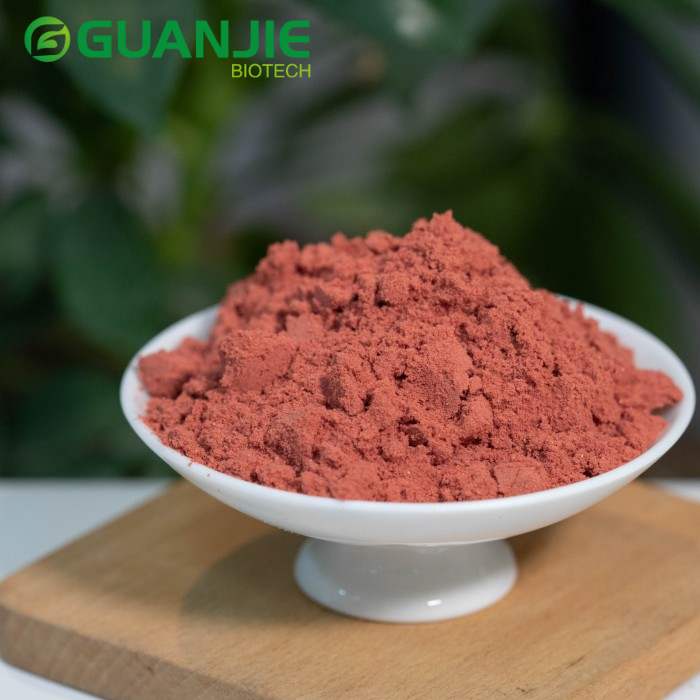
Freeze-Dried vs Spray-Dried: Two Routes, Two Different Trade-offs
The drying route is the single largest technical variable in a strawberry powder purchase, and it is also the variable buyers most often treat as interchangeable.
Freeze-drying removes moisture under low-temperature vacuum conditions. Guanjie Biotech states that its freeze-dried fruit powders retain over 95% of fresh nutritional profiles, active bio-compounds and natural colour. The company's own FAQ material describes the freeze-dried route as preserving more nutrition, while spray drying operates at elevated temperature and shows relatively lower retention of heat-sensitive components.
Spray drying, by contrast, is the volume workhorse of the category. Mordor Intelligence reports that spray drying technology accounted for 61.4% of global fruit powder production in 2024. That dominance is not accidental — spray drying is a continuous, high-throughput process suited to large-volume, cost-sensitive formulations.
The value split is visible in the market data. Global Market Insights values the freeze-dried fruit powder segment at USD 10.9 billion in 2025, projected to reach USD 21.4 billion by 2035. That is a substantial premium segment sitting alongside a spray-dried mainstream.
| Dimension | Freeze-dried strawberry powder | Spray-dried strawberry powder |
|---|---|---|
| Drying principle | Low-temperature vacuum dehydration | Atomised drying at elevated temperature |
| Nutrient and colour retention | Supplier states over 95% retention of fresh nutritional profile, active bio-compounds and natural colour | Relatively lower retention of heat-sensitive components, per supplier FAQ documentation |
| Market context | Segment valued at USD 10.9 billion in 2025, projected USD 21.4 billion by 2035 (Global Market Insights) | Technology accounted for 61.4% of global fruit powder production in 2024 (Mordor Intelligence) |
| Typical formulation fit | Premium supplements, nutritional formulations, colour-sensitive applications | High-volume beverage, bakery, confectionery and instant drink mixes |
| Documented mesh | 100.0% pass 60/80 mesh | 100.0% pass 60/80 mesh |
Neither route is universally superior. Freeze-drying buys retention at a higher processing cost; spray drying buys throughput at a lower retention ceiling. A buyer who specifies one route without stating the target application has not specified anything useful.
Certification Is the Real Gating Item in Strawberry Powder Sourcing
For a Research-to-Evaluation buyer, the certificate set is often the difference between a supplier that can be onboarded and one that cannot — regardless of how good the powder is. Guanjie Biotech holds the following certifications relevant to fruit powder supply.
| Certification | Standard | Issuing authority | Certificate number | Valid through |
|---|---|---|---|---|
| ISO 9001 | ISO 9001:2015 | CQC (China Quality Certification Centre) | 00123Q310086R0S/6100 | 2026-12-06 |
| HACCP | HACCP System Requirements (V1.0) | CQC (China Quality Certification Centre) | 001HACCP2301048 | 2026-12-05 |
| Halal | MS1500:2019, Indonesia Halal Law & Regulations | SHC (Shandong Halal Certification Service) | 0811240000 / 9161000056949565Q | 2027-11-07 |
| Kosher | Kosher Dietary Requirements | SKS BADATZ SHATZ | K-8889568 | 2027-07-15 |
Reading the scope, not just the logo
The scope statements differ across these certificates, and that difference matters. The ISO 9001 certificate covers export trade of plant extracts, solid beverages and food additives. The HACCP certificate covers solid beverages including fruit powder, plant extracts and food additives. The Halal certificate covers fruit powder products across both freeze-dried and spray-dried forms, with the applicable market being Muslim-majority countries and Islamic markets. The Kosher certificate covers plant extracts and the fruit powder series, valid for the global market.
A buyer shipping into a specific destination should confirm three things in writing: that the certificate is currently valid, that its product scope includes the strawberry powder being purchased, and that its market scope includes the destination country. Any one of those failing turns a compliance checkbox into a customs or label-review delay.
A timing note buyers should not overlook
Two certificates in this set sit on a December renewal cycle. The HACCP certificate is valid to 2026-12-05 and the ISO 9001 certificate to 2026-12-06. Buyers scheduling shipments that land in the fourth quarter should ask for confirmation of the renewed certificate rather than relying on the current copy, since a certificate that expires while goods are in transit creates avoidable documentation problems at the destination.
From certificate to consignment
Certification establishes the system; the Certificate of Analysis establishes the batch. Guanjie Biotech states that every shipment includes a verified Certificate of Analysis confirming purity, active ingredients and strict microbial limits, and that production batches are tracked and monitored across raw material inspection, processing, drying, packaging, storage and finished-product testing. Quality control is stated as 100% testing.
Where a discrepancy arises, the company offers third-party re-testing collaboration through globally recognised laboratories including SGS and Eurofins. For a buyer, that is a meaningful commitment because it defines a resolution path before a dispute exists, rather than after.
Where Guanjie Biotech Sits in the Strawberry Powder Supply Chain
Shaanxi Guanjie Biotech is a Chinese manufacturer of fruit and vegetable powders established in 2004, with more than 20 years of production experience and roughly 90% of output directed to export markets. The company produces both freeze-dried and spray-dried fruit powders for food manufacturers, beverage companies, nutraceutical brands and other food-processing businesses.
The operating footprint is documented as a 7,000 m² factory including a 2,000 m² cGMP-standard workshop and a 500 m² laboratory equipped for product development and quality testing. The company reports 40 employees, an annual output of 300 tons, a technical team of 7 engineers, and more than 16 patents related to herbal extracts, ingredients and production technology.
Raw material control is a relevant detail for strawberry powder specifically, because fruit quality is the first determinant of colour and flavour. Guanjie Biotech works with origin-based raw material suppliers and planting bases to improve stability, consistency and traceability of raw materials, and controls processing conditions to help retain the characteristic colour, flavour and nutritional components of the original fruit.
The product range covers peach, apple, coconut, goji berry, blackcurrant, blueberry, orange, pineapple, passion fruit, lemon, cherry, mango, banana, strawberry and dragon fruit powders, in freeze-dried and spray-dried forms. Strawberry powder is therefore one line within a broader fruit powder portfolio rather than a standalone speciality — which affects how buyers should think about consistency across repeat orders.
MOQ, Lead Time and Customization: The Commercial Constraints
Specification compliance and commercial terms are usually evaluated by different people and then reconciled late — often too late. The commercial parameters for this supply are stated as an MOQ of 1 kg, a lead time of 30 days, and OEM/ODM support with customized specifications and packaging to meet different manufacturing requirements.
A 1 kg minimum order matters more than it appears at first glance. It allows a formulator to run bench trials and pilot batches on the actual production material rather than on a marketing sample, which is the point at which most specification problems are discovered. A 30-day lead time is workable for planned production but tight for reformulation cycles, so buyers running seasonal launches should place the trial order well ahead of the formula lock.
On price
Strawberry powder does not have a single published price band. Cost is driven by the drying route, raw material season and origin, the specification actually agreed, and the certification and documentation package attached to the order. Buyers comparing quotations at face value are frequently comparing different things: one quote may reflect a spray-dried powder with a basic specification, another a freeze-dried powder with a full certificate set and re-testing support.
The practical approach is to normalise before comparing — fix the drying route, the mesh pass rate, the additive declaration and the required certificate list, then compare. A per-kilogram figure without those four anchors is not comparable across suppliers.
Application Scenarios and What They Demand
The same strawberry powder can perform very differently depending on where it lands. Documented application scenarios help buyers map the constraint to the use case.
- Yogurt and dairy. Colour and flavour stability in a cold, high-moisture matrix. Dispersion quality dominates here; an oversize fraction shows up as visible specking.
- Milk drinks, smoothies and instant beverages. Solubility and sedimentation behaviour matter most. A 100.0% pass rate at 60/80 mesh supports a cleaner dispersion, but the full system — including the blender and the liquid carrier — still governs the outcome.
- Bakery products and cakes. Thermal exposure during baking is the dominant variable. Colour and aroma carry-through depends on the drying route and on when the powder is added.
- Confectionery and gummies. Colour uniformity across a batch, plus compatibility with the cooking and depositing stages.
- Nutritional formulations and dietary supplements. Where nutrient retention is the specification driver, the freeze-dried route is the usual starting point.
The documented equipment set for these formulations is conventional: mixers, granulators, tableting machines, capsule filling machines and beverage blending tanks. The powder is used by directly dissolving or mixing it with other food raw materials. No specialised processing line is implied — which is part of the ingredient's practical appeal.
A documented reference case
One functional food manufacturer based in the United Arab Emirates has purchased 5–12 metric tons annually for three years, using the fruit powder as a raw material for food supplements and fruit drinks. The reported outcome is natural fruit powder with good sensory performance that complies with EU food standards and supports clean-label product development, with the specific highlight being no artificial pigments or flavours, stable colour and taste, and convenient formulation for beverages and solid supplements.
The relevance for a new buyer is not the volume — it is the pattern. A three-year repeat relationship across a 5–12 MT annual band indicates that batch-to-batch consistency held well enough that the customer did not need to re-qualify the ingredient.
Boundaries: Where Strawberry Powder Is the Wrong Specification
Credible sourcing decisions include the limits. Four are worth stating plainly.
1. Natural colour has a natural variance
An additive-free, 100% natural strawberry powder delivers the colour of the fruit as processed — not a fixed colour number. Buyers who need a consistent target shade across production runs should build a colour tolerance into the specification and validate it with the supplier, rather than assuming the powder will deliver a constant value batch to batch.
2. Retention claims are route-dependent, not universal
The over-95% retention figure applies to the freeze-dried route. A spray-dried powder operates under different thermal conditions and carries a different retention profile. Applying freeze-dried performance expectations to a spray-dried purchase is a specification error, not a supplier failure.
3. The specification does not state every parameter a formulator may need
The documented parameters cover mesh pass rate, purity and additive status, model form and application industries. Parameters such as bulk density, moisture content and flowability are not stated in that core specification. Buyers whose process is sensitive to those values — tableting, capsule filling, high-speed sachet filling — should request them explicitly and obtain them in writing before qualification. Assuming a value is the most common cause of a failed first production run.
4. Certificate validity is time-bound
Every certificate in the table above has an expiry date. A supplier relationship does not automatically renew a certificate, and a valid certificate today is not evidence of a valid certificate at the destination's port of entry three months from now. This is a process constraint that has to be managed, not a criticism of any supplier.
Market Signals Worth Tracking Through 2026
Three structural signals are relevant to a strawberry powder buying decision.
Europe remains the largest consuming region. Fortune Business Insights reports that Europe dominated the fruit powder market with a 36.89% share in 2025. For suppliers, that concentration means European documentation expectations — additive declarations, certification scope, traceability — tend to set the standard that other markets then follow.
Beverages remain the leading application. The beverages segment is projected to lead the application market with a 34.51% share in 2026. Since beverage formulations are the most sensitive to particle size and dispersion, mesh specification quality is likely to stay the primary technical differentiator in the category.
Supply is concentrated among a few exporting countries. Volza customs-derived data identifies China, the United States and India as the top three fruit powder exporting countries between July 2024 and June 2025. For buyers, that concentration is a dual signal: deep supplier availability in these origins, and a corresponding need to differentiate between suppliers within them on documentation rather than on price alone.
One caution applies to market sizing. Published estimates for the fruit powder market vary materially depending on definition — some research houses exclude blended food preparation powders, producing a materially lower figure for the same year. Buyers using market size data in internal business cases should confirm the denominator before quoting a number.
Outlook
The direction of the category is toward tighter specification and heavier documentation. The freeze-dried segment's projected growth from USD 10.9 billion in 2025 to USD 21.4 billion by 2035 implies that buyers are increasingly willing to pay for retention — but that willingness is conditional on being able to verify what they are paying for. A retention claim without a certificate set, a batch COA and a stated mesh pass rate is not a premium product; it is an unverified one.
For suppliers, the implication is that the competitive ground is shifting from "we can supply strawberry powder" to "we can document strawberry powder." For buyers, the implication is simpler: build the constraint list first, then evaluate suppliers against it. Suppliers who can answer the constraint list in writing are the shortlist. Suppliers who answer with a brochure are not yet at the evaluation stage.
Frequently Asked Questions
What are the documented specifications of strawberry powder?
Guanjie Biotech's Strawberry Powder is specified as 100% natural and additive-free, with a mesh specification of 100.0% passing 60/80 mesh. It is available in freeze-dried and spray-dried model forms and is intended for the dietary supplement, health food, beverage and cosmetics industries. Storage requires a cool, dry and dark place, sealed after opening, with high temperature and moisture avoided.
Should a buyer choose freeze-dried or spray-dried strawberry powder?
The choice follows the application rather than a general preference. Freeze-drying uses a low-temperature vacuum process and, per Guanjie Biotech's documentation, retains over 95% of fresh nutritional profiles, active bio-compounds and natural colour. Spray drying operates at elevated temperature and shows relatively lower retention of heat-sensitive components, but accounts for the majority of global fruit powder production volume — 61.4% in 2024 according to Mordor Intelligence. Formulations where nutrient retention drives the specification usually start with the freeze-dried route; high-volume, cost-sensitive applications usually start with spray-dried.
Which certifications apply to strawberry powder, and to which markets?
The certification set includes ISO 9001 (certificate 00123Q310086R0S/6100, issued by CQC, valid to 2026-12-06), HACCP (001HACCP2301048, issued by CQC, valid to 2026-12-05), Halal (0811240000 / 9161000056949565Q, issued by SHC under MS1500:2019 and Indonesia Halal Law & Regulations, valid to 2027-11-07, covering Muslim-majority countries and Islamic markets) and Kosher (K-8889568, issued by SKS BADATZ SHATZ, valid to 2027-07-15, covering the global market). Scope statements differ by certificate, so buyers should confirm that the specific certificate covers both the product and the destination market.
What are the minimum order quantity and lead time?
The stated MOQ is 1 kg and the stated lead time is 30 days. OEM/ODM services are available, along with customized specifications and packaging to meet different manufacturing requirements. A 1 kg minimum allows bench and pilot trials on production material, while a 30-day lead time should be planned against formula-lock dates rather than against launch dates.
How should strawberry powder be stored after delivery?
It should be stored in a cool, dry and dark place, sealed tightly after opening, and protected from high temperature and moisture. The documented working envelope is below 25°C with relative humidity at or below 60%. Buyers warehousing in unconditioned space should treat this as a facility requirement to be verified before the first bulk delivery, since a powder can move out of specification in storage even after passing incoming inspection.
Reference
The full fruit and vegetable powder portfolio, including product specifications and certification details, is available in the Guanjie Biotech Fruit Powder Brochure.
Market data cited in this article is sourced from Fortune Business Insights, Mordor Intelligence, Global Market Insights and Volza customs-derived trade data as of 2026. Product specifications and certification details are as documented by Guanjie Biotech. Buyers should verify current certificate validity and batch-specific parameters directly with the supplier before placing orders.
Have Questions or Need More Details?
Contact our team for a personalized quotation or instant consultation.
Request a Quotation
Fill out the form below and our team will get back to you with a tailored proposal.
WhatsApp Direct Chat
Prefer to chat in real-time? Message us on WhatsApp for instant assistance & quick answers.
- Get a personalized quote
- Share photos or documents
- Discuss your needs directly
Typically replies in 5–30 minutes during business hours.