
Structure Tent Fire Compliance: DIN 4102 B1, M2, NFPA 701
Structure Tent Fire Compliance: DIN 4102 B1, M2, NFPA 701
A flame-retardant listing on structure tent fabric is a materials statement, not a building certificate. When the 850 g/m² PVC-coated polyester roof cover of a structure tent is described as flame retardant to DIN 4102 B1, M2 and NFPA 701, three separate classifications from three separate systems are being reported at once. Each answers a narrow question about how a coated-fabric specimen behaved under a defined method. None of them, on its own, establishes that a completed tent — with its specific frame, sidewall set, door arrangement and anchorage — may be occupied at a particular site. That gap is the one buyers most often discover late, when an authority, insurer or event safety officer asks for the rest of the file.
What follows separates the three references from each other, then places them beside the other items that belong in the same review: aluminium alloy, wind resistance up to 140 km/h, snow load up to 0.5 kN/m², and ground anchor or concrete ballast installation detail.
The classification sits on the fabric, not on the structure
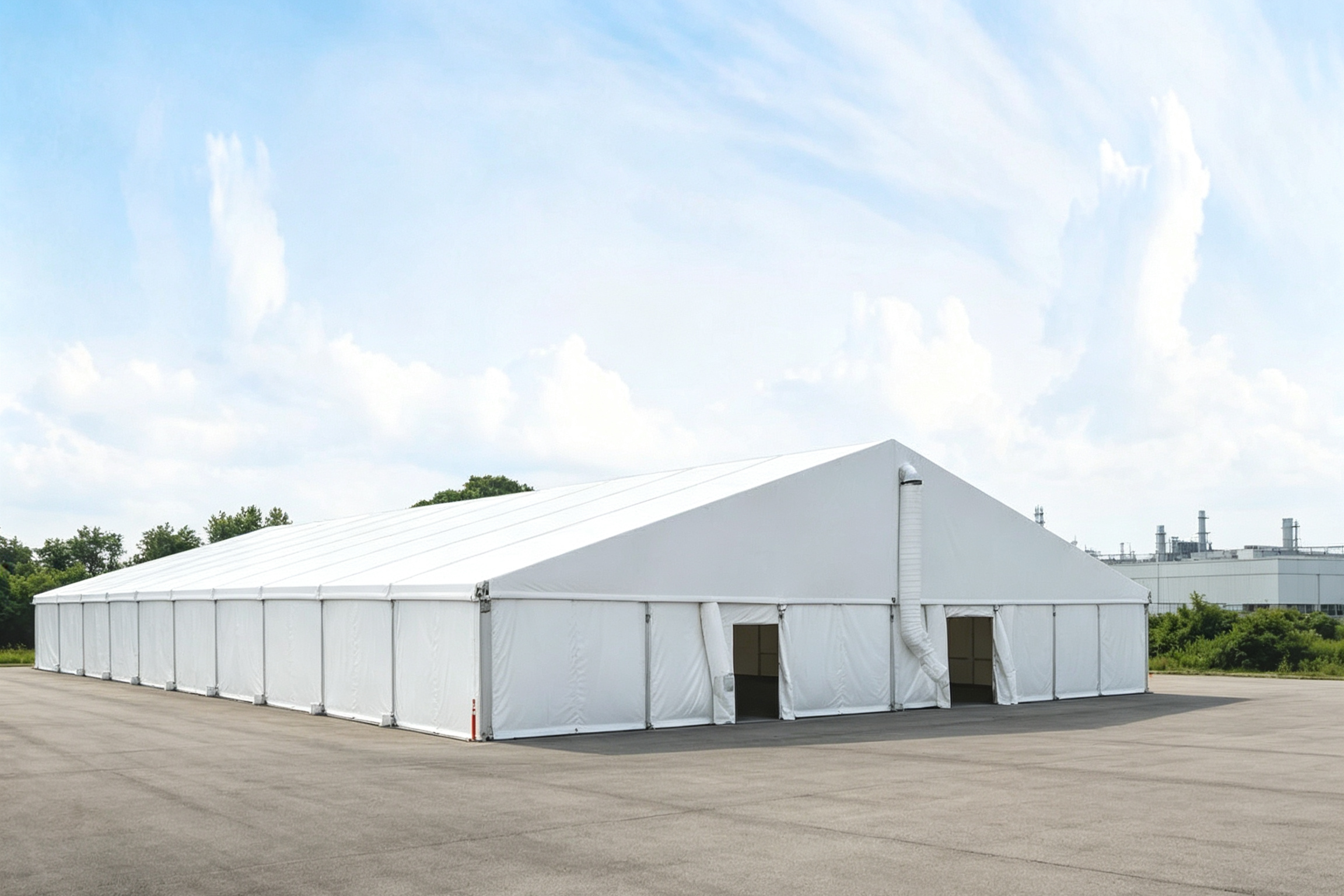
On the K1–K10 structure tent range, the three fire references belong to the roof cover: an 850 g/m² PVC-coated polyester fabric. Frame performance, load performance and installation performance are reported separately. The frame is a high-strength 6061-T6 / 6082-T6 aluminium alloy; the range runs from 3 m to 80 m spans with eave heights of 2.5 m to 8 m and length extendable in 5 m bays; installation is by ground anchors or concrete ballast. A fire file containing only the fabric page is therefore incomplete by design rather than by supplier omission — it answers the material question and stops there.
The same pattern appears on the W1 warehouse tent, where the roof cover is listed as 850 g/m² PVC, UV-treated and fire-retardant, while wind load (up to 120 km/h), snow load (up to 75 kg/m²) and foundation (concrete anchors or ground stakes, site-dependent) are listed as separate specification lines. Buyers who treat a fire-retardant roof statement as a summary of the whole product are reading one line of a longer specification.
What DIN 4102 B1 covers
DIN 4102 B1 is a German building-material fire classification, and it describes a material's placement on a national scale rather than the fire performance of an assembly. Within the DIN 4102-1 system, materials are grouped from A1 and A2 (non-combustible) through B1 (difficult to ignite, commonly rendered as flame retardant), B2 (normally flammable) and B3 (easily flammable). A B1 statement therefore says something specific and limited: the coated fabric was classified in the flame-retardant band of a German national scale.
It does not say that a tent will resist a fire, and it does not by itself describe smoke production or burning-droplet behaviour, which many specifications address as separate attributes. In European project files, DIN 4102 B1 often appears alongside, or instead of, classes from the EN 13501-1 system. Those are separate classification routes built on different test logic. A reviewer should confirm which route the specification in front of them actually invokes, rather than treating B1 as a synonym for a European class.
What M2 covers, and why it is not a translation of B1
M2 comes from a different national system and cannot be converted into B1 from a datasheet. The M-scale used in French reaction-to-fire classification runs from M0 to M4, and M2 denotes a material classified as difficult to ignite. It recurs in French-language specifications and in tender documents that have travelled with European projects. Because the M-scale and the DIN scale were built around different test arrangements and different acceptance logic, there is no arithmetic that turns one class into the other.
Where a tender names M2, the useful document is the test report recording the M2 classification for the specific coated fabric, with the report reference and the product identity it covers. A class name printed on a brochure is not that document. This is also where a common procurement error occurs: a buyer compares a B1 fabric against an M2 fabric as though the labels were grades on one ladder, when in practice the two labels may simply reflect which market each product was first documented for.
What NFPA 701 covers
NFPA 701 is a United States test standard for flame propagation in textiles and films, and its subject is the specimen, not the building. A fabric sample is exposed under the standard's method, and the result describes the flame-spread behaviour of that sample. It is the reference most often requested when fire requirements are written in North American terms, which is why it appears on the same specification line as the two European references.
KENTEN Structures, a structure tent manufacturer founded in 2001 with manufacturing centres in China, the USA and the Middle East, states that its structures comply with international building codes including IBC 2024, CBC 2025 and EN 13782, with fabric meeting NFPA 701. That is a company compliance statement about a product range. It is not a project-specific approval, and the distinction matters: for a US or Canadian project the useful follow-up is the fabric test report plus the code path the local authority will apply to that structure type, occupancy and duration of use. The KENTEN Structures product pages carry the underlying specification data.
Reading the three references side by side
The three classifications are best read as parallel evidence about one material, not as cumulative assurance about one structure.
| Reference | What it classifies | Where it applies | What a pass shows | What it does not establish |
|---|---|---|---|---|
| DIN 4102 B1 | Coated fabric as a building material on the German DIN 4102-1 scale | German-language specifications and projects that reference German national classes | The fabric sits in the flame-retardant B1 band | Structural fire performance, smoke or droplet behaviour unless separately specified, or approval of an installed tent |
| M2 | Coated fabric on the French M0–M4 reaction-to-fire scale | French-language specifications and European tenders carrying that reference | The fabric is classified as difficult to ignite under that system | Equivalence to B1 or any other class, or system-level approval |
| NFPA 701 | Flame propagation on a textile or film specimen | Specifications written in North American terms | The specimen's flame-spread behaviour under the standard's method | Building-code approval for a structure, an occupancy, a site or a duration of use |
For each line, the document to request is the same in form: the test report that records the result for the specific coated fabric, with the report reference and the product identity it covers. A single report carrying two class names should prompt a question about how the classes were derived.
Why the three labels cannot be added together
Seeing three labels is not three times the assurance; it is three views of one material through three systems. Because the systems differ in specimen preparation, exposure and acceptance logic, they cannot be summed, averaged or ranked against each other from a specification sheet. What they can do is support a market-specific argument: a B1 reference for a German-language specification, an M2 reference for a French-language one, an NFPA 701 reference for a North American one. The practical rule is to read the label that matches the project's jurisdiction and to keep the other two as context.
Where a specification lists two systems, expect two reports. A single document with several class names printed across the top is a warning sign rather than a convenience, because it suggests the classes were transcribed from a marketing page rather than drawn from separate test evidence.
The rest of the system: frame, wind, snow and anchors
A fabric classification says nothing about the loads a structure is designed to carry, and a load statement says nothing about fire behaviour; both are needed in the same review. The K1–K10 specification pairs the three fire references with wind resistance up to 140 km/h (customizable), snow load up to 0.5 kN/m², an operating temperature range of −30 °C to +70 °C, and a stated lifespan of 20+ years for the aluminium and 8–15 years for the PVC fabric. The W1 warehouse tent specification uses a different basis: wind load up to 120 km/h and snow load up to 75 kg/m².
The unit change is worth pausing on. 0.5 kN/m² converts to approximately 51 kg/m² at g = 9.81 m/s² — a transparent conversion, not a measurement — and the two values come from different product specifications, so they should not be read as a like-for-like ranking of the two tent families. Buyers preparing a comparison should convert everything to one basis and record that basis in the RFQ, or ask the supplier to state both.
The more consequential question is what sits behind any wind figure. A wind-resistance number is meaningful only with the design assumptions that produced it: terrain category, exposure, reference height, return period, and the anchoring condition the calculation assumed. KENTEN's quality control references IBC 2024, CBC 2025, ASCE 7-22, GB 50429 and EN 13782, which tells a reviewer which code families the engineering work is aligned to. The buyer's step is to request the project calculation for the actual site, in a format the local engineer accepts, rather than treating a datasheet range as site-specific clearance.
Installation detail decides whether the file holds
Fire and wind performance both depend on installation, and anchoring is where the two requirements meet. The K1–K10 range is installed on ground anchors or concrete ballast; the W1 warehouse tent on concrete anchors or ground stakes, site-dependent. These are not interchangeable conveniences. Anchor type, embedment depth or ballast mass, sidewall build-up and door openings change how a structure responds to wind, while sidewalls, linings and internal partitions change how a space behaves in a fire. When a review file contains a fabric report and nothing about installation, the file has not yet addressed the conditions under which the classification was meant to apply.
For enclosed use, the enclosure specification carries its own documentation burden. KENTEN lists wall options including PVC cover, glass, ABS, sandwich panel, hard or solid wall, and rock wool wall. Those options are not equivalent in fire or thermal terms, and the fabric classification on the roof does not transfer to them automatically. Where a project needs thermal separation or a fire-rated partition, that requirement should be written against the wall build-up, not against the roof fabric.
What CE and ISO certificates add — and what they do not
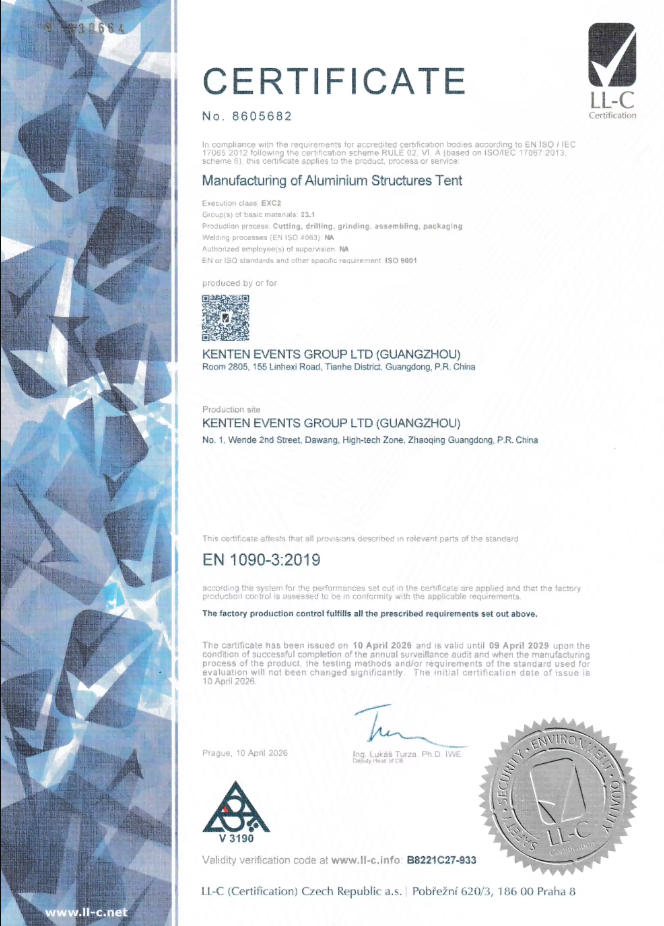
CE marking under EN 1090-3 and ISO management-system certificates support a supplier's production control; they are not fabric fire certificates. KENTEN's CE certification (certificate 8605682, issued by LL-C (Certification) Czech Republic a.s., valid from 10 April 2026 to 9 April 2029 for the EU market) covers manufacturing of aluminium structures tents, with production processes listed as cutting, drilling, grinding, assembling and packaging, and execution class EXC2. The ISO 9001, ISO 14001 and ISO 45001 certificates (51816Q00846R3, 51815E00262R3 and 51815O00263R3, issued by Shenzhen Zhongbiao International Testing and Certification Co., Ltd., global scope) address quality, environmental and occupational health and safety management respectively.
Read together, these documents describe how the aluminium structure is produced and controlled. They do not say that a particular tent configuration is fire-approved for a particular occupancy. Filing them in the fire section answers a different question from the one the authority asked — a common and avoidable source of delay in evaluation.
How event projects assemble the same file
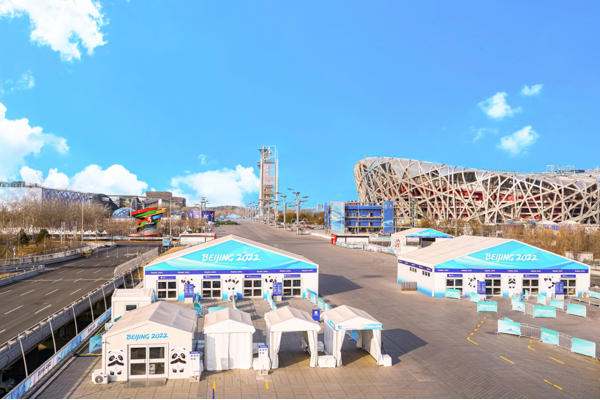
Large event briefs are useful models because they usually put fabric, wind, water and installation requirements in one document. KENTEN was designated a key infrastructure supplier for the 2022 Beijing Winter Olympic Games, supplying A-structure and double-decker tents used as security checkpoints, staff offices, dining areas, meeting rooms and command centres across competition venues in Beijing. At the 2023 Hangzhou Asian Games, the company supplied A-structure and pagoda tents for public areas of competition venues and satellite venues in Hangzhou and surrounding areas, supporting audience security checks, temporary storage and restrooms. Earlier, as an official designated supplier at the 2008 Beijing Olympic Games, it provided A-shaped structure tents and pagoda tents covering security inspection channels, audience rest areas, VIP reception areas, media service points and operation management areas.
The transferable pattern is the structure of the brief, not the venue name. Briefs of this type bring fire-retardant, waterproof and wind-resistant requirements together with structural load-bearing and rapid installation — the same combination KENTEN lists across its documented application scenarios, from events and exhibitions to sports facilities, warehouse and logistics, aviation, automotive and hospitality venues. The requirement is written as a set because the useful unit of assurance is the installed structure, not a single material property.
Market context, read for what it is
Commercial forecasts help explain why fire documentation keeps surfacing in tender files, but they do not measure compliance demand. One commercial research estimate puts the global clear-span tent structure market at US$1,110 million in 2025, rising to US$1,721 million by 2032 (Market Research Database, 2026). A second, differently scoped estimate values temporary storage buildings at US$3.10 billion in 2025 with a 6.1% CAGR projected to 2036 (Future Market Insights, 2026). The two use different product definitions and should not be combined. Neither substitutes for the project documents an authority will actually review, and neither tells a buyer whether a given fabric class is acceptable at a given site.
A document checklist for the qualification review
One short list separates a fabric claim from a qualification file, and it can be sent with the first RFQ.
- Fabric test report naming the coated fabric, the system invoked (DIN 4102 B1, M2 or NFPA 701) and the report reference; ask separately about any lining, blackout or insulation layer.
- Product identity confirming the model family (K1–K10 or W1), the roof fabric weight, and the configuration actually quoted rather than the family headline.
- Structural basis for the site's wind and snow figures, including terrain category, exposure, reference height and return period.
- Anchoring design stating anchor type or ballast, embedment depth or mass, and the assumption the wind calculation used.
- Installation drawing with sidewalls, doors and any internal partitions, since these change both wind response and fire behaviour.
- Current certificates — CE 8605682 and the ISO 9001, 14001 and 45001 certificates — with scope and validity dates visible.
- Local authority conditions for the intended occupancy and duration, which sit outside the supplier's documents entirely.
What this means for the next evaluation
The direction of travel for buyers is toward configuration-level evidence, and the reason is procedural rather than technical. A fabric class is easy to state and will remain the first line a supplier quotes. The rest of the file — calculation basis, anchoring, wall build-up, certificate validity — is what a reviewer uses to decide whether a specific tent can stand on a specific site for a specific period. In an evaluation, a supplier who can produce that set quickly removes a source of delay, not because the fabric is different but because the qualification path is shorter.
For the K1–K10 range and the W1 warehouse tent, the fire references are consistent and documented: DIN 4102 B1, M2 and NFPA 701 on the coated roof fabric. The remaining work belongs to the buyer — pairing those references with the load, anchoring and installation evidence for the actual project, and keeping each document attached to the configuration it describes.
FAQ
Do DIN 4102 B1, M2 and NFPA 701 certify the whole tent?
No. All three describe the coated roof fabric. DIN 4102 B1 and M2 are material classifications under German and French systems respectively, and NFPA 701 is a flame-propagation test for textiles and films. Frame capacity, anchoring and installation are separate subjects with separate documentation.
If a fabric is B1, is it also M2?
Not automatically, and the two cannot be converted from a datasheet. The scales were built around different test arrangements and acceptance logic. A supplier holding both classifications should be able to produce a test report for each, naming the same fabric and the report reference.
Which wind and snow figures belong next to the fire references?
For the K1–K10 range, the specification lists wind resistance up to 140 km/h (customizable) and snow load up to 0.5 kN/m². The W1 warehouse tent lists wind load up to 120 km/h and snow load up to 75 kg/m². Because the figures use different units and different product bases, they should be converted to one basis before comparison, and the site calculation should be requested separately.
What anchoring information should accompany a fire and wind review?
Anchor type or ballast, embedment depth or mass, and the anchoring assumption used in the wind calculation. The K1–K10 range is installed on ground anchors or concrete ballast; the W1 tent on concrete anchors or ground stakes, site-dependent. Installation conditions determine whether the stated performance applies.
Do CE and ISO certificates cover fire performance?
No. CE certification 8605682 under EN 1090-3:2019 covers manufacturing of aluminium structures tents, with execution class EXC2, and the ISO 9001, 14001 and 45001 certificates cover management systems. They evidence production control, not the fire classification of a fabric or the fire approval of a configuration.
The KENTEN Structures product catalogue, covering structure tent and warehouse tent configurations, is available for download: KENTEN Catalog.
Have Questions or Need More Details?
Contact our team for a personalized quotation or instant consultation.
Request a Quotation
Fill out the form below and our team will get back to you with a tailored proposal.
WhatsApp Direct Chat
Prefer to chat in real-time? Message us on WhatsApp for instant assistance & quick answers.
- Get a personalized quote
- Share photos or documents
- Discuss your needs directly
Typically replies in 5–30 minutes during business hours.