
Strut Channel Fittings and OEM Manufacturing: A Procurement Perspective on Industrial Fastener Capability

CNS INDUSTRIAL's manufacturing facility in Jiaxing, near Shanghai Port.
Industry Context: Strut Channel Fittings as a Fastener System Challenge
Modern construction and industrial facilities rely on strut channel systems to support piping, cable trays, HVAC equipment and mechanical components. These systems are only as reliable as the fittings that connect them. Channel nuts, spring nuts, pipe clamps, beam clamps and threaded rods must work together with bolts, washers and anchors to create secure, adjustable installations.
For procurement teams, the challenge is not simply finding a supplier who stocks these parts. The challenge is finding a manufacturer who can produce fittings and fasteners to compatible specifications, manage custom requirements, and deliver them as a coordinated package. That is why OEM capability has become an important evaluation factor in industrial fastener sourcing.
Problem and Opportunity: Fragmented Sourcing vs Integrated Capability
In typical MEP and structural support projects, buyers often purchase strut channel components from one source, fasteners from another, and custom-stamped brackets from a third. This fragmented approach creates risks: inconsistent thread standards, mismatched coatings, different material grades and unpredictable delivery schedules.
The opportunity lies in working with a single manufacturer that offers manufacturing, OEM product processing, packaging and trading services. A coordinated supplier can align product specifications, reduce interface friction and simplify quality control. For buyers evaluating suppliers, understanding the depth of the manufacturer's production capability is as important as checking product dimensions.
Brand Profile: CNS INDUSTRIAL (JIAXING) CO., LTD.
CNS INDUSTRIAL (JIAXING) CO., LTD. is a hardware manufacturer located in Jiaxing City, Zhejiang Province, China, with convenient access to Shanghai Port. The company focuses on fasteners, channel fittings and metal stamping parts. Its product portfolio includes strut fittings, strut channel systems, channel spring nuts, pipe clamps, custom metal stamping parts, screws, bolts, nuts, washers and threaded rods.
The manufacturer's service portfolio includes manufacturing, OEM, product processing, packaging and trading services. The company offers OEM services to clients looking for customized manufacturing solutions. This means buyers can work to existing drawings or to standard systems, with multiple specification and surface finish options.
Production is organised as a manufacturing and OEM model, with collaboration across multiple factories, as well as product processing, packaging and trading services. The company reports a 30,000 square metre factory, a team of 50 to 100 employees, and an annual output of approximately 8,000 tons. Export accounts for 100% of output, with main markets in the EU, the US, South America and Canada.
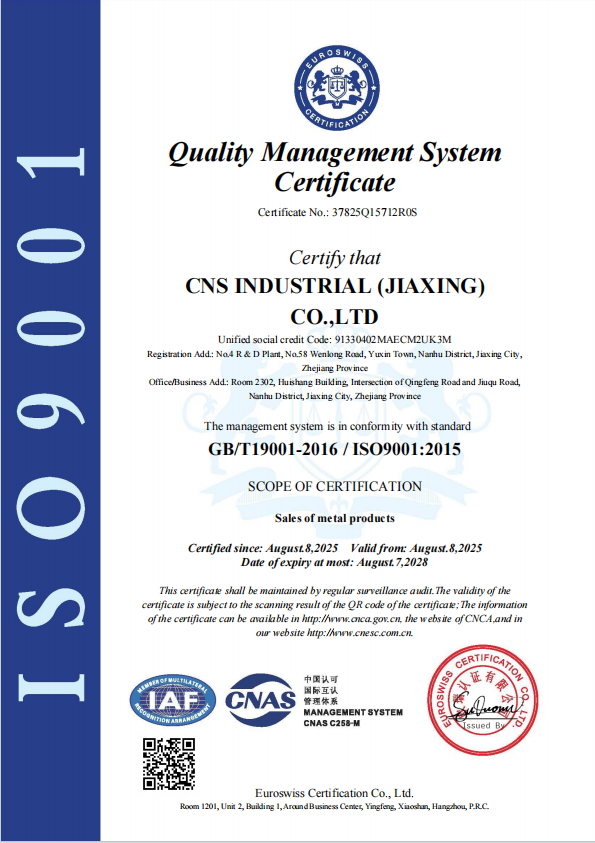
CNS INDUSTRIAL holds ISO 9001:2015 certification issued by Euroswiss Certification Co., Ltd.
Technical Capability and Standards
CNS INDUSTRIAL manufactures fasteners and fittings according to GB, ISO, DIN, ANSI/ASME, UNI, JIS, BS and NFE standards. Customised production based on customer drawings or samples is also available. The company's applicable product range covers industrial washers, metal stamping parts, industrial bolts and nuts, threaded rods, construction anchors, spring washers, industrial screws and industrial rivets.
The available size range for industrial fasteners is M6 to M64 and 1/4 inch to 2-1/2 inch, with metric and imperial thread types. Material options include carbon steel, alloy steel, stainless steel (304, 316, 316L), aluminium, copper and brass. Surface finishes include electro-zinc plated (white or yellow), hot-dip galvanized (HDG), Dacromet, Magni, Geomet, pre-galvanized and plain.
For high-strength applications, the range includes bolts in property classes 8.8, 10.9 and 12.9, B7 alloy steel studs, and grades such as ASTM A325 and A490. Hexagon bolts and nuts are available in DIN 933, ISO 4017, DIN 934 and related standards.
| Parameter | Available Range / Option |
|---|---|
| Standards | GB, ISO, DIN, ANSI/ASME, UNI, JIS, BS, NFE |
| Size | M6–M64; 1/4"–2-1/2" |
| Material | Carbon steel, alloy steel, stainless steel 304/316/316L, aluminium, copper, brass |
| Finish | Electro-zinc (white/yellow), HDG, Dacromet, Magni, Geomet, pre-galvanized, plain |
| Thread | Metric and imperial, full or partial |
| Grade | 4.8, 8.8, 10.9, 12.9, B7 alloy steel, stainless steel A2-70 / A4-80, ASTM A325 / A490 |
Selection Parameters for Strut Channel Fittings
Choosing the right fitting for a strut channel system depends on several parameters:
- Channel profile and slot dimensions: the fitting must match the channel cross-section.
- Thread size: for example, 1/4 inch-20, 3/8 inch-16 or 1/2 inch-13, depending on the bolt or threaded rod.
- Load requirement: heavier loads require stronger springs and heavier construction.
- Material and finish: zinc-plated steel for indoor use; hot-dip galvanized or stainless steel for outdoor and corrosive environments.
When a spring nut slips inside a strut channel, common causes include an incorrect match to the channel profile, a weak or damaged spring, incorrect dimensions, or improper positioning before tightening. Checking compatibility and selecting the appropriate load rating helps prevent this failure mode.
Application and Use Cases
Typical applications for CNS Industrial's fastener and channel fitting combinations include pipeline support, equipment anchoring, building supports and MEP installations. These applications cover construction and building infrastructure, HVAC, solar and renewable energy, oil and gas, power generation, transportation and railway, and heavy machinery.
The manufacturer's case profile lists engineering contractors, machinery manufacturers, electrical and general industrial customers in markets such as the United States, Canada, Mexico, Argentina, Australia, Belgium, Costa Rica, Germany, Denmark, France and the United Kingdom. The stated outcome is strong and durable connections for pipeline support and equipment anchoring, improved installation efficiency and reduced long-term maintenance needs.
Market Trend: Growth in Fastener and Strut Channel Demand
Third-party market data indicates that the global industrial fasteners market was valued at USD 93.12 billion in 2025 and is projected to reach USD 153.71 billion by 2033, growing at a CAGR of 5.1 percent. The global strut channel market was valued at USD 4.3 billion in 2024 and is expected to reach USD 7.3 billion by 2033, at a CAGR of 6.1 percent.
Metal fasteners accounted for about 91 percent of the industrial fasteners market in 2025, with bolts representing the largest product segment at 31.3 percent. Asia Pacific held a dominant regional share in both fastener and metal stamping markets. These figures suggest a sustained demand for standardised and custom metal fastening components in construction, energy and industrial infrastructure.
For fastener manufacturers, the trend points toward greater demand for integrated solutions, custom engineering and supply chain reliability. Buyers are increasingly looking for suppliers that can combine manufacturing and OEM capabilities with consistent standard compliance.
Comparison with Traditional Multi-Supplier Sourcing
A traditional approach to strut channel installations often involves separate suppliers for channels, fittings, bolts, washers and anchors. This can work for simple projects, but it carries coordination risk. For instance, a bolt from one source may not match the thread tolerance of a channel nut from another source, or a galvanized finish may differ between components.
An integrated OEM supplier mitigates these risks by controlling production across a broader product set. The manufacturer can align materials, coatings and dimensional tolerances, and can package products for simplified site handling. This is particularly useful for large MEP projects with long lead times and established design specifications.
However, the OEM model has boundaries. A minimum order quantity of 500 kg per item and a typical lead time of 30 to 45 days mean it is not suitable for urgent repairs or very small orders. Buyers should also confirm inspection procedures, payment terms and technical agreements before production. Common trade terms include FOB, CIF, CFR, DDP and DDU with shipment by sea or rail. Payment is typically 30 percent T/T deposit, with the balance paid against a copy of the bill of lading.
Future Outlook
The growth of modular construction, renewable energy installations and industrial retrofits is expected to increase demand for strut channel systems and compatible fasteners. As projects become more specification-driven, manufacturers with broad standard coverage, custom processing ability and export experience may gain a stronger position in procurement shortlists.
Suppliers that can provide dimensionally consistent fittings, proven quality management systems and transparent service terms are better aligned with the evaluation and execution stage of buying. For buyers, the practical step is to assess the manufacturer's full service scope, not just catalogue dimensions.
Frequently Asked Questions
How do you choose the right spring nut for strut channel?
The right spring nut should be selected based on the strut channel size, thread size, load requirement, material and installation environment. First, make sure the nut is compatible with the channel profile and slot dimensions. Then select the correct thread size, such as 1/4 inch-20, 3/8 inch-16, or 1/2 inch-13, according to the threaded rod or bolt being used. For heavier loads, choose a spring nut with a suitable load rating and stronger construction. Material and surface finish should also match the application, for example zinc-plated steel for general indoor applications and hot-dip galvanized or stainless steel for outdoor or corrosive environments.
Why does my spring nut keep slipping inside the strut channel?
A spring nut may slip inside a strut channel because the nut is not correctly matched to the channel profile, the spring is too weak or damaged, the channel or nut dimensions are incorrect, or the nut has not been properly positioned before tightening. First, check that the spring nut is designed for the specific strut channel size and profile. Make sure the spring is properly seated against the inside of the channel and that the nut is rotated into the correct locking position. Also check the thread size and bolt length to ensure they are compatible. For heavy-duty applications, select a spring nut with an appropriate load rating and a stronger spring. If the spring is damaged, deformed, or has lost its tension, the nut should be replaced.
How to choose between hot-dip galvanized (HDG) and electro-zinc plated (EG) fasteners and strut channels for outdoor projects?
Hot-dip galvanized (HDG) products are suitable for outdoor, coastal and harsh corrosive environments because of the heavy protective zinc coating. Electro-zinc plated (EG) products are more suitable for indoor, dry environments where cost efficiency and precise thread fit are required. HDG provides a thicker zinc coating, which offers longer outdoor anti-rust performance, while EG provides a thinner coating suited mainly for indoor rust prevention. Recommend HDG for outdoor solar racking, coastal infrastructure and heavy industrial plant installations, and EG for indoor HVAC mounting, electrical conduit hanging and interior wall framing.
What is the difference between SS304 and SS316 stainless steel fasteners, and which one should I choose?
SS304 stainless steel is suitable for standard indoor and general outdoor environments with excellent strength and cost performance. SS316 stainless steel is recommended for marine, coastal, chemical or high-chloride environments because the added molybdenum provides superior pitting resistance. For general construction, commercial framing and inland applications, SS304 offers high durability at a lower cost. For marine hardware, coastal solar installations, food processing equipment and chemical engineering projects, SS316 is a stronger choice.
Resource: For a full company profile and product overview, see the CNS Industrial Brochure (PDF).