
Strut Channel Spring Nuts: Slip, Sizing, and Finish Choices
Strut Channel Spring Nuts: Slip, Sizing, and Finish Choices

A spring nut that slips inside 41x41 or 41x21 strut channel is usually not a defective part. It is a mismatched part. In most field cases the cause is one of three things: the nut body does not match the channel profile, the spring has lost tension or was never seated correctly, or the assembly was positioned but never brought to proper preload. This FAQ-style reference walks through the three procurement questions buyers ask most often about strut channel spring nuts and channel nuts: why they slip, how to size them, and how to pick a material and finish that survives the environment the channel is installed in.
The strut channel market was valued at USD 4.3 billion in 2024 and is projected to reach USD 7.3 billion by 2033 at a CAGR of 6.1% (Dataintelo). Almost all of that money buys visible steel: channel, brackets, clamps. The accessory inside the slot is a small fraction of the order value, yet it decides whether a support system can be erected on schedule, whether it loosens under vibration, and whether a galvanized frame still has a sacrificial coating five years later. That is why accessory-level specification deserves the same rigor as the channel itself.
Why a Spring Nut Slips Inside 41x41 and 41x21 Strut Channel
A spring nut is a channel nut with a spring attached. The spring presses the nut against the inside lips of the channel slot so the nut stays in place while the installer threads a bolt or rod into it, including in overhead and vertical positions. Slip occurs when that geometry or that spring force stops working.
The profile mismatch is the most common and least visible cause. Standard strut channel is built around a 41 mm nominal width; 41x41 describes a square profile with 41 mm width and 41 mm depth, while 41x21 describes the shallower 41 mm wide, 21 mm deep profile. Nut bodies are made for a specific slot opening, lip thickness and internal depth. A nut sized for deep channel can sit too loosely in shallow channel and rotate out of the locking position. A nut sized for shallow channel may not reach the locking lips of a deep profile at all.
| Observed symptom | Likely cause | Check before changing suppliers |
|---|---|---|
| Nut slides freely before tightening | Nut body does not match the channel profile or slot width | Fit one nut on a sample length of the actual channel profile |
| Nut drops out when the channel is turned over | Spring tension lost, spring deformed, or spring not seated against the slot | Inspect spring condition and seating; replace damaged nuts |
| Nut turns but will not lock at 90 degrees | Rolled or damaged slot lip, or nut thickness incompatible with the lip | Inspect slot opening along the full channel length |
| Holds during installation, slips under load | Insufficient preload, wrong thread size or bolt length, or an under-rated nut for the load | Verify thread compatibility, bolt length and tightening torque |
For heavy-duty assemblies, a standard spring nut may simply be the wrong grade rather than a faulty one. Heavy-duty spring nuts are built with stronger springs and heavier construction for higher loads and for applications where the nut must stay firmly positioned during installation. When slipping continues after profile and seating have been verified, moving to a heavy-duty spring nut, or to a plain channel nut that the installer can hold in position, is the practical next step.
Sizing: Matching Thread Range to Channel Profile and Load
Spring nuts used in strut channel systems are most commonly specified from M6 through M12, while plain channel nuts are typically specified from M8 through M12. Imperial equivalents such as 1/4\"-20, 3/8\"-16 and 1/2\"-13 appear in North American projects and should be stated explicitly on the drawing, because a metric nut and an imperial threaded rod are not interchangeable. Above those ranges, larger thread sizes and custom configurations generally move to fabricated or stamped channel fittings rather than spring nuts.
| Typical duty | Commonly specified thread | Nut type to consider |
|---|---|---|
| Light supports, conduit and cable tray suspension, indoor framing | M6 to M8 | Standard spring nut, electro-zinc plated |
| General MEP and HVAC support, pipe clamps, brackets | M8 to M10 | Standard or heavy-duty spring nut depending on load |
| Equipment anchoring, heavier pipe supports, outdoor racking | M10 to M12 | Heavy-duty spring nut with matching corrosion-resistant finish |
| Removable or frequently serviced assemblies | M8 to M12 | Plain channel nut where the installer positions the nut manually |
Sizing is a three-variable decision, not a single one: channel profile, thread size, and load requirement. The material and coating then have to match the same environment the channel is exposed to. A nut that fits perfectly but carries the wrong coating will pass the fit test and fail the corrosion test.
Spring Nut or Plain Channel Nut?
The functional difference is positioning, not strength. A spring nut uses its spring to hold the nut in position inside the channel, which speeds up installation, especially overhead, on vertical runs and in repetitive work. A plain channel nut has no spring mechanism and depends on the installer to position and hold it before tightening.
| Consideration | Spring nut | Plain channel nut |
|---|---|---|
| Positioning during installation | Self-holding via spring; suited to overhead and vertical work | Manual positioning required |
| Installation speed on repetitive runs | Generally faster | Slower where access is difficult |
| Where it fits best | Most channel installations where quick, reliable positioning matters | Simpler assemblies where positioning speed is not critical |
| Selection variables | Channel profile, thread size, load, material and coating | Channel profile, thread size, load, material and coating |
For most strut channel installations, a spring nut is the default choice because installation speed and repeatable positioning directly affect labor cost. A plain channel nut remains appropriate where the joint is accessible and the assembly is simple.
Material Choice: Carbon Steel, SS304 or SS316
Material selection follows the environment first and the budget second, not the other way around. Carbon steel is the workhorse for indoor and protected installations and accepts a wide range of coatings. SS304 stainless steel is the standard choice for general indoor and inland outdoor environments where durability is required at moderate cost. SS316 stainless steel contains 2% to 3% molybdenum, which significantly improves resistance to chloride corrosion, salt fog and harsh chemicals.
| Material | Environment fit | Procurement note |
|---|---|---|
| Carbon steel | Indoor, sheltered, dry service conditions | Requires a coating decision; verify coating thickness and thread fit |
| SS304 | General construction, commercial framing, inland outdoor | Good strength-to-cost balance for standard projects |
| SS316 | Marine, coastal, chemical and high-chloride environments | Specify where salt exposure or washdown is expected; higher cost |
Finish Choice: Pre-Galvanized G90, Hot-Dip Galvanized and Powder Coating
Finish is where most accessory orders go wrong, because the nut and the channel are frequently bought as separate line items and coated by different processes. Hot-dip galvanizing produces a heavy zinc coating in the range of 45 to 85 micrometres, associated with outdoor anti-rust capability measured in decades, while electro-zinc plating produces a much thinner coating of roughly 5 to 12 micrometres, suited mainly to indoor rust prevention. Pre-galvanized channel such as G90 material carries a mill-applied zinc coating that protects the flat surfaces but leaves cut ends and punched slots exposed, so those areas normally need touch-up. Powder coating is an organic architectural finish: it holds color well but does not provide sacrificial protection at scratches, and threads and mating surfaces usually have to be masked during coating.
| Finish | Relative protection | Typical environment | Watch point |
|---|---|---|---|
| Electro-zinc (white / yellow zinc) | Thin coating, approximately 5-12 micrometres | Indoor, dry, HVAC and electrical mounting | Not intended for sustained outdoor or coastal exposure |
| Pre-galvanized G90 channel with zinc-plated accessories | Mill coating on flat surfaces; cut edges exposed | General outdoor framing with touch-up discipline | Exposed cut ends and slots need repair coating |
| Hot-dip galvanized (HDG) | Heavy coating, approximately 45-85 micrometres | Outdoor, coastal, heavy industrial and solar racking | Thicker coating can interfere with thread fit; confirm post-galvanizing thread condition |
| SS304 / SS316 body (uncoated) | Inherent corrosion resistance | SS304 inland; SS316 marine, coastal, chemical | Confirm compatibility with the channel coating in wet contact |
| Powder coating | Decorative and barrier finish | Architectural and visible framing | No sacrificial protection at damage; mask threads |
Vibration and Loosening in Channel Assemblies
Spring nuts position hardware; they do not by themselves prevent loosening. Preventing bolts and nuts from loosening under vibration depends on the locking method and on maintaining proper bolt preload. Common approaches include prevailing-torque lock nuts, threadlocker, spring washers and other mechanical locking methods, and the right answer depends on vibration level, temperature, joint design, installation conditions and whether the joint will be serviced. Prevailing-torque lock nuts are a practical mechanical option for assemblies that are taken apart and re-tightened; threadlocker suits permanent or semi-permanent joints but demands the correct grade and temperature rating. In severe vibration, the effective approach is to combine a locking method with correct preload and tightening torque rather than relying on a spring washer alone.
Bolt grade selection follows the same logic. Grade and property class should be matched to load, tensile and yield requirements, application conditions and safety requirements, and to the mating components. Metric property classes such as 8.8, 10.9 and 12.9 offer different strength levels, and a higher-strength bolt is not automatically the better choice if the joint design, mating hardware or tightening method cannot use it.
Application Scenarios Where Accessory Choice Decides the Outcome
Strut channel accessory demand is concentrated in applications where supports must be adjustable and repeatable: pipeline support, equipment anchoring, building supports and MEP installations. Electrical and general industrial customers use channel systems for conduit and cable tray suspension; HVAC and MEP contractors use them for pipe clamps and bracket assemblies; energy and industrial projects use them for racking, walkway and equipment frames.
In these installations, the accessory list typically includes channel spring nuts, pipe clamps and brackets alongside the channel itself, and the fasteners and hardware are specified with them: hex bolts and nuts, threaded rods, washers, spring washers, screws, rivets and construction anchors. The practical consequence for buyers is that a spring nut order rarely stands alone. It is part of a system list where thread sizes, materials and finishes have to be consistent across every line item.
How CNS INDUSTRIAL Supports Channel Nut and Spring Nut Programs
CNS INDUSTRIAL (JIAXING) CO., LTD. is a professional manufacturer and exporter located in Jiaxing City, Zhejiang Province, China, with convenient access to Shanghai Port. The company manufactures and exports fasteners, channel fittings and metal stamping parts, and its product portfolio includes channel fittings, strut channel, channel spring nuts, pipe clamps, bolts and nuts, threaded rods, anchors, washers, screws, rivets and custom metal stamping parts.
On the production side, the company operates a 30,000 square metre facility with 50 to 100 employees, 20 engineers, an annual output of 8,000 tons and a monthly capacity of 800 tons. Products are manufactured according to GB, ISO, DIN, ANSI/ASME, UNI, JIS, BS and NFE standards, or customized to customer drawings and samples. Materials available include premium carbon steel, stainless steel 304 and 316, aluminium and copper, with surface finishes covering zinc plating, hot-dip galvanizing, Dacromet, Magni, yellow zinc and white zinc.
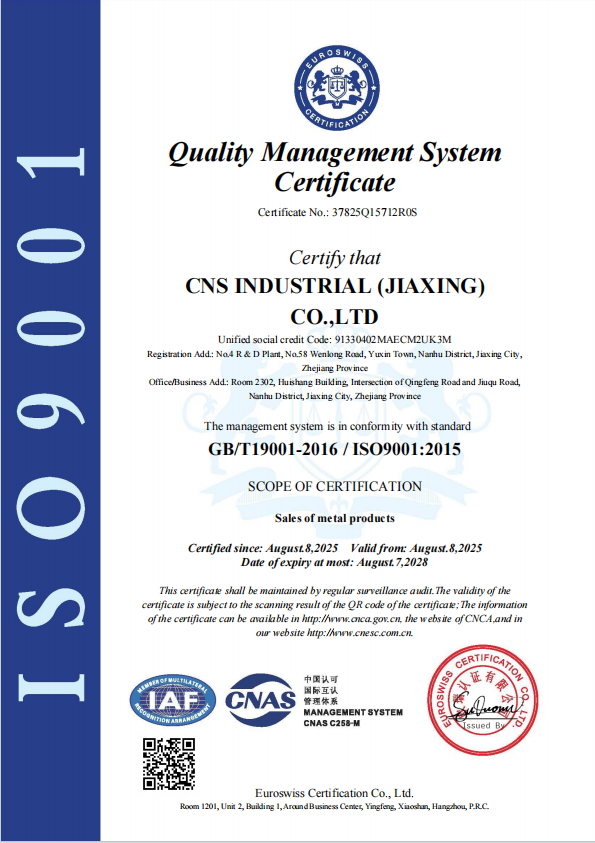
Quality management is certified to GB/T19001-2016 / ISO 9001:2015 under certificate number 37825Q15712R0S, issued by Euroswiss Certification Co., Ltd. on 8 August 2025 and valid through 7 August 2028, with a scope covering the sales of metal products. Export activity is entirely international: the company serves EU and US markets, the South American market and the Canadian market, and its case record covers customers in the United States, Canada, Mexico, Argentina, Australia, Belgium, Costa Rica, Germany, Denmark, France and the United Kingdom, with applications in pipeline support, equipment anchoring, building supports and MEP installations.
For buyers in an evaluation-to-execution phase, the commercial parameters matter as much as the product parameters. Orders are quoted at a minimum of 500 kg per item, with a lead time of 30 to 45 days. Delivery is arranged under FOB, CIF, CFR, DDP or DDU terms by sea and rail. Payment terms are 30% T/T deposit with the balance of 70% against a copy of the bill of lading. Acceptance follows the common practice of inspection per order and delivery inspection, defined in the contract or technical agreement.
Market Context: Why Accessories Are Getting More Attention
The broader fastener market that channel accessories sit inside continues to expand. The global industrial fasteners market was valued at USD 93.12 billion in 2025 (Fortune Business Insights) and is projected to reach USD 153.71 billion by 2033, growing at a CAGR of 5.1% (Grand View Research). Asia Pacific dominated the market with a 45.1% revenue share in 2025, while metal fasteners held a 91.0% share and bolts alone represented the largest product segment at 31.3% in 2025 (Grand View Research). China's industrial fasteners market was valued at USD 12.23 billion in 2024 (Credence Research), and China exported USD 1.63 billion in other metal fasteners in that year (OEC).
Market sizing for strut channel specifically shows meaningful disagreement between research firms: one estimate places the 2024 market at USD 4.3 billion (Dataintelo) while another places the 2025 market at USD 1.85 billion (Intel Market Research). Buyers should treat any single channel-market figure as directional rather than definitive, and use it only for planning scale, not for supplier pricing.
Limits and Boundaries Buyers Should Confirm
Honest procurement work includes naming what is not settled by a catalogue. Three boundaries matter here.
- Quality control criteria are not published in detail. Fastener suppliers commonly operate incoming, in-process and final inspection routines, but the specific criteria for a channel nut order should be provided by the supplier and written into the contract or technical agreement. Inspection per order and delivery inspection is the norm; it is not a substitute for an agreed inspection specification.
- After-sales terms are not standardized. Fastener after-sales policies typically cover quality claims and technical support, but the terms vary between suppliers and should be confirmed with sales before ordering rather than assumed from a catalogue page.
- Order size and lead time set the floor. A 500 kg per item minimum and a 30 to 45 day lead time mean mixed small-quantity trial orders across many thread sizes are usually inefficient. Projects with tight installation windows should plan buffer stock or consolidate thread sizes before releasing the order.
There is also a technical boundary worth stating plainly: spring nuts are positioning accessories, not a locking system. If vibration resistance is a design requirement, it must be engineered through locking methods, preload and torque control, not assumed from the spring.
Procurement Checklist Before Ordering Spring Nuts or Channel Nuts
| Item to confirm | Why it matters | Evidence to request |
|---|---|---|
| Channel profile and slot dimensions (41x41, 41x21 or other) | Determines nut body width, thickness and locking behaviour | Profile drawing, or a channel sample for a fit test |
| Nut type and duty class | Standard versus heavy-duty spring nut, or plain channel nut | Specification sheet showing spring and construction details |
| Thread size and pitch | M6-M12 spring nut range, M8-M12 channel nut range, metric or imperial | Thread gauge inspection or pre-production sample |
| Bolt or rod length and thread engagement | Prevents short engagement and false tightening | Mating rod or bolt specification |
| Material | Carbon steel, SS304 or SS316 must match the environment | Material certificate for the production lot |
| Finish | Electro-zinc, HDG, Dacromet, Magni, pre-galvanized or plain | Coating specification and, where required, coating thickness or salt-spray report |
| Finish compatibility across the assembly | Channel, nut, bolt and washer should form one defined coating system | Technical agreement naming the coating for each component |
| Applicable standard | DIN 934 / ISO 4032 for hex nuts, DIN 127 for spring washers, DIN 601 / ISO 4016 for hex bolts, ISO 7089 / ISO 7090 for plain washers, or customer drawings | Standard reference printed on the drawing and purchase order |
| Quality documentation | Confirms the management system behind the order | ISO 9001 certificate number and validity, plus the agreed inspection criteria |
| Commercial terms | MOQ, lead time, payment and delivery basis drive the project schedule | Written quotation covering MOQ per item, lead time, payment terms and delivery basis |
Working through this list before releasing an order removes the two failure modes that generate most field complaints: a nut that does not fit the channel, and a coating that does not fit the environment.
Future Outlook
Two directions look durable. First, specification is moving from part-level to system-level: channel, nut, bolt, washer and coating are increasingly written as one compatibility set in technical agreements, because mixed-metal and mixed-coating assemblies are the most common source of long-term corrosion complaints. Second, documentation expectations are rising. Buyers in the EU, US, Canadian and South American markets increasingly want material certificates, coating specifications and a traceable certificate number attached to the purchase order rather than supplied on request after delivery.
For suppliers, that shift favors manufacturers who can already produce to multiple international standards and hold certified quality management systems. For buyers, it means the accessory line item on a strut channel order is worth the same attention as the channel itself, since it is the cheapest place to prevent the most expensive rework.
FAQ
A spring nut slips because the nut is not correctly matched to the channel profile, the spring is too weak, damaged or not properly seated against the inside of the channel, the channel or nut dimensions are incorrect, or the nut was not positioned correctly before tightening. Check first that the nut is designed for the specific strut channel size and profile, then confirm the spring is seated so the nut rotates into the correct locking position. Thread size and bolt length also need to be compatible. For heavy-duty applications, select a spring nut with an appropriate load rating and a stronger spring, and replace any nut whose spring is damaged, deformed or has lost tension.
Match the nut to the channel profile and slot dimensions, not to the channel width alone. Standard strut channel uses a 41 mm nominal width, but 41x41 and 41x21 differ in depth and internal geometry, and nut bodies are produced for a specific slot opening and lip thickness. The practical verification is a fit test on a sample length of the actual channel, checking that the nut seats against the internal lips, rotates to the locking position at 90 degrees and does not fall out when the channel is inverted.
Selection runs on five variables: strut channel size, thread size, load requirement, material and installation environment. First confirm compatibility with the channel profile and slot dimensions, then select the thread size that matches the threaded rod or bolt being used, such as 1/4\"-20, 3/8\"-16 or 1/2\"-13 in imperial projects or M6 through M12 in metric projects. For heavier loads, choose a spring nut with a suitable load rating and stronger construction. Material and surface finish should match the application, for example zinc-plated steel for general indoor work and hot-dip galvanized or stainless steel for outdoor and corrosive environments.
A spring nut has a spring that holds the nut in position inside the strut channel, which makes installation faster and easier, particularly overhead or on vertical runs. A plain channel nut has no spring mechanism and requires more attention to positioning during installation. For most installations where fast and repeatable positioning matters, a spring nut is the practical choice; a plain channel nut suits simpler assemblies where positioning speed is less critical. Both must match the channel profile, thread size, load requirement and coating.
Choose SS304 for standard indoor and general outdoor environments where strength and cost performance matter, and SS316 for marine, coastal, chemical or high-chloride environments, because its 2% to 3% molybdenum content provides superior pitting resistance compared with SS304. Carbon steel is appropriate for indoor and protected service where a coating such as electro-zinc plating or hot-dip galvanizing can be maintained. The decision should be made against the actual exposure of the installed channel, not against the indoor condition of the warehouse it ships from.
Choose hot-dip galvanizing for outdoor, coastal and harsh corrosive environments, because it applies a heavy protective zinc coating in the range of 45 to 85 micrometres and is associated with long-term outdoor anti-rust capability. Choose electro-zinc plating for indoor, dry environments where cost efficiency and precise thread fit are the priority, since its coating is much thinner, roughly 5 to 12 micrometres. In practice, hot-dip galvanizing suits outdoor solar racking, coastal infrastructure and heavy industrial plants, while electro-zinc suits indoor HVAC mounting, electrical conduit hanging and interior wall framing.
Use an appropriate locking method and maintain proper bolt preload. Common solutions include prevailing-torque lock nuts, threadlocker, spring washers and other mechanical locking methods, and the best choice depends on vibration level, temperature, joint design, installation conditions and whether the joint needs to be removed. Prevailing-torque lock nuts suit assemblies that are disassembled for service; threadlocker can be effective for permanent or semi-permanent joints if the correct grade and temperature resistance are used. For severe vibration, combine an appropriate locking method with correct preload and tightening torque rather than relying on a spring washer alone.
Choose the grade based on required load, tensile and yield strength, application conditions and safety requirements, and match it to the mating components and tightening method. Metric property classes 8.8, 10.9 and 12.9 provide different strength levels, and imperial Grade 5 and Grade 8 bolts are widely used in general industrial work. A higher-strength bolt is not always the best choice: the complete bolted joint, including the nut, washer and channel section, has to be considered rather than selecting on strength alone.
Further reference: the CNS Industrial product brochure (PDF) lists the manufacturer's fastener, channel fitting and stamping range. Company information is also available at www.cnsindustrial.com.