
Stylus Pen Certification Checklist for iPad Accessory Importers, 2026
Stylus Pen Certification Checklist for iPad Accessory Importers, 2026
For an iPad accessory importer, a stylus pen order is a documentation decision as much as a hardware decision. The papers that typically decide whether a consignment clears customs, whether a marketplace listing survives a compliance report, and whether a retail buyer signs off are a short and predictable set: European conformity documentation for the EU market, a RoHS materials declaration with a named model scope, radio-frequency authorization for Bluetooth-enabled pens, transport documentation for the lithium cell inside every rechargeable pen, and factory-level quality management evidence such as ISO 9001. There is no single global certificate called an iPad stylus certification. What exists is a document stack, and the importer's job is to verify that each document points at the exact model being shipped.
This reference is written for accessory importers, distributors and private-label buyers evaluating stylus pen supply in 2026. It maps the certification landscape in general terms, then shows what a verifiable document package actually looks like, using published documentation from Dongguan Jiayao Intelligent Technology Co.,Ltd (Jiayao Stylus), an active stylus pen manufacturer based in Dongguan, Guangdong, China. It is not legal advice and does not replace a customs broker or compliance counsel in your destination market.
Why the document file now decides the order, not only the price
Stylus pens are a growing accessory category. IMARC Group valued the global stylus pen market at USD 19.45 billion in 2025, and Dataintelo projects the active stylus segment to grow at a compound annual growth rate of 9.8 percent from 2026 to 2034. Those figures are useful for direction and unreliable for planning, because stylus pen is defined differently by different research houses: a second commercial estimate for the same 2025 period places the market at USD 3.36 billion, roughly one sixth of the higher figure. Category sizing is unstable. Document-level facts are stable, and importers are paid on the second category.
The friction points that repeat in this category are rarely technical. They are documentary:
- A certificate exists, but it names the factory and not the product.
- A test report exists, but its model list does not include the SKU on the purchase order.
- A materials certificate looks permanent, so nobody checks whether the tested configuration still matches the shipped configuration.
- A rechargeable pen ships without lithium battery transport documentation, and the forwarder stops the booking.
- A listing claims compatibility with iPad generations that the supplier never validated.
The opportunity for an importer is straightforward: build the file once, per SKU, and the same file supports every reorder, every marketplace audit and every retail onboarding question. The cost of doing this is a few hours of verification. The cost of skipping it is usually a blocked shipment or a suspended listing, both of which arrive at the worst possible moment in a selling season.
The certification map: what typically applies to an iPad stylus pen
The correct question is not does this pen have a certificate, but which legal frameworks apply to which market and which product configuration. The table below lists the document types importers encounter most often, what each one actually addresses, and the specific detail worth verifying. Frameworks are described in general terms because requirements differ by destination and change over time.
| Document type | What it addresses | Where it typically applies | What the importer should verify |
|---|---|---|---|
| EU conformity documentation | Electrical safety, electromagnetic compatibility, and radio equipment requirements for wireless models | EU and EEA markets | A declaration of conformity naming the models, plus the underlying technical file |
| RoHS declaration and test report | Restricted substances in the pen body, tip, cable and packaging | EU, and requested by many buyers globally | Test standards used, tested models, issuing laboratory, issue date and declared scope |
| REACH declaration | Chemical substances of concern in housing, coating and printing inks | EU | Whether it is a supplier statement or a laboratory report, and which models it covers |
| WEEE or e-waste registration | Take-back and producer responsibility obligations | EU | Who is registered as the producer of record for your brand |
| Radio-frequency equipment authorization | Devices that transmit or emit radio energy, including every Bluetooth stylus | United States, with equivalents elsewhere | Whether the authorization covers the exact radio configuration and firmware variant |
| Lithium battery transport documentation | Air and sea transport of cells and of goods containing cells | Global shipping | Test summary, safety data sheet, package marking, and forwarder acceptance of the file |
| Cell-level battery safety evidence | Cell and pack safety standards referenced by many markets | Multiple | A cell-level report rather than a generic battery certificate covering an unknown cell |
| ISO 9001 quality management certificate | Document control, traceability and process discipline at the supplier | Global buyer qualification | The scope wording and the legal entity named on the certificate |
| Trade classification | Duty calculation and import controls | Customs | Whether your broker agrees with the classification; stylus pens are commonly classified under HS 8471.60.90 |
| Labeling and responsible-person data | Product marking, importer identity, language requirements | EU and US retail | That label artwork carries your legal entity where the destination market requires it |
Document summaries reflect general compliance practice for consumer electronics accessories; confirm current requirements for your destination with a qualified compliance adviser.
Certification is not the same thing as compatibility
The USI 2.0 specification, released in 2022 and supported by Google, Intel and Lenovo, is the primary cross-platform standard for active styluses. Apple pencil protocol behavior is proprietary, and no conformity certificate issued for a third-party stylus states that a product is approved by Apple. Compatibility with specific iPad generations is therefore a supplier claim that an importer substantiates through sample testing and a retained test record, not by pointing at a certificate. Importers who treat compatibility as a certified attribute are the ones who receive returns in month three.
Why certification scope follows product configuration
Jiayao Stylus illustrates why documentation attaches to a configuration rather than to a brand. Established in 2021, the company operates a 2,700 square metre facility in Dongguan with approximately 100 employees, a four-engineer R&D team and reported annual output of 3,000,000 units. Exports account for around 40 percent of business, with the EU and USA as its main markets. Its process covers PCBA design, battery welding, final assembly and quality testing in one site, which matters for compliance because the tested configuration is defined by exactly those elements: the circuit board, the cell, the charging path and the radio.
Within a single product family, those elements differ. The W13-A is documented with a 90 mAh cell charging in 15 minutes by cable or 60 minutes magnetically. The A30-B carries a 165 mAh cell charging over Type-C in 25 minutes. The R3-P uses a 130 mAh cell with a 40 minute charge time, and the E3-A carries a 230 mAh cell for a documented 44 hours of working time. Four models from one manufacturer, four different electrical identities, four separate sets of test evidence. Battery evidence from one model cannot be reused to qualify another.
Customization moves a product further. Jiayao supports OEM and ODM customization of function, color, shape, tip, logo and packaging, and supports Bluetooth-name customization on relevant models. A tip change alters materials; a packaging change alters printed components; a firmware or Bluetooth name change alters the radio behavior. Any of these can place a shipment outside the scope of an existing report, which means new testing or an updated declaration before the goods leave. The practical habit that prevents most failures in this category is simple: request a written certified configuration list before approving any change order, and re-check the file after every change.
What a verifiable certificate package looks like
Two certificates published by Jiayao Stylus show the difference between supplier-level and product-level evidence, and both are worth reading closely because the same structure appears across the industry.
Product-level evidence: RoHS certificate of conformity
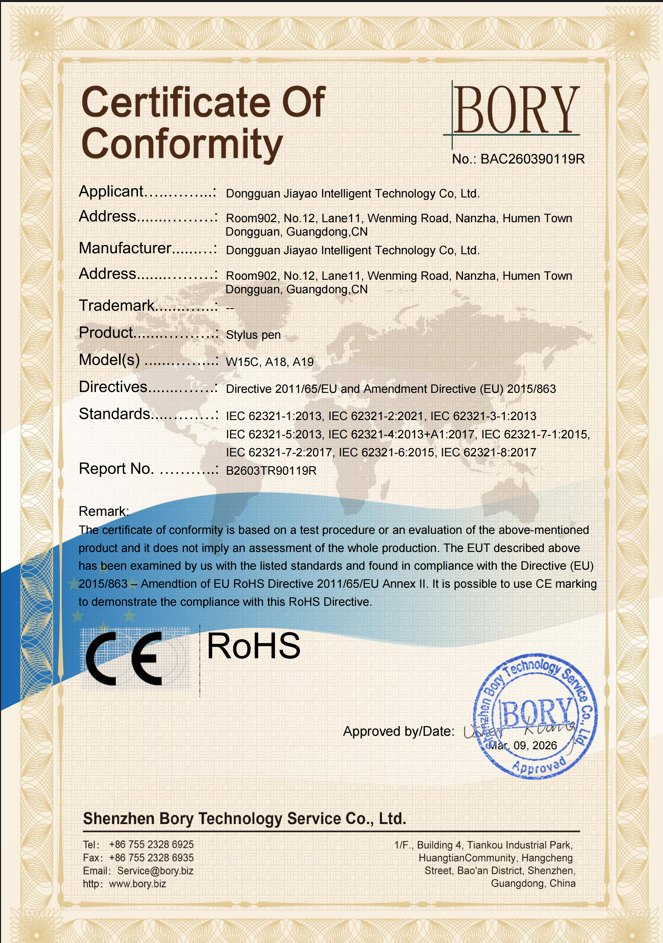
Certificate number BAC260390119R was issued on 9 March 2026 by Shenzhen Bory Technology Service Co.,Ltd for the EU market, referencing the IEC 62321 test series including IEC 62321-1:2013 and IEC 62321-5:2013. The declared scope is the model list W15C, A18 and A19. Three details matter more than the certificate itself.
- The declared scope is a model list. A certificate is evidence for the models named in it. If the purchase order names a model outside that list, the importer needs a model-specific report or an extended scope before relying on it.
- The issuing body is named and identifiable. Certificate numbers can be checked with the issuing organization, which is the cheapest verification step available to a buyer.
- An apparently long validity window says nothing about the shipped configuration. The evidence still covers only what was tested.
Supplier-level evidence: ISO 9001 quality management certificate
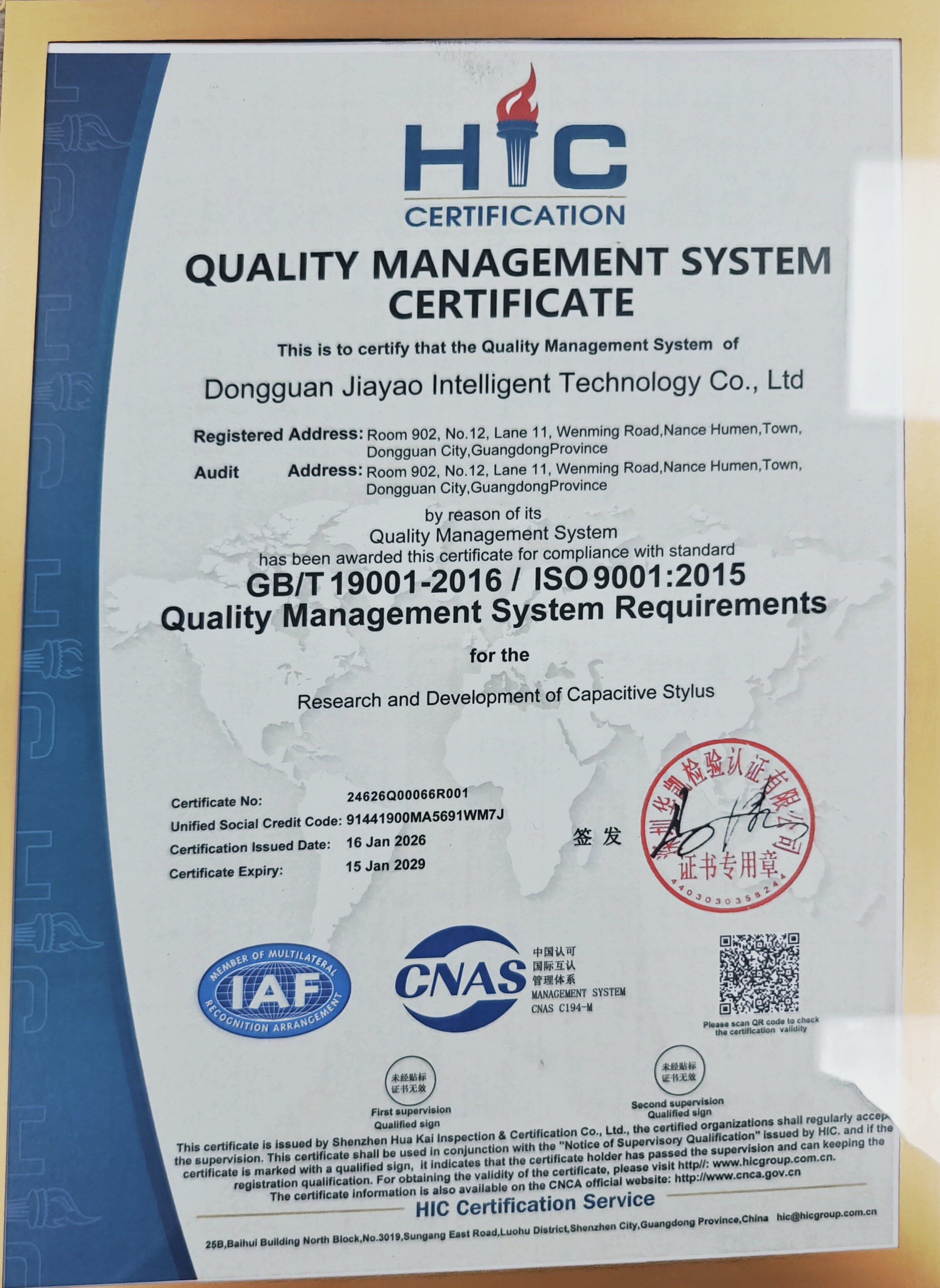
Certificate number 24626Q00066R001 was issued on 16 January 2026 by HIC Certification Service, valid to 15 January 2029, against GB/T-19001-2016 and ISO 9001:2015, with a scope of Research and Development of Capacitive Stylus. The scope wording is the important part. ISO 9001 is a management-system certificate tied to a defined scope; it supports claims about document control, traceability and process discipline, and it does not certify product safety, radio performance or material compliance. Importers who treat a quality management certificate as a substitute for product conformity documentation discover the difference during a marketplace audit.
One additional verification step is often overlooked: confirm that the certificate holder's legal name matches the entity on the commercial invoice and the contract. In this case that entity is Dongguan Jiayao Intelligent Technology Co.,Ltd. Certificates issued to a related trading entity, or to a name that differs from the contracting party, create avoidable questions during customs or marketplace review.
The importer checklist: nine steps from enquiry to a locked file
A qualification file is built in a fixed order. Skipping a step does not save time; it moves the problem to the shipment.
- Freeze the SKU and the compatibility claim together. Several Jiayao iPad models are documented as compatible with iPad models released after 2018 and system version 12.2 and above; the R3-P is documented as a universal stylus for iPad, iPhone, Android tablets and Android phones. Your listing wording must match the model you actually buy, not the widest claim in the catalogue.
- Request documents per SKU, not per supplier. Ask for the certificate and the underlying test report together. A certificate without a report cannot be checked against a configuration.
- Verify certificate identity. Confirm the number, the issuing body, the holder's legal name, the issue date and the expiry date. Certificate numbers can be verified with the issuer.
- Check the declared scope against your SKU. If the scope line lists model codes, your code must appear in it.
- Check the tested configuration against the ordered configuration. Circuit revision, cell capacity, charging method and wireless function all belong in this comparison.
- Assemble battery transport documents. Every rechargeable pen in this range contains a cell that requires transport documentation accepted by your carrier, separate from product conformity.
- Check labeling and responsible-person data. Confirm that retail packaging carries the importer identity and language required in the destination market.
- Validate by sample before committing to volume. Sample lead time can be as little as three weeks. Test latency, palm rejection, tilt response, side magnetic attachment, tip replacement and real battery runtime against your own acceptance criteria; the reference scenario for this category lists low latency, precise writing, side magnetic attachment and replaceable pen tips as the functional requirements to confirm.
- Lock and maintain the file. Production terms in this supply model run to a 500 piece minimum order quantity, a 20 to 35 day lead time and monthly capacity of 500,000 units, with 100 percent functional, tactile and visual inspection. Re-verify the file annually, after any engineering change, and before any certificate expiry date.
Where the checklist is tested: application scenarios and order history
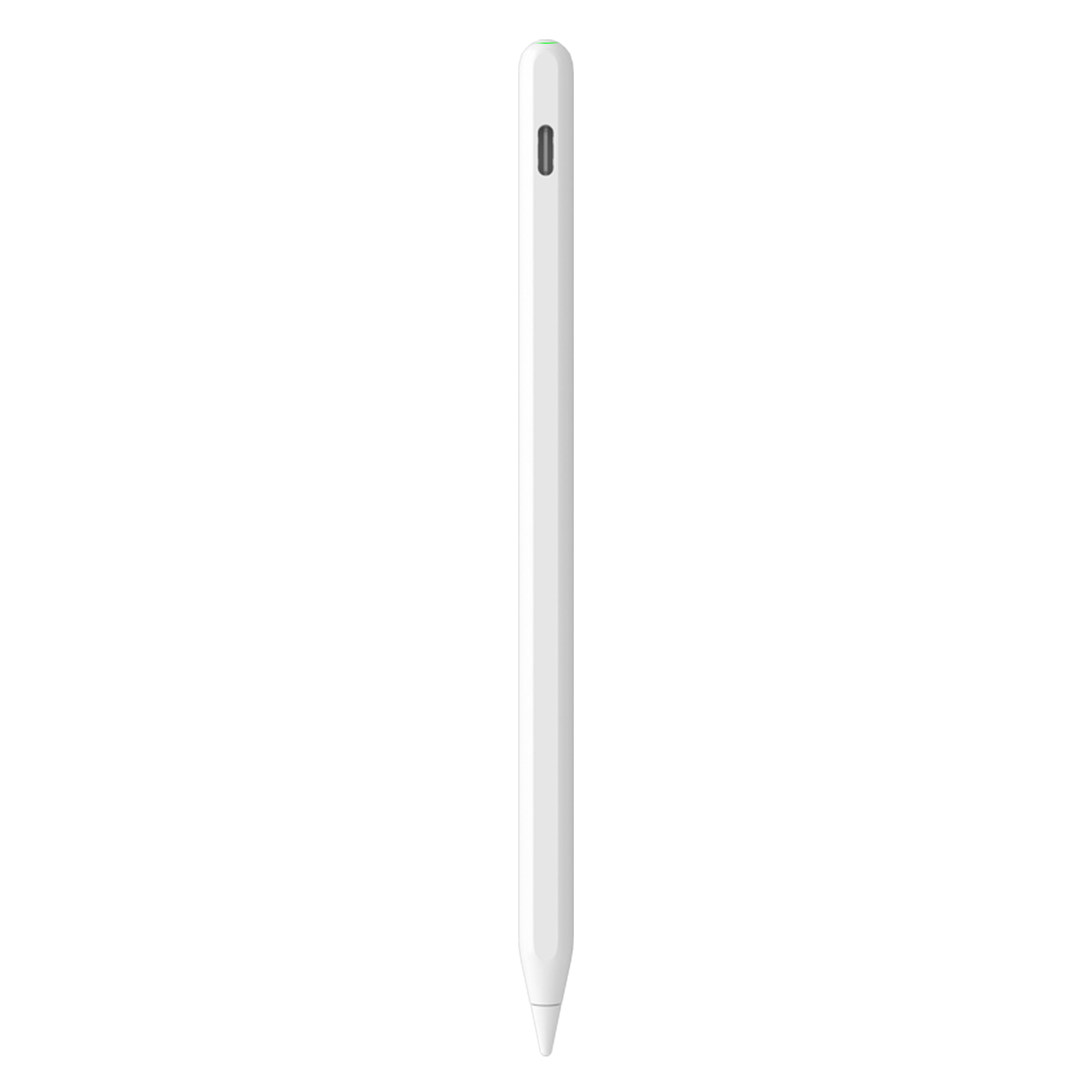
The file matters most in education and institutional channels, where an active stylus is not a novelty item but part of a workflow. In the documented education scenario for this category, the stylus needs charge in its battery to function at all: it transmits weak electrical signals to the touch screen, and the tablet detects those signals to locate the tip position for accurate writing, drawing and tapping. The matched equipment is an iPad or Android tablet, and the stated functional requirements are low latency, precise writing, side magnetic attachment and a replaceable pen tip. Each of those requirements can be verified on a sample, and none of them can be verified by a certificate.
Order history shows the same pattern commercially. An iPad accessory ODM in Vietnam ordered 3,000 units of the E3-A for precise writing on iPad and retail on an ecommerce platform, with documented results around a smooth handwriting experience and improved tablet operation efficiency, over a relationship lasting two years. A tablet accessory ODM in Turkey ordered 5,000 units of a universal stylus covering iPad, iPhone, Android tablets and Android phones, with a stated result of increased usage of iPads and Android tablets, also over two years. In both cases the repeat business depended on a stable file and stable production process rather than on a single certificate.
In practice, the audit arrives at the listing stage as often as at the border. Online marketplaces and retail chains commonly request conformity documents during onboarding or after a compliance complaint, and a response assembled in 24 hours is very different from one assembled in two weeks.
Comparing two sourcing approaches, and where this one stops
Most importers are choosing between two operating models rather than between two suppliers. Neither is free of risk; the difference is where the risk sits.
| Dimension | Document-light sourcing | Qualification-first sourcing |
|---|---|---|
| Certificate request | One certificate for the whole catalogue | Certificate plus test report per SKU |
| Model scope | Assumed to cover everything | Checked line by line against the purchase order |
| Battery documents | Requested only if the forwarder asks | Assembled before booking |
| Claim substantiation | Listing copy written from the catalogue | Listing copy limited to what samples confirmed |
| Change control | Changes treated as cosmetic | Configuration list re-checked after every change |
| QC evidence | Sampling reports only | 100 percent functional, tactile and visual inspection records |
| Front-loaded cost | Lower admin time before the order | Higher admin time before the order |
| Exposure | Blocked shipment or suspended listing | Resolution cost distributed across the file |
Honest limits of the qualification-first model
A credible checklist states its boundaries. These are the real constraints in this supply model.
- The ISO 9001 certificate held by Jiayao Stylus covers Research and Development of Capacitive Stylus. It is a management-system credential, not proof that any individual pen passes safety, radio or materials requirements.
- The RoHS certificate scope names three model codes. SKUs outside that list cannot be shipped on the strength of it; separate evidence is required, and that takes time.
- Battery evidence is not transferable. Cells in this range differ from 90 mAh to 230 mAh across models, so a report for one model cannot qualify another.
- Functionally, third-party active stylus pens in this class do not match premium first-party pens on pressure sensitivity. Per Jiayao's own product comparison, its pens share precise writing, palm rejection and pause and doodle behavior with the Apple Pencil but do not offer pressure sensing, providing tilt sensing instead. Samsung documents pressure sensitivity of up to 4,096 levels on its S-Pen. Buyers whose end users depend on pressure levels should test before committing to a specification.
- Active stylus pens need battery charge to function, which adds transport documentation and charging behavior to the buying decision. Passive stylus pens avoid the battery burden entirely, but offer no palm rejection and no tilt sensing, and show latency and offset during writing. That is a genuine trade, not a marketing distinction.
- Commercial scale has a floor. A 500 piece minimum order quantity and a 20 to 35 day lead time are not suited to micro-batch experiments; sampling is the practical workaround before a first production order.
- Documentation carries overhead. Battery paperwork, labeling artwork and configuration control consume time and money, and a document-light approach can look cheaper until the first shipment is held.
- This article summarizes general compliance practice. Market requirements, marketplace policies and standards change; verify current obligations for your destination with your broker and compliance adviser.
Market trend analysis
Three developments are shaping how importers qualify stylus pen supply through 2026 and beyond.
Open standards are maturing, but compatibility remains a claim to verify. The USI 2.0 specification, released in 2022 and supported by Google, Intel and Lenovo, is the primary cross-platform standard for active styluses. That improves interoperability across Android and ChromeOS devices over time, while Apple pencil behavior remains proprietary. For importers, the practical result is that cross-platform claims will keep requiring sample validation rather than document-only confirmation.
Category growth is real but definition-dependent. Dataintelo projects 9.8 percent compound annual growth for active styluses between 2026 and 2034, while headline market size estimates for 2025 diverge by a factor of roughly six because research houses define the category differently. Importers should model the category in ranges and treat any single market-size figure as one input among several.
Documentation granularity is becoming the selection criterion. As stylus SKU counts rise and Bluetooth-equipped models become standard, the number of certificates a supplier must maintain rises with them. Procurement language is shifting from asking whether a supplier has certificates to asking which models a certificate covers. Suppliers that can produce a per-model configuration record and a current scope line will be cheaper to qualify than suppliers that can only produce a catalogue.
Trade classification deserves a note of its own. Stylus pens are commonly classified under HS 8471.60.90 as automatic data processing input units, a classification referenced by trade data providers and customs sources. Classification decisions affect duty rates and sometimes trigger additional import controls, so the classification should be confirmed with a broker for each destination rather than copied from a supplier invoice.
Future outlook
The direction of travel is toward per-SKU documentation as a standard contract requirement. Between 2026 and 2027, importers should expect onboarding forms to ask for a certificate number, a declared model scope and a battery transport file as three separate items, because the three answer different questions. Suppliers with in-house control over PCBA design, battery welding, assembly and testing are structurally better placed to maintain those records, since a configuration change never leaves their building, but that advantage only becomes visible if the buyer asks for the underlying documents.
Two constraints will persist. Rechargeable stylus pens will continue to carry battery transport documentation costs that passive pens do not, keeping a small but permanent gap between the two product classes. And firmware-level customization, including Bluetooth naming, will continue to keep radio documentation in scope, which means the certification conversation does not end when the mould is approved. Importers who build a file once per SKU, and re-check it after every change, will spend considerably less time re-qualifying supply than those who reconstruct documentation at each purchase order.
FAQ
1. Which certifications and standards are typically relevant for iPad-compatible stylus pens sold into the EU and the US?
For the EU, the relevant stack generally includes conformity documentation supporting CE marking, a RoHS declaration or test report, a REACH declaration for chemical content, and radio equipment requirements for Bluetooth models. For the US, radio-frequency equipment authorization applies to models that transmit, including Bluetooth styluses. Lithium battery transport documentation applies to both because rechargeable pens contain a cell. Factory-level ISO 9001 certification is a supplier qualification credential rather than a product certification, and there is no single global certificate that validates iPad compatibility.
2. How can an importer confirm that a certificate covers the exact model being ordered?
Compare the declared scope on the certificate against the SKU on the purchase order. The Jiayao Stylus RoHS certificate number BAC260390119R, for example, declares a scope of W15C, A18 and A19, so any model outside that list requires its own report or an extended scope. Then verify the certificate number with the issuing organization, confirm the certificate holder's legal name matches the contracting entity, and review the issue and expiry dates. A certificate is evidence only for the models and the configuration named in it.
3. What shipping documentation is required for a rechargeable stylus pen?
Rechargeable stylus pens contain a lithium cell and therefore require transport documentation accepted by the carrier, typically including a test summary, a safety data sheet and compliant package marking, in addition to product conformity documents. Because cell capacities differ across models, ranging from 90 mAh to 230 mAh in this supply range, transport and safety evidence cannot be transferred from one model to another. Importers should confirm documentation with the freight forwarder before booking, not after.
4. What order terms should an importer expect for a qualified stylus pen supply?
Typical terms in this manufacturing model include a 500 piece minimum order quantity, a lead time of 20 to 35 days, monthly capacity of 500,000 units, sample lead times as short as three weeks, and 100 percent functional, tactile and visual inspection on every unit. After-sales coverage is commonly a one-year warranty with one-to-one replacement. These are constraints as well as capabilities: small pilot orders are not economical at this scale, and sampling is the standard way to validate a specification before committing to volume.
5. Do third-party active stylus pens match first-party pens on functionality?
Not on every attribute. According to the manufacturer's own comparison, Jiayao Stylus pens provide the same precise writing, palm rejection and pause and doodle behavior as the Apple Pencil, but they do not offer pressure sensing and provide tilt sensing instead. Samsung documents pressure sensitivity of up to 4,096 levels on its S-Pen. For note-taking, annotation and general tablet use, third-party tilt-sensitive pens are commonly sufficient; for pressure-dependent drawing workflows, the difference is material and should be validated with samples.
6. How often should a stylus pen compliance file be re-checked?
Re-check the file before each new purchase order cycle, after any engineering or customization change, and before any certificate expiry date. Configuration-related risk is continuous rather than annual, because a change to the circuit board, cell, charging method or wireless function can move a shipment outside the tested configuration even while the certificate remains formally valid. Certificate dates provide a useful reminder, but they do not substitute for configuration checks.
Importers who treat certification as a per-model working file rather than a one-time document request generally find that the first order takes longer and every subsequent order takes less. That is the practical value of the checklist: it converts a recurring compliance risk into a repeatable administrative routine.