
Stylus Pen Procurement FAQ: Purchase Terms, Acceptance Criteria and Apple Pencil Differences
A stylus pen purchase is settled by documents before it is settled by the pen: purchase terms, acceptance criteria and the compatibility list decide whether a shipment is accepted at goods-in or sent back.
Buyers evaluating a stylus programme usually approve a sample on writing feel and then meet the real problems later — a shipment where nobody agreed what a failed unit looks like, a specification claiming features the host tablet does not support, or a certificate whose scope does not match the model actually ordered.
The category justifies that discipline. IMARC Group valued the global stylus pen market at USD 19.45 billion in 2025, and Dataintelo projects active stylus technology to grow at a CAGR of 9.8% between 2026 and 2034. Published market-size figures diverge sharply because definitions differ — a broad input-device definition and a narrow active-digital-pen definition can differ by several times — so procurement teams should compare figures built on the same definition instead of treating any single number as absolute.
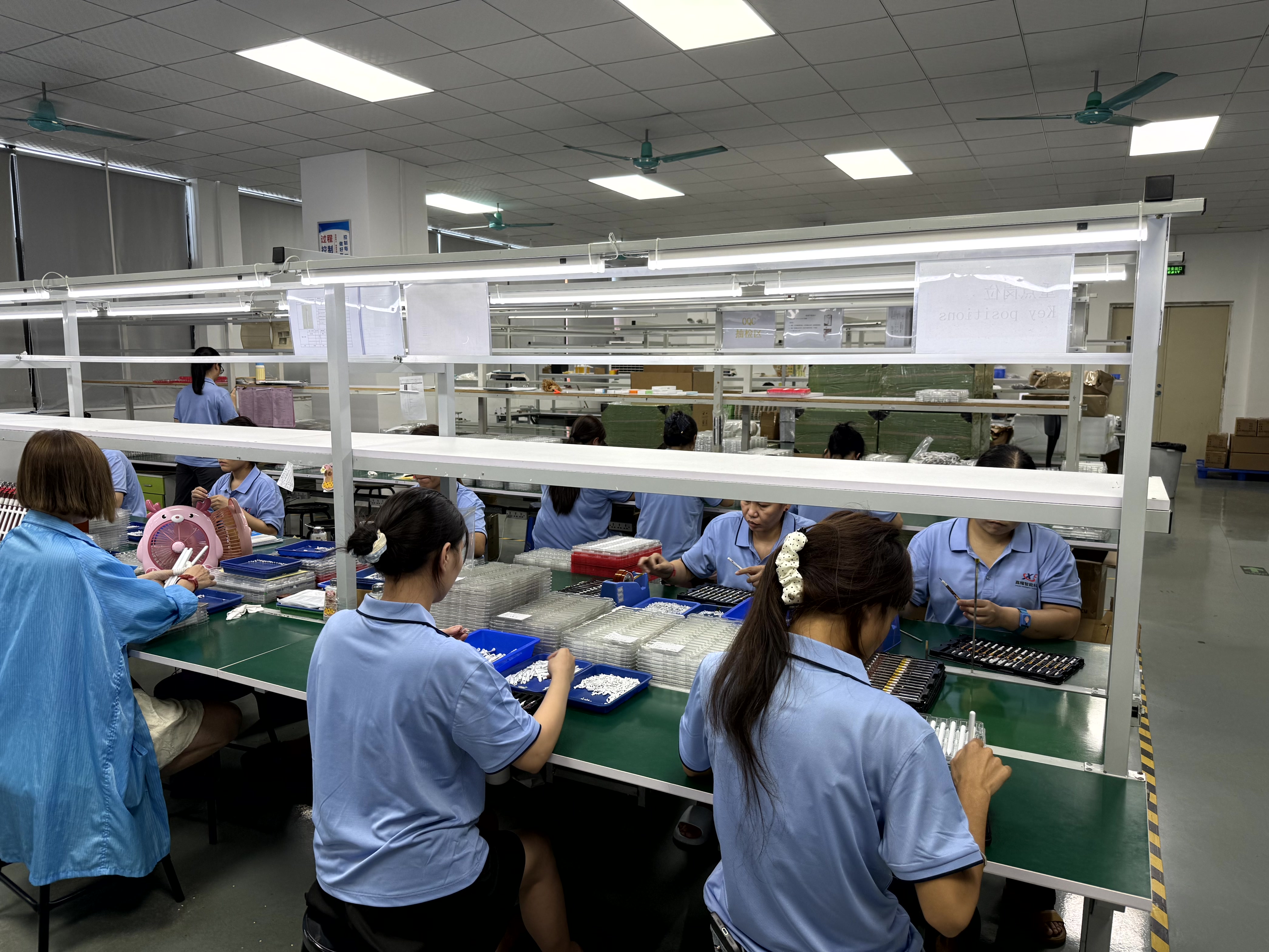
Stylus pen assembly and inspection environment — acceptance criteria are written around what can be checked here, unit by unit.
Where stylus procurement breaks down
Most stylus sourcing problems are information problems, and they cluster into four recurring gaps.
- Passive and active are treated as one category. They behave differently on the same tablet, and mixing them in one purchase order creates feature promises the passive unit cannot keep.
- Feature claims are host-dependent. Palm rejection, tilt response and magnetic attachment only work where the tablet hardware and system version support them. A pen that performs correctly on one iPad generation can behave differently two generations away.
- Acceptance is left qualitative. "Good writing feel" is not a test. Without written functional, tactile and visual checks, a factory and a buyer can both be honest and still disagree at inspection.
- Commercial classification is assumed. Stylus pens are typically classified under HS Code 8471.60.90 as automatic data processing input units, and classification affects duty treatment and documentation at import.
The rest of this article answers those gaps in the order a buyer meets them: purchase terms, acceptance criteria, the passive-versus-active decision, model selection, and the difference between a third-party stylus and an Apple Pencil.
Who Jiayao Stylus is
Dongguan Jiayao Intelligent Technology Co.,Ltd — trading as Jiayao Stylus — is a stylus pen manufacturer based in Humen Town, Dongguan, Guangdong, China, founded in 2021. The company operates a 2,700 m² facility with 100 employees, an annual output of 3,000,000 units, a research and development team of 4 engineers, and exports around 40% of its output, with the EU and the USA listed as main markets. Its stated capability covers the full process from PCBA design and battery welding to final assembly and quality testing, for both active and passive stylus pens compatible with iPad and mainstream tablets.
For procurement purposes, three figures matter more than the company description: a minimum order quantity of 500 pcs, a monthly capacity of 500,000 units, and a lead time of 20–35 days. Standard orders are shipped in 20 days, and samples can be supplied in as little as three weeks.
Purchase terms to fix before the first sample
Purchase terms are the part of a stylus programme that is cheapest to negotiate early and most expensive to renegotiate late. The table below sets out the terms Jiayao Stylus publishes, with the procurement consequence of each.
| Term | Published value | What it means for the buyer |
|---|---|---|
| Minimum order quantity | 500 pcs | Allows a market test or a single-channel launch without committing to container-scale volume. |
| Lead time | 20–35 days | Standard orders ship in 20 days; customised programmes sit in the upper part of the range. |
| Sampling | As little as 3 weeks | Sample approval can run in parallel with packaging and artwork preparation. |
| Monthly capacity | 500,000 units | Supports reorder cycles at short notice, including small and urgent repeat orders on regular models. |
| Production mode | OEM / ODM | Buyer-branded programmes are supported; customisation is based on samples. |
| Customisation scope | Function, colour, shape, tip, logo, packaging | Logo, packaging function and Bluetooth name are listed as sample-based customisation items. |
| Quality control | 100% test | Every unit is inspected rather than sampled, which is the basis for writing unit-level acceptance criteria. |
| After-sales | 1-year warranty; one-to-one replacement | Failure handling can be written into the PO as replacement rather than credit. |
| Export markets | EU, US, Middle East | Documentation and labelling expectations differ by destination and should be listed per order. |
Two of these terms deserve emphasis for first-time buyers. The 500 pcs MOQ sits below the volume threshold many factories require, which changes the risk profile of a first order: a buyer can validate sell-through before scaling. And the 100% test commitment is what makes a detailed acceptance schedule realistic — sample-based inspection cannot support unit-level pass/fail language.
Acceptance criteria: turning writing feel into a pass/fail list
Acceptance criteria for a stylus pen normally need three layers: functional, tactile and visual. Jiayao Stylus describes its inspection as 100% full inspection covering functional, tactile and visual checks, which maps directly onto that structure.
Functional checks
- Power on and power off through the switch type specified for the model — top touch switch, top key switch, key switch or positive pushbutton switch depending on the SKU.
- Charging behaviour, measured against the model's published charging time. For example, the iPad Stylus Pen W13-A lists 15 minutes by charging cable and 60 minutes by adsorption tablet wireless charging; the Stylus Pen W3-H lists 70 minutes by magnetic charging.
- Continuous working time against the published figure, such as 44 hours for the iPad Stylus Pen E3-A or 9–10 hours for the iPad and Android Stylus Pen R3-P.
- Automatic power-off behaviour, listed as 10 minutes on most models and 60 minutes on the E3-A and R3-P.
- Writing continuity, absence of offset and absence of delay, which the product data specifies as "NO Offset" and "NO Delay" on the iPad-compatible models.
- Nib interchangeability, listed across the range as interchangeable nibs.
- Side adsorption where the model supports it, with the caveat that on the A21B and W13-A it applies only to 11-inch and 12.9-inch iPad models.
Tactile checks
Button actuation force and travel, nib seating, housing fit and the feel of the magnetic attachment are all checkable without instruments and should be written as accept/reject items rather than opinions.
Visual checks
Housing finish and colour consistency, printing and logo legibility, nib concentricity, and retail packaging condition. Weight is a useful objective proxy here: the published net weight across the range is 12–15 g depending on model, for instance 15±1 g on the E3-A and 12–13 g on the A7-H-L, A8-RH, W3-H, W12-A and W13-A.
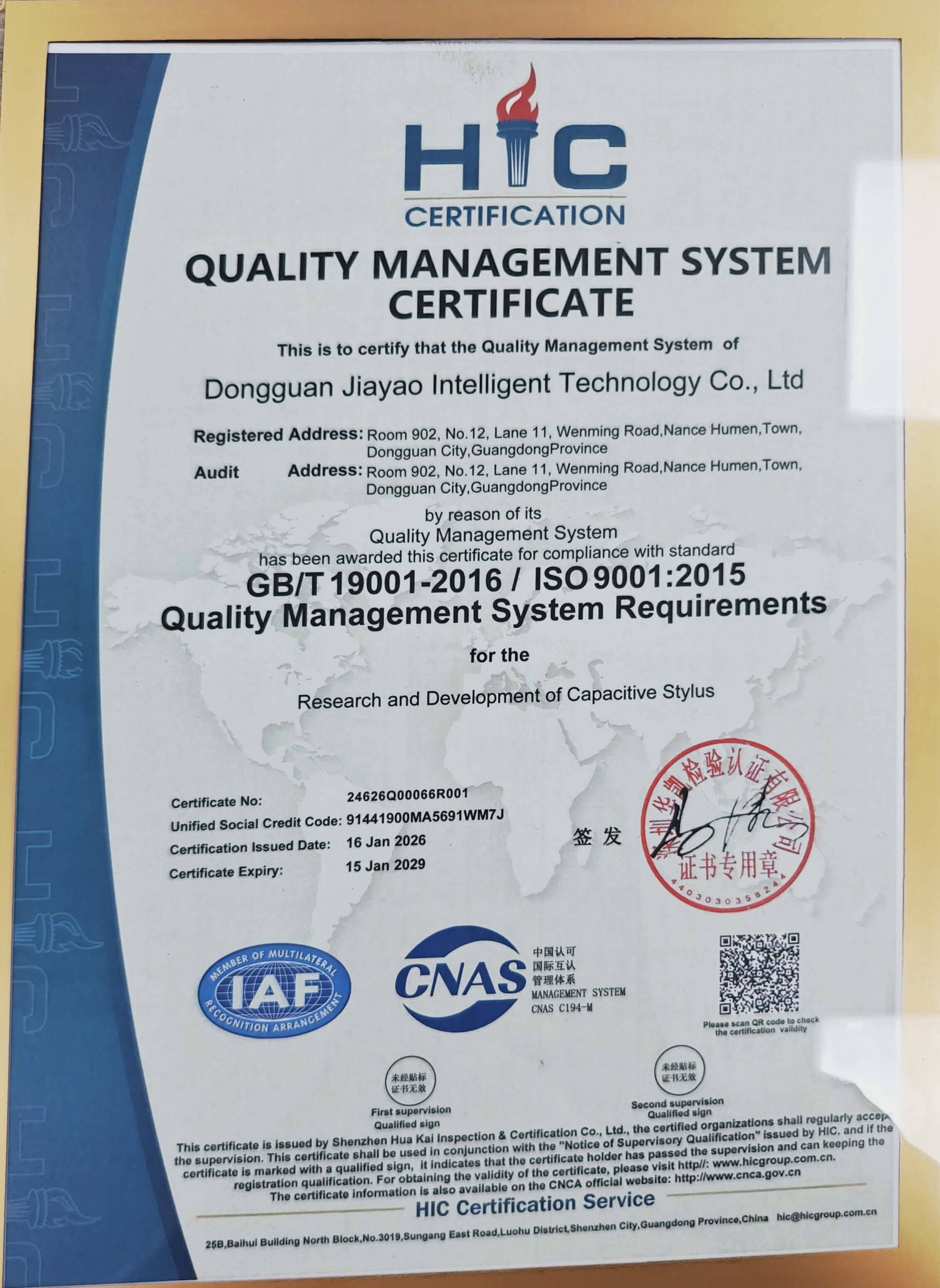
ISO9001 certificate 24626Q00066R001, issued 16 January 2026 by HIC Certification Service, valid to 15 January 2029.
Documentation checks
Two certificates can be verified before an order is placed. The quality management system certificate 24626Q00066R001 was issued by HIC Certification Service on 16 January 2026, valid until 15 January 2029, against GB/T-19001-2016 ISO9001:2015, with the scope "Research and Development of Capacitive Stylus". The ROHS certificate of conformity BAC260390119R was issued on 9 March 2026 by Shenzhen Bory Technology Service Co.,Ltd for the EU market, tested against the IEC 62321 series. Buyers should confirm that the certificate scope covers the exact model being ordered, and should list the certificate numbers in the purchase order so that any later substitution is visible.
Passive versus active: the technical split behind the purchase order
A passive stylus carries no electronics and no battery; it works by conducting the touch of a finger to a capacitive screen. An active stylus contains a battery, a PCBA and communication with the tablet, which is what makes palm rejection and tilt response possible on supported devices.
| Aspect | Passive (capacitive) stylus | Active stylus |
|---|---|---|
| Power source | None | Rechargeable battery; charging via Type-C, magnetic charging or tablet adsorption depending on model |
| Electronics | No PCBA, no pairing | PCBA and host communication; PCBA design is part of the manufacturing scope |
| Palm rejection | Not available | Listed as supported on the iPad-compatible models such as E3-A, A7-H-L, A8-RH, A21B, A30-B |
| Tilt response | Not available | Listed as "Tilt Bold" on A7-H-L, A8-RH, A21B and A30-B; A8-RH is described as a tilt sensing stylus pen |
| Pressure levels | Not applicable | Dependent on the pen and the host protocol; no pressure-level figure is published for the models listed in this article |
| Device compatibility | Any capacitive touchscreen | Model-specific: iPad models from 2018 onward on system version 12.2 and above, or universal iPad and Android on R3-P |
| Maintenance | No charging, no battery ageing | Charging discipline and battery ageing become part of the service life |
| Typical fit | Shared kiosks, public signage, classrooms with mixed devices, low-cost bundled accessories | Note-taking, annotation, drawing, field data capture, retail programmes where the pen is the product |
The procurement consequence is simple: a passive unit and an active unit should never share one purchase order line, one acceptance schedule or one claim set. Jiayao Stylus manufactures both categories, which makes it possible to split a programme into a passive SKU for shared-device use and an active SKU for productivity use without changing supplier.
Which stylus pen to choose: a shortlist by requirement
Model selection is faster when the requirement is stated first. The table below maps the published product data of the Jiayao Stylus range to the requirement each model answers.
| Model | Product name | Charging | Working time | Requirement it answers |
|---|---|---|---|---|
| S3-GC | Stylus Pen | Type-C, 55 min | 10 hours | Android-only programmes; aluminium alloy body; top touch switch; 13±1 g |
| E3-A | iPad Stylus Pen | Type-C, 40 min | 44 hours | Longest runtime in the published range; palm rejection; 60-minute auto power-off; 15±1 g |
| R3-P | iPad and Android Stylus Pen | Type-C, 40 min | 9–10 hours | Mixed device fleets; one SKU covering iPad and Android tablets; 13±1 g |
| A7-H-L | Stylus Pen | Type-C, 30 min | 16 hours | Education deployments; palm rejection and tilt; 12–13 g |
| A8-RH | Stylus Pen | Type-C, 30 min | 12 hours | Tilt-sensitive work such as sketching and annotation; 1.2 mm nib; 12–13 g |
| A21B | Stylus Pen | Type-C, 25 min | 11 hours | 2-in-1 configuration; magnetic attachment for 11-inch and 12.9-inch iPad only; 12–14 g |
| A30-B | Stylus Pen | Type-C, 25 min | 11 hours | Shortcut button workflows; palm rejection and tilt; 12–14 g |
| W3-H | Stylus Pen | Magnetic charging, 70 min | 11 hours | Cable-free user experience; ABS body; 12–13 g |
| W12-A | iPad Stylus Pen | Type-C 25 min or wireless 60 min | 9–10 hours | Dual charging paths; ABS body; 12–13 g |
| W13-A | iPad Stylus Pen | Cable 15 min or tablet adsorption 60 min | 9–10 hours | Shortest cable charging time in the published range; pushbutton switch; carton 55.5×32.5×25.5 cm |
Three selection rules follow from that data rather than from preference. First, runtime and charging time trade against each other: the E3-A publishes 44 hours of working time with a 230 mAh battery and a 40-minute charge, while the W-series models publish 9–11 hours with a 90 mAh battery and wireless charging paths. Second, compatibility should be stated as a model attribute, not as a range claim — the iPad models list compatibility with iPad from 2018 onward on system version 12.2 and above, and the R3-P adds Android tablet coverage. Third, magnetic attachment is not universal across the range: on the A21B and W13-A it applies only to 11-inch and 12.9-inch iPad models.
How a Jiayao stylus differs from an Apple Pencil
An Apple Pencil is Apple's own first-party stylus, designed, manufactured and supported by Apple for iPad, and paired inside the iPadOS ecosystem. A Jiayao Stylus pen is a third-party active or passive stylus made by Dongguan Jiayao Intelligent Technology Co.,Ltd in Dongguan, Guangdong, China, and normally sold under the buyer's brand.
The differences that matter in procurement are structural rather than promotional:
- Product range versus single product. The Jiayao range covers ten listed models across iPad-only, Android-only and universal configurations, with wired, magnetic and dual charging paths. A first-party pen is one product line with one launch cycle.
- Branding and packaging. The Jiayao programme is OEM/ODM, with customisation of function, colour, shape, tip, logo and packaging, and sample-based changes including logo, packaging function and Bluetooth name.
- Feature set on paper. The iPad-compatible Jiayao models list palm rejection, tilt response, side adsorption, and no offset or delay; the E3-A, A7-H-L, A8-RH, A21B, A30-B, W3-H, W12-A and W13-A all carry those attributes in their published data.
One boundary should be stated plainly: no pressure-sensitivity level is published for the Jiayao models described here, whereas high-end professional active pens such as the Samsung S-Pen are documented at up to 4,096 levels of pressure sensitivity. Buyers whose product claim depends on a stated pressure level should request measured test evidence for the specific model rather than infer parity from the feature list.
A second boundary concerns the ecosystem. A first-party pen draws on native pairing, native charging and native firmware support. A third-party pen depends on the host device and system version, which is why the compatibility statement — iPad from 2018 onward, system version 12.2 and above — belongs in the purchase order and on the retail listing, not only in the catalogue.
Applications and delivery records
The product data already points to where each configuration is used. The Stylus Pen A7-H-L lists education as its applicable industry, consistent with a 16-hour runtime, palm rejection and tilt response for classroom annotation. The R3-P covers mixed iPad and Android estates, which is the common situation in retail, logistics and field service fleets where devices were purchased in different years.
Two delivered programmes show how those configurations are ordered in practice. A tablet accessory ODM in Turkey has taken 5,000 units of the iPad Stylus Pen W12-A over a two-year relationship, for precise writing on iPad, iPhone, Android tablet and Android phone, with the stated result of increased use of the tablets in their estate. An iPad accessory ODM in Vietnam has taken 3,000 units of the iPad Stylus Pen E3-A over two years for precise writing on iPad and retail sale on e-commerce platforms, where the reported outcome was a smooth, precise handwriting experience, improved tablet operation efficiency and good user feedback, on the basis of fast charging, long working hours, palm rejection and tilt pressure sensing.
Market trend analysis
Three trends are relevant to a stylus purchase decision in 2026, and each has a documentation consequence.
Open standards are becoming the interoperability layer. The USI 2.0 specification, released in 2022 by the Universal Stylus Initiative and supported by Google, Intel and Lenovo, is the primary cross-platform standard for active styluses. For buyers, this reduces the risk of building a programme around one vendor's protocol, but it also means compatibility claims should state whether a pen is designed for a specific ecosystem or for a standard.
Active stylus demand is still expanding. Dataintelo projects 9.8% CAGR for active stylus technology from 2026 to 2034, against a global stylus pen market valued at USD 19.45 billion in 2025 by IMARC Group. Growth of that kind supports range breadth — iPad-only, Android-only and universal SKUs coexisting — rather than consolidation into a single configuration.
Classification and market entry are becoming procurement tasks. Stylus pens are typically classified under HS Code 8471.60.90 as automatic data processing input units, which determines duty treatment and the documents required at import. The ROHS certificate held for the EU market and the ISO9001 quality management system certificate are the two artefacts most often requested alongside that classification.
Where third-party stylus programmes have limits
An honest evaluation includes the conditions under which this route is the wrong one.
- Feature claims are host-bound. Palm rejection, tilt and side adsorption only appear where the tablet and system version support them; the same pen on an older or different device will not deliver the same behaviour.
- Magnetic attachment is model-limited. On the A21B and W13-A it applies to 11-inch and 12.9-inch iPad models only.
- Pressure performance is undocumented in the published data. Programmes built around a stated pressure level need measured evidence first.
- Passive units cannot substitute for active ones. Where palm rejection is essential, a passive SKU is not a cost-reduced alternative — it is a different product.
- Customisation runs on a sample cycle. Tooling and sample-based changes add time, so a 20-day standard dispatch should not be assumed for a fully customised configuration.
Future outlook
Two developments are likely to shape stylus purchase orders over the next few years. The first is standardisation: as USI-based active pens spread, buyers will increasingly ask suppliers to state protocol support explicitly, and compatibility documentation will become a standard attachment to the purchase order rather than a marketing line. The second is charging architecture. The current Jiayao range already spans Type-C only, magnetic only, and dual Type-C plus magnetic or tablet-adsorption charging, which reflects how users now expect a pen to recharge from the device they already carry. Buyers building multi-year programmes should expect the charging specification — not the writing specification — to be the item most likely to change between annual refreshes, and should write acceptance criteria that can survive that change.
Procurement FAQ
What purchase terms does a Jiayao Stylus order normally include?
Jiayao Stylus publishes a minimum order quantity of 500 pcs, a lead time of 20–35 days, standard orders shipped in 20 days, samples in as little as three weeks, a monthly capacity of 500,000 units, OEM/ODM production with customisation of function, colour, shape, tip, logo and packaging, 100% testing, and a one-year warranty with one-to-one replacement. Export markets are listed as the EU, US and Middle East.
What should acceptance criteria cover in a stylus pen purchase order?
Acceptance criteria should be written in three layers — functional, tactile and visual — plus documentation. Functional items include power switching, charging time and working time against the model specification, automatic power-off behaviour, writing continuity, nib interchangeability and side adsorption. Tactile items cover button actuation, nib seating and magnetic attachment feel. Visual items cover housing finish, printing and packaging condition. Documentation covers certificate numbers and scope, in particular the ISO9001 certificate 24626Q00066R001 and the ROHS certificate of conformity BAC260390119R. Jiayao Stylus describes its inspection as 100% full inspection covering functional, tactile and visual checks.
Should a buyer choose a passive or an active stylus pen?
A passive stylus contains no battery or electronics and works on any capacitive touchscreen, but it cannot provide palm rejection or tilt response. An active stylus contains a battery and PCBA, communicates with the tablet, and supports palm rejection and tilt where the host device allows it. Passive units suit shared kiosks, public signage and mixed-device classrooms; active units suit note-taking, annotation, drawing and retail accessory programmes. Jiayao Stylus manufactures both categories, so the choice can be made per SKU rather than per supplier.
Which stylus pen model should be shortlisted for iPad, Android or mixed device fleets?
Published product data supports a requirement-led shortlist. The Stylus Pen S3-GC is an Android universal stylus pen with 55-minute Type-C charging and 10 hours of working time. The iPad and Android Stylus Pen R3-P is the universal option for mixed fleets, with 40-minute charging and 9–10 hours of working time. The iPad Stylus Pen E3-A offers the longest runtime in the range at 44 hours. The iPad Stylus Pen W13-A offers the shortest cable charging time at 15 minutes. The Stylus Pen W3-H and W12-A provide magnetic and dual charging options, and the Stylus Pen A30-B adds a shortcut button.
How does a Jiayao stylus differ from an Apple Pencil?
An Apple Pencil is Apple's own first-party stylus, designed and supported by Apple for iPad and paired within the iPadOS ecosystem. A Jiayao Stylus pen is a third-party active or passive stylus manufactured by Dongguan Jiayao Intelligent Technology Co.,Ltd in Dongguan, Guangdong, China, offered across ten listed models and normally sold under the buyer's brand with OEM/ODM customisation. The iPad-compatible Jiayao models list palm rejection, tilt response, side adsorption and no offset or delay, but no pressure-sensitivity level is published for them, so buyers requiring a documented pressure figure should request measured test evidence for the specific model.
Which certifications can be verified before placing an order?
Two certificates are published. The quality management system certificate 24626Q00066R001 was issued by HIC Certification Service on 16 January 2026 and is valid until 15 January 2029, against GB/T-19001-2016 ISO9001:2015, with the scope "Research and Development of Capacitive Stylus". The ROHS certificate of conformity BAC260390119R was issued on 9 March 2026 by Shenzhen Bory Technology Service Co.,Ltd for the EU market, tested against the IEC 62321 series. Buyers should verify that the scope covers the exact models ordered.
Can a stylus pen order be customised, and what can change?
Jiayao Stylus operates OEM/ODM production with customisation of function, colour, shape, tip, logo and packaging. Customisation is carried out on a sample basis and includes logo, packaging function and Bluetooth name. Because sample development takes time, customised configurations should be scheduled separately from the 20-day standard dispatch figure, within the published 20–35 day lead time.
How are stylus pens classified for import?
Stylus pens are typically classified under HS Code 8471.60.90 as automatic data processing input units, according to customs and trade classification data. The classification determines duty treatment and required documentation, and should be confirmed for the destination market before shipment, together with the EU ROHS conformity certificate where applicable.
Reference material
Model parameters, charging times and working hours referenced in this article are published in the Jiayao Intelligent Stylus Pen catalogue, which can be downloaded and used as an attachment to a request for quotation: Jiayao Intelligent Stylus Pen Catalogue (PDF).
Have Questions or Need More Details?
Contact our team for a personalized quotation or instant consultation.
Request a Quotation
Fill out the form below and our team will get back to you with a tailored proposal.
WhatsApp Direct Chat
Prefer to chat in real-time? Message us on WhatsApp for instant assistance & quick answers.
- Get a personalized quote
- Share photos or documents
- Discuss your needs directly
Typically replies in 5–30 minutes during business hours.