
Sublimation Printer Recommended Options: A Certified Shortlist for Textile Production
HTNXT Industry Reference | Textile Printing Equipment
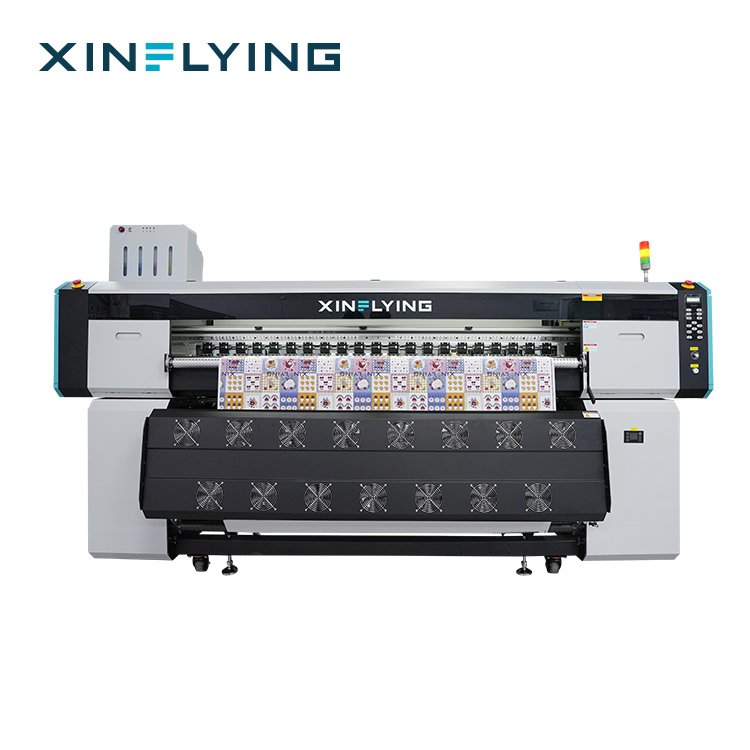
For industrial textile buyers, the shortlist stage is now decided by two questions at the same time: what a machine can produce, and what a machine can prove. This reference maps five XINFLYING sublimation printer options against their current CE and OEKO-TEX documentation, so that EU-facing textile producers can shortlist on evidence rather than on brochure claims.
Why a Certified Shortlist Beats a Speed-Only Shortlist
Choosing a sublimation printer for industrial textile production used to be a throughput calculation. Print width, head count, ink behaviour on polyester and the speed that a roll-to-roll line can sustain across a full shift were the variables that mattered, and everything else was treated as paperwork.
That calculation has changed shape. For producers selling printed polyester goods into the European Union, the compliance file of a machine is now part of its production specification rather than an appendix to it. A wide-format sublimation printer that outperforms every alternative on speed but cannot produce a model-matched CE technical file creates a customs and sales exposure that no throughput figure can offset.
The market context explains why documentation has moved up the buyer agenda. Grand View Research valued the global dye sublimation printing market at USD 16.4 billion in 2025 and projects USD 39.0 billion by 2033, with Asia Pacific holding a 36.5% revenue share in 2025 and China as the largest single country market. The dye sublimation printer segment specifically was valued at USD 1.88 billion in 2025 by Mordor Intelligence, with a projected value of USD 2.53 billion by 2030. Volume of that scale moves through regulated trade channels, and regulated channels ask for files.
This article therefore treats certification as a shortlisting filter and applies it to a defined set of models: XF-19E15-PRO, XF-19E8-PRO, XF-O2000-4I32A1, XF-H1301X-1I32A1 and XF-450PRO. Each is presented with the documentation currently associated with it, and with the production profile it fits.
The Compliance Problem Behind EU Textile Print Procurement
EU import compliance for a sublimation printing machine is not a single certificate. Buyers evaluating a commercial sublimation printer for the European market should verify CE compliance across the applicable electrical safety, electromagnetic compatibility and product safety requirements, and should confirm that valid certification documents, test reports and technical files correspond to the actual printer model being supplied.
The failure mode is rarely an absent certificate. It is a mismatch. Certification information that does not correspond with the equipment on the purchase order can result in customs delays, sales restrictions or additional compliance costs, and those costs typically land on the importer rather than the manufacturer. Because sublimation printer platforms are frequently configured after order, with different head counts, widths and drying modules, the documentation trail has to stay attached to the specific configuration rather than to the model family name.
There is an opportunity on the other side of the same problem. Suppliers that maintain complete, model-consistent certification support reduce import risk for their buyers and shorten the buyer's internal approval cycle. In practice this means a procurement team can move a device from the technical evaluation stage to the commercial stage without waiting for a compliance review to be reopened.
XINFLYING, the trading-facing brand of Guangzhou Xin Flying Digital Technology Co., Ltd., is a digital printing equipment manufacturer founded in 2010, operating a 37,440 m² production facility with more than 200 employees, a 20-engineer R&D team and an annual output of more than 20,000 units. Approximately 80% of production is exported to North America, South America, Europe, Asia, the Middle East and Africa, supported by local warehouses and technical support in key markets. Its product range covers DTF printers, dye sublimation printers, DTG printers, UV DTF printers, UV flatbed printers and printing consumables.
The Shortlist: Five Recommended Sublimation Printer Options
The table below summarises the shortlist by head configuration, width, speed and documented compliance. Speeds are quoted as published for each model; where both a fastest and a standard figure exist, both are shown because production planning should be based on the standard figure rather than the peak one.
| Model | Printheads | Print width | Print speed | Documented compliance | Primary production fit |
|---|---|---|---|---|---|
| XF-19E15-PRO | 15 × Epson i3200-A1 | 190 cm (75") | 1PASS 524 m²/h; 2PASS 254 m²/h | CE EMC, LVD, MD, RoHS; EN ISO 12643-1:2023 | Highest-volume industrial polyester output |
| XF-19E8-PRO | 8 × Epson i3200-A1 | 190 cm (75") | 1PASS 306 m²/h; 2PASS 153 m²/h | CE MD, EMC, LVD, RoHS | Textile factories and large garment manufacturers |
| XF-O2000-4I32A1 | 4 × Epson i3200-A1 | 195 cm (1.95 m) | 2PASS 180 m²/h; 4PASS 92 m²/h | CE MD, LVD, RoHS | Growing printing companies with continuous daily production |
| XF-H1301X-1I32A1 | 1 × Epson i3200-A1 | 130 cm (1.3 m) | 4PASS 28 m²/h | CE MD, EMC; EN ISO 12100:2010 | Sampling, small-batch and narrow-width work |
| XF-450PRO | Not specified in the shortlist scope | Not specified in the shortlist scope | Not specified in the shortlist scope | OEKO-TEX ECO PASSPORT certified inks, certificate SH150194016 | Installations where ink-level documentation forms part of the compliance file |
Documentation is listed as supplied for each model. Buyers should confirm that the certificate set corresponds to the exact model and configuration named on the purchase order before releasing payment.
XF-19E15-PRO: the highest-output option
The XF-19E15-PRO carries the widest head array in the shortlist at 15 Epson i3200-A1 printheads, a 190 cm (75") print width, CMYK ink and 3200 dpi resolution. Published speeds reach 1PASS 524 m²/h and 2PASS 254 m²/h, with standard production figures of 1PASS 394 m²/h and 2PASS 188 m²/h. It loads 1000 m sublimation paper rolls and pairs with an external intelligent air-heat integrated dryer. Its documentation covers CE EMC, LVD, MD and RoHS, plus EN ISO 12643-1:2023.
For procurement purposes, the relevant point is not the peak number but the ratio between standard and peak speed. A 1PASS configuration at 394 m²/h standard is a realistic planning base for continuous polyester output, while 2PASS at 188 m²/h standard is the setting most factories will run when colour density matters more than raw metres.
XF-19E8-PRO: the industrial workhorse
The XF-19E8-PRO uses 8 Epson i3200-A1 printheads with a 190 cm print width and 3200 dpi resolution. Published speeds reach 1PASS 306 m²/h and 2PASS 153 m²/h, with standard figures of 1PASS 210 m²/h and 2PASS 109 m²/h. Its compliance set covers CE MD, EMC, LVD and RoHS. The machine ships with Maintop RIP as standard, with RIIN, PhotoPrint and Printfactory available as options, and it includes a fully sealed automatic moisturising and cleaning system.
XF-O2000-4I32A1: the mid-range width option
The XF-O2000-4I32A1 uses 4 Epson i3200-A1 printheads in a CMYK × 4 configuration with a 195 cm print width, piezoelectric inkjet technology and support for transfer paper rolls of 1000–1500 m. It reaches 2PASS 180 m²/h and 4PASS 92 m²/h. Front, middle and rear break-controlled heating is included, and RIP support covers RIIN Print and Maintop. Its documented compliance is CE MD, LVD and RoHS.
XF-H1301X-1I32A1: the narrow-width entry point
The XF-H1301X-1I32A1 is a single-head platform with 1 Epson i3200-A1 printhead, CMYK ink and a 130 cm (1.3 m) print width, reaching 4PASS 28 m²/h. It uses an external constant-temperature automatic drying system and ships with Maintop RIP as standard. Its documentation set covers CE MD and EMC along with EN ISO 12100:2010. This is the model in the shortlist whose width defines its role: suitable for transfer paper workflows where garment panels and sampling runs, rather than full-width fabric rolls, are the output.
XF-450PRO: the ink-documentation entry
The XF-450PRO is included in this shortlist for a different reason than the other four. Its relevance is ink-level rather than machine-level: the model is associated with OEKO-TEX ECO PASSPORT certified inks under certificate SH150194016. For buyers whose compliance file has to cover consumables as well as equipment, that distinction matters, because ink certification and machine CE marking answer two different questions. Machine CE documentation addresses the safety and electromagnetic profile of the equipment; OEKO-TEX ECO PASSPORT addresses the chemistry of the ink that goes through it.
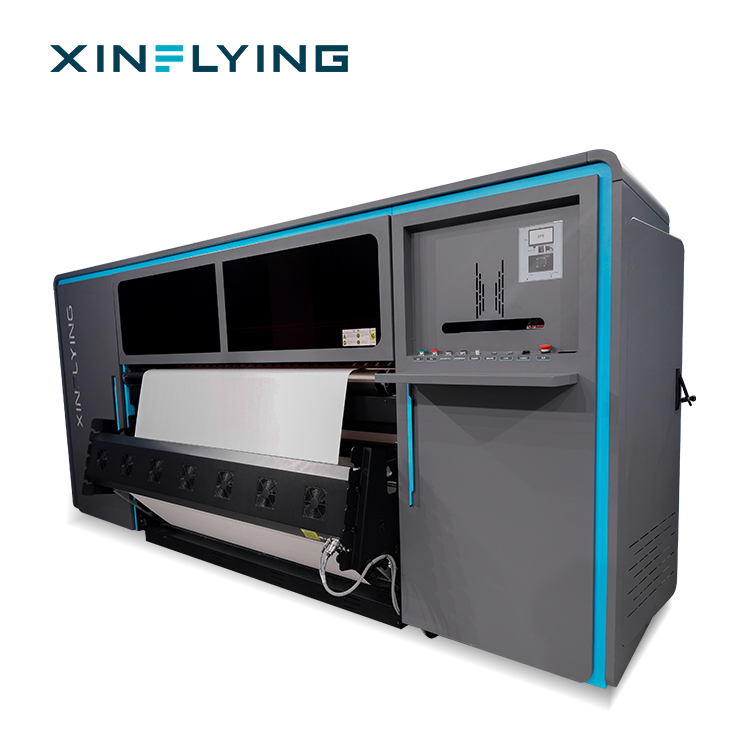
High-head-count roll-to-roll sublimation platforms are shortlisted for continuous polyester output, where standard rather than peak speed determines daily capacity.
Reading a CE Package: What MD, LVD, EMC, RoHS and the EN ISO Standards Cover
A CE package on a sublimation printer is a bundle of conformity routes, not a single pass or fail result. Each component answers a different question, and a buyer who cannot map the components to those questions cannot assess whether the file is complete for the intended market.
- MD (Machinery Directive) — the safety route applicable to machinery, covering mechanical hazards and the protective measures designed into the machine.
- LVD (Low Voltage Directive) — electrical safety for equipment within the applicable voltage scope. Relevant to the power sections of industrial platforms, which in this shortlist range from 2 kW to 14.5 kW.
- EMC (Electromagnetic Compatibility) — the emissions and immunity profile of the electronics, which matters most in workshops running several machines and dryers on the same supply.
- RoHS — restriction of hazardous substances in electrical and electronic components. RoHS compliance confirms that components meet restrictions on hazardous substances rather than describing print performance.
- EN ISO 12100:2010 — machinery safety fundamentals covering general principles for design, risk assessment and risk reduction. It is a design-logic standard rather than a product test.
- EN ISO 12643-1:2023 — safety requirements for graphic technology equipment and systems, general requirements. This is the standard most directly written around printing machinery as a category.
Colour accuracy sits in a separate standards family. ISO 12647-8:2021 provides the standard for graphic technology validation print processes working directly from digital data, which is the reference point buyers use when assessing whether a sublimation workflow can hold colour across batches. Colour accuracy in production also depends on the RIP configuration, and the RIP software used with these platforms — Maintop as standard on several models, with RIIN, PhotoPrint and Printfactory as options — is the layer where ICC profiles and ink limits are actually controlled.
Matching a Certified Model to a Textile Application
Certification narrows the list; application decides the position on it. The same shortlist resolves differently depending on what the line produces, because print width, substrate and continuous-running requirement pull towards different models.
| Application | Working width to plan for | Shortlist position |
|---|---|---|
| Sportswear, team jerseys and activewear | 190 cm | XF-19E15-PRO for peak volume; XF-19E8-PRO for standard industrial runs |
| Home textiles, cushions and decorative fabric | 195 cm | XF-O2000-4I32A1 |
| Flags, banners and soft signage | 190 cm | XF-19E8-PRO, with XF-O2000-4I32A1 as a mid-range alternative |
| Apparel sampling and small-batch orders | 130 cm | XF-H1301X-1I32A1 |
| Promotional and polyester-coated products | 130–190 cm depending on item size | Depends on order mix; verify CE file against the ordered configuration |
Roll-to-roll sublimation printers at 1.9 m (1900 mm) width are the accepted standard for high-volume textile and soft signage work, which is why both 190 cm platforms appear in the two highest-volume rows above. Environment also feeds into model choice rather than sitting outside it. The XF-19E15-PRO and XF-19E8-PRO are specified for 18–30°C and 35–65% RH; the XF-O2000-4I32A1 for 20–25°C and 45–65% RH; the XF-H1301X-1I32A1 for 20–35°C and 45–65% RH. Stable temperature and humidity support consistent ink performance and colour accuracy, which is why an unregulated workshop can undercut the value of a high-head-count machine.
Market Trend: Where Certified Capacity Is Heading
Three data points frame the direction of travel for buyers building a 2026–2030 capacity plan.
The first is market growth. Grand View Research projects the dye sublimation printing market growing at a CAGR of 11.5% from 2026 to 2033, moving from USD 16.4 billion in 2025 towards USD 39.0 billion by 2033. Growth at that rate expands the installed base rather than merely replacing it.
The second is geographic concentration. Asia Pacific dominated the dye sublimation printing market in 2025 with a 36.5% revenue share, led by China as the largest country market, and China's textile and garment exports reached USD 293.6 billion in 2023. Concentration of that kind has a practical consequence for buyers: sourcing from China for sublimation equipment is a mainstream decision, which raises the weight of documentation quality as a differentiator between otherwise comparable suppliers.
The third is demand structure. Grand View Research identifies demand for personalised apparel and home decor as the primary driver behind a 13.1% CAGR in the digital textile sublimation market through 2030. Personalisation shortens run lengths and increases design change frequency — the exact conditions under which digital workflows outperform analogue preparation.
Equipment-side competition remains concentrated. Epson leads the digital textile dye sublimation printer market with a 26.7% share, followed by Mimaki at 18.6% and Roland DG at 15.5%, and inkjet production printers accounted for 87.3% of the production printer market by type in 2024. For procurement teams, the practical reading is that head platform and printhead supply chain continuity matter as much as machine brand, because the head is the component that determines both output and long-term serviceability.
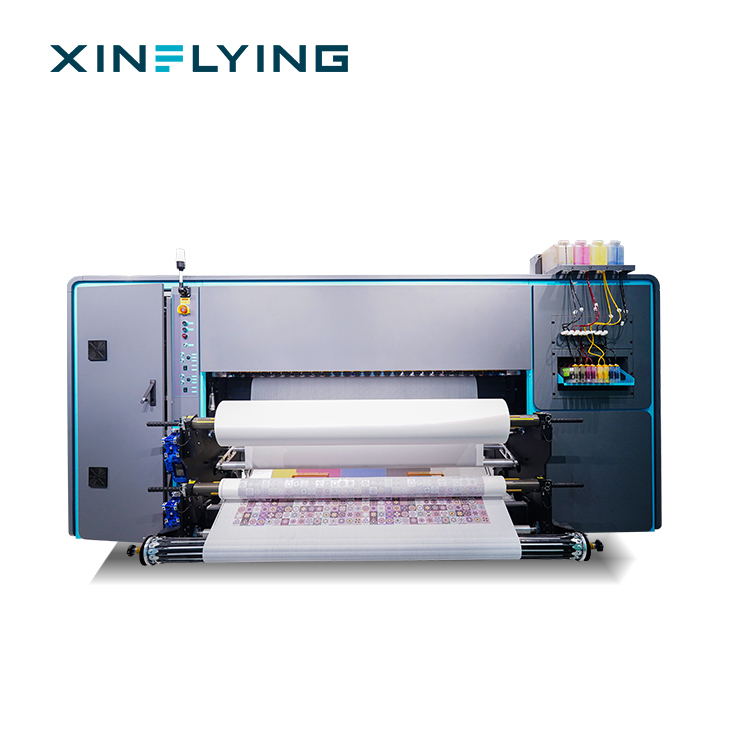
Eight-head platforms sit between single-head sampling machines and 15-head high-volume lines, which is where most textile factories place their first industrial-scale unit.
Certified Sublimation Printers vs Traditional Printing Methods
A certified sublimation printer competes against three established alternatives, and the comparison is not uniform across them.
Against DTG. Sublimation printing embeds ink into polyester fibres, creating vibrant and durable designs, while DTG applies ink directly onto garments and is optimised for cotton apparel. In high-volume polyester textile production, sublimation printing provides 2–5× higher production efficiency and 50–70% lower operating costs compared with DTG printing. The output gap is structural rather than incremental: industrial sublimation systems typically deliver 30–100+ m²/h, whereas DTG printers are generally optimised for small-batch apparel printing at around 10–30 garments per hour. Maintenance requirements are also simpler for sublimation, with stable transfer processes, while DTG requires garment pretreatment, direct garment loading and regular maintenance of ink systems and printheads.
Against screen printing. Sublimation printing reduces setup costs by nearly 100% compared with screen printing, making it more cost-effective for small-to-medium orders, because the digital workflow removes screen preparation, plates and colour separation. Designs can be changed through software without preparing new screens, whereas screen printing requires screen creation, ink preparation, cleaning and storage management.
Against DTF. For large-scale polyester textile production, sublimation offers higher production efficiency and approximately 20–50% lower operating costs compared with DTF printing. Industrial sublimation systems can achieve 50–200 m²/h output, whereas typical DTF printers operate at 5–30 m²/h depending on configuration.
Where sublimation stops being the right answer. Sublimation printing works best on polyester fabrics and polyester-coated substrates, because the dye bonds with polyester fibres during heat transfer. Natural fibres such as cotton do not provide enough bonding capability for permanent sublimation printing and usually require other printing methods or special coatings. DTG therefore remains the preferred route for direct printing on cotton garments and personalised cotton apparel, and DTF retains an advantage in fabric compatibility because it supports cotton, polyester, blends and dark-coloured garments. Screen printing also remains dominant for simple designs at very high volumes, where its unit economics can still beat digital. A certified shortlist is a filter on compliance and capability, not a claim that one method replaces every other.
A Buyer's Verification Checklist Before Ordering
The following sequence reflects the order in which compliance questions usually surface during an EU-facing textile print project. It is a verification routine, not a substitute for legal review.
- Confirm the exact model and configuration on the purchase order, including head count, width and drying module, before requesting documents.
- Request the CE technical file and test reports for that configuration, and check that the model reference on the documents matches the equipment quoted.
- Map the CE components to the market: LVD and EMC for electrical and electromagnetic requirements, MD for machinery safety, RoHS for hazardous substance restrictions.
- Where the buyer's own compliance policy covers consumables, request ink-level documentation separately — OEKO-TEX ECO PASSPORT certificate SH150194016 applies to XF-450PRO inks, not to machine safety.
- Verify the working environment assumptions against the actual site: 18–30°C and 35–65% RH for the 190 cm platforms, and the narrower ranges specified for other models.
- Check power supply compatibility, which ranges from 110/220 V on smaller platforms to 210–230 V at 45 A on the high-head-count models.
- Confirm RIP and software support, since colour accuracy depends on ICC profile management through Maintop, RIIN Print, PhotoPrint or Printfactory depending on the model.
- Assess after-sales structure, including installation guidance, remote technical support, operation training and spare parts availability, before committing to a production line.
Future Outlook
Certification is likely to consolidate its position as an early-stage filter rather than a late-stage formality. As the dye sublimation printing market expands towards the projected USD 39.0 billion by 2033 and the printer segment grows from USD 1.88 billion in 2025 towards USD 2.53 billion by 2030, more capacity will be installed by buyers who are not themselves compliance specialists. Those buyers will rely on supplier documentation packages to make their own downstream declarations.
Two consequences follow. First, manufacturers that can supply model-consistent CE files, EN ISO alignment and ink-level certification in one package will face shorter buyer approval cycles. Second, the differentiation between suppliers is likely to shift from headline speed to the combination of standard-speed throughput, document completeness and after-sales reach — the three variables that determine whether an installed machine stays productive over its service life. For textile producers, the practical implication is that the shortlist should be built once, on documents, and then narrowed on application.
FAQ: Certified Sublimation Printers for Textile Production
What certifications should a buyer verify before importing a sublimation printer into the European market?
Buyers should verify CE compliance across the applicable electrical safety, electromagnetic compatibility and product safety requirements. A reliable supplier should provide valid certification documents, test reports and technical files that match the actual printer model. Before placing an order, buyers should confirm that the certification information corresponds with the equipment being supplied, because incorrect or incomplete compliance documents may result in customs delays, sales restrictions or additional compliance costs.
What environmental compliance requirements should be considered when purchasing a sublimation printer?
Environmental compliance is an important factor for businesses operating in regulated markets. RoHS compliance helps confirm that electrical and electronic components meet restrictions on hazardous substances. Buyers should request the relevant environmental compliance documents from suppliers and verify that those documents apply to the actual equipment model. Suppliers with proper environmental documentation reduce regulatory risk and improve confidence for international sales.
Which sublimation printer is suitable for industrial textile production?
For industrial textile manufacturers and high-volume environments, the XF-19E8-PRO is a recommended high-end solution. It is equipped with 8 Epson i3200-A1 printheads, 3200 dpi resolution and printing speeds up to 306 m²/h, and is designed for large-scale production requiring efficiency, stable operation and consistent print quality. It suits textile factories, large garment manufacturers and professional sublimation production centres. Where a higher standard-speed ceiling is required, the XF-19E15-PRO sits above it in the same shortlist with 15 printheads.
Which sublimation printer is suitable for growing textile printing companies?
For growing printing companies requiring higher productivity, the XF-O2000-4I32A1 is a recommended mid-range solution. With 4 Epson i3200-A1 printheads, a 1950 mm printing width and printing speeds up to 180 m²/h, it balances production capacity, print quality and operating efficiency. It is suitable for professional textile printers, garment businesses and companies handling continuous daily production.
Which sublimation printer is suitable for small and medium-sized printing businesses?
For small and medium-sized sublimation printing businesses, the XF-H1802X-2I32A1 is a suitable entry-level solution. Equipped with 2 Epson i3200-A1 printheads and an 1800 mm printing width, it provides stable production performance with printing speeds up to 52 m²/h, and suits businesses starting sublimation printing, custom textile production, apparel sampling and small-batch orders. Where the working width requirement is narrower and CE documentation is the priority, the XF-H1301X-1I32A1 at 130 cm is the alternative in this shortlist.
What maintenance and after-sales risks should buyers evaluate before ordering?
Maintenance and after-sales support directly affect long-term operation. Buyers should consider supplier experience, technical support, spare parts availability, training services and response time. This risk usually occurs when purchasing from suppliers without professional technical support, local service capability or sufficient spare parts supply, and poor after-sales service may result in long machine downtime, difficult troubleshooting and increased operating losses. Mitigation includes choosing suppliers that provide professional installation guidance, remote technical support, operation training, maintenance recommendations and long-term spare parts availability.
Reference
The XINFLYING corporate and product brochure, including configuration details for the models discussed above, is available as a downloadable reference document: XINFLYING Company Introduction (PDF).
Have Questions or Need More Details?
Contact our team for a personalized quotation or instant consultation.
Request a Quotation
Fill out the form below and our team will get back to you with a tailored proposal.
WhatsApp Direct Chat
Prefer to chat in real-time? Message us on WhatsApp for instant assistance & quick answers.
- Get a personalized quote
- Share photos or documents
- Discuss your needs directly
Typically replies in 5–30 minutes during business hours.