
Sublimation Printer Supplier Audit: CE, RoHS and OEKO-TEX Files
Sublimation Printer Supplier Audit: CE, RoHS and OEKO-TEX Files
Verifying a sublimation printer supplier now means reading documents - reference numbers, model designations and issuing bodies - rather than accepting a compliance sentence inside a quotation. This article works through one published evidence set to show how that audit is performed, and where it stops.
Industrial buyers evaluating a large format sublimation printer for a regulated market face a specific problem: the equipment proposal, the ink proposal and the compliance statement often arrive in the same file, and only one of the three can be independently checked before an order is placed. Certificates can be checked. Claims cannot.
The example used here is the documentation set published by XINFLYING, the brand of Guangzhou Xin Flying Digital Technology Co., Ltd. - a digital printing equipment manufacturer founded in 2010 in Panyu, Guangzhou, that builds dye sublimation printers, DTF printers, DTG printers and UV printers from a 37,440 m2 facility with 200+ employees, a 20-engineer R&D team and an export share of roughly 80%. The set covers the XF-19E15-PRO, extends to the XF-19E8-PRO, XF-H1301X-1I32A1, XF-O2000-4I32A1 and XF-450PRO designations, and includes an OEKO-TEX ECO PASSPORT for textile inks and pastes.
The audit method is portable. Applied to any supplier, the same checks - number, model, issuer, scope, validity - either produce verifiable evidence or expose its absence.
Why Compliance Files Became a Capability Test
Sublimation printing capacity is expanding quickly enough that supplier differentiation can no longer rest on machine availability alone. Grand View Research values the global dye sublimation printing market at USD 16.4 billion in 2025, with a projected path to USD 39.0 billion by 2033 and an 11.5% CAGR across 2026-2033. Within that total, the dye sublimation printer segment itself was valued at USD 1.88 billion in 2025 and is expected to reach USD 2.53 billion by 2030, according to Mordor Intelligence.
The demand is concentrated. Asia Pacific held a 36.5% revenue share of the dye sublimation printing market in 2025, with China the largest country market, and the underlying driver is consumer-facing: personalised apparel and home decor is identified as the primary driver behind a 13.1% CAGR in the digital textile sublimation market through 2030. China's textile and garment exports reached USD 293.6 billion in 2023, which is the demand base that industrial sublimation capacity in the region serves.
In a market of that size, a buyer comparing suppliers usually cannot inspect every factory. What can be inspected early, and at low cost, is the document file. A certificate is a dated artifact with a number, a named issuer and a subject; it can be challenged, verified or failed. That is why documentation has moved from administrative afterthought to shortlisting criterion - especially for buyers whose own customers ask where the production equipment and the chemistry came from.
The Evidence Set Under Review
| Document | Reference | Subject named | Issuing body | Scope addressed |
|---|---|---|---|---|
| CE EMC certificate | TQT1550D270EC | XF-19E15-PRO | TQT | Electromagnetic compatibility |
| CE LVD certificate | TQT1550D271EC | XF-19E15-PRO | TQT | Electrical safety (low voltage) |
| CE MD certificate | M.2026.206.C142365 | XF-19E15-PRO | UDEM | Machinery safety |
| RoHS certificate | M.2026.206.C142366 | XF-19E15-PRO | UDEM | Restriction of hazardous substances |
| OEKO-TEX ECO PASSPORT | SH150194016 | Textile inks and pastes | TESTEX AG | Chemical safety of consumables |
Table 1: The five references reviewed in this article, with the subject named on each document and the scope it addresses.
Three features make this set auditable rather than decorative. The references are specific and citable. The subject is specific: four machine-level documents name one model, the XF-19E15-PRO, while the fifth covers consumables rather than equipment. And the issuing bodies are named rather than implied - TQT for the TQT-prefixed CE EMC and CE LVD references, UDEM for the CE MD and RoHS references, and TESTEX AG for the OEKO-TEX ECO PASSPORT. The same documentation package also names CTIC among its testing and issuing bodies, and extends coverage discussion to the XF-19E8-PRO, XF-H1301X-1I32A1, XF-O2000-4I32A1 and XF-450PRO designations.
The most useful thing a buyer can do with this table is to read it not as a result but as a checklist. Every row should be matched against the issuing body's own record before it is treated as evidence.
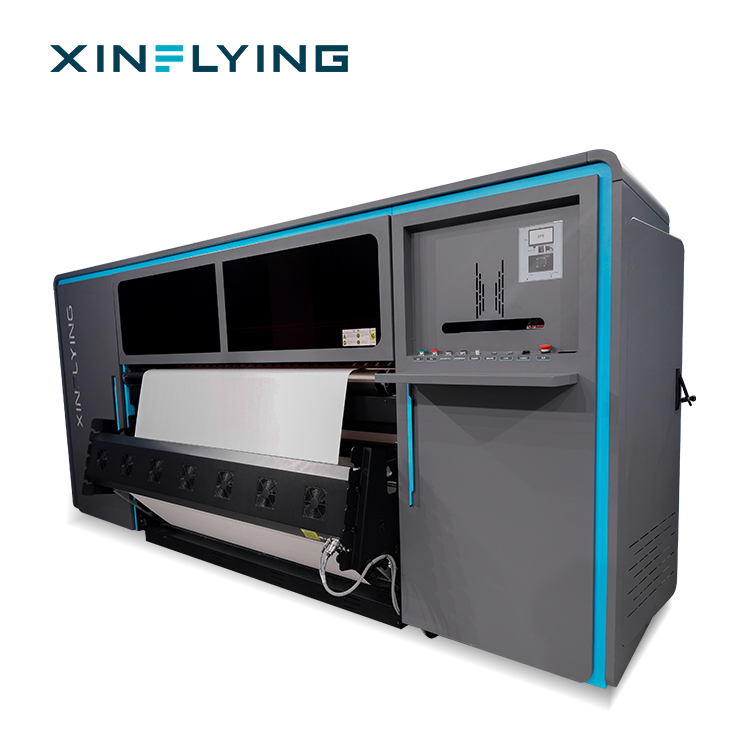
The XF-19E15-PRO is the model named on the four machine-level certificates discussed in this article.
What Each CE Document Covers - and Where It Stops
CE EMC - TQT1550D270EC
Electromagnetic compatibility testing examines emissions and immunity: whether the machine disturbs other equipment, and whether it continues to function in a normal electrical environment. For a printer in the XF-19E15-PRO class this is not a marginal question, because the machine is rated at 14.5 kW on a 210-230V, 45A supply, with heaters, motors and drive electronics sharing one frame. What EMC does not cover is equally important: it says nothing about print quality, ink chemistry, mechanical durability or colour consistency. A buyer who reads an EMC document as a general quality mark is reading the wrong document.
CE LVD - TQT1550D271EC
The Low Voltage Directive reference addresses electrical safety. On a roll-to-roll sublimation printer, the safety-relevant assemblies include the power supply, the heater circuit and the drying system. The XF-19E15-PRO uses an external intelligent air-heat integrated dryer together with a fully sealed automatic moisturising and cleaning system, so the electrical build is more complex than on a compact unit. LVD documentation is where a buyer should expect the tested configuration - voltage, current rating and power - to match the specification sheet that the quotation is based on.
CE MD - M.2026.206.C142365
Machinery safety documentation concerns the physical machine: guarding, moving parts, risk assessment and protective measures. This matters on a format-carrying printer with 27 press rollers and a linear motor with magnetic grid drive, where operators load and unload paper close to an active carriage. One caution applies to all CE files, including this one: buyers should establish whether a document is an accredited third-party certificate or a manufacturer's declaration of conformity. Both routes exist within CE rules - a declaration is signed by the manufacturer, a certificate is issued by a body - and the weight they carry in an audit differs. The M.2026.206.C-series reference should therefore be read on its own letterhead rather than inferred from its numbering.
RoHS - M.2026.206.C142366
RoHS documentation addresses restricted substances in electrical and electronic equipment. For an importer it supports both market placement and end-of-life obligations. The practical audit point is document-to-model matching: the manufacturer name and model designation on the RoHS document should be identical to the nameplate on the delivered machine and to the model named in the proforma invoice. Suffix differences between models - for example between the XF-19E15-PRO and the XF-19E8-PRO - are not cosmetic, because each designation is a separate configuration with its own head count and power rating.
OEKO-TEX ECO PASSPORT SH150194016 and the Chemistry Layer
The ECO PASSPORT reference applies to textile inks and pastes, not to the printing machine. That distinction is the single most common source of confusion in supplier documentation packs. A printer can hold every machine-level certificate available and still produce a non-compliant article if the ink used with it falls outside the certified formulation range.
For apparel manufacturers and brand owners, the chemistry layer is where restricted substance requirements are enforced. Ink and paste certification is therefore directly relevant when a sublimation printing service provider produces sportswear, uniforms or home textiles for customers who run their own supplier audits. The reference SH150194016, issued by TESTEX AG, is the credential that belongs in that part of the conversation.
The limit is scope-bound: certified chemistry covers the listed formulations. If a buyer or a downstream distributor substitutes a different ink or paste, the certification does not follow. Buyers who intend to use third-party consumables should treat machine certificates and chemistry certification as two separate files with two separate owners.
Traceability: Six Checks Before Accepting a Certificate
- Match the reference to the issuing body's own record. Start from the issuer printed on the document, not from the number format. TQT-prefixed references point to TQT; the M.2026.206.C-series in this set is associated with UDEM; the OEKO-TEX reference should be checked through the OEKO-TEX public certificate directory.
- Read the model list, not the brand name. Coverage is defined by the designations printed on the certificate. A document naming the XF-19E15-PRO does not automatically extend to the XF-19E8-PRO, XF-H1301X-1I32A1, XF-O2000-4I32A1 or XF-450PRO.
- Compare designations character by character. Check the certificate against the proforma invoice and, at delivery, against the machine nameplate. Model suffixes carry different electrical and mechanical configurations.
- Check dates and validity. A certificate describes conformity at a point in time and references the directives in force when it was issued. Older files are not automatically invalid, but they do require a follow-up question about what has changed in production since.
- Identify the document type. An accredited third-party certificate and a supplier declaration of conformity are both legitimate CE instruments, and they are not interchangeable in an audit file. Record which one you received.
- Request technical files or test reports when required. Buyers whose own compliance departments need the underlying data should ask for test reports rather than only the summary certificate - and should expect the tested configuration to match the ordered configuration.
Extending the Audit Across the Model Range
| Model | Print heads | Print width | Print speed (fastest) | Power |
|---|---|---|---|---|
| XF-19E15-PRO | 15 x Epson i3200-A1 | 190 cm (75 in) | 1PASS 524 m2/h; 2PASS 254 m2/h | 14.5 kW, 210-230V / 45A |
| XF-19E8-PRO | 8 x Epson i3200-A1 | 190 cm (75 in) | 1PASS 306 m2/h; 2PASS 153 m2/h | 10.2 kW, 210-230V / 45A |
| XF-O2000-4I32A1 | 4 x Epson i3200-A1 | 195 cm (1.95 m) | 2PASS 180 m2/h; 4PASS 92 m2/h | 8.5 kW, 220V |
| XF-H1301X-1I32A1 | 1 x Epson i3200-A1 | 130 cm (1.3 m) | 4PASS 28 m2/h | 2 kW, 110/220V |
Table 2: Model configurations in the same range as the certified XF-19E15-PRO. Document coverage is defined per designation, not per series.
The range spans a 2 kW single-head printer at 130 cm and a 14.5 kW fifteen-head printer at 190 cm, with a 195 cm four-head model and a 190 cm eight-head model between them. For an auditor, that spread is precisely why model-level traceability matters. Electrical load, head count and dryer configuration change substantially from one designation to another, so EMC, safety and RoHS scope cannot be assumed to travel with the series name.
The XF-450PRO designation appears in the same coverage discussion. A buyer encountering it in a quotation should request its specification record and its own document trail before treating it as covered. That is not a criticism of the model; it is the normal consequence of auditing by document, where an unlisted designation is simply an open item - and open items are resolved by requesting the file.
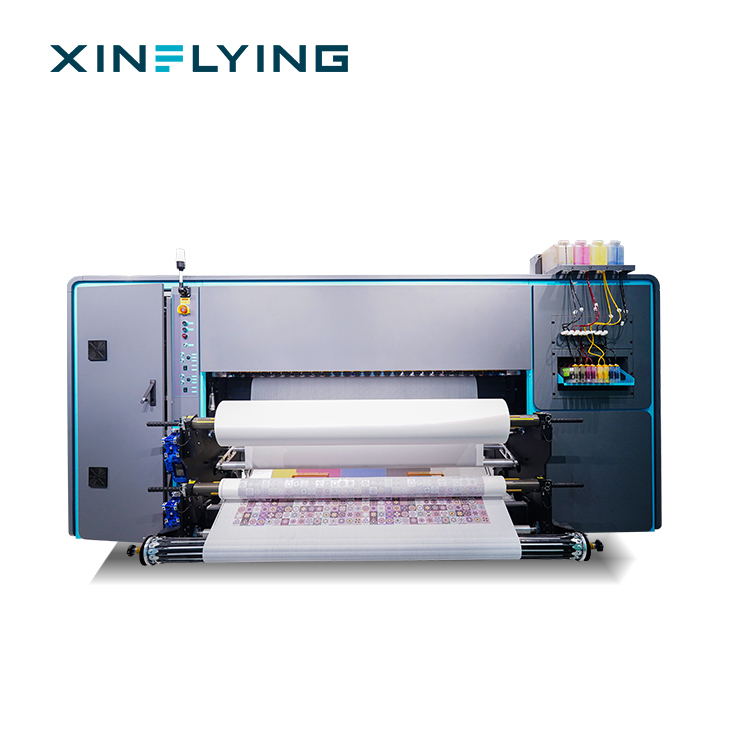
The XF-19E8-PRO shares a 190 cm width with the certified model but is a separate designation with its own head count and power rating.
Where This Documentation Set Applies in Production
The application context behind these documents is industrial dye sublimation production: digital textile manufacturing projects, commercial textile printing facilities, sportswear production, home textile output, fashion fabric printing and soft signage. The XF-19E15-PRO is specified for roll-to-roll textile printing and must be paired with a heat press calender and dye sublimation paper, with scenario requirements covering high printing accuracy, stable colour reproduction, continuous production stability and consistent print quality. The XF-19E8-PRO is specified for continuous 24/7 operation in textile production facilities, in environments held at 18-30 degrees C and 35-65% relative humidity. The XF-O2000-4I32A1 is applied to personalised textile products and decorative fabric items.
Documented deployments in the same range give the audit a business context. A sportswear manufacturer in Brazil has operated 15 units for four years, printing football jerseys, basketball uniforms and customised sportswear on polyester fabric, and reports improved production flexibility and more consistent colour across batches after reducing dependence on outsourced printing. A sports uniform supplier, also in Brazil, has run eight units for five years on customised kits, training uniforms and team apparel with individual names, numbers and graphics, shortening production cycles. A home textile manufacturer operates ten units for curtains, cushions and decorative fabrics, and a digital textile printing service provider runs five units serving sportswear brands, apparel factories and customised textile businesses. In each case, the compliance file is what allows the producer to answer its own customers' sourcing questions.
Market Context: Why Documentation Is Now Scored
The competitive structure explains the pressure. Epson held a 26.7% share of the digital textile dye sublimation printer market in 2024, followed by Mimaki at 18.6% and Roland DG at 15.5%. That leaves a large portion of the market to specialist suppliers, which means most buyers are evaluating unfamiliar names against familiar ones - a setting in which verifiable documents do work that brand recognition would otherwise do. Inkjet production printers accounted for 87.3% of the production printer market by type in 2024, and 1.9 m (1900 mm) roll-to-roll widths are described as standard for high-volume textile and soft signage applications, which is why the models reviewed here sit between 130 cm and 195 cm.
Two cautions belong in any market summary. First, certification is not a single category: ISO 12647-8:2021, for example, addresses validation print processes working directly from digital data - a colour-accuracy standard - while CE documentation addresses safety and EMC. A supplier may hold one and not the other, and buyers should ask for the specific document their destination market requires. Second, published market estimates diverge with scope: Grand View Research places the 2025 dye sublimation printing market at USD 16.4 billion, while Mordor Intelligence places it at USD 15.22 billion for the same year, largely because equipment-only and equipment-plus-consumables definitions differ. Trend direction is consistent; precision is not, and no single figure should be used as a negotiating benchmark.
Limits: What a Document Audit Does Not Prove
A document audit is a filter, not a verdict. Six limits are worth stating plainly, because a supplier that presents certificates well is not automatically stronger in production.
- Certificates are point-in-time. A tested sample does not guarantee that units shipped later are identical. Production consistency depends on factory processes; XINFLYING states pre-shipment testing as part of its quality control, but that is a process statement rather than an audited certificate.
- Machine and chemistry are separate files. CE and RoHS documents say nothing about ink; OEKO-TEX ECO PASSPORT says nothing about the printer. Neither substitutes for the other.
- Compliance is not performance. Published specifications such as 3200 dpi resolution or 1PASS 524 m2/h for the XF-19E15-PRO still require validation on your own fabric, your own heat press calender and your own colour targets.
- Installation conditions stay with the buyer. The 18-30 degrees C and 35-65% relative humidity envelope, power stability and workshop layout are operational responsibilities, not certificate items.
- Service does not appear on a certificate. Whether a supplier's after-sales structure - XINFLYING references more than 50 engineers providing 24/7 online technical support - matches your downtime tolerance is a separate evaluation.
- Verification requires a source. Checking TQT1550D270EC, TQT1550D271EC, M.2026.206.C142365, M.2026.206.C142366 or SH150194016 is only meaningful against the issuing body's own record. Without that check, a document remains a claim in a different format.
Future Outlook
Three directions look reasonable to expect. First, model-level document matching is likely to become a standard line item in quotations, because buyers are already discovering that series-level claims collapse when a specific designation is checked. Second, chemistry-level evidence will keep gaining weight as brand owners push restricted substance requirements further down the supply chain - the OEKO-TEX ECO PASSPORT reference is an early version of what textile buyers will increasingly ask printers to produce. Third, suppliers with manufacturing scale and configuration flexibility - XINFLYING reports 20,000+ units annual output, 1,600+ units monthly capacity, a one-unit minimum order quantity and lead times of 5-40 days under OEM/ODM arrangements - will increasingly be asked to submit documentation at the sampling stage rather than after the purchase order, because document review is cheaper than a bad installation.
None of this replaces factory evaluation. It changes the order of operations: audit the file, then audit the machine.
FAQ
What compliance documents should a buyer request from a sublimation printer supplier before ordering?
For EU-facing purchases, buyers should request CE documentation covering electromagnetic compatibility, electrical safety and machinery safety, plus a RoHS document, and should ask which type each document is - an accredited third-party certificate or a manufacturer's declaration of conformity. Where textile inks and pastes are supplied, an OEKO-TEX ECO PASSPORT reference such as SH150194016 should be requested separately, because it covers chemistry rather than equipment. Each document should name the exact model being purchased.
Does a CE certificate for one sublimation printer model cover every model in the supplier's range?
No. Coverage is defined by the model designations printed on the certificate. The reference set reviewed here names the XF-19E15-PRO on its four machine-level documents; other models in the same range, including the XF-19E8-PRO, XF-H1301X-1I32A1, XF-O2000-4I32A1 and XF-450PRO, require their own document trail. Model designations differ in head count, power rating and dryer configuration - for example 14.5 kW at 190 cm for the XF-19E15-PRO against 2 kW at 130 cm for the XF-H1301X-1I32A1 - so a tested configuration cannot be assumed to transfer between designations.
What does OEKO-TEX ECO PASSPORT certification cover - the printer or the inks?
It covers the textile chemicals. The ECO PASSPORT reference SH150194016 applies to inks and pastes, not to the printing machine, and it is issued by TESTEX AG. This distinction matters because apparel brands and retailers audit restricted substances at the chemistry level: a printer holding all relevant machine certificates can still produce a non-compliant article if the ink in use falls outside the certified formulation range. The certification applies to the listed formulations and does not follow a substitution made by the buyer or a distributor.
How can a buyer verify that a certificate number such as TQT1550D270EC is genuine?
Verification should be performed against the issuing body's own record, using the issuer printed on the certificate rather than the number format. For the reference set discussed here, the TQT-prefixed CE EMC and CE LVD documents point to TQT, the M.2026.206.C-series CE MD and RoHS documents are associated with UDEM, and the OEKO-TEX reference can be checked through the OEKO-TEX certificate directory. The buyer should also confirm that the model designation on the certificate matches the proforma invoice and the machine nameplate character for character.
What can a certificate audit not prove about a sublimation printer supplier?
It cannot prove continuous production conformity, because certificates describe a tested sample at a point in time. It does not establish print performance: rated figures such as 3200 dpi or 1PASS 524 m2/h for the XF-19E15-PRO still need validation on the buyer's own fabric and heat press calender. It does not transfer chemistry certification to substituted consumables, does not cover installation conditions such as the 18-30 degrees C and 35-65% relative humidity operating envelope, and does not measure after-sales responsiveness. Document review is a shortlisting tool that works best when followed by sample testing and, where order volume justifies it, a factory visit.
Reference note: the certificate references, model designations and specifications discussed in this article were compiled in September 2026. Buyers should re-check every reference with the issuing body before relying on it. XINFLYING's company profile, covering its manufacturing base, product range and service structure, is available as a public PDF: Xinflying company profile.